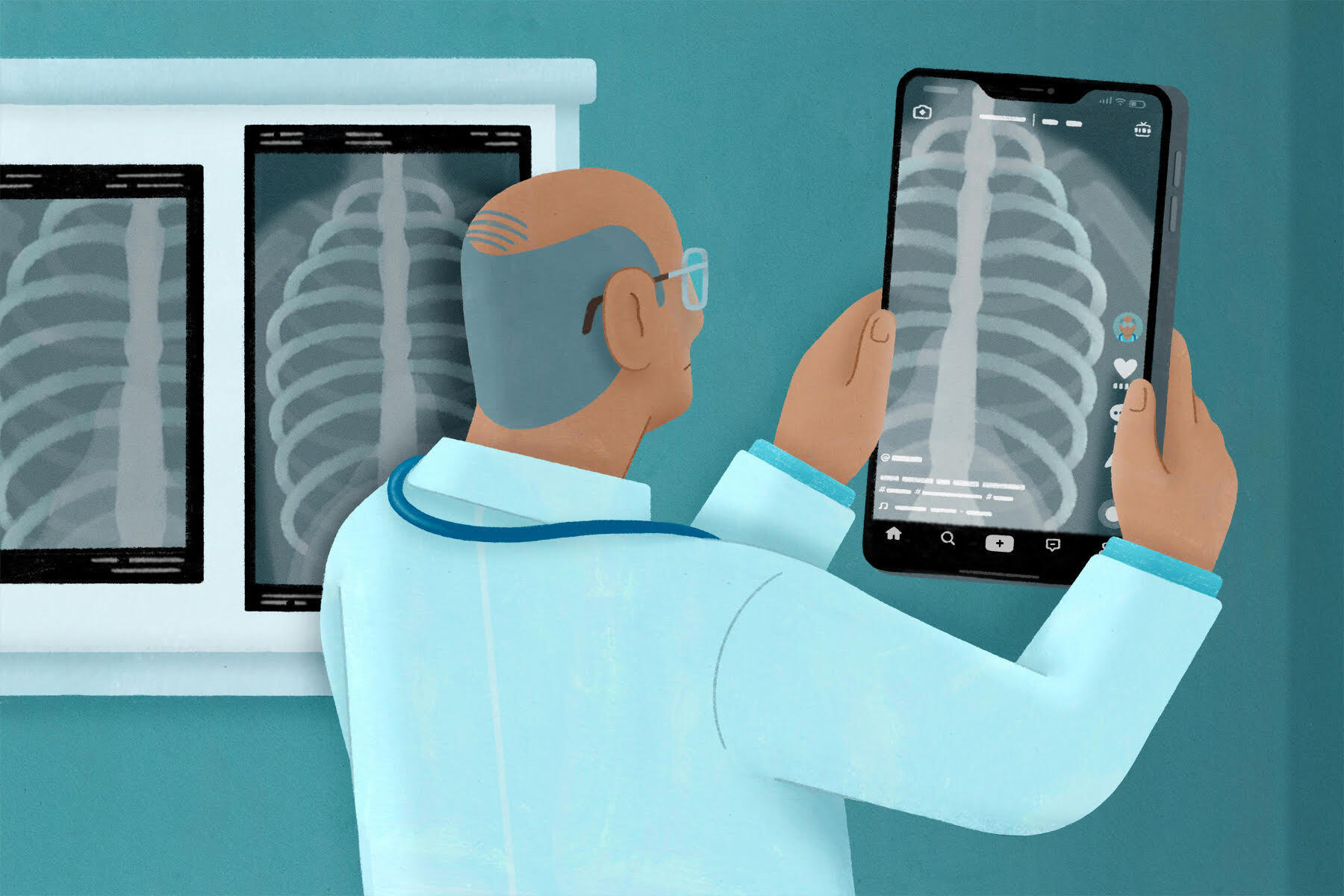
Doctors on TikTok: The Dark Side of Medical Influencers | The Walrus
Medical data is supposed to be confidential. But social media is threatening the privacy and dignity of patients
The Walrus
124 points · by thm · 3y ago · 125 comments
I think using surgery/medical procedures for entertainment is unethical and irresponsible even if consent is given. Firstly in addition to privacy concerns, there is also concerns around being distracted while doing surgery, and infection control risks. For that reason, I don’t think any responsible healthcare practitioners that had their patients well-being at the forefront of their mind would be indulging in that kind of behaviour. However, I think there is a place for surgery to be shown to the general public, but from an educational perspective for both healthcare professionals that are learning, but also for people to know what happens to their bodies when they have surgery. It should not be some unknown exclusive mystery. (I think the mystery of it is what makes it appealing as a form of entertainment.) However, I think the sharing of medical procedures should be done responsibly, and accurately, and not for entertainment - which has a tendency to overdramatise things, or misrepresent things. My biggest daily drama in an operating room is actually often dealing with the anxiety patients have around coming in for their procedures because what they expect to happen is so warped by biased representation’s of what happens in operating rooms. I think the article does bring to light some issues in healthcare being used as a form of entertainment
https://www.washingtonpost.com/nation/2022/01/13/doctor-bran...
My personal experience is that some surgeons (definitely not all of them) are particularly prone to suffering from hubris - at which point they genuinely believe they can do anything they want and it’ll be fine, and god have mercy on anyone who tries to tell them they’re wrong.
Absolutely. Obviously not for every patient as some are more squeamish than others.
I recently underwent a surgical procedure. It was great to be able to find several recorded procedures on YouTube. The videos were recorded in an academic context rather than sensational clickbait, it definitely made going into the procedure easier.
How many does it take to be widespread (or more crucially, addressable) behavior, is it N+you?
Yes, if I saw myself on social media without consent, I would go straight to the college or professional association with a privacy violation complaint. But this article is just trying to fuel hatred.
Are there any release documents for doctors that you can cite that include a patient appearing, either knowingly or unknowingly, in social media? I know this sounds sarcastic because it's so ludicrous but if they exist I would like to know.
In fact I could see an unscrupulous doctor being able to write one vague enough to do it without the person knowing it's going to be in social media. No idea where that would go with ethics boards and such, though.
That i have to go to 5 doctors to even find one who will take the time to listen to my issue is the problem.
There are impediments to all of these groups doing what they need to do.
Well, yeah; that's the point of the article. That doctors are publicly displaying this attitude on social media, and it's becoming more and more normalized.
I've seen it. I've been victim to it. It's a real thing, causing real harm, and it's not talked about enough.
There are systemic reasons for this, which are worth addressing and exploring, but don't need to be addressed in every article that touches on the subject.
> this article is just trying to fuel hatred.
I don't think that's a fair assessment. This is a real and widespread culture problem. You can see it for yourself, if you choose to.
Casting doubt that this problem exists, while smearing (sourced and verified) pieces that address it as a "hit piece", is just sweeping a big problem under a very squishy rug.
Reinforce in medical professionals that patient privacy is crucial and that explicit, informed consent is not negotiable when it comes to sharing their stories on socials (with the exception of anonymised medical papers created for academic purposes).
It doesn't have to be widespread to do a lot of harm.
The worst of the homeless -- street homeless, pushing stolen shopping carts -- are a tiny minority, but it's what everyone remembers. It harms both public perception of unhoused individuals and the way public policy regarding homelessness gets made.
They're otherwise more diligent and ethically minded than their coworkers in how they attend to patients and happen to be very progressive politically. I believe they see it as irreverent gossip about work just like any other profession, although sometimes to me it seems like TMI.
It doesn't shock me though, my grandfather told me stories of how at NYU Medical & Dentistry school he and other students in the late 1930s would prank subway-goers by leaving a purse with a cadaver body part inside.
While gossip to private circles may be widespread, I am unsure if public sharing is.
That abject hubris of that is astounding.
I've seen a lot of hateful, unhinged, divisive attacks from the health establishment on ordinary people in the past few years. Much of it cheered on by people in internet forums such as this one.
On other hand the gazillion self taught quacks and wannabe influencers out there won't be bothered by morals and a few laws if the price is a thousand more followers.
One is too many.
Yes, it was wrong for that one person to do that. Yes, they should face appropriate consequences in order to attempt to make the victim whole, to change their own behavior, and to serve as a warning/deterrent to reduce the probability that their peers will make the same mistake.
But one infraction does not mean that people should stop going to the doctor; that harm is a negligible, infinitesimal fraction of the benefit that medical professionals provide to our society. A news article warning about "Doctors on TikTok" will, at the margins, cause some people to not seek care they need, and can cause far more harm than one instance of this behavior.
There is an element of coercion when you ask the patient who is about to place their life in your hands, for consent to do this sort of thing.
In your situation it does seem coercive to ask beforehand.
you still need good post op care from the doctor after the follow up to , people would tend to consent when their doctor asks
> “TikTok singlehandedly made me not seek medical care recently,” wrote one user
is pretty cringey. You could probably find comments in favor or against literally any story that you want to tell.
(edit: "you" in a "them"sense)
And would get emails like “anyone willing to give a background flavor quote on…”
Whenever I see a news story and the random example is some rich New York person I assume they are friends with the producer or whatnot.
So I think journalists have always done this, just now it’s so much easier.
Edit: just wait until AI starts giving medical advice and people start listening to it.
And they'd get medical advice from grandmothers, aunts, parents, and friends. And be convinced they were right even though they weren't.
Alternative "medicine" has been around for many many years. I'm pretty sure there are books about it.
This isn't a new thing, it just uses whatever tech people happen to use (or lack thereof).
What if the influencer is... a doctor? I recently saw a TikTok from a self proclaimed doctor with about 500k likes about how Benadryl is not recommended as an antihistamine anymore compared to newer ones like Claritin because it can potentially cause dementia when habitually used for many years.
I don't know if it's true or not, but it's something I'd consider looking into further the next time I need to make a decision like that.
Interesting side note. I tried to actually find this TikTok and searched "benadryl" in TikTok's search and got this message instead of any search results:
>Be informed and aware
>Some substances can be dangerous when used or misused. Learn more about how drugs, alcohol and tobacco can affect your mind, body and behavior: https://www.tiktok.com/safety/substance-support/
But it's also important to acknowledge that doctors also give bad and incorrect medical advice. That's why the concept of "getting a second opinion" exists. I think especially in the United States, there are many maladaptive incentives that encourage this. In the United States, it's still routinely recommended by doctors to circumcise baby boys for supposed health purposes even though no other developed country does this for non religious reasons.
Dentists are notorious about this sort of thing:
- https://www.theatlantic.com/magazine/archive/2019/05/the-tro...
- https://www.rd.com/article/how-honest-are-dentists/
I think the healthcare situation in the U.S. has given going to see a doctor this rarified air - like I had to fill out so many forms to go through this experience, I got to my appointment right on time and still had to wait 45 minutes, and will have to deal with so much hassle after it's done and probably a surprise bill or at least a phone call with either the doctor's office, or my health insurance company. It's like peasants seeking an audience with the king.
TBH LLMs probably give better medical advice on average than the median layperson (if deprived of Google).
Plenty of people take medical advice from their neighbors or friends who have no medical background.
Some people are going to make bad choices, you can't avoid it.
Due to a variety of reasons, like wealth, ego or political/religious agenda.
For example transgender, both for and against, there are medical professionals pushing nonsense for political gain/clout.
Or say police officers giving advice about traffic stops that isn't based on any procedure but instead "common sense".
Like the other poster, I also couldn't read on - felt like fear-oriented news designed to prey on readers.
Even if the images are altered to make them impossible to identify the individual, the patient still "owns" their medical record and if that patients medical information is not being used in the course of treating that patient, then informed consent must be given before it can be used for other purposes.
Edit to add:
It's going to be very difficult to explain why a doctor posting their patients pre/post op photos on TikTok without consent is not a violation of HIPAA Privacy Rule.
Deidentification is technically possible but much harder to do and reidentification risks are higher (e.g. distinctive mark) so it’s strongly advised to obtain consent.
I expect most TikTok doctors are getting consent, I’ve heard happy aesthetics patients tend to give consent.
Depends how unique the part of your body looks, I agree it’s very hard (potentially impossible) so it shouldn’t be done.
My point is mostly about the comment I was replying to which posited this as a hypothetical and incorrectly stated it couldn’t be used, I’m clarifying that’s not how HIPAA works.
And it doesn’t violate HIPAA even in those situations as HIPAA allows a certain percentage of reidentification (not specified in the law, but generally accepted at 1%) before it’s a breach.
Photos are a type of data and are equivalent under HIPAA which only considers "Full-face photographs and any comparable images" PHI.
For further clarification of what "any comparable images" means we can turn to the slightly less ambiguous commentary from HHS:
>Comments: Some comments noted that identifiers that accompany photographic images are often needed to interpret the image and that it would be difficult to use the image alone to identify the individual.
>Response: We agree that our proposed requirement to remove all photographic images was more than necessary. Many photographs of lesions, for example, which cannot usually be used alone to identify an individual, are included in health records. In this final rule, the only absolute requirement is the removal of full-face photographs, and we depend on the 'catch-all' of 'any other unique characteristic' to pick up the unusual case where another type of photographic image might be used to identify an individual.
https://aspe.hhs.gov/sites/default/files/private/aspe-files/...
> it’s going to be very hard to argue tiktok posts fall under an exception for the privacy rule.
I completely agree that it's very hard to deidentify photos to a degree that they can be publicly disclosed (noting that TikTok is not specifically relevant to this challenge, the same considerations apply to a training dataset as one example).
However, you described a specific hypothetical (Even if the images are altered to make them impossible to identify the individual) that would by definition satisfy deidentification requirements and no longer be considered PHI per this guidance.
IMHO the real question of privacy is whether they would be identifiable to others, not to themselves.
I disagree. Just because my headless naked body can't easily be traced to me doesn't mean my privacy isn't violated if pictures are shared without my explicit concent.
Yeah, it would be identifiable to others, so that’s a violation of your privacy.
A more accurate analogy is if someone shared a picture of the back of your own hand or something that would be basically impossible for anyone but you to recognize.
I’m not saying it is or is not a violation of your privacy, but your example is flawed.
See Ryan Calo’s work: https://papers.ssrn.com/sol3/papers.cfm?abstract_id=1641487
You might insist that people knock before entering your room to respect your privacy. No identification is relevant here; your housemates know who and where you are already.
Someone might ask you what you did this weekend, and you might not want to reveal that you spent the weekend on a hobby you're embarrassed or sensitive about. Maybe you spent the weekend writing your novel, but you aren't ready for people to know about it yet. If you tell a white lie that you spent the weekend camping, you're doing so to preserve your privacy. Again, no identification is relevant here.
If something can be linked back to you, then you lose control of the information and your privacy is compromised. But that's an implication of the definition, not the definition itself.
It is a violation because of the lack of consent, but it is also a violation because now you have to live with the fact that maybe some other information can link you to that picture in the future. There is no such thing as perfect privacy if any link can be created in the future, and the fear of the creation of that link going forward is itself a problem for the subject.
Proctologists...not so much.
So there is an audience, they're just not advertiser friendly.
Sure as hell beats traditional advertising means in this digital age.
They're bringing up the rear in the rush to social media.
They wouldn't want to be the butt of jokes.
They can't manually type in URLs, because they're always getting distracted by the colon.
Seems professionalism goes out of the window - esp those who practice crap like boob, tummy and butt lift cosmetic surgery - yes woman who had a mastectomy have a need for it.
People go into marriages completely oblivious to the ~40% chance that the person they're marrying will turn out in n years to be their life's greatest nemesis, in multiple comically extreme and callous ways.
But I am 25 years in my own marriage (2 kids) and if I knew what I know now I would probably would not have done it - it has a cost.
You might enjoy this video - a interview with a divorce lawyer on love and marriage - it is pretty good.
That “one day the granola ran out” story is fascinating. It’s the little things that make or break a marriage.
company: https://www.wyndly.com/
I wouldn't have much patience to deal with that. I got 12 complex patients that need shit done for them, and my login don't work because I missed some email, or something updated, or some network thing is down etc etc. Sounds like someone has not done their job well enough and that interrupting my patient care that I dedicated my life to.
I work in IT, hang out with a ton of physicians though, and I absolutely get why they'd be bad clients. They don't got any time to deal with issues.
off topic but
Nope that's just shit that happens.
Like saying "I want 100% guarantee that my car won't crash ever never ever!!"
Dedicate your life all you want
In EU these would be fucked by GDPR.
Social media doctors are clearly driven by the same idea this article calls out. Most of them want out so they can “practice” on social media instead of in the system. Many will do whatever it takes to make it. This can be seen by the absurdity of posts and privacy violations being made.
The sad part of all this is that you can get more helpful information from a 15s TikTok than you may get from a 15 minute doctor visit you waited months for. While most TikTok doctors today are the early adopters, you’ll start to see the laggards who have actual valuable information adopt it with time like we’ve seen on YouTube.
Well, then while we are at it we might as well evaluate whether we need to be on this planet at all? I mean what's even the point in being mortal if in the end we are anyway going to the mortuary? We might as well fast track it. I mean, right?
So my question is - did you write this statement in all seriousness or there were traces of sarcasm that my radar totally failed to detect.
This is not a generalization saying to not get checked for cancer or other serious diseases early, but to take any self-promotional “medical advice” with a grain of salt like whether you need to fix your nose, buy expensive probiotics, or try to get prescribed a certain drug based on a list of symptoms.
And no, we should not fast track death. Life is already too short.
So the question as to whether people need medical care to begin with is a bit of a waste of time in my humble opinion.
Because that is the context of my comment.