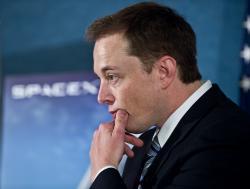
Why Elon Musk Wants To Bring People to Mars—and Go There Himself
At a small Future Tense gathering last night, Elon Musk—he of PayPal, Tesla Motors, and SpaceX—discussed the privatization of space travel and...
Slate Magazine
95 points · by edw519 · 14y ago · 109 comments
It's also close, so, even if someone screws up very badly, a rescue mission would be less than a week away. If someone on Mars manages to, say, contaminate the colony's water supply, all we can do is record farewell messages for loved ones and deal with the bad publicity for decades. I wouldn't like that.
A second step could be an Aldrin cycler space station - this way you could ride a small spacecraft to the cycler, live there for a couple months and depart to Mars when it passes by. Plus, you'd get some prime moving real-estate - one that goes between Earth and Mars without spending fuel.
Have a read of the book "Barrow's Boys: A Stirring Story of Daring, Fortitude, and Outright Lunacy":
http://www.amazon.com/Barrows-Boys-Stirring-Fortitude-Outrig...
NB Having read too much Kim Stanley Robinson and Zubrin, I'd jump at the chance to go to Mars.
(This trend holds at least at the societal level, and over long terms. For individuals over the short term, it can be weaker, e.g., you might buy a helmet or a safer car, and then ski or drive more dangerously.)
In principle, each Earth flyby is used to rotate the orbit so that it goes to Mars, but the problem with the Aldrin cycler is that the required flyby distance is too close to Earth: it's smaller than Earth's radius! As a result, rocket fuel is required to give it the required extra kick.
But there are other Earth-Mars cycler trajectories! One of my projects in grad school was to investigate them, and there are some that really can keep going without spending fuel (except for minor adjustments). In particular, the so-called "Ballistic S1L1" cycler is very promising. Here's a paper about it:
McConaghy, T. Troy, Landau, Damon F., Yam, Chit Hong, and Longuski, James, M., “Notable Two-Synodic-Period Earth-Mars Cycler,” Journal of Spacecraft and Rockets, Vol. 43, No. 2, March–April 2006, pp. 456–465.
The same is true for a major disaster at the South Pole in winter, though. There's a several month period in which vehicles cannot reach the pole due to the temperatures and weather involved. We still go there.
The moon is also close enough that I could imagine a private company like Virgin Galactic building lunar resorts in a couple decades. :D
His point was that the Moon can never be made habitable for humans, and the low gravity makes it hard to work.
The analogy he made was the Arctic--sure, it's a lot closer to Europe and Asia, but Columbus et al. went to the Americas instead. Farther away, but more habitable.
If I were Elon, I would focus on the building of the delivery system to get materials and equipment to the moon - then have an X-prize for people to develop the robots to build stuff.
Get a heavy payload like that to the moon, assemble some stuff and test it. Then make money off moon tourism Parlay this to mars research, funding and experience.
“I would definitely like to go to Mars. I think it would be cool to be born on Earth and die on Mars,” he said as the night wrapped. “Hopefully, not at the point of impact.”
Far too many people criticize lavish dreams such as what Musk has but that is what separates the watchers from the doers.
?? Not sure of your meaning: Dreams are usually the domain of the watchers, expertise and hard work are usually the domain of the doers. Musk has demonstrated expertise and hard work, but in a different area; here he is a dreamer. Is that what you meant?
Visit? Yes. Settle? Not yet. Like it or not, for the moment the Earth is where we make our stand.
Not that there's anything wrong with wanting to go to Mars as a hobby, as a tourist-- if that's how you want to spend your billions, fine. But I worry that too many impatient sci-fi lovers see space travel as some way to escape from the problems of Earth, which it will never be. If we can't figure out how to live sustainably on Earth, humanity will perish long before we have any realistic possibility of emigrating.
"A planet is the cradle of mind, but one cannot live in a cradle forever."
usually cited as "Earth is the cradle of humanity, but one cannot live in a cradle forever."
If all we care about is continuing to live (excepting the limitations imposed by entropy) then continuously importing resources from somewhere else is a perfectly valid solution. For that matter, no amount of efficiency will ever eliminate the necessity of importing resources.
Pushing that necessity into the future is probably a good idea, of course. Continuing to live is not all I care about. But mature space infrastructure would positively contribute to doing just that, even if a colony on Mars might not in and of itself.
It is only unsustainable at current technology levels.
The way we lived in 1900 was unsustainable then, but we could survive like that with 2012 tech no issue (less coal burning, improved sanitation, etc). In 100 years it will be sustainable to live like we do today.
To think of Mars as just the new New World is a romantic idea, but there is no basis for the comparison. Populating another world will be the most significant undertaking of humanity by orders of magnitude; to assume it can be done while it remains to be seen whether we can survive as a species on a planet with an atmosphere which is exactly what we breathe, which is made of as much water as we are, of the same phase ours is, where food grows in the ground all by itself and we are nearly completely protected from debris large and small, and with a legacy of billions of years to prove it can be done-- well, I'd ask to know your reasoning.
There are technological hurdles to living on Mars, but not much we already don't know how to handle. Food, water, air - that's the minimum, and thats not all that hard given raw materials and energy, which is abundant on Mars.
Life quickly develops on any new land that appears on Earth. But without Oxygen I'm skeptical that we could accomplish similar on Mars in the near future.
I can't think of any risk to humanity where going to the moon or Mars makes sense as insurance.
If we find out about it decades or centuries out. If it's a year out when we spot it, there's very little we can do with current technology to head it off (asteroid disaster movie plots notwithstanding).
> And if self sustaining is all you need, setting up a self-sustaining colony a mile underground is also five or six orders of magnitude cheaper.
It's also much more accessible by desperate refugees trying to get in as the planetary disaster approaches.
What makes SpaceX important is that they've rethought the design and manufacturing process to make their rockets far cheaper than others to date. If you bend the cost curve enough, surprising things become reasonable.
That isn't true. There are no asteroids big enough to do that, that we haven't seen. The asteroid risk is a regional one, not a global one.
How exactly are you proving that negative?
Gingrich's moon base by 2020 is probably less ambitious than Musk's Martian colony by 2042. The moon is orders of magnitude closer, doesn't involve leaving Earth orbit, doesn't involve the radiation hazards, and we've actually been to the moon before. I don't want to get into a political argument, but going back to the moon and staying there is not an especially difficult or onerous goal for the next eight years.
At 4% per annum growth the world economy will be triple the current size in 30 years. (assuming no technological singularity event).
An economy triple the current size doesn't seem like it can easily afford a colony on Mars either but I think Elon Musk thinks my assumption is wrong.
Larger economy can speed up technological advancements too, but I guess that is irrelevant here.
A lot of people are. I had the pleasure of chatting with the NASA program manager in charge of one of the rovers. She was a bit hilarious: When it came time to set the height of one of the mission cameras, someone whipped out a ruler and measured the distance from the floor to her eyes -- and then wrote it in the spec.
Her comment on the first manned mission: Inevitably it leads to a discussion about one-way missions to mars. The next discussion is "who would volunteer", next followed by "who would you volunteer?"
[btw, she said NASA will not officially consider one-way missions as a matter of principle.]
Does anyone know if there is some reason why this technology seems to get ignored? According to wikipedia it seems like a big win. Why aren't we doing this right now?
I'm sorry, but I just get frustrate with all these wondrous predictions that always seem to be about 30-50 years in the future. Short enough away to be enticing, but long enough away where no one making these predictions will really he held accountable for their ridiculousness.
It just seems that every single generation a) has some "new threat" for "how the world will end" and b) has some technological vision that ends up being way overestimated.
Also, I notice that people are much more likely to condemn space development as frivolous than they are to criticize, say, football or whittling. Does that seem like a double standard to you, too?
Well, such inspiring, exciting stuff, as colonizing other planets. Doing that also improves all other areas. Transportation of course. Electronics. Software. Radio. Medicine. You name it.
That is why such projects not a "childish idea" but actually a great plan.
There's only 2 reasons for humans to work hard, and work good:
- fear of death (war)
- f* exciting stuff (and no, software idea 923839 is not nearly exciting enough, and money isn't either)
If Elon Musk wants a base on mars, have him start putting missile silos up there, there will be a McDonalds up there in 30 years instead of some decrepit shack with a few science projects going on.
Edit: In terms of technology/wealth, imagine a future in, say, 2100 when we have mastered things like automation, 3D printing, etc. When we can fill out a form on a web app, upload a few files and not just have, say, a fully reusable rocket ship pop out the end of a factory but actually a rocket ship producing factory pop out. Such things are technologically possible, and within our grasp. What happens when we have such power? Do we sit at home?
Given what happened in last 30 years, I would rather say in 2100 you will be able to scan yourself into a readable file and shoot it across the solar system all the way to the Mars, and print yourself out anew (printing algorithm would catch and get a rid of all cancers you caught and aging too).