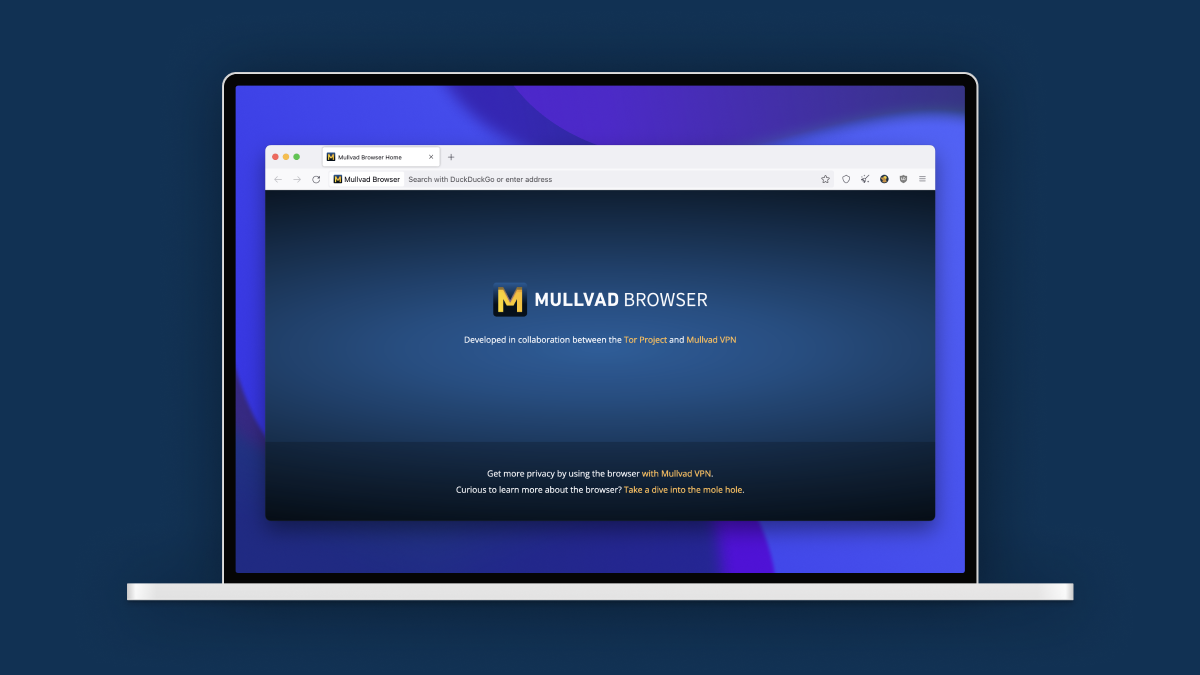
We've Teamed Up With Mullvad VPN to Launch the Mullvad Browser | Tor Project
We have partnered with Mullvad VPN to develop the Mullvad Browser - a Tor Browser without Tor
blog.torproject.org
325 points · by dotcoma · 3y ago · 165 comments
- Can we HN users help push Firefox to incorporate better fingerprint circumvention? (more than current) This is, imo, one of the worst technologies that has been developed around the web. This seems like a thing all privacy focused browsers, which includes FF, should be working on together. This seems like a thing that wins by the network effect, but can be done without an authoritative browser. You just need mass numbers, and while FF isn't that large of a user share, it is large enough that probably most local networks have at least a few connections and every ISP has thousands.
FWIW, using amiunique.org I am unique on FF, Safari, Mullvad, Chrome, and Edge on a M2 Air. Mullvad is 0.22% across the board btw, so looks like that's how many Mullvad/Tor users have tried it. Though I am a bit surprised by some of the results. Similarity is very low for: UTC-07 (3% of users are on the... west coast? This can't be right), screen sizes (I thought this was going to be a win because apple consistency, but all values are <0.1% -- except depth, which is best on Safari and identical on FF/Chrome/Edge. Do people not make their browsers the full screen size? (not clicking green expand)).
- Will the browser end up having a Tor connect switch? I'd imagine this would make Tor more accessible and could make the entry via VPN method easier and safer for many users. Is that why they're working together? I guess I'm a bit confused at the collaboration here? But it does seem natural that they could work to set up easy interfaces like x -> Mullvad -> Tor, x -> Tor -> Mullvad, or even x -> Mullvar -> Tor -> Mullvad? Is this the natural extension?
They can't win, no matter what there's going to a subset of sites that simply won't function when you block their fingerprinting techniques, and you'll get people every thread going "Firefox sucks! It doesn't run this website when Chrome happily does!" and then you get everyone on the other side going "Firefox sucks! It isn't as private as Librefox/Tor/my-other-obscure-fork!"
I don't envy their position.
I was just thinking that this could be the strict option or the custom option in the settings.
Making it an option defeats the purpose - but alleviates the hate OP was talking about. It’s a no win
I dunno, seems about right to me. It's only something like 60ish million people and there are somewhere around 5 billion internet users. Obviously who will be checking the site isn't expected to be perfectly even but that's why the number is also 3x higher than plain user count would suggest.
> screen sizes (I thought this was going to be a win because apple consistency, but all values are <0.1% -- except depth, which is best on Safari and identical on FF/Chrome/Edge. Do people not make their browsers the full screen size? (not clicking green expand)).
Screen size, not browser size. Even on the exact same make and model hardware the OS UI scale setting will alter the reported screen dimensions in the browser. The same is true with people who change the default browser zoom in the browser instead.
You know, I feel dumb now that you're pointing this out. I'm not sure why I originally interpreted this value as an "amount of identifiablity" variable rather than the pure amount. You're right to point that this is a variable that can only be used in support of others and not unique in of itself.
> Screen size, not browser size.
I would think this would make it more likely to be less common. Apple has tight control and thus more consistency. But it is a good point, especially considering the prior point. The M2 Air has a different screen size than the M1 Air, which has a different screen size from *-Air which has a different from pros and so on. We don't need to get into UI scaling to change that. I was just thinking about consistency and popularity of the Apple ecosystem, in the West, compared to the variance in Windows machines. For example, I know that canvas fingerprints tend to have lower variance between apple machines of the same model than windows/linux machines of the same model. Just because there is different chip binning. I was thinking about the same thing with screens. But again, I clearly did a major brain fart and I appreciate the correction.
Not sure if this is representative. According to their website, they have collected about 2 Million fingerprints. Firefox accounts for 42% of those fingerprints, which does not reflect the global market share.
Yes, it's OSS and they are very happy to receive third party patches.
I was more suggesting that maybe we can demonstrate the desire of this, to put positive pressure on making this, and other privacy measures, a higher priority of FF
What does masking specifically mean? Is it returning pre-canned responses to those queries that match non mullvad browser users. Because otherwise the absence of these APIs basically fingerprints the user to the Mullvad Browser which, realistically, will always be a small fraction of total browser sessions.
Some amount of research into fingerprinting techniques will always be needed but it seems to me that a far simpler solution would be to randomize the fingerprint for each connection. It doesn't matter if your browser fingerprint is unique as long as it's always changing. That would also make it harder to detect TOR/Mullvad users since they'll look exactly the same as anyone else with a unique fingerprint. It also gives users the ability to modify some of their fingerprint according to their needs without losing protection. For example, they could freely change their useragent for certain websites/requests while still having a unique fingerprint.
Actually, which other crowd could they even be referring to with "hide-in-the-crowd"?
Here's a complete list of settings and modifications:
https://blog.torproject.org/browser-fingerprinting-introduct...
The Mullvad Browser download page has this to say:
"Strong anti-fingerprinting from the Tor Project
The Tor Project has a proven track record of building a privacy-focused browser. The Mullvad Browser has the same fingerprinting protection as the Tor Browser – it just connects to the internet with (or without) a VPN instead of the Tor Network."
probably more annoying to fingerprint in general, but its own signal in another way
Basically everyone I know, techie or not have many many tabs open, always. I might have 200+ at the moment? Something like that. They are hidden in containers so I don't see them all but in this current window I have maybe 20.
I never liked vertical tabs, takes up too much screen.
Don't most people? I basically always do. And yes, I'm a techie, but anecdotally I see many non-techies with zillions of browser tabs open because they barely notice that tabs are even a feature and so they continually allow new ones to be opened without going back and closing anything.
I wanted to love vertical tabs but I just keep going back. If you have multiple browsers open side by side it gets annoying how much screen the tabs take up.
For example, I often have my browser on the left side and my editor on the right. With only 50% of the width, I sometimes prefer to reclaim the horizontal space and switch back to horizontal tabs.
What people want to do is fit stuff side-by-side and move up and down, rarely ever the other way around. That's why vertical tabs make no sense in most contexts. It's why narrow-width fonts exist, those columns are valuable real estate as soon as you have another window pulled up to the left or right, there's virtually no case where a few rows made a difference.
Additionally, I'd argue Multi Account Containers + Total Suspender are not either. Even MAC doesn't come by default w/ Firefox, you still need to install it. I'm willing to bit the vast majority of internet users still don't know about it.
And Total Suspender is really a response to RAM use by browsers. It's a great idea, browsers should implement it, but many people still don't know about it and it's not necessarily a deal-breaker.
you can silo websites away from each other. for example, your work uses outlook and slack. a work tab has those logins memorized, but it won't know about your Facebook login.
you could have a banking tab just for logging in to places like that. I'm a fan
In other words: What I want to do is to use one of the Firefox web browsers to connect to my normal ISP and the others traffic to go thru MULLVAD VPN. I know about "split tunnel", but it does not feel optimal, because every single app must be deselected no to use VPN, to just make one web browser use the VPN. And if you want to run another app thru VPN, you must remember to activate it, not only turn on the VPN tunnel. So is there any way an extension could connect Firefox to Mullvad VPN directly or configure some proxies in Firefox that connects to Mullvad VPN app or similar?
if you use their app it depends on your operating system how their whitelisting works, but you can pick apps you don't want to have routed through their vpn (but by default with their app all system traffic will be routed through the vpn except what you explicitly deny).
This way I have a single browser profile that is routed through Mullvad while everything else works normally.
FYI: news from April
Bunch of discussion then: https://news.ycombinator.com/item?id=35421034
Considering your question from a host/website point of view, connections trough TOR endpoints are blocked way more often than connections trough a VPN.
The problem is, when you did that, many websites would break in the most bizarre of ways. Even now, it still breaks a lot of the web. Couple that with a well known VPN and large swathes of the web are going to be difficult to access.
I'm sure this may go down well with the privacy crowd, but for the general user it was and still is a hard pill to swallow. I wound down any attempts, figuring a balance of privacy and usability would be better and if I were to offer this, why not just point users to use Tor instead?
I figure this is a good opportunity for Mullvad to capture its VPN users and shift them onto a platform they control. Not necessarily a good or bad thing, as I know VPN providers try to launch their own browsers and even some browser vendors launching their own VPN to capture the maximum value out of their users.
I feel like the very act of trying to opt out of the web's surveillance is enough to mark you as a second class citizen on the web. You either submit, and let your isp and google resell your most sensitive secrets, or you're effectively shunned.
Regarding tor, it's a great idea tarnished by the fact that it's used for vile illegal activity. There's no way I would ever run a tor exit node. The risk of some 3 letter agency taking all my hardware for a few months while they figure out I'm not the guy they're looking for is too damned high.
Hell I'm using completely unmodified Edge for banking and government agencies because even something as simple as ublock cosmetic filters manages to break them.
I used to use dark.fail but every site they listed has been continually down for the last 2 years due to some widespread DDOS attack on onions, and now dark.fail itself is basically always down too
Is there a good Dread replacement while we are at it?
Did everyone really move to i2p? because I rarely see anyone talking about that network
> It did take setting a couple environment variables, no GUI method
, which is unknown to almost anyone, would scare an absolute majority of non-technical folk away. Even if what mullvad does is relatively small in scope, it can still provide a lot of value to people.
Think of it this way: Mullvad is sponsoring Tor at >=$100,000/year, and in exchange the Tor Browser developers made a slight fork of their codebase that sets a couple of environment variables and changes the branding. Now the fact that it's just a couple of environment variables sounds like a good thing, right?
Librewolf breaks trust (for lack of a better term) by not offering both of those options.
You just have to assume the binary you download isn’t compromised (maybe you could argue checking the hash is enough) and that the third-party updating service won’t serve you a compromised update.
I'm curious, what do people mean by this? How is the bank's financial system any less "nonsense" than crypto? Second question: when the banks start using crypto in not too long (via CBDCs), how will that crypto be any less "nonsense" than crypto?
The actual reskin is technically not all that challenging, for all that I'd still not want to do it just for fun. I'm sure that if Mullvad wanted to, they could have released a rebranded Tor Browser with their own development team. But that would have meant missing out on what is probably the main point of the exercise, which is giving more¹ money to the Tor project to make things better for everyone.
[1]: See also https://www.torproject.org/about/membership/, wherein we discover that Mullvad gives Tor a minimum of $100k/year for membership.
Options for incrementally improving privacy are still good, even if it doesn't go as far as the normal Tor browser.
This whole thing STINKS.
I think Tor is inferior to be honest.
If someone uses a commercial VPN I think they're privacy conscious. If someone uses Tor I subconsciously assume something else.
I wouldn't be recommending Tor to my friends of family.
Huh? The Tor Project is primarily funded by the US Government.
You might even encourage some of those criminal acts that will be performed through this browser.
Wanting to be criminal also doesn't make you a criminal.