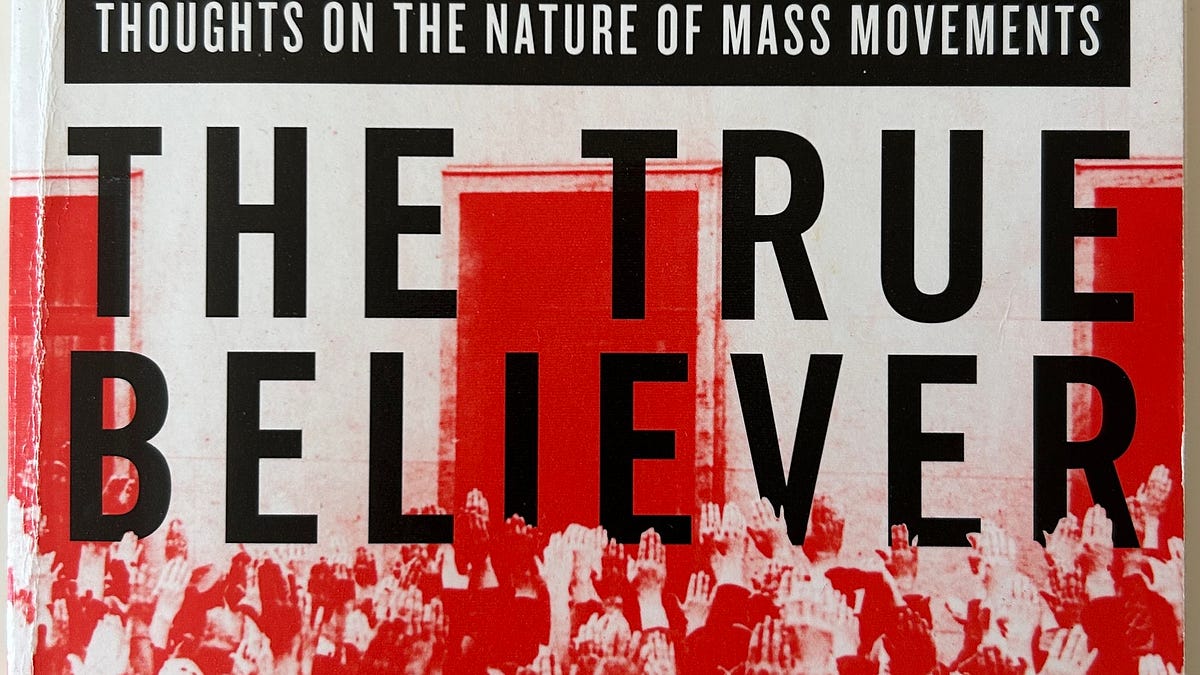
Without Belief in a God, But Never Without Belief in a Devil
The True Believer: Thoughts on the Nature of Mass Movements—A Review
robkhenderson.com
229 points · by Bostonian · 3y ago · 223 comments
It is shocking how so many replies are hostile or defensive. The author (or the author the author is citing) isn't even claiming that movements are bad, or giving any qualitative judgment (e.g. citations about equal rights or the American revolution as if they're counterpoints somehow seem off the mark), just noting the qualities of most movements and the environments in which they occur. If you're looking to engineer a group for some cause, even if the cause is ostensibly good, this is a good how to guide.
The “frustration” echoed in the book and article is real. Most people today have had a taste of the things they didn’t know they wanted and more apt to join a movement.
The green revolution and smallpox elimination operated very differently than something designed to create a regime or gather political power in a democracy.
Movements that have a truly profound impact in human history operate rather differently. Compare say the Age of Reason with Communism and they both caused revolutions, but first had a far more long term impact while the second had more zest.
That mass movements coincide with a period of "betterment" is an interesting way to try to understand the civil rights and equal rights movements in the 50's and 60's. When the classes are no longer merely struggling to put food on the table they can rise up and demand something better than separate but equal education. And the comfortable and educated middle class white population had nothing to lose by joining those causes.
At the same time if there is a growing frustration among the masses now I have no doubt it is being fueled by a wealth inequity that seems to shower all the accolades of life on a very select few. And not just private jets and private islands but exemption as well from the laws that govern the rest of us.
Unlike many of my progressive friends, I understand the root frustration of the MAGA crowd and see something there that we are all frustrated about — those of us on both (all) sides.
(As an aside, I discourage friends and family (and any who will listen) from having anything to do with any movement that embraces violence — whether on the "right" or "left". Because I believe any successful movement that relies on violence to succeed will then rule with violence. Not cool.)
These are specifically not what the author was talking about, since they had clearly defined goals that were achieved, as per:
> The True Believer advises against supporting organizations without clear, attainable objectives. The dockyard philosopher reminds us that we should be skeptical of mass movements without clearly defined goals.
> Mass movements that are good at what they do make previously content individuals frustrated and further frustrate their adherents while pretending to advance the movement. This means that the strongest mass movements are inevitably going to be the ones that are the best at not delivering the goods.
Equal pay for equal work is pretty much achieved and the so-called gender wage gap is extremely misleadingly used to foster frustration.
Maybe he means narrow vs broad goals, but given the absurd breadth of his poorly defined hypothesis (irony alert) I’m not inclined to try and make his thesis clear for him.
Some of their grievances are legitimate (government failures, the decline of relative prosperity) and others are "understandable" (the fear and dislike of "others" that they are uncomfortable with (LGBQT+, different religions and races, the decline of the default dominance of their alphas (white men)), the defining name of their movement is as vague as can be.
That is, what is the specific greatness to be returned to and what does achieving it look like?
The first one that comes to mind was Occupy Wall Street. BLM also suffered from this to some degree.
After hundreds of think pieces about this, I think very few progressives don't understand the root frustrations here. We just find the outlet for that frustration hopelessly misguided.
But a broad interpretation misses most of the nuance that matters in practice.
If you conceive of state violence instead as something like "the probability that you will get tortured, or beaten, or lose your money or property for things like speaking out against those in power", then the original statement is no longer true, and there are stark differences between living in modern western democracies and actually violent regimes -- which of course there are.
I think the elephant missed here is the focus on what we have or do not have instead of a focus on what we can attain. Mass movements are created and accelerated by the thought that things can be achieved through them. Regardless of how much you currently have, a mass movement is appealing if it offers you hope to get things you otherwise couldn't. If you think violent revolution will bring you immortality, that's a "pretty good deal" and you might want to take it. It's no surprise that many religions heavily depend on this for controlling and gaining followers.
Being limited by your imagination, I think, is the driving force behind "your situation improves and then you revolt." Your situation improving can transition you from a hopeless "this is always how it will be (suffering)" to a "hey, things can change" mindset, which allows you to hope for and potentially even fight and die for a better future. It doesn't matter what you have, it matters what you can get.
Sorry, there is way more to this story than this paragraph. If I can help someone by sharing more, we could communicate in some other way. Also, I'm not native English, so don't read nuances where they're not intended :)
The terms are loaded. If they were equal on the horseshoe so to speak, the far left would be talking about communism, which they are not. In that sense, yes communism and authoritarianism are two sides of the same coin. Our current political definitions “far left” and “far right” are not.
EDIT: Where X here means an specific group of people.
This is a weird way to think.
Your revue theatre’s enemies are the people against the arts.
Your place of employments enemy is lazy and rogue employees, or even competing employers.
There are enemies all around if you are willing to find them.
I.e. Anacapitalists who love capitalism so much they think it can solve virtually all of societies decision making scenarios better than alternatives, such as democratic government, justice systems, etc.
I came across a poet from a Soviet controlled country who referred to ideologists as "lunatics with a good idea". I have tried repeatedly to identify the poet since but have not been able to.
The political meaning of the world radical traces back to a British movement of, as Wikipedia puts it, “the late 18th century to support parliamentary reform, with additional aims including lower taxes and the abolition of sinecures.”
Parliamentary reform, lower taxes, and the abolition of sinecures were once the literal definition of radical.
The idea of this piece to tar and feather mass movements as inherently bad happily and absurdly glides past the reality that basically everything he says about bad mass movements also applies to good mass movements. The fundamental problem with these movements is that in the moment it is hard to tell the useful from the destructive. Neither this discussion nor the original piece seem to offer much useful information on sorting the two cases. People instead seem to embrace these ideas to justify their feelings about “bad” social movements (including those with ambiguous qualities that they personally dislike).
> the faithful strive to escape suspicion by adhering zealously to prescribed behavior and opinion
And also the demonising of individuals or groups, rewriting of history and not having any clear goals or demands, or them being utopian as in unattainable.
Universal suffrage seemed utopian and unattainable for a long time – until it happened. It's actually rather difficult to predict which political goals are or aren't obtainable without the benefit of hindsight.
“ Hoffer writes that “in a mass movement, the air is heavy-laden with suspicion…the faithful strive to escape suspicion by adhering zealously to prescribed behavior and opinion…”
Totally specious. How is this true of the civil rights movement, or the gay rights movement , or the movement for labor rights (pensions, 8 hour workdays, weekends) in the first half of the 20th century?
The whole piece is painting mass movements with a broad brush because the author doesn’t like certain specific recent ones.
I’m a foreigner so my only data is from random Americans I talk to, but all progressive Americans seem to have a strong hatred for conservatives. Same thing for Trump supporters hating progressives.
As an American (and somewhat to the left of Obama or Biden for that matter), I don't hate anyone.
I don't care for many of the policies or the attempts to scapegoat minority groups (LGBTQIA+, those with higher melanin content, etc.) espoused by US "conservatives" (I use quotes because most of those policy proposals aren't "conservative," but rather are radical reactionary policies), but I don't hate such folks.
What's more, those with an axe to grind or those that benefit from division and distrust often claim that the most extreme positions which aren't supported by anyone but the lunatic fringe is the mainstream belief among those they wish to demonize.
In truth, the vast majority of Americans just want to have a decent life, with equal opportunity to succeed. But that doesn't drive political donations, advertising engagement or voter turnout.
As such, we end up with the most extreme positions held up as "mainstream," when they're mostly just crackpot ideas that people would otherwise reject out of hand.
It's sad and more than a little frightening, to be honest.
Without an organized faith, without a belief in a greater good, in the idea of unity in particular, the average masses would fall to nihilism - a midpoint between a god worship and a devil worship. But any movement, no matter how good it is initially, is made of people that aren't perfect, and their selfish feelings eventually create that egregore.
It would be ‘nice’ to say that such things are just a social dysfunction that we can safely avoid. They may not be. A lemming that follows the herd may find that it has led them off a cliff, but a lemming that doesn’t will certainly die.
We may now have better options to opt out. I’m mostly speaking to the relatively wealthy, skilled, and able. But I’m not sure. Opting out of one hysteria may also require membership in another such mass movement, complete with an obvious enemy, and a ridiculous but necessary set of rituals to convince others that we are not a threat.
I’ve believed throughout most of my life that communications and especially privacy technology would give us better options. I’m not sure it’s ending up that way. I see great technological developments in that direction, but almost all social developments in their use going the opposite way.
I think what these things come down to is each individual assessing a practical threat to themselves and reacting accordingly. I don’t generally accept explanations that assume entire populations acting wholly irrationally. It can also probably be seen as arising from material conditions such as increased resource scarcity, which is a tautological result of economic cycles, regardless of how the economists may measure their positive effect. This view requires extraordinary sociological imagination, to consider what type of situation that you could find yourself in, which would lead you to switch sides on your most ardent beliefs. That situation is therefore the threat, not the people, but it may be unavoidable. I believe that people are smart and compassionate and empathetic and do realize this, but it doesn’t affect their best option for actions, posturing, and espoused beliefs.
For example, it's pretty clear to me that whether you are talking about a startup team, or a cult, or a religious group, or a political party (the smaller the party, the truer this is) one of the core aspects of social organization is recruiting: i.e. why can you attract people to your group. That messaging is important and has to work and it has to address some core human/individual need, but after you make it work, adding people to your group becomes easier.
Now, conversely, if that startup is not doing very well, or that political party doesn't look like it will get power, the messaging / recruiting mechanism becomes much more important: it's how the group is tied together and how it survives (by attracting more people / replacing attrition). At that point, for the people in the group that need the group to continue, recruiting becomes a primary goal; more so than even the actual operative / paper goal of the group (profit, political power, whatever). That's where niche marketing / issue of the day becomes more important than ever: join our startup/party to provide alternative food sources to the world; to shift the world's consciousness; to provide justice to those wronged; whatever.
To me that's a core failure point, where the startup/party/group should just fold up tents and do something else. They are wasting energy just to keep being a group rather than achieve an end result (their original goal). But we, as social animals (ants as per the OP) can't/won't see that far. We just keep on grinding.
This is part of a series of articles called "Uruk Machines" -- https://samzdat.com/the-uruk-series/ -- which profoundly changed how I see the world. Use caution.
It has nothing to do with ballooning university tuitions that finance a bloated administration and fancy building while providing a much poorer education.
It's all the ability of the proles to read uncensored news
Outrage is a common theme of previous generations, you only have to take a casual glance at any decade to find a movement fuelled by outrage.
The temperance movement that lead to prohibition. McCarthyism. Even the rise of Nazism.
Of course not. Digital age has made measuring what works better to get clicks possible, and this has completely changed the incentives of the news industry.
1. As a random example
But the US Civil Rights Movement that ended official and systematized racial discrimination against minorities was also a mass movement. The labor movement that gave us the 8 hour workday and weekends was also a mass movement. Women’s suffrage, abolition of slavery, and US independence from Britain also came out of mass movements.
It’s silly to say that all these were manifestations of emotional dysfunction by participants.
I don’t know the history well but I think you could look at the civil rights movement as ending due to progress, then restarting a long time those gains were made and frustration has rebuilt. I’ve heard a lot of talk from US political commentators about reparations and Black Lives Matter, but both groups seem to fit his definition of a mass movement without explicit goals.
This article reads a bit it was written by a British servant of the Crown giving advice to imperial administers on how to keep their colonists under control and head off any movement towards independence.
More generally, mass movements often arise in situations where a small group with elite privileges (e.g. the French aristocratic class before 1790) rules over a much larger relatively impoverished group lacking any such privileges. A similar situation arose in the American South at the height of the plantation slavery system in the first half of the 19th century (of 10 million people in the US Confederacy, around 3.5 million were enslaved, and the majority of the wealth was held by a small group of plantation owner elites).
Clearly, the author believes that mass movements are undesirable (since the author only references Mao and Hitler as examples of outcomes), but the French and American Revolution ushered in democracy on a large scale, which are generally good things. I suppose people who've been indoctrinated into belief in the superiority of the Ivy League elite schools system might think that democracy itself is unwise, and that rule by a small educated elite is preferable. Sometimes they'll even admit this in private, though rarely in public.
A lot of citations needed. The American revolution was a revolt of the upper class of the colonies against the upper class of England. The average colonist didn't particularly care one way or the other as can be seen by post war migration over the boarder into Canada and vice versa.
The French Revolution ushered in the Terror and, within just a few years, an emperor. Over the 19th century the French downplayed and retreated from many aims and outcomes of the revolution, they even restored the monarchy multiple times. The belief that the French Revolution ushered in a lasting democracy is historical. Arguably things like the events of 1848 did more for lasting democracy in Europe.
It did not. It ended with a military officer declaring himself emperor.
> They seek fulfillment in something that extends beyond PRACTICAL acts in the present, leading them to mass movements.
I think the essay explicitly excludes movements driven by a clear practical obtainable goal, and organized around practical steps to achieve it.
US Slavery as an institution was gradually on the way out before the civil war. Again a bloodthirsty mass movement was not willing to let time take its course. Slavery is wrong but murder is worse.
Also majority of abolitionists were pacifists to a fault. Literally to a fault.
Yet also, slavery was holding only due to violence. Both violence against white abolitionists and against blacks - slaves and free. Violence here includes murder and torture.
https://www.youtube.com/watch?v=j4kI2h3iotA
>The Part of History You've Always Skipped | Neoslavery
'Slavery' did not end at the end of the civil war. It continued on till WWII and in many ways was somehow even worse after the civil war.
Can you link to some places I can read more about this?
[1]https://books.google.co.kr/books/about/The_Scorpion_s_Sting_...
Brown raised an army of, like, 30 men to attack slavery with. Planned partisan war basically, lost pretty quickly.
The book is not long, and a lively read, highly recommended. Sample: Hoffer quotes a low-level "true believer" as exclaiming "We Nazis are the happiest people in the world!"
Why'd a god be special over any other one?
There is no easy way to fix this, because they are resistant to education and wish to indoctrinate their children into their same nonsense beliefs. The only hope is that with access to the internet the kids will be able to teach themselves and break free.
I'd be careful with this line of thinking. Cults can often grab well educated individuals. Heck, I've had cult members proposition me on HN.
Cults don't generally grab members by appealing to knowledge. They do it by being friendly, providing community, filling needs. The people sucked into cults generally get there because of loneliness, trama, or high stress. It can be super rewarding when that nice neighbor you know invites you to a social activity sponsored by their church, after all, what's the harm?
Cults love the "love bomb" and it's effective.
Don't underestimate them. I was born into a high demand religion and I'm pretty familiar with the techniques used to get new members.
The defense against a cult is recognizing how they operate. Most cults do the same thing. They don't start you with the weird beliefs, they start you with "we just love having parties together. We're not like other churches, we're fun!"
The cross over between radicalization, cults, and conspiracy mindset is extensive. Each feeding and stealing the others greatest hits.
In my childhood cult, everyone believes they're the chosen, the ones that have figured everything out. When someone points out "hey, you are wrong about X" they just laugh because obviously those people aren't as good or loved as you are.
Before anyone gets out of such a cult, the first thing that has to happen is the question "What if I'm wrong?". That's why the cult spends so much time telling you to "doubt your doubts" and "everything bad you hear about us is actually the devil trying to trick you".
You can see this in radicalized groups all the time. "We are right. It's all a lie when someone says we did something bad. It was actually this group we hate, a psyop"
The qualifier "proud" makes all the difference.
A number of other things that aren’t traditionally considered to be education would have a better effect, I think. Things like living abroad, making friends of different social classes, reading books by people that you strongly disagree with.
This does not match my experience at all.
> It's primarily the uneducated who fall for nonsense arguments...
Article:
> Personally, I saw this when I first arrived at Yale. I recall being stunned at how status anxiety pervaded elite college campuses.
Though they might lack official names, formal rolls of members, and designated leaders...I'd say that there are some rather strong mass movements with majority-educated membership.
Also, I run in circles where PhDs are still wearing cloth masks at the beach because of Covid (very old priors).
Education has little to do with it, it’s mostly resistance to fear.
Opinions on abortion and taxes are entirely moral judgements, so if the university system is swaying its graduates' opinions regarding them, this confirms what its critics say: that the system is a form of indoctrination.
Isn't it curious how teaching the ability to argue the opposing point of view (e.g. in what used to be called debate clubs) has been largely written out of the American educational curriculum, for example?
This is a huge problem, as well as the lack of critical thinking skills being taught in general.
We have to move away from this idea that level of education == intelligence.
Historically, this was probably true, since there was no economic benefit for education beyond primary school. The people who ended up in universities would have to have been strongly intrinsically motivated to learn and discover, likely because those activities played to one of their strengths (high IQ). The world today is much different; there are high economic returns to completing formal education even if one is not naturally inclined to do that.
My guess would be that people who are more intelligent, while not immune to falling in with cults or mass movements or any other wrongheaded idea, are going to be quicker to observe what is happening to them and modify their beliefs or behavior accordingly.
Aside: why is parent being down voted?
I agree, but I'm not saying that. Education however does grant a better understanding and allow for people to make more informed decisions.
They also promulgated plenty of verifiably false information. The popular misconception that pre-Columbian Europeans thought the world to be flat is attributable to these two. They also spread ahistorical claims that the Catholic Church was broadly opposed to science and forbade human dissection.
White was Cornell's first president, and his book, "A History of the Warfare of Science with Theology in Christendom," was influential among the public and academics. Much of it had been serialized earlier as articles in Popular Science Monthly, now the magazine known as Popular Science.
In addition to popularizing the idea of an inherent conflict between faith and science, Draper had theories on the causes of the American Civil War. He attributed it to climate and its influence on the personalities of the people who reside in those climates. He proposed building more north-south railroads as a preventative measure.
What seems more likely (to me) is that due to advancements in transport and information technology people increasingly learned about different world religions, and did the math.
If there is only one God, how can other people worship a different one who is also the only one?
Also, religion started to fade during The Enlightenment, and things took a little while to completely crumble.
Are you able to justify this belief with anything more concrete than selective memory of anecdotal encounters?
Perhaps it's a false sense of security, or the dunning-kruger effect.