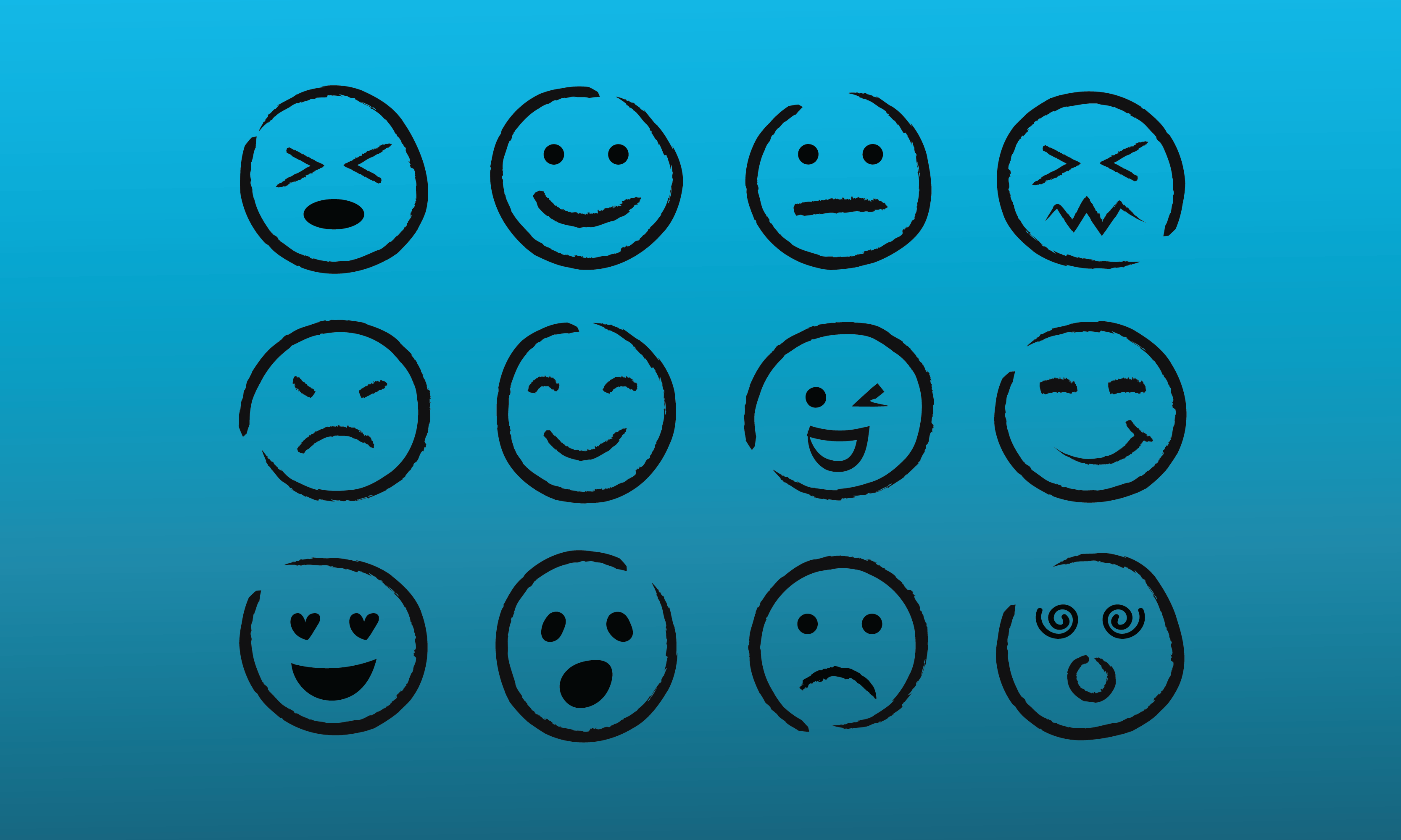
Your 🧠 On Emoji - Nautilus
It’s complicated. And that’s good.
nautil.us
104 points · by dnetesn · 3y ago · 175 comments
As a IRC-chatting teenager in the mid-90s, I am somewhat an expert in emoticons and can’t possibly imagine a world where emojis didn't exist.
But I m surprised no one mentions the “!” or other stylistic tools like all caps. These are “contextual modifiers” for text that have existed for ages. Some languages do have sarcasm punctuation and possibly small adverbs that annotate some kind of emotional state.
So basically yes, the article is right, emojis work mostly like words, but for me it’s just a continuation of what existed before (punctuation and onomatopoeia), and its extension and spread was made possible by the technology (an imposed vocabulary and convenient keyboard).
Are Your Texts Passive-Aggressive? The Answer May Lie In Your Punctuation
>"And we found consistently through many experiments that 'Yup' with a period resulted in responses that were more negative. So people thought 'Yup' with a period was less friendly, less sincere, and so on."
>"I actually really don't like getting text messages that end in periods because it always feels so harsh and passive-aggressive," said Juan Abenante Rincon, 24, a social media manager for Adidas. "Like, are you mad? What's going on? Like, did I do something wrong?"
https://www.npr.org/2020/09/05/909969004/before-texting-your...
What level of neuroticism is this?
¨In other words, enough to send a chill down anyone's spine.¨
I say again, what level of neuroticism is this? If folks are reading that much into a standard element of grammar, then maybe the grammar isn't the problem.
¨Klin said the entire debate demonstrates that language is constantly changing — and that's OK.¨
Language exists to communicate ideas; if a change makes things harder to communicate, it's a bad change. Change isn't inherently good.
If hundreds of millions of people are using grammar one way (and have been for a long time), and some young adults come along and _misread_ that grammar, the worse course is to tell the 100s of millions to change their behavior.
Single period is normal, surely.
> Single period is normal, surely.
This I understand. Ending a text with a period does make it seem more "serious". I would interpret "yup." to have an almost annoyed tone, and I think that's pretty common. I think it just comes from not needing to punctuate statements given that most texts are single sentences anyway. The end of the text implies the period, adding it implies more.
Username checks out!
(And I completely agree with your last point ^_^)
Especially when I'm using BrowserTamer[1] to intercept all URL launches so I can feed a few work URLs to Edge and Chrome, and FireFox as the default for everything else, so it effectively is my default browser. It's not the only piece of software behaving somewhat like that, either.
(While usually expected, it's not socially mandatory to give out tips in my country.)
The irony of using the normative "should" to project your preferences onto Firefox, while expressing a desire that Firefox not do so on you.
Also - what about iPhones stubbornly showing green texts from Android messagers? That's not even "I'm sad you're using Android." It's more a passive-aggressive "I'm going to degrade your experience because your friend uses Android." Forget about emojis- Apple is weaponizing colors!
Firefox is not a person, why should it have "preferences"? It's a tool. Tools should be used because they're useful, not because they "prefer to be used."
> A bad workman always blames his tools –Old proverb
Because I'm a person and Firefox is a tool? How is it irony? Next time you're going to say Firefox can set my diet just like I can set its search engine?
Apple is full of marketing geniuses. They’re maybe using a lot of dark patterns but they’re raking in profit.
... what's degrading about green?
1: https://www.wsj.com/articles/why-apples-imessage-is-winning-...
2: https://uxdesign.cc/how-apple-makes-you-think-green-bubbles-...
Interesting article either way.
Emoji is a Japanese word, which is the biggest hint they didn't come from Microsoft. (And yes, its a specific subset of Unicode characters, though that proper use is getting diluted by people using it to refer to any and every inline pictograph in text, even non-Unicode ones, a use more similar to "emoticon" from the 90s… that word seems to have faded into obscurity, largely supplanted by "emoji")
Even "emoticons"¹, or pictographs replacing some text like ":-)" (which is how they were called before the west imported "emoji", largely because it showed up in phone IMEs after its inclusion in Unicode) were definitely a thing in the late 90s. I suspect AIM must have had them before Messenger, but frankly, I didn't think anyone actually used Messenger except maybe business types?
Everyone I seemed to know was on AIM, with a few odd exceptions on Yahoo, if they were normal. If they were more nerdy, IRC, but that was text based. (Though some clients would still translate certain text sequences into pictures. I'm pretty sure, e.g., Trillian could/would, but I don't remember when I adopted it. But it could have been earlier than 2003.)
¹The picture version. As I recall the usage of this word in the late 90s/early '00s, it could mean either ":-)" as text, or the pictogram version thereof, largely because clients at the time would just convert between the two freely. One end might send text, but the receiving client would pictogram it.
I suspect this was the norm also elsewhere in Europe. I am talking about Messenger 4.6 that came built in with windows xp and its later versions, not the business version.
With the rise of smartphones though, it ended up being supplanted by WhatsApp, with the ill-conceived migration to Skype killing off most of the last stragglers.
Emoji as originally created/used in Japan were not Unicode, Unicode emoji only came many years later, so referring to non-unicode emoji as emoji isn't improper and doesn't dilute the term.
Also Microsoft's emojis are currently the worst by a mile out of the big tech companies.
See https://www.global.ntt/contributing-society-emoji.html
They are not the "smiley" / "emoticon" character art stuff like :-) or =ò.ó= or whatever.
As far as Unicode, the impetus for inclusion, while petitioned by Google, was at least officially due to enabling compatibility with Japanese phones where emoji were also quite popular.
At the same time, I do realise "emoji" is now often being used as a generic term that encompasses both true emoji (unicode-based) and general emoticon images.
Platforms like Slack and Mastodon now let you add what they call "custom emoji" which back in a web forum in 1999 we would have called "smilies", but in any case are definitely not part of unicode.
The term has evolved to just mean any graphical smilies/small embedded images
https://en.wikipedia.org/wiki/Emoji
The article above also noted how MSN Messenger and BlackBerry adopted emoji from 2003 onwards.
https://nypost.com/2022/10/26/gen-z-has-hidden-meanings-for-...
Second, even if it was true (which I doubt), there are some things which should be ignored and someone believing this nonsense should not be coddled.
I'm very liberal, but this is just pure nonsense.
This is largely a "know your audience" sort of thing. My approach is to just write like I normally do when I don't know the peculiarities of the specific people I'm talking with. In general, they will know you aren't "on the inside" and will understand that you don't know what the various connotations are. Even if they'll mock you for it later amongst themselves.
(AFAICT talking to people, everyone I've seen who thinks this is a thing appears to think such because they've encountered these news posts / reposts of this, not because they genuinely hold the belief themselves. Self-fulfilling prophecy, at this point. Though now that I've invoked a weird form of Cunningham's Law, I'm sure someone will tell me they're the one, and that there are dozens of them out there. Tell me why you can't just read :+1: in an "assume best intent" light and treat it as the literal "ack/agree/yes" that it's probably meant as, and what, you want me to spam everyone with reply notifications instead of just a reaction…?)
(There is also an episode of Dr. Phil out there that goes into how a bunch of emoji are supposedly poisoned one way or another, again with nary a citation to most of it, or they're saying "X emoji is ruined" where, no, it's only ruined if you use it in a particular context where the meaning of the emoji isn't the original meaning, but rather the context puns it to something else. Cf. the eggplant emoji.)
[1]: https://www.tampabay.com/opinion/2022/10/28/gen-z-thumbs-up-...
[2]: https://www.today.com/news/news/thumbs-up-emoji-debate-rcna5...
[3]: https://web.archive.org/web/20221013050626/https://www.reddi...
Also, thumbs-upping the question, what does that even mean? It's a good question? I also have this question? The answer is yes? What if it wasn't a yes/no question?
o_O
Besides, as the sibling notes, it can be slightly negative, because a mere thumbs-up means that you didn’t find it worth to bother typing some actual text.
And it doesn't apply to emoji.
My reasons: "There's a method to my madness. You see, gifs are trivially infinitely extensible and backward compatible. Whereas each new emoji requires an addition to Unicode and software updates. And the demand for more emoji is insatiable. That system is not practical or scalable." (I mentioned gifs there because I was known to frequently post gifs.) https://twitter.com/lapcatsoftware/status/105276966084695244...
Apparently emoji aren't the greatest for accessibility: https://www.tiny.cloud/blog/emojis-and-accessibility/
It may be even worse for emoticons, so that's a legitimate criticism: https://uxdesign.cc/emojis-in-accessibility-how-to-use-them-...
The bad news is that X's gifs' alt text is absolute trash most of the time. Stuff like "office stare gif" etc.
To understand a meaning of a word/emoji/gif you have to see it in context several times or look up a definition. (with emojis and gifs there is additional problem in lack of dictionaries for them). When amount of words in a language is finite or they are extending slowly (emoji) I ma able to keep up with thier meanings as opposed to gifs and memes. Which are evolving to quickly for me to keep up.
EDIT - guilty party in my inbox today is Newegg, twice. I should unsubscribe from those.
(I also judge anyone who stresses the second syllable of 'emoji', which is basically everyone.)
I had a bunch of russian coworkers once, and one of them would constantly type “)))” any time I asked him a question. I thought it was some weird cyrillic keyboard quirk and never paid it any mind, until I learned it’s the approximate russian equivalent for “lol.”
Didn’t know what to make of him after that. I guess he thought I was a moron.
`vlad: )`
Another one I encountered at work was a Taiwanese coworker ending sentences with a ~ character which apparently indicates "cute" / "playful"
Separately, I remember years ago doing social media competitive audits and someone saw >>>>>> in there and thought it was errant text. E.g. "Taco Bell >>>>>>>". Of course what it means is Taco Bell is better than everything
Vladimir : )))
So I thought that they "reused" the colon that separated the name from the message. That was my theory at least...
Samsung had some rough emojis for a while. Look at their old "grimacing" face. Or the old cookies emoji that they made saltine crackers. Or their eye roll emoji which was a sarcastic eye roll on Apple, but Samsung had it as a cute smile. I'm sure that caused many a communication issue.
I've recently discovered there is a generational gap in smiley usage :)
If you are younger, my ":)" above can be taken more as a condescending smirk that puts down the reader. If you are older, it is just a smile and signifies that I'm, well, what a smile usually means: I'm being friendly, happy, non-threatening.
I apparently now have to watch how I use smileys because younger people have started interpreting the symbol, imho, incorrectly :(
(I am unaware if a similar proviso extends to the sad face above)
Internet is a highly sarcastic world so it's not a surprise that people eventually perceive it to be more sarcastic than it should be I suppose.
You can just add a - to make it unambiguous. :-)
Like 20 years ago, if I was sending an IM or something, I would always just write like I'm writing here. But now, if I'm sending someone a text or slack or something, I always feel like it's more casual/less try hard if it's lowercase with relaxed punctuation. (That's just my style, I don't expect others to match). If I end a text with a period and everything properly capitalized, I almost feel like I'm being too formal. (Admittedly, some people probably just think I'm sloppy and lazy!) I never got into writing "u" or "ur" though. For some reason those still bug me.
I know a lot of people don't like memes or gifs, but actually, I think they're great. Sometimes it's much more effective to express a sentiment with an image instead of a word or phrase.
I always feel a little cringe when I end a sentence in lol, like I'm laughing at my own joke, although sometimes it helps to soften something I'm saying.
I think humans just tend towards registers of communication, regardless of the medium.
I don’t want to see a post full of emoji either, but perhaps a filter that allows one emoji per 20 words would work. Perhaps using a font with black line or grayscale emoji?
For me at least, seeing emoji makes me even more uncertain about the meaning of the message.
* Unfortunately, her cake she was terrible.
* Her cake was such a failure, I had to laugh.
* She made a nice cake.
I'd hate to see them on HN though. :(
¯\_(ツ)_/¯
In Poland we just use the US keyboard layout so that's not a problem. I assume it's similar for other non-cyrillic slavic languages.
Also emojis are yet another data point to do things like sentiment analysis, and have been weaponized by social media companies to target more relevant ADs at you. Tweeted/X'd the beer emoji? Get ready for Heineken ADs.
As far as I can tell the emojis thing is (has been) mostly a millenials thing, the zoomers are mostly on the side of AAVE-speak and such related jargon (the famous fr fr, for example, even actively avoiding capitalisation is now seen as a thing).
So, yeah, I'd say that the emojis have passed the peak of cool relevancy, hence why they're discussed on this quite boring forum by definitely not cool men in their late 20s and 30s (I'm a definitely not cool man in my early 40s myself).
"The cake that horrible coworker of mine made was terrible, and everyone hated it. I delight in this schadenfreude." vs "The cake my loving and adorable girlfriend made me for my birthday was terrible, and while I appreciate the effort, it was hard to stomach. "
Russian smiles are even more advanced. They use only one sign ")" and "(". Of course you can multiply them.
Unicode is supposed to be a universal standard, but the inclusion and exclusion of some emojis is an ideological issue. The inclusion and wide usage of emojis gives the Unicode consortium a disproportionate degree of influence over the way we communicate.
I keep finding weird places that support emojis, like usernames on some web sites. And someone on HN showed me recently that you can make emoji filenames in Windows at least.
I perpetually react poorly to the wink icon, at least, as it appears on Apple devices.
I get the sense people intend it to mean "droll wink" which is inclusive and often characteristic of good humored positive "play."
For me the icon parses as a more confrontational eyebrow raise, sardonic shading into sarcastic, with a whiff of the scornful, contemptuous, or hostile.
It's not a big deal, but it's been years and I still have to hand-hold myself past the intuitive reaction by reminding myself that's almost never how it was meant.
I wish you could swap out the glyphs.
She went into the unicode side of things as well.
In particular, I have lamented the paucity of information that modern short form social media - 280 character Tweets; 10 second shorts; soundbytes, quips, and shitposts on Reddit - is able to carry. There simply is not enough information within the medium to sufficiently disambiguate the multiple senses and interpretations one can read into the message, and I believe it is this lack of being able to even agree on what is being said that leads to so much miscommunication and conflict today.
After all, any reading or interpretation of a message requires some form of _projection_ on the audience's part onto the canvas of the medium.
Frege once wrote, "Si duo idem faciunt, non est idem. If two persons picture the same thing, each still has his own idea." [0] Perhaps it is for this reason that Victorian-era writers (John Stuart Mill's "On Liberty" comes to mind) employed such a flowery and verbose brand of English; it is only by sketching out their ideas in high enough resolution that one can have some hope in hell of conveying an idea to their reader, intact and bearing at least some resemblance to whatever it is they had in mind.
To steal an idea from Wittgenstein's Tractatus, 4.026: "The meanings of the simple signs (the words) must be explained to us, if we are to understand them." If one does not take the time to expand upon the definitions or the subtleties of the words, signs, or emoji they use, it is no surprise that some misunderstanding may arise.
Why then, do we suppose that emoji will indeed communicate, unambiguously, the shades and nuances of meaning that we intend, simply because they bear some resemblance to a real-world object or common symbol? Did you contextualize its usage adequately? Is that picture indeed "worth a thousand words?" Which thousand did you choose when you last punched in that heart emoji?
Emoji have progressed to a fourth-order simulacrum, in Baudrillard's terminology: "it has no relation to any reality whatsoever." Where perhaps emoji once may have been able to refer to the depth of meaning, the underlying reality to which they point, I find they are now carelessly thrown around, often, as another commenter has mentioned below, towards manipulative ends. Even the simple heart emoji is not something I've even used with my father over iMessage until very recently. Love is after all, a very powerful concept, and yet here we are, throwing it around willy-nilly, left and right, to people we haven't even met in person - or worse, _next to the links to purchase reddit premium or reddit gold._ Far from being an actual message of _agape_ or even _philia,_ which may have been a function of a first-order simulacrum, where the map accurately reflected the territory, it has become a hollow icon, meant to evoke some sentiment or feeling in the reader by its presentation alone, and not by virtue of its connection to some actual underlying sense of love.
Baudrillard also writes: "All Western faith and good faith became engaged in this wager on representation: that a sign could refer to the depth of meaning, that a sign could be exchanged for meaning and that something could guarantee this exchange - God of course. But what if God himself can be simulated, that is to say can be reduced to the signs that constitute faith?"
I am not a Christian, or perhaps even a religious man, but the example is quite poignant. Can you draw me an emoji, an icon, of what was once taken to be the highest and most ineffable concept? And if emoji can fall short of communicating one ideal, why not others?
Yet here we are, exchanging hollow signs in a lifeless, meaningless formal system of cold syntax, bereft of semantics.