We Might Have Accidentally Killed the Only Life We Ever Found on Mars Nearly 50 Years Ago - JSTOR Daily
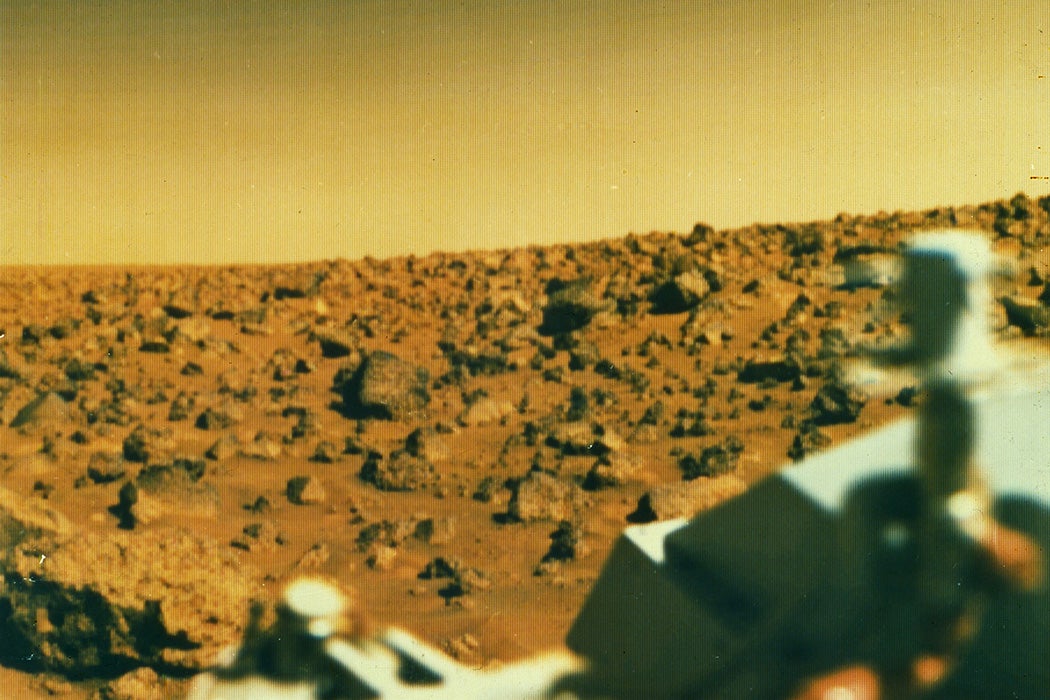
In one experiment, the Viking landers added water to Martian soil samples. That might have been a very bad idea.
JSTOR Daily
250 points · by onychomys · 3y ago · 165 comments
Here are some interesting slides I found while trying to figure out what his actual experiment idea involved: https://www.vanderbilt.edu/olli/archive/Life_On_Mars_Session...
Something I noticed a few years ago is that NASA publishes a press release every month or so with the title "possible hint of water found on Mars". There are literally thousands of such web pages on their site:https://www.google.com/search?q=site%3Anasa.gov+"hint"+"wate...
Nobody ought to be this obsessed with something, unless there's an agenda. It's like cigarette companies going on and on about how their latest product is "more healthy".
What's going on is that NASA has had a lot of trouble in recent decades maintaining their funding. There's not a lot in space that excites US senators. There's no oil, no resources that can be practically mined, etc...
So they have to have some sort of goal, something they have to get funding for so that they can go "look for it".
Some NASA administrator picked "water on Mars". Now it has morphed into a reason for the agency to exist, which means if it was ever shown not to exist, then NASA would face a real existential risk itself.
So they'll drag their feet as long as possible, sending every possible instrument they can pack into a rover, except for the one that could definitively rule out life and/or water.
This is why they didn't send a microscope, and most likely won't send one on the next mission either.
I agree that mars has been over explored to the detriment of all other planets, especially the outer ones.
Asteroid mining would at least have a huge economic payout if achieved.
It seems like all life on earth descended from one species, that was a cell. So all our life on earth is made out of cells. But couldn't life be completely different somewhere else?
It's a very simple object--kind of a thermodynamic primitive for resisting entropy. The organelles within cells are themselves cells. I'm not sure what life would look like without cells but it would probably rely on some type of otherwise naturally occuring gradient like a tide pool or mineral formation.
The local star, especially if close enough, creates lots of gradients.
Cells (as in the bit that makes it a contained volume) are both a thing that forms spontaneously without biology, and very useful for isolating one blob of chemistry from others right next to it.
There is however life on earth with huge cells and multiple nucleuses: https://en.wikipedia.org/wiki/Plasmodium_(life_cycle)
But also, the Viking test was more general than "cells", it would have ben positive with anything that could, to simplify, eat the food it was given.
More precisely, they are just cell membranes, not cells. Cell membranes form spontaneously from many fatty substances, the root cause being that oil and water do not mix, i.e. fatty substances are hydrophobic.
A dead cell or cell membrane does not exchange chemical substances with the environment (except passively, i.e. when molecules or ions diffuse from high concentration towards low concentration).
A living cell has not only a cell membrane that separates the interior from the exterior, but it also has molecular pumps and ionic pumps embedded in the membrane, which selectively pump some substances in and other substances out. Without this controlled exchange between interior and exterior, the growth and multiplication that define life are impossible.
What is characteristic for life are the molecular pumps and ionic pumps. The cell membranes have only the passive role of preventing the substances that have been pumped in one direction to come back to the place from where they had been taken by the pump.
But it would be really interesting, if there were other possibilities too we could think of.
A hundred years ago nobody thought something like quantum entanglement could be possible. Maybe there will be a similar eye opening surprise in extra terrestrial life.
But off course it’s reasonable to start looking for all the things we can already imagine, and make observations in a way we already know of.
We simply don't have a framework other than basic physics and chemistry to speculate in this area. The possibility space is too large and we don't know the fitness function.
That doesn’t mean your idea is wrong, but if we assume regular cold chemistry (i.e. not stellar insides or other exotic states/physics), membranes are just the sane and obvious default. Which conditions could make them less effective than something else?
That's what I believed too, but I have doubts now after reading another comment that defines it as energy gradients. As far as I understand the concept, a crystal is low entropy as well. Or is it the same thing? Or the combination of the two (Use energy to keep entropy low)?
> membranes are just the sane and obvious default
The less sane one could be... Magnetic confinement fields I guess?
It helps to look at how biology actually works; we get these images of things like DNA copying where the next amino acid is just sitting there, all but busting in the door to be copied. It gives a very false image of how biology works. In reality it's an insane world down there with a whole bunch of the cell just jiggling around thermally all the time, and the mechanisms all work by waiting to be bashed into by the right thing. Everything is so fast and the rate of jiggling is such that it all ends up working out. But it's nothing like anything we'd design or even very easily wrap our head around. I've sometimes wondered if we were somehow otherwise the same, but not biological, how long it would take for us to ever invent biology. We are certainly nowhere near it now.
Crystals and solid-phase in general doesn't have an obvious route to chemistry occurring anything like the way it does in biology, and indeed, it doesn't have an obvious route to chemistry occurring at all at any scale.
I'm struggling to imagine what usable energy generation in a high entropy environment would look like.
It's something that I've been very interested in for a long time, especially the idea of "scale of life" - could there be a brain the size of a solar system? How would we even understand it? What about life which operates on a different time scale (in the solar-system brain example, it would operate on a different scale on two axis - space and time).
I believe, In the slim chance we encounter some kind of 'life', it wouldn't be even considered as life by our standards.
Just a simple quiz to exercise the brain: - should life move at all? - what's the maximum distance between molecules we can still consider as one entity? - can a state of matter be 'life'. Not a matter itself, but just a state of it?
Our lifespan also seems quite arbitrary. Some sophisticated animals live quite a bit longer than us and others live a tiny fraction of a percent as long. One would imagine that between solar systems there is a much greater degree of variance.
It would be difficult to understand the time horizons of a collectively intelligent swarm of fruit flies or a serene pod of whales, but imagine if interstellar life has a geologic component to its life cycle?
The reality might be very boring. Way too boring for a good story.
Life? Don't talk to me about life.
I think the only wiggle room there is "nontrivial".
Martian isn't a broad synonym for alien or extraterrestrial. It just means life on mars
I am unaware of any understanding of evolution or early life on Earth which supports an idea of some giant contiguous life-form.
That said, Mars is not Earth, and our definition of life is ever evolving (is a virus alive? is fire alive?) so, again anything is possible, but not everything is likely.
Okay? People have no idea what pre-cellular life looked like so the entire earth being a giant cell is not out of the question.
A stray breeze blowing away chemicals would effectively kill life. A "cell" having a barrier would allow that chemical process to happen.
Life may not require cells in the way cells on Earth evolved, but they'll require cells of some sort.
Like what a gas cloud with intelligence?
We live in a universe with distinct rules, saying life doesnt have to have cells is basically fantasizing about other dimensions where we're made out of hot dogs or something. Saying life doesn't require cells is just redefining what words mean, since a cell literally means the smallest functional unit of life.
Cells are much too complex to appear spontaneously, without evolving from an acellular form of life. Cell membranes can form spontaneously from fatty substances, but no cell can live without complex molecular pumps that are embedded in the cell membrane and which bring in some substances from outside and which expel some other substances from inside. Such pumps must be the result of a long evolution that preceded the first cells.
Nevertheless, any form of life that is not made of cells cannot live free in a fluid like water, but it must be attached to the surface of some suitable rocks, where a flow of nutrients must exist.
The most plausible hypotheses about the appearance of life on Earth suppose that before the appearance of cells, life was restricted to pores inside rocks from hydrothermal vents, where a flow of dihydrogen and of alkaline ions could provide the energy, and metallic sulfide minerals could provide the catalysts for organic syntheses.
But the only life we know... is cells. Unless you count viruses. Which most biologists don't.
... But the kind of thing people mean by "life" colloquially is really multicellular or at least eukaryotic life, which only arose on earth like 600 million years ago, which is only like 15% of the time that life in the more strict sense (bacteria/archae) has existed here.
I don't really see much of controversy in what I said here?
Making a lander where we know there are no earth microbes on it is quite difficult and certainly important for testing for life.
https://www.sciencealert.com/a-bunch-of-earth-organisms-were...
https://marsnext.jpl.nasa.gov/scieng_plantary.cfm
> A Special Region is defined as a location where the temperature could exceed -28° Celsius (-18.4° Fahrenheit) and water activity is at least 0.5. Water is key to life as we know it, and water activity considers the availability of water and water vapor as a potential support for life processes.
> The Mars 2020 mission is restricted from landing in, entering, or creating, a Special Region on Mars
[...]
> Thus, the Mars 2020 mission is also restricted from landing in sites where scientists suspect water, brine, or water ice could be present, or could be induced, within 5 meters (about 16.4 feet) of the surface
And the refutations to the authors original pleas are still as valid as they were then: https://www.liebertpub.com/doi/10.1089/ast.2017.1749
The discussion about Viking lander results was just build-up for that final paragraph making the argument for new life-searching mission.
I feel like I'm wading into the middle of a lover's quarrel, where the words have nothing to do with the actual fight...
passive aggressive subtitle vs. headline wars ftw
That's why we don't have one.
Science is about trying things and learning from our mistakes.
I hope this is actually just brain dead clickbait and not genuine simping for aliens by claiming xenocide based on literally nothing. hey, maybe one of the scientists accidentally farted on all the moon rocks too. we can't rule this out. better alert the media and make it seem like we're actually on the case
alien hunters can't get a life here where it's warm so why would they get any out there? the real aliens are truly the friends we made along the way
there was no life. the only fluid anywhere near the planet surface is a weak amount of carbon dioxide. there are no billion-year-old organisms still alive from when there was liquid water. I've heard of child-like wonder but this is just embarassing. i hope none of my taxes go to this
"if elvis is alive, he lives on the moon" is a true statement only because elvis is not alive. if life was in the sample, it was killed by water is a true statement only on the technicality that the premise is impossible. the author either deeply misunderstands propositional logic or it's intentional clickbait. probably both.
https://www.wolframalpha.com/input?i=truth+table+%28p+implie... https://www.wolframalpha.com/input?i=truth+table+%28p+implie...
I see a lot of young SV types thinking they want to build a deep tech space company. And they can. But it requires a couple years of deep training in of aeronautics and physics before you even know what's going on.
Elon for instance spent years studying space on his own before launching SpaceX. Elon's at a different level, but we can at least learn a few things from him and SpaceX.
Oh, most people don't start off rich? Oh what a shame.
Elon bought Tesla, Elon is only vaguely a part of SpaceX, and every single other venture he has been involved with has either gone nowhere, been a scam/grift/lie (boring company, hyperloop, neurolink though it shouldn't be judged just yet) or even classic nepotism with Solar roofing.
Elon is such a good businessman, which is why he bought Twitter at the peak of it's valuation, continually flakes on all it's bills, publicly admits to losing half of that peak value, saddled it with a billion dollar a year debt, erased any brand recognition it might have to replace it with a stupid domain name he has been obsessed with for twenty years, lost half of the advertising revenue, blocked it off from public access, fired anyone who isn't a sycophant, and repeats really dumb conspiracy theories about fucking everything.
What does being a founder have to do with being a doctor?
Or a physicist for that matter?
There are also a lot of space companies focusing on a narrow niche that doesn't involve rockets — sometimes imagery (Planet, other satellites), sometimes 3D printing, etc. It's not like deep training in aeronautics will make you an expert in 3D printing in space - there's not a 101 guide to the space, it's novel tech.
So you're saying that the people who designed and launched the Viking lander back in the 70s (it landed on Mars when Musk was about 5) were amateurs?
Well as far as Mars exploration is concerned they achieved much more than him with basically stone age tech compared to what's available now...