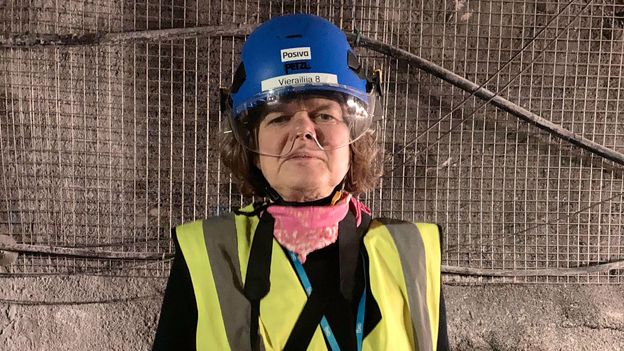
The place where no humans will tread for 100,000 years
In a few years, Finland will begin depositing spent nuclear fuel underground in Onkalo, where it will remain for millennia. Erika Benke describes her experience of visiting the site.
bbc.com
165 points · by Vigier · 3y ago · 212 comments
Take what I said with a grain of salt as I am not an expert in the matters of nuclear technology, just sharing my layman's viewpoint. It's probably a complex system so I'm not sure if anyone has definitive answers as it all depends on the amount of nuclear power the world is going to build, how the reprocessing technology and know-how develops, how the alternative means for electricity production develop etc. etc. -- so we can only make educated guesses for now, but I see that we're making a good compromise here with the marginal amount of the global spent nuclear fuel we possess considering our options. For other parts of the world the equation probably plays out differently, e.g. not having suitable solid bedrock to utilize might be an obvious showstopper.
Uranium mining is extremely destructive to the environment, not to mention using a lot of energy, so this isn't just opportunity cost, it's externality cost.
I'll assume that you are a proponent of Solar/Wind/Hydro. Which also have externalities, including human death, but let's ignore that.
But I am onboard with all of those. My problem is that I think solar, wind and hydro are not enough. We don't have a way to store energy in massive ways, so in order to account for cloudy days, non-windy days and nights, we need something else.
I see uranium filing that niche. If not uranium, what else? All the options I see mentioned are along the lines of "let's continue burning stuff, then, and keep adding solar/wind/hydro".
But that is what we are doing now already. And the temperature and CO2 concentration graphs keep going up. So, what is the alternative?
So we can build either energy storage or nuclear plants. Storage must surely be the better choice!
It seems quite obvious to me that it will be cheaper, faster, simpler and more reliable, not least because it will be distributed and we can engage many more people to the task of building storage than we can to the task of building nuclear plants.
Heat storage, pressure storage, gravity storage, hydrogen, methane, batteries, all so easy to make (compared to nuclear plants) that you can have thousands of "small town scale" projects going at the same time.
With few notable mega-projects, solar has still grown in capacity equivalent to several nuclear reactors per year the past few years. I think a similar thing will happen with energy storage.
It's kind of happening already (several storage projects are underway and some are online) but the results are good and it's early days.
I enthusiastically support any and all nuclear options. Especially traveling wave and SMRs.
Unfortunately, nuclear won't arrive in time to keep us under 2C. Fortunately, we'll still need it to help with going net-negative.
How so? Any pointers for more info - I'm somewhat ignorant on this topic.
https://world-nuclear.org/information-library/nuclear-fuel-c...
[1] https://www.nrdc.org/bio/nrdc/epa-tries-sign-away-authority-...
Nuclear fission based on uranium is a lot of things, but definitely not "clean" or "green" even on the raw material sourcing side like the pro-nuclear crowd keeps blathering.
[1] https://en.wikipedia.org/wiki/List_of_countries_by_uranium_p...
Depending on your criteria, no human industrial activity is green. Digging up precious metals for solar panels? Pouring tons of concrete in mountain valleys to make dams? Building forests of windmills?
At the end of the day, the question becomes “does this enable us to reduce our carbon emissions whilst keeping a reasonable quality of life”. And to that question nuclear is without a doubt a good thing
Making human lives better means that you have to do dirty, destructive work like mining, drilling, and manufacturing. To some degree, we're trading pristineness of nature for increased living standards for people. As technology improves, there is potential for our footprint to get smaller, but that's almost always balanced out (or more) by an increase in population.
It's easy to make the whole country a nature preserve. You then either import things that were produced in a dirty manner overseas, or your living standards drop to that of our Aboriginal ancestors.
OK buddy
Everything has externalities, even the "renewables" (which are not, by definition, because nothing is renewable) - if you want to have an adult conversation you need to talk in terms of pros and cons across multiple dimensions.
This is an obviously silly structure and yet it persists.
In reality, Uranium is mostly mined by leaching which is the least destructive form of mining. Not to mention the quantity actually mined is several orders of magnitude less than other things we mine in much more destructive fashions like Copper, nickel, zinc etc
And in fact, a major part of uranium is in-situ leaching, which is less enviromentally damaging than most other mining.
Zoom right in on Olympic Dam on Google maps.
This is the largest known single deposit of uranium in the world.
Now zoom out. Keep zooming out. Now zoom out further. Australia is big.
Uranium mining causes approximately zero damage.
The story changes significantly if we start using breeder reactors and other designs.
Uranium is everywhere. While there are mines that have extremely high concentrations of Uranium, it is present in trace amounts in almost everything from granite to sand to soil to groundwater. There are 4 billion tons of Uranium dissolved in the oceans. A number of projects have looked at filtering and extracting it from the oceans. It's relatively expensive to extract it from seawater, but not insane--4x-10x the cost of mining. We won't run out.
https://deeply.thenewhumanitarian.org/oceans/articles/2018/0...
> I believe I read the estimate is something like 50 years?
It's more like 200 years. And that's "economically accessible", not accessible.
https://www.scientificamerican.com/article/how-long-will-glo...
> estimate is something like 50 years
those are pretty pessimistic estimates.
From a 2009 article on Scientific America
According to the NEA, identified uranium resources total 5.5 million metric tons, and an additional 10.5 million metric tons remain undiscovered—a roughly 230-year supply at today's consumption rate in total
the extraction of uranium from seawater would make available 4.5 billion metric tons of uranium—a 60,000-year supply at present rates
fuel-recycling fast-breeder reactors, which generate more fuel than they consume, would use less than 1 percent of the uranium needed for current LWRs. Breeder reactors could match today's nuclear output for 30,000 years using only the NEA-estimated supplies.
Since the fuel is cooled in water ponds for decades before it is processed, even in the case of a nuclear industry boom there's ample lead time to alter the plans if running out of materials seems to become an issue. I'd be much more worried about usage of oil as it is the base material for a lot of different things like medicines, and we're burning the stuff away (granted, we can do synthetic hydrocarbons, but the whole thing with oil is a bigger problem in my books than running out of uranium; it's still there to be retrieved if it really comes down to it).
If it's "undiscovered", presumably that 0.5 metric tons amounts to spurious precision. Call it ten million, and it becomes clear that it's a wild guesstimate.
Also: the location of these Uranium deposits is not evenly distributed. I understand that substantially all of France's Uranium, for example, comes from Niger, a politically-unstable country where much of the mining is controlled by the Wagner Group.
The key thing here is "known". In order to "know" of the economic viability of a mining source you need to invest serious money. Mining companies have serious money, and they invest them to "prove" new reserves, because that's how they can get loans from banks. But once the reserves exceed whatever demand there is in the world for more than a hundred years, there's absolutely no incentive to keep exploring further. That's where we are now: there are about 8 million tons of proven uranium reserves [1]. The annual production fluctuates very slightly around 50,000 tons [2]. At the current production levels we have more than 150 years of proven reserves.
But if we were to suddenly double the number of reactors, we would very quickly double the proven reserves. If we were to multiply 100-fold the number of reactors, we'd multiply the proven reserves by 100, or more likely more than that.
In the end there is absolutely no limit. The current market price of uranium is about $130 per kg. It is estimated that it can economically be extracted from seawater for $1000/kg, so less than a factor of 10. Such a cost would not increase the cost of electricity by even one cent per kWh ( see the math in the notes).
As for breeder reactors or other designs. The current generation reactors produce about 40 to 60 GWday of energy from 1 ton of uranium fuel (which is generally enriched to close to 5% U-235). New designs will increase this number (called burnup) to 100 [3] and some even to 180, but generally not because they are more efficient, just because they'll use fuel enriched to up to 20% U-235. There are 2 designs that will exceed that, but they are supposed to burn thorium rather than uranium. We have easily 100 times less experience with thorium than uranium, so I wouldn't hold my breath that it's a piece of cake to achieve higher burnup with it. In theory we could, but practice finds ways to disagree with theory.
Notes: the math of 1 cent per kWh: you need about 10 tons of natural uranium to produce one ton of fuel-grade uranium, and with that you get about 50 GWd, or 50 x 24 = 1200 GWh = 1.2 billion kWh of electricity. 10,000 kg at $1000/kg is $10 MM for 1.2 billion kWh, or 0.83 cents/kWh.
[1] https://en.wikipedia.org/wiki/List_of_countries_by_uranium_r...
[2] https://world-nuclear.org/information-library/facts-and-figu...
Where did you get that notion?
[1]: https://en.m.wikipedia.org/wiki/Long-term_nuclear_waste_warn...
This is one of my favorite little quotes/references to use if I can find a way to work it in. I know it’s about something very serious but it always makes me giggle.
I’ve used it on a few commit messages/comments before for particularly gross code.
Just put up a sign that says “no cash kept on premises” and an empty cash tray on a counter, behind some glass sliding doors.
So, even if that doesn't sate their curiosity, they can learn enough to not get themselves killed if they do try to dig it up.
https://emperorx.bandcamp.com/album/10000-year-earworm-to-di...
I think it's a bit late to emphasize this concern, when even North Korea has nukes.
But one of the interesting things about WIPP is how they thought about how to mark the site as "do not dig" in a way that would last a very long time. See https://en.wikipedia.org/wiki/Waste_Isolation_Pilot_Plant#Aw... for what they came up with...
I guess I'm describing a pyramid which made it about 4k years before we forgot what the symbols meant and went digging through them anyway. 4/100 ain't bad for a first try though!
It takes a lot of resources (today) to dig down 1400' so that might be helpful. However, it's still doable with time and motivation for practically any human society. Space is another interesting idea with its own set of issues (eg: getting waste there safely) but has the advantage of requiring a space-fairing civilization which also requires advanced knowledge, cooperation and communication which gives a better chance that simple grave-robbers don't dig something up after the decline of our current knowledge, skillsets and civilization.
Most likely in the next few decades they'll figure out how to make it useful or at least not be a problem anymore.
Designing something to last 100, 200 years, alright... but 100,000? We probably won't even be here, on Earth. Waste of time.
> If you work in tech you know that 99% of the stuff you build wouldn't (or shouldn't) last another 5 years.
We have technologies that have survived for thousands of years (agriculture, writing, etc.) This statement is completely myopic and absurd.
If "we" are here, or "something else" arrives at that time they are likely so advanced that the topic of communicating nuclear risks to them is rather pointless.
What?!
This is the right solution - dry storage in hard rock in some rock formation that hasn't done anything in millions of years. Originally, in addition to Yucca Mountain, there was a plan for an East Coast nuclear waste repository in hard rock, probably in Maine or Vermont.
When it's full, the Finland plan is to fill in everything, seal it off, and not mark it. If some future society can drill through that much hard rock, they probably know about radiation, since that's a routine hazard in mining.
that's exactly why they chose it and it makes a lot of sense.
If the environment is so stable, you don't have to worry about earth own internal movements too much.
This is old news, it's been amply debated, there's a documentary by Michael Madsen titled "Into Eternity" where pros and cons are discussed at lenght, the movie is from 2010, 13 years ago.
You can find it on YouTube
Reminds me of that Star Trek episode where Data, confused, walked with an suitcase with irradiated materials to a village that was just discovering the basic elements. They got irradiated because they couldn't understand the radiation symbols on the suitcase.
https://memory-alpha.fandom.com/wiki/Thine_Own_Self_(episode...
Right to me implies the best. Its not the best. Shooting it to the sun seems like a better alternative.
Putting it deep underground is the safer option.
[1] you can use gravity assists like the Parker Solar Probe, or go very, very far out, make a small adjustment and then fall back in for about 1/3 the total delta-v, which is still a rather large amount.
To get something to fall into the sun rather than just carry on orbiting it you need it to lose the velocity it has by virtue of being launched from Earth, if you just punt it into interstellar space on the other hand you need a lot less fuel and you can get a boost from the planets if you line it up right.
"Space Launch Vehicle Reliability" - https://www.tech-insider.org/related/research/2001/0301.html
"Of the 4378 space launches conducted worldwide between 1957 and 1999, 390 launches failed (the success rate was 91.1 percent)"
...may not be the correct decision.
It makes a fantastic double bill with Herzog's "Cave of Forgotten Dreams". I feel his weird epilogue monologue epilogue links them well.
Both movies span and ponder on such a vast period of time, which is awe inspiring, terrifying and fascinating.
Waiting also reduces the difficulty of dealing with waste, since the fission products decay relatively rapidly. Aside from seven very long-lived fission products, they will be gone in 300-500 years (depending on your definition of "gone"). Indeed, the problem then becomes that the gamma emission of the spent fuel elements is so low they are no longer self-protecting against "amateur" diversion of the plutonium. (Note that this is fission products, not actinides, that decay relatively quickly.)
Personally, I suspect spent fuel will be dealt with by launching it beyond Earth. Think how cheap and reliable distant descendants of today's rockets will be several centuries hence.
Can't wait to see the reaction when one of these barrels inevitably hits something important to someone.
the DOE currently thinks it's a bad idea https://www.energy.gov/ne/articles/3-reasons-why-we-dont-lau...
I like the Economist's style, articles don't even have authors listed and when they must talk about themselves they say "your correspondent" which I perceive as much more humble
It's worth exploring the experience, in spelunking or meditation, if it changes your fundamental incentives. Or read Ecclesiastes, et al. empathically.
Finland is at least trying, doing the engineering and engaging the question. Perhaps because it has no fossil fuels?
It need to be stored in a clearly marked and delimited place, to avoid accidents, until someone in the future finds a more definitive/cost effective solution, or until it wears off, even if it take a long time for our standards.
What are some points that I could use to differentiate the two ideas? e.g.
- not enough waste to be an issue
- waste is properly secured so won't be an issue
- less impact than coal/oil/gas
Just to be clear, I'm quite sure humans will still be here, but I think there's a good chance we'll exist in much smaller numbers, in isolated pockets. Individuals probably won't have the kind of ready access to the sum total of human knowledge that we now take for granted. I'd be amazed if any digital information from today survives even one century into the future, never mind five.
Of course oil, coal, solar, idro, etc have their own costs for cleaning up the places.
In Finland, and I believe many other countries as well, there is a special tax on nuclear power plants whose proceeds go into a fund for handling the end of life costs, like building this repository.
> Of course oil, coal, solar, idro, etc have their own costs for cleaning up the places.
Indeed, all energy generation should have similar schemese like nuclear to handle end of life cleanup costs. Unfortunately it seems nuclear is fairly unique in actually having it.
The only problem is that these are not pooled up towards fixing environmental issues but used as part of the general budget by whoever holds the government at any time.
Which in turn annoys even people like me who think it is a good idea to tax it because:
1. not enough gets done to combat environmental damage
2. it gives politicians an incentive to keep increasing these taxes to afford other projects they want
I seriously wish it was like water and sewer and waste taxes around here:
the municipality can increase these as needed but are not allowed to make a profit from them so if money is saved then the next years these taxes are lowered. (Or the year after, whenever the calculations are finished.)
It's factored in, and especially on new projects such as Hinkley Point C it'd actually a pretty sizable chunk of the budget, and increases the price of the electricity produced even more because the timeline is quite short (the goal is to reimburse the construction costs within 20-25 years, meanwhile the power plant can operate for 50-70 years with some maintenance; that's what happens when you add a commercial profit incentive to such long term projects that simply shouldn't have one).
Other energy systems have their clean up costs too, but they don't need to consider a 100,000 year time scale, so are much, much cheaper.
In a few decades after filling that place in, people may determine that it's valuable, send in robots to get everything back out for re-use, and make the area safe again.
Maybe a few hundreds of years, or thousands, but we just don't know what inventions the future will bring
I think your reasoning is pretty sound for the existing waste (and maybe that's all you're talking about). But for new waste it's a different game. We could simply not generate it. I'm not even asserting that we shouldn't use nuclear power, just that this argument should not be over-extended.
Another thing to consider with the "well it might be useful later so lets not dump it" argument is that we probably don't need the waste we already created. We can just make more.
It won't be filled until the last nuclear reactor is closed. With current plan that is 60 years from now (or 80/100 depending on extensions for OL3).
It is actually a bit more then that (a decade or two in worst case) as the plan is to also store a some of the waste from decommission of the reactors down there.
Maybe even further if we decide to build more reactors which would mean adding new caverns into the site.
The issue is that the assumption is that it will take 100k years to get back in there, not that it's a bad idea to store nuclear waste.
Storing it is critical for safety, but I'm sure that within 100k years we will have a way to process it that is more intelligent than just putting it in a hole.
And then we can get into that storage system well before 100k years are up.
the fact that we don't know what the future will pan out, doesn't mean we shouldn't take precautions.
Everybody knows that a lock won't keep a determined thief out, but we lock the door nonetheless to make their job a little bit harder, enough to discourage the average ones.
It works the same way here: there will be much better places in the future to steal the same materials.
> Maybe a few hundreds of years, or thousands, but we just don't know what inventions the future will bring
And yet you predicted only the worse outcome, not the best.
We decide what to expect from the future, we don't predict it.
Maybe in the future we'll invent technologies that will make nuclear waste as safe as clean water and kids will play with it.
Who knows?
If we cannot or will not do the reprocessing, it's a safe bet that some future generation will.
The material would be flying on a rocket that has proven itself over many flights, with a rigorously tested design, with a safe abort mode for every point along the way to orbit and on top of that, stored in a vessel such that it wouldn't be released into the atmosphere if a failure still occurred.
The proper answer is that it'd be absurdly expensive and completely pointless. After all, why bring it down to Mars? Just put it in an appropriate orbit around the Sun and you're basically guaranteed to never see it again unless you want to.
How old are reusable rockets? 5 years? And up until that point they were considered worse because they weren't new. I think you're overstating how safe it is to put nuclear waste onto a maybe bomb.
Very expensive,but you can reuse the shell for many launches.
https://www.nasa.gov/feature/goddard/2018/its-surprisingly-h...