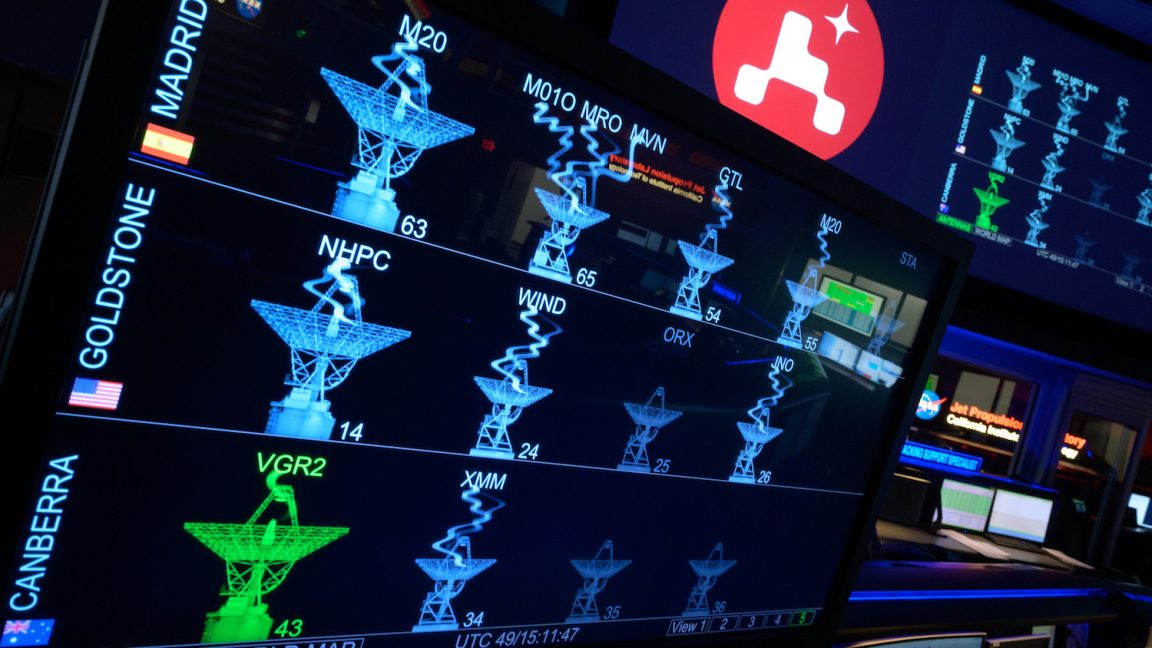
NASA officials sound alarm over future of the Deep Space Network
I'm not sure who thought it was a good idea to put up CubeSats with Artemis I."
Ars Technica
214 points · by bpierre · 3y ago · 134 comments
Is this a reason why India's moon craft had such low resolution images? I checked and the rover only has 2x 1 megapixel cameras for some 3d stuff. The pictures from the lander were the usual low res generic stuff we've always gotten.
Why cant they put a 4k lense on these things? That has to have scientific value even for looking at their own rovers/landers for defects.
My other question would be whether this is due to the need to radiation harden stuff? We were developing for what effectively was equivalent to an arduino in terms of processing power due to the need for radiation hardening (and other legacy / slow moving reasons).
It depends on the spacecraft. DSN is currently talking with the Mars Reconnaissance Orbiter at 1 Mbit/s (https://eyes.nasa.gov/dsn/dsn.html, select MRO, click "more detail" in the bottom-left).
Unfortunately big transistors are old transistors. Modern 7 nm geometries are much too small to be rad-hard. Rad-hardness needs big 20-year-old geometries or even older. That also implies slower clock speeds.
It's been a very long time since I read about it so I cannot provide my source but yes that is likely part of it. There's also the resilience of the components to trauma to consider.
https://spectrum.ieee.org/nasa-designed-perseverance-helicop...
The bandwidth depends upon the power levels, antenna size, signal strength and the noise level. See the Shannon-Hartley theorem for details.
This means from a small lander on the moon all the way back to earth the bandwidth is small. Sure put a big camera on there, but it'll take weeks to send one picture in its entirety. The Indian lander only has like 2 weeks of life total.
I mean, how would we communicate with Mars colonies when the earth and mars are at opposite sides of the sun without some series of satellites in a elliptical orbit possibly at angle perpendicular to our general orbital planes?
Bigger focal plane means more power, more data processing/storage means more power. More power means more solar arrays/batteries. More solar arrays/batteries means more mass. More mass means larger actuators to move it around. Larger actuators means more power...all of the above means more money.
I can't give a specific reason why, but there are likely cascading effects and system impacts to the mission. Its not like larger space rated focal planes, larger data storage and high powered amplifiers to get more data down don't exist. But at some point you do just have to call it "good enough" or "meets requirements" to avoid the system spiraling out of control.
Such is space. Everything needs to be designed specially for it, especially for trips beyond LEO (where the magnetosphere is still providing you significant protection).
Radiation hard electronics are not.
And you don't have to send everything high quality. But at least some shiny pictures would be nice.
I had no idea that we still monitored these things from the ground.
But they probably can't just buy it from industry, it has to be custom made for the project, with some gov-heavy regulation no doubt.
But surely they could do far better than 1 megapixel.
The ISS has off-the-shelf notebooks, but apart from that the uptake of regular non-hardened hardware is relatively recent and quite slow. I think the Falcon 9 has a couple non-hardened systems, and of course Ingenuity has lots of regular off-the-shelf hardware. That was one of the big reasons the predicted lifespan of Ingenuity was so low, but software mitigations (like the ability to reboot mid-flight) have proven very effective.
I truly believe that NASA would fare much better if they focused on regulation, deep space research, and communication. They already do the first 2, but for some reason, they neglect communication.
They build these fantastic probes, but then don't build out a communication network. This *despite the fact that they have people like Vint Cerf at their disposal !! This just boggles my mind.
Once they build out for the moon, they could have a blueprint for deep space, while still being easy enough to iterate on designs (the moon being a much closer and easier to reach target, thereby reducing the development/test/feedback loop, as they wouldn't have to wait 6+ months for travel time.
Satellite communications systems aren't as easy of a jobs program as giant outdated rockets, thus they'll only allocate funding to SLS at the cost of everything else.
If they can't make space-internet sexy, then they should hire a marketing firm. Heck, insurance companies (insurance!!!) are able to raise millions from VC firms, then space-internet should be able to raise something from Congress.
My belief is that it's not really important to NASA, and they aren't really trying to sell it to congress. My bet at this point is that the Chinese have internet access on the moon before we do (albeit they're firewalled version).
It's the system needed to talk to specifically deep space satellites and space probes. It's the thing talking to the Voyager probes all the way out past the heliosphere. It has trouble raising funding because it has to be spread around the world and thus doesn't result in as many jobs across different states.
Such a system doesn't really have commercial value (yet) because there aren't really any deep space privately operated probes. Privately owned things are close enough that they can either talk directly to the ground using their own much smaller base stations, or hitchhike on other networks (eg TDRSS, geostationary relay sats or Starlink).
The problem is also especially bad with these small satellites. The big crewed vehicles would be less problematic since they can have larger more powerful transmitters, which therefore won't require as much DSN attention.
NASA started way after artemis, which strongly suggests this is an afterthought. The documents are design and planning of the architecture, - nowhere near rollout.
Further, STMD doesn't even mention anything close to communications on it's home page (correct me if I missed it). It's also not listed on their Spacetech page [0]. Also, teh LNSS project only goes so far as a demonstration scheduled for 2028 that will test whether they can pick up earth-GPS signals on the moon. [1]
Communications is essential to growing work outside of earth orbit. Nowhere do I see that NASA has this as a "priority".
Now, it's possible that NASA has 1,000 priorities, but that just means they have none.
I appreciate the ESA link - glad to see they are doing something about this, but I was referring to the article about NASA and NASA priorities. I get that we share things, but really, there is nothing significantly there regarding NASA.
[0] - https://www.nasa.gov/directorates/spacetech/programs [1] - https://www.gps.gov/cgsic/meetings/2022/murata.pdf
Satellites have limited lifespans. You can build them bigger, better, stronger, to last longer, but inevitably they break down and cannot be serviced. One micrometeorite in the wrong place, and the entire investment is gone. Even the day to day wear and tear from the radiation of space slowly breaks them down.
What's more, they can't change orbit once launched. If you lose one, you can't reposition another to make up the difference. It's just a gap, so you need high redundancy.
You would need very well-built satellites (expensive) with high powered transmitters (expensive because they need lots of power/solar panels) in a large network (lots of them) to provide high redundancy. They'd also each need to be launched with an expensive rocket (maybe when Starship is operating?).
The DSN using dishes on the ground on earth is the cheaper option, because you can fix things that break. It's maintainable with a low ongoing cost instead of a super high up-front cost.
Also, satellites can last a long time. There are GPS satellites that are a quarter of a century old and still functioning [0]. I didn't check about other satellites, but I'm sure there are older ones.
If we are to become a space-faring species, then we will need to learn how to do this. Original sea-faring peoples did this millenia ago, and today we ship all sorts of things to every corner of the globe.
Building a shared communication infrastructure is a logical next step. Otherwise we are going to build oversized devices with larger batteries almost like making a walkie-talkie trying to communicate between countries - it's not a good approach. Build out the infrastructure and then the devices (probes/satellites/spacecraft/etc) can leverage the shared infrastructure.
It's the other way around, actually. JPL and others, including Vint Cerf, have been working on the blueprint for a couple of decades, and the spacecraft in orbit around Mars have been acting as relays for the landers (e.g., Perseverence) for years. It's a question of bringing something similar to the Moon.
I believe that NASA recognized the problem and potential solutions, but they moved slowly probably due to their clunky bureaucracy.
> NASA relies on commercial ground stations for more than half of its ground station support for the agency's satellites in low-Earth orbit. NASA last year selected SpaceX, Amazon, Viasat, Telecast, SES, and Inmarsat to begin developing commercial capabilities to replace the government-owned Tracking and Data Relay Satellite network, which is used for near-continuous connectivity with the International Space Station and other satellites closer to Earth.
The TDRSS is separate from DSN. Expanding low-orbit options won't do anything to help here.
I worked at JPL, sometimes with the folks mentioned in this article. I suspect this is a money problem, not a technology problem. IIRC, everyone knows optical (laser) comms are going to carry a lot more load, and the DSN build-out plan already specs more ground-stations with smaller radii (better for closer tracking) vs larger dishes (better for voyager / juno style missions). There's also been commercial support (e.g., Amazon[1])
These folks know how to do it effectively and efficiently (and cheaply) just need the resources and permission.
1. https://www.datacenterdynamics.com/en/news/amazon-launches-a...
https://en.wikipedia.org/wiki/Deep_Space_Optical_Communicati...
And here on Earth there's a new DSN antenna currently under construction at Goldstone (California) that will be capable of handling both radio and optical signals.
https://www.peraton.com/news/meet-dss-23-the-112-foot-wide-a...
So nothing operational yet, but stuff is happening.
They should fund the DSN and make sure that not only all antennas are operational, but build new ones at the 3 locations or even better create additional locations.
A strike from DSN personnel would teach NASA to spend some money on dish antennas. It's insane to "throw" hundred of billions of USD for Artemis and not invest 1 billion for the comms infrastructure.
I guess it won't be long until a "genius" manager comes up with the idea of DSNaaS (Deep Space Network as a Service) :-)
Bonus link, live console/status of the DSN: https://eyes.nasa.gov/dsn/dsn.html
Perhaps, but that's largely not in NASA's control; Congress appropriates money for specific purposes. NASA can't legally go grab Artemis money and shift it over to DSN.
https://www.congress.gov/members/find-your-member
"Hello, my name is $name. I am asking you to either sponsor legislation or to support legislation sponsored by another memeber of Congress to increase funding for NASA's Deep Space Network to an appropriate level, which to my understanding is roughly $700M, about $500M more than current allocated. I'm sure you are aware of the enormous amount of value that we enjoy from space science [1], and therefore why it is crucial NASA has the capability to continue to operate this communications network in order to enable that ongoing science. Thank you for your time."
They will ask for your zip code and possibly contact info to follow up (you'll usually get a letter or email from your rep on the topic).
> The agency's internal watchdog said a project to upgrade the three DSN sites with more 34-meter antennas and higher-power transmitters is five years behind schedule, and the cost of the upgrades has increased to $706 million. That expense takes a long time to pay off for the DSN's budget account, which has fallen from an annual level of about $250 million in 2010 to about $200 million today.
[1] https://www.nasa.gov/sites/default/files/files/Benefits-Stem... (if you want specific value talking points)
They might have tried attaching this to Artemis, as you suggest, but gotten political pushback. They might have known that they can get Artemis approved without the DSN improvement and then hold Artemis hostage for DSN improvements. DSN money might have ended in the wrong Congress person's district. So many possible political reasons we might never know
Well, it doesn't seem such a bad idea considering the alternative is to do nothing. (now if the alternative was to build more sites and more antennas that would be great, but I think its unlikely).
As for DSNaaS it could be provided by a number of competing companies just like intercontinental fiber links are today.
Very cool--you can even see the data rate for each one, AND the animation changes if the data rate is higher.
It also looks like they have proposed some options to provide additional downlink by doing raw recording of the intermediate frequency with a high bandwidth receiver and doing the demodulation with additional processing to get telemetry/data for more spacecraft [1]. So they could support getting more data, but not necessarily "realtime" data.
[0] https://deepspace.jpl.nasa.gov/dsndocs/810-005/206/206D.pdf
[1] https://ipnpr.jpl.nasa.gov/progress_report/42-200/200B.pdf
Congress has been hearing about it forever. DSN has been a constrained resource for a long, long time.
Could this be commercialized? If there's high demand it should be profitable to build new dishes to increase bandwidth.
It likely is somewhat profitable, but would require a huge investment. Some have suggested (can't find the source) that the DSN should be charging closer to $35,000/hr to cover costs of maintenance and building new dishes to expand the network, but NASA themselves can't be a for profit company. So if there was someone providing commercial ground services for deep space, lets say with commercial efficiency they get services to cost $20,000/hr. Great! But why would I do that if I can still go to DSN and pay $5000.
But as the article indicates there were probably be a reckoning soon because I've already heard people describe scheduling and allocation of DSN time at JPL as a battle royale.
https://deepspace.jpl.nasa.gov/files/6_NASA_MOCS_2014_10_01_...
That also explains the challenge for private investment. If none of the missions are budgeted to buy bandwidth, then you would have no customers for a private DSN service.
> “When Artemis comes online, everybody else moves out of the way, and it’s an impact to all the science missions, even the flagship science missions," Dodd said.
> What makes CubeSats appealing to NASA and research scientists is what makes them unappealing to the Deep Space Network, Dodd said. ... "When your DSN is oversubscribed, I don't think it's a good use to put throwaway missions on the same set of antennas.
The obvious solution is more big antennas on Earth and network if store-and-forward relays all over the Solar System.
I predict they'll get cheap instead of fixing it.
Or sending less crap in space...
> AWS Ground Station Easily control satellites and ingest data with fully managed Ground Station as a Service
But that doesn't solve for limited availability of regulated spectra or spectra regulation.
Can ionizing radiation affect trapped ions in crystal lattice quantum sensors, for fiber optics?
FWIU degree of collinearity is the degree of quantum entanglement for photons and probably also phonons in a vacuum?
[1] - Flat-Earther accidentally proves the earth is round in his own experiment https://youtu.be/GFqmDazwb6Y?si=4umT9XKG6ZCdJWKU
(Indeed, though, all of the other rotating bodies in n-body gravity fluid spacetime which are visible from here appear to have assumed the shape of a sphere probably like ~fixed-point attraction; and there's no way to swim to the edge)
The “is” question is harder to evaluate, but to the degree it’s a meaningful question I’d say “probably not”.
Godel had a few interesting spacetime solutions that may be helpful for Deep Space Communications.
Evolved Antenna: https://en.wikipedia.org/wiki/Evolved_antenna
Rogue wave: https://en.wikipedia.org/wiki/Rogue_wave
Can DSN be scaled? Or would it be best to use quantum radio?
Hawking radiation: https://en.wikipedia.org/wiki/Hawking_radiation
Perhaps if Hawking radiation is in all the things, Hawking radiation could be used for DSN-like communications.
When phenomena in the quantum foam "dissolve", is there an ~ejection fraction? Couldn't there be ±t per minimally perturbable effect in the quantum foam, though? Maybe internet/p2p-like routing algorithms, or, which field/wave/fluid perturbations are omnidirectional?
Rydberg antenna / Rydberg sensor: https://en.wikipedia.org/wiki/Rydberg_atom
> The Rydberg sensor can reliably detect signals over the entire spectrum and compare favourably with other established electric field sensor technologies, such as electro-optic crystals and dipole antenna-coupled passive electronics.[59][60]
Ambient backscatter: https://en.wikipedia.org/wiki/Ambient_backscatter
Backscatter: https://en.wikipedia.org/wiki/Backscatter
Passive W-Fi: https://en.m.wikipedia.org/wiki/Passive_Wi-Fi
LiFi: https://en.wikipedia.org/wiki/Li-Fi
With ambient backscatter, passive WiFi is already implemented; and maybe someday backscatter LiFi could achieve very high signal efficiency at low-energy in deep space, too?
.
Could there be deviations from stable patterns in the CMB: Cosmic Microwave Background?
Quantum navigation maps such signal sources such that inexpensive sensors can achieve something like inertial navigation FWIU?
.
"Smaller, more versatile antenna could be a communications game-changer" (2022) https://news.ycombinator.com/item?id=37337628 :
> LightSlingers use volume-distributed polarization currents, animated within a dielectric to faster-than-light [FTL] speeds, to emit electromagnetic waves. (By contrast, traditional antennas employ surface currents of subluminally moving massive particles on localized metallic elements such as dipoles.) Owing to the superluminal motion of the radiation source, LightSlingers are capable of “slinging” tightly focused wave packets with high precision toward a location of choice. This gives them potential advantages over phased arrays in secure communications such as 4G and 5G local networks
.
/? Curved photon beams: https://www.google.com/search?q=curved+photon+beam
.
Newer Waveguide approaches;
- "Experiment demonstrates continuously operating optical fiber made of thin air" (2023) https://news.ycombinator.com/item?id=35812168
- https://news.ycombinator.com/item?id=36408561
- https://phys.org/news/2023-06-trillionths-photon-pairs-compr... :
> The physicists chose the incidence angles and frequencies so that the co-propagating electrons, which fly through vacuum at half the speed of light, overlap with optical wave crests and troughs of exactly the same speed
.
PROMPT: Read/write nonlocal spacetime with minimal perturbations at safe energy levels for high-throughput data transmission over astronomical-scale distances