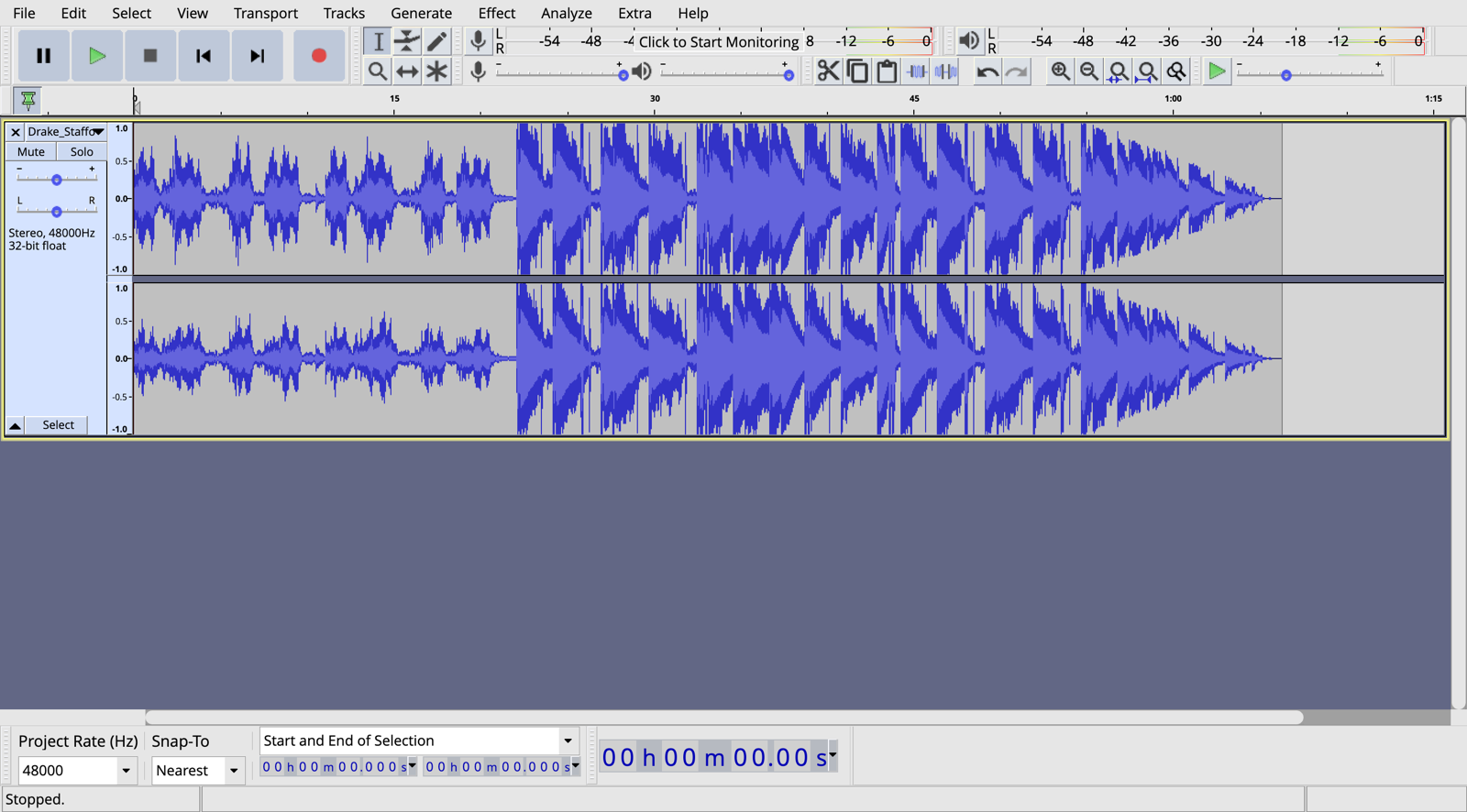
Wavacity | Online Audio Editor Based on Audacity
Wavacity is a port of the Audacity audio editor to the web browser. Free and open-source. No install required.
wavacity.com
814 points · by _Microft · 3y ago · 142 comments
The world needs more folks to take initiative like this.
Maybe add a description and URL in the repo settings? https://github.com/ahilss/wavacity
(and linking back to the GitHub from Wavacity would be nice too, as right now it's not obvious it's available)
Because that seems to me to be a very awesome use-case ..
Audacity is an indispensable utility. It’s great to see it and other “real” software on the web. I’m reminded of Photopea[1] which is a web clone of Photoshop.
It's been a very long time since I used it, but didn't Audacity turn evil, add a bunch of networking code it never needed before, and start spying on people? (https://fosspost.org/audacity-is-now-a-spyware/). I remember people reverting to older "safe" versions.
I guess that doesn't much matter for this web app since it's collecting your IP and data by design (their privacy policy seems very vague and handwavy), but for the desktop app it seemed like kind of a big deal at the time.
Even A/B testing could be considered an ethical hazard because it disrupts the user's understanding of the software for the sole purpose of decisions that, frankly, devs should have made before telemetry.
Users should be able to trust that their software won't be blabbing over the network about what you're doing. In an age where privacy is attacked from all angles, it's the least a developer could do.
You don't need telemetry for that. We have several decades of data showing that software can be developed, tested, deployed, used, and valued without ever forcibly collecting a single bit of data from users.
Why on earth should a user trust that their data isn't being used to spy on them just because it's being collecting under the guise of being for something else? Once the data is collected, the user has no control over what a company will do with it and the only sane assumption users can make these days is that if a company can make more money by doing something (like selling or abusing the personal data of their users) they will do that thing.
The practice of collecting telemetry is also highly suspicious because it's often done without the user's consent (opt out at best), and without showing the user exactly what data is collected and sent.
The fact is that companies have betrayed the public's trust so many times, and in such egregious ways, that it's unreasonable for developers to expect people to "just trust them" to do the right thing. If you don't want to be accused to spying, maybe just don't behave like spyware. Do testing, solicit voluntary feedback, and eat your own dog food.
https://developer.mozilla.org/en-US/docs/Web/API/File_System...
There was nothing biased in my comment - even Chrome for Android doesn't support these APIs.
A UI rework to incorporate mobile-friendly design would be a ton of effort, but it would really take this project to the next level!
That's not to say that there can't be mobile audio apps, or mobile whatever. I just think that's a separate app, and should be designed and written as a mobile app from conception.
I realize that a large cohort finds desktop applications uncool today, but I'm just so frustrated with the idea that serious and powerful desktop interfaces need to crippled in order to fit into a "mobile-first" (a.k.a. "lowest-common denominator") paradigm. For audio listening, that's fine. But for serious audio creation and editing? FUCK an iPhone, sheesh.
Yeah, my primary issue with this sort of thing is that there is very little personal A/V content I'd feel comfortable uploading to some random server in the first place, but I agree that there are some tools better suited for the desktop and more specifically a keyboard and mouse.
The problem is that a very sizable part of the population doesn't have a desktop. It's not that they think it's uncool exactly but for a lot of people, kids especially, all they have are cell phones and tablets which were designed first and foremost for content consumption. I can't blame developers for wanting to target the needs of that audience to whatever extent they can.
This is what people like me have been getting at for ages when we talk about decoupling interfaces from application logic. It's also incidentally a really strong argument for decoupling state presentation from visual presentation. I should be able to build a mobile interface for Audacity without rebuilding Audacity both because the audio processing logic should be separate from the interface and because the interface should be separate from the visuals -- I should be able to consume Audacity's interface as an XML tree and pipe it into a separate renderer.
Because if that was the case it wouldn't be that hard to make Audacity mobile friendly (or at least more mobile friendly than it currently is).
As a bonus, if your interface is consumable as an XML tree without rendering anything, it's very likely going to be much easier to make the interface accessible. From what I can see in the documentation, Audacity as a native app on desktop doesn't work with screen readers on Linux.
This is not necessarily anyone's fault beyond GUI toolkit designers, it's not particular to Audacity, but it's a paradigm shift. Some visual controls wouldn't work well on mobile, but for most apps including Audacity there's really no reason (other than lack of existing infrastructure and toolkit support) why people shouldn't be able to just swap out those visual controls with ones that do work on mobile and use Audacity normally otherwise.
So yes, this is a WebAssembly app. It loads a 5.2MB .wasm file and 2.3MB .data file.
Neat, isn't it?
Edit I guess the wxWidgets lib is smaller, as it is more incomplete.
A lot of people/companies tried their best to impede this progress (1) for promoting app stores but I'm so glad we are finally getting there regardless. Better late than never!
(1) https://thenewstack.io/apples-browser-engine-ban-is-holding-...
https://github.com/ahilss/wavacity
Remarkable.
Edit: the previous submission had a helpful thread on this very topic: https://news.ycombinator.com/item?id=32689423
https://chromium.googlesource.com/chromium/src/+/main/docs/l...
I don't understand anything about ChromeOS. At one point it was a bad but clear idea: a machine with just a web browser, capable only of running web apps. Then at some point they decided to just make the world's most complicated and confusing Linux distro, with the vestigial browser-centric design kept around just to make things as inconsistent as possible.
Does drag and drop work? Can I choose a random image/file somewhere in one tab/application and drop it into another.
Just testing that now...
* Drag HN logo to Whatsapp Web: Pass
* Drag from Google Photos to Photopea: Pass
* Drag a zip file from Google Drive to Dropbox: Fail.
* Drag an attachment from an email from gmail into an online hex editor: Fail
Conclusion: The web platform isn't yet ready.
This is mixed up. "Developer mode" is a firmware mode that allows you to run unsigned images. You use that if you want to hack your ChromeOS image itself. The Linux development environment feature (crostini) runs in a VM on any chromebook, it doesn't require developer mode or any firmware features. Technologically it's basically the same thing as WSL, though integrated much better with the OS UI.
Now, it just seems like a bad version of the legacy operating systems. Android, but in a VM, Linux, but in a VM, and Windows delivered via the cloud!
All of this is worse than just running any of those systems alone.
The whole OS is really the best "app fusion" desktop environment out there. I've got Android apps for Threads and Tesla running alongside all the web apps you'd expect to find. I've got my personal email via linux Thunderbird. I read my PDFs in Evince (because, let's be honest, both the Chrome and Adobe readers are junk) and it integrates with the native ChromeOS Files app like a normal app. In fact all the Gnome .desktop files in the Crostini personality appear as apps in the OS menu that can be associated with files types or pinned to the shelf, so there's a surprising amount of scriptability to the process. Likewise it makes a great X terminal for shells and emacs windows from development machines.
In fact I've moved (to be fair: for professional reasons, and I resisted for quite a while) to a mid-tier junky old Chromebook for basically all my client activity at this point (windows games being the sole exception). Really it's pretty great. The proverbial year of Linux on the desktop arrived and won while we were all looking elsewhere.
Also, note that most creative apps (music, video, art) do not follow the UI guidelines for any particular OS platform (partly because they tend to be cross-platform, partly because their needs are very different from office productivity and communications apps. This is true even when the apps are nominally made by Apple for Apple (see Logic Pro or FCP for examples).
Finally, Tantacrul has zero responsibility for the UI appearance of the Audacity that Wavacity is based on.
Blender, Houdini, 3DCoat, Photoshop, Krita, FL Studio, Bitwig... all of them use their own UI widget.
The next step will be the same stack except the browser engine will be running in """The Cloud""" and streamed to your consumption-only device like an OnLive/Stadia/PSNow game. Everything already has dedicated video-decoding hardware so it will probably be sold as better for battery life to rely on that instead of the unpredictable load of your own local OS and browser engine.
Recompile Chromium for webasm. Run Chromium in Chromium in Chromium…
Then add Firefox into the mix.
(Being facetious of course, not wishing to put down managing to get an Audacity port running this way which is cool and even potentially useful (should you find yourself desperately in need of an audio editor in a place where you can't install software packages)).
On the right, we have more layers, so we must boot a VM in the browser, visit the same webpage, boot a vm on that page, and then run wavacity in that.
My heart will go on.
Here you go.
https://blog.mozilla.org/en/mozilla/mozilla-and-epic-preview...
In the 2020s, when 90% of software development consists of using a database, tooling supplied by various open source projects and some choice of web front- and backends to create a front end to enter/edit/view the database contents, the results are called "apps".
plus ça change, plus c'est la même chose
Though if you call the PNG file that's a menu for your restaurant an app, that's just wrong.
And that's why they are wrong. If anything and everything can be called an app then the word lost its meaning.
This sort of stuff is so prime to me, so excellent.
There's plenty of scary platforms about, less than great sites, sure. But there is no other connected medium available for humanity.
And to let the Fear Uncertainty & Doubt - or to let IMHO pitiful pointless sad grumbling about performance - dog us down is is to miss such huge potential, to grow & expand & improve, in unconstrained & vast greatness. This sort of shit is so excellent. Yes you can. And anyone with any kind of computing device can tune in & try it. Heck yeah!
We still don't have a standard HTML text editor, instead relying on hundreds of Incompatible WYSIWYG editors which all produce custom output, or worse (much, much worse) the abomination that is MarkDown. Every browser should be an editor which all produce standardized output.
In 2023, we're still relying on asterisk, hash marks and underscores to format text, while simultaneously being able to run full fledged audio editors. It's ridiculous.
Notepad.
https://www.destroyallsoftware.com/talks/the-birth-and-death...
One tiny thing I noticed is that the build information tab seems to point to a commit that no longer exists.