39 points · by bookofjoe · 3y ago · 15 comments
just in terms of low-hanging fruit in that category, not most people know this, but the gut contains a "brain" on the level of a frog's brain, which is more reasonably understood as a specialized brain-like digestion processing management unit. similar to the way computers have CPUs and GPUs, humans have brains and stomach brains.
there's evidence that female humans may also have a third "brain" which performs similar specialized processing for the uterus, but I don't remember if that was ever fully proven.
I bet cells not in the brain use it too.
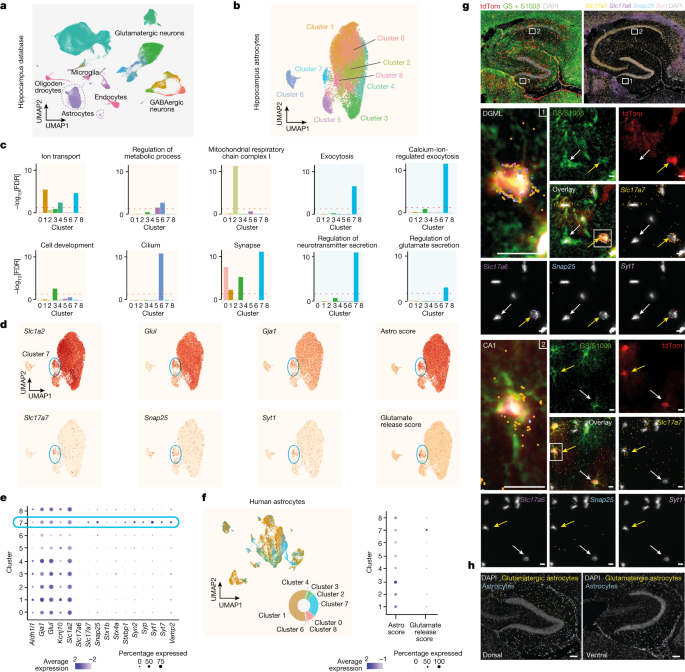
First, there is evidence for approximately nine subclasses of astrocytes within hippocampus of mouse and human. Whether class membership is fixed or plastic is not yet known. Most readers may assume these types are fixed. Don’t.
Second, several of these astrocytic types have the capacity to handle glutamate to a much greater degree than others. The type 7 astrocytes win the glutamate processing award. This heterogeneity result looks very solid to me. But again, astrocyte “type” may wander over time and stage.
Third, the type 7 cells dynamically release glutamate via vesicular exocytosis and modulate neuronal and presumably also astrocytic function. The speed of exocytosis is not yet well defined but is is not unusually slow even by the standards if some types of neurons (modulators). This is the strongest novel claim of the study. I would love to see transmission electron microscopy of glutamatergic vesicles in these type 7 astrocytes. That would make me even mire comfortable with the claims of this paper.
Note—The distinction between neurons and glial cells is a useful heuristic but the more you know about these cells, the blurrier the distinction becomes. Horizontal cells in retina also blur this boundary.
Great work.
I have a disorder that I know is triggered by high levels of glutamate triggered by my overly sensitive calcium ion channels (CACNA1C).
IMHO, ion you are depressed you have too much GABA. Manic? too much glutamate. And yes, I think it is that simple.
I agree, but the problem still if the glutamate and GABA.
> There are dozens of highly polymorphic (genetically variable) receptors for both of these neurotransmitters.
I agree, but the problem still if the glutamate and GABA.
You negated nothing I said, in fact, you agreed with it. I never said the fix was simple, I said the cause is simple.
- The G in MSG is for Glutamate.
- > High glutamine-to-glutamate ratio predicts the ability to sustain motivation: The researchers found that individuals with a higher glutamine-to-glutamate ratio had a higher success rate and a lower perception of effort. https://neuroscienceschool.com/2020/10/11/how-to-sustain-mot...
If you want to turn your glutamate into glutamime take some manganese.
I have the problem of high glutamate and my mother and I would freak out after eating at asian restaurants in the 70's. No one believed us.
Manganese: https://en.wikipedia.org/wiki/Manganese :
> For manganese labeling purposes 100% of the Daily Value was 2.0 mg, but as of 27 May 2016 it was revised to 2.3 mg to bring it into agreement with the RDA (in the US, for males >= 19).
https://www.hsph.harvard.edu/nutritionsource/manganese/ :
> RDA: The Recommended Dietary Allowance (RDA) for adults 19+ years is 2.3 mg a day for men and 1.8 mg for women. For women who are pregnant or lactating, the RDA is 2.0 mg and 2.6 mg, respectively.
> UL: The Tolerable Upper Intake Level (UL) for manganese for all adults 19+ years of age and pregnant and lactating women is 11 mg daily; a UL is the maximum daily intake unlikely to cause harmful effects on health.
Looks like EU proposed 3mg/day for Mn in 2013.
https://pubmed.ncbi.nlm.nih.gov/27385039/ :
> The mean intake of Mn was 6·07 (sd 2·94) mg/d for men (n 998) and 5·13 (sd 2·65) mg/d for women (n 1113). Rice (>42 %) was the main food source of Mn. The prevalence of the MetS was 28·0 % (590/2111). Higher Mn intake was associated with a decreased risk of the MetS in men (Q4 v. Q1 OR 0·62; 95 % CI 0·42, 0·92; P trend=0·043) but an increased risk in women (Q4 v. Q1 OR 1·56; 95 % CI 1·02, 2·45; P trend=0·078)
That says dietary intake of Manganese in e.g. China is more than double average intake here in the US and also in the EU, where "No MSG" also results in much lower MSG dietary intake.
Manganese deficiency: https://en.wikipedia.org/wiki/Manganese_deficiency_(medicine... :
> Manganese is found in leafy green vegetables, fruits, nuts, cinnamon and whole grains. The nutritious kernel, called wheat germ, which contains the most minerals and vitamins of the grain, has been removed from most processed grains (such as white bread). The wheat germ is often sold as livestock feed. Many common vitamin and mineral supplement products fail to include manganese in their compositions. Relatively high dietary intake of other minerals such as iron, magnesium, and calcium may inhibit the proper intake of manganese.
MSG > Stigma in Western countries: https://en.wikipedia.org/wiki/Monosodium_glutamate#Stigma_in...
FDA says that MSG is GRAS: Generally Recognized as Safe.
I grew up in the US with a fear of MSG.
The manganese, by reducing glutamate, lowers my blood pressure from 160/90 to 123/79. My doctors are amazed but don't care since I have had unresponsive hypertension for 10 years.
nevertheless white matter does appear to exhibit BOLD responses that aren't merely physiological but arr related to task based cognition.
I am willing to entertain the idea that white matter bold is important to study, but wanted a mechanism to explain why its relevant, and not mere epiphenomenon or spatially-temporally lagged response to neural activity elsewhere. Now I wonder whether astrocyte signaling is involved.