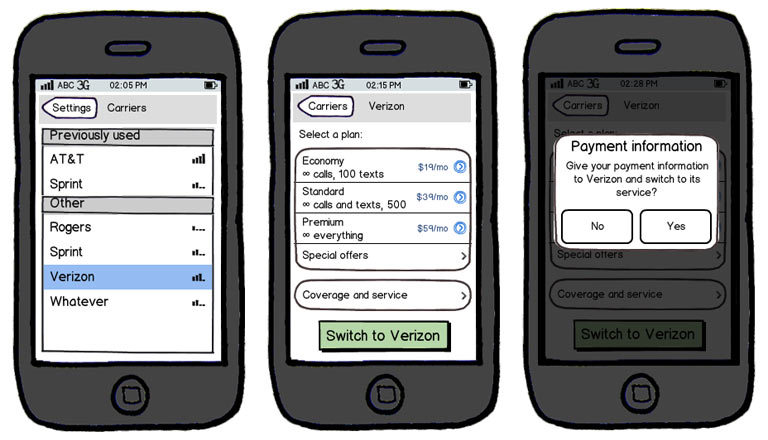
SIM cards must die
So, Apple still fighting for smaller SIM card standard for future iPhones. What? Why isn’t Apple fighting to kill the SIM cards?...
ilyabirman.net
148 points · by adeelk · 14y ago · 138 comments
There's no way killing SIM cards would be a good thing.
Anyway, as panman says, i think it will cause the opposite effect. Didn't the original GSM phones work in a similar way, with no SIM and some sort of mapping to a phone number at the carrier end? What is the likelihood that the carriers would remove the ability to change carriers, pretty high i'd say.
Didn't the original GSM phones work in a similar way, with no SIM and some sort of mapping to a phone number at the carrier end?
The first SIMs where credit card sized. Later generations where still credit card sized, but with a perforated breakout for the SIM as we know it (mostly).
The predecessor system (analogue mobile) didn't use SIM.
I think I've had the same SIM card for about 6-7 years now!
This is exactly what happened with the original analog and CDMA networks. Most carriers these days have converged on the HSPA and LTE standards which thankfully support SIM cards.
There's no technical reason why CDMA networks couldn't have supported SIM cards in their phones, but it was just never done. As evidenced by the overwhelming popularity of SIM cards, this particular battle has been won by almost unanimous decision in favour of the cards.
Only a few bastions of the original CDMA networks still don't natively support SIM cards (e.g. South Korea). But on the whole, it was already decided that SIM cards are here to stay since carriers demonstrated that without them, they are more prone to higher switching costs.
Indeed. RUIMs (and CSIMs) were standardized for CDMA, but carriers in the americas never bothered with them. A fair number of asian countries have CDMA carriers that use the, though.
This is likely to shift as V rolls out LTE, which DOES take SIM cards. So we're actually likely to see more intercompatibility as things progress. Except, of course, that everything's still likely to be carrier-locked.
A very large proportion of GSM subscribers use dual-sim handsets, to take advantage of the cheapest available tariffs. This is the norm in price-sensitive markets like China, India and Africa.
Many GSM subscribers use several phones with the same SIM. Outdoor enthusiasts switch their SIM between their smartphone and a rugged dumbphone. Some ladies use a smartphone during the week when they use their normal handbag, but switch to a tiny dumbphone for parties.
The SIM makes life very easy for small carriers to connect new subscribers. In London, virtually every shopping centre and high street has someone handing out SIMs for Lyca or Lebara, two Virtual Network Operators offering cheap international calls to mainly immigrant customers. They can connect subscribers on the spot in a matter of seconds.
IMO we should be working in the opposite direction, towards a proliferation of SIM-like devices in other markets. A physical token which securely establishes a pseudonymous identity on a network is quite ingenious and facilitates all sorts of really elegant HCI.
(North) American telco misregulation is a disaster.
But your first example isn't like that: the SIM card, in essence, is a form of two-factor authentication. And it's really useful that way. Unfortunately it's a pity that it can only be used by the carriers...
For example, the US carrier T-Mobile has a whole lot of customers with iPhones despite not offering it themselves. That's possible because consumers are able to pick up a used GSM iPhone and stick their SIM card into it.
That isn't really happening for US Cellular, because Verizon and Sprint's (SIMless) handsets can't readily be made to connect to talk to their network.
I do not care when I travel which carrier my phone will pick. It will work, nothing to do and I know what it will cost in advance.
I love SIM cards.
Update: Keep reading the thread with very good comments about identity. The added benefit of the SIM card is that it is protecting/managing your identity on the network without a hard link between your phone and you.
I travel enough to see the benefits as well. Phones that handle multiple sim cards are also nice.
I also view it as an added layer of security. My phone can't be connected to the network until the pin for my sim is entered. The ability to save data to the sim is also a nice feature. I don't really see any reason for them to go away.
"You could tell operators"... How and where? When I'm in Thailand on vacation, I want data but I don't want to have to worry about registering my phone - I just go to kiosk and get a sim.
When I was in Ethiopia a few weeks ago getting a sim took a bit of work. I had to give them photos and some other documentation. A lot of governments are moving this way. Once it was done though, I had the sims I needed and the phone choices were wide open.
Maybe I'm missing a piece of the puzzle but in my experience the sim is what makes me free. The idea that the existence of a sim == being locked down comes from a broken telecom system not a technical limitation of the format.
Good idea!
Besides it's not that bad in EU with roaming anymore http://ec.europa.eu/information_society/activities/roaming/t...
Also, some operators allow to purchase "european data" - ie. unlimited european data roaming for cheap.
Actually from a UX perspective sim cards are a pretty strong solution because there is a clear and simple 1:1 mapping between a physical object and a carrier. That's as simple an UX as can be: if I want to use carrier A I use SIM A, if I want to use carrier B I use SIM B.
> For a starter, why do I have to reboot my phone to switch carriers?
I don't know, do you? I don't. I just take out the iPhone's SIM tray, replace the SIM and put the tray back in.
That must be why it's so common and popular to use physical tokens for the address list too. I really live to sift through the little plastic cards I keep in my pant pocket (careful not to lose one!) to find John Doe, insert it into the phone and reboot, just to make a phone call.
Or not.
They tried: http://blogs.wsj.com/tech-europe/2011/05/24/apple-wanted-to-...
Personally I'm a big supporter of SIM cards. While competing network systems (CDMA, iDEN) were designed to lock in networks and users to a single vendor, GSM was designed by a consortium of european national telecoms at every single layer to ensure that all the stakeholders (users, telecoms, regulators) had as much interoperability and freedom as possible, and SIM cards are the user's end of that plan.
If Apple implemented his proposal, you can bet iPhone users would only be able to pick special overpriced iPhone plans, instead of just using whatever prepaid plan they want.
SIM cards (as implemented everywhere in the world except the US) is made to allow exactly the portability which he seeks.
I fail to see why it is even linked here.
Edit: Also why is he illustrating this with an iPhone? Is it for lulz that he in the name of advocating openness links to the closest closed phone of all out there?
I'm voting troll here.
SIM cards as authentication tokens work just fine. My phone takes SIM cards from any carrier. If I want to switch carriers, the new carrier just sends me a new SIM card.
Get rid of SIM cards, and you're going to end up with a security problem with keys being copied/cloned from phones. You're going to find that you need some kind of authentication based on a hardware crypto token, and will end up inventing...the SIM card.
The last time I checked Orange was charging something like 70 EUR for unlocking iPhones under contract, which is really not bad, considering you get the freedom to put any SIM in it after that.
Also, my own mobile carrier (Cosmote) sells subsidized unlocked iPhones. Basically for them the contract is enough to keep you "locked" as if you terminate early, you have to give back the subsidy you received for the remaining time, which is fair to both consumers and the mobile carrier.
It's crazy how better the mobile carriers are in Europe, versus the US.
They aren't. That they can be used as such does not make what you said true.
And the other way around, nothing in SIM cards mandate lock-ins, I bought my phone unlocked (the previous one was bought simlocked and I'd made use of my legal rights to get it unlocked 6 months into my contract) and my current ISP is pre-paid, no-contract on SIMs. I ordered a SIM from them, popped it into my phone and I fill the account when I need to.
And when I travel across europe, I can trivially get cheapo pre-paid SIMs and put them in if I need to. There is no lock anywhere.
In fact, I'd expect far more lock-in with TFA's solution: my current indie ISP never managed to get a reply from Apple when they tried to get their IPCC into iTunes (so user would not have to enter e.g. data network info by hand), Apple only deals with big ISPs, not with virtual operators for a few tens of thousand clients in minor euro countries.
So if, say, Sprint issues a portability request to Syniverse (the mapping platform provider) so that they can have your number from Verizon, Syniverse puts that request in the next batch. Then the batch gets passed to VZ for evaluation for things like whether you still owe them money. If you're good to go, VZ kills your DN (that's your number and the associated SVC mapping), and your VZ service goes dead. Then they pass your record back to Syniverse who then passes the thumbs-up and the number to Sprint who sets up a new DN to your new service (and presumably your new handset if you're going from one locked-in CDMA net to another).
That's a really watered down, 4am version of what happens. But the upshot of all of it is that if it worked like WiFi SSID switching, every time you switched, you'd probably lose service for awhile. If all things work for the good, the switch can take like 10 minutes. I'm sure they could get it down to 1 or 2. But probably not 0.
Here's the punchline... the SIM card in GSM was specifically designed to OBVIATE the need for all that (also to act as an encryption key, but that got hacked years ago). The SIM is supposed to authenticate you to a particular DN and link you back to a billing record at your primary carrier. The theory was that every carrier would create roaming treaties, and you'd just wander from network to network, oblivious to whose actual network you were on. And your primary carrier would sort it out on the backend. And in many places, it actually pretty much works that way. You can carry 3 or 4 cards and swap carriers and numbers based on the plan you want to use. Because the phones aren't locked to a single carrier's cards.
A good example of this is that in the T-Mobile / AT&T breakup, they came to an agreement to allow cross-network roaming sometime late this year. So if you're a TMo subscriber, but you've got an AT&T signal, even in a TMo service area, you'll just ride AT&T instead.
So essentially the reason it doesn't already work this way is because A) CDMA is so popular in the US, and CDMA really requires the rigorous porting process, and B) the carriers who do support it (AT&T, TMo and Sprint on their now-dwindling GSM net) have been jerks about it for years. It's a business decision, not a technical one.
In practice it also makes it much more difficult to switch between carriers (which is in fact much more common than switching between phones when you travel across Europe or south-east asia): to switch carriers right now, I just need to replace my current SIM with a new one (assuming the phone is not SIM-locked, which it is not).
As others have commented though, I'm afraid that they would use it to lock the consumer to phone specific plans.
I like a lot the ability to take my SIM card to other phones, as it allows to carry some kind of ID with me, there are better and seamless ways of doing that that I can't wait to be implemented and deployed (a user and password to put when booting the phone is not a solution).
The problem is that the soft SIM provisioning process will become like DRM for phones. The users desires and the service providers desires are fundamentally misaligned here. Users want to be able to choose freely from the best tariffs available to them in a given location. Service providers want to lock people in and keep roaming expensive.
First of all, it's a secure element: it allows authentication of the user's credentials with the cell phone. SIMs and smart cards in general provide security at the hardware level as well as the software level (using Triple DES encryption).
Also, they are essential in NFC: that standard is developed around the SIM card and the ISO 14443 standard.
Recent technology also allows the development of Java programs WITHIN the SIM card (it's called a JavaCard: http://en.wikipedia.org/wiki/Java_Card ) and allows to use a single SIM for multiple applications. For instance, you could use your phone's SIM as a mobile wallet, a metro pass, etc...
Of course, as many others have noted in this thread, removing the SIM card would just add the vendor lock-in inside the phone.
Where I live (France), most phones can be legally (or illegally) unlocked to accept different SIM cards.
"Select from this list to send your payment information to an unknown carrier" is not exactly a realistic scenario. Instead, you have an agreement with an organization (let's call it "your carrier") who handles your payment information/billing, then that organization makes arrangements with other carriers to allow you to roam on their networks. The SIM is your account identifier, and most (GSM) phones allow you to select among available networks. Anyone who has used their GSM phone abroad has probably experienced this.
The only thing preventing the scenario he describes from being more common today is the reality of capital expenditure required to build a network and the consolidation of carriers (aka botched deregulation), making it uncommon in the US to have any real choice.
In the US, carriers love to lock their customers in by SIM locking their subsidized hardware and customers have come to expect this low cost subsidized hardware.
If you suddenly switched to a system where hardware was sold at retail cost, there would be a lot of confusion. I am guessing that if you ask the typical US consumer if they would like to buy their iPhone at $199 and commit to a contract or pay $649 for the ability to switch to another carrier at will, they will choose the contract option. It's what they have come to expect.
This type of system seems more suited to work in countries where subscribers already purchase unlocked hardware at full retail prices.
For instance, when I tell my US friends that I pay £15 / month for unlimited data, 300 mins, and 3000 texts on my iPhone with tethering in the UK, it blows their minds. The fact that I can hop over to another country, buy a sim card for 10 bucks and instantly have data without having to sit on hold and beg a customer service rep to unlock my phone and then wait weeks is another huge bonus that any internationally traveling American can appreciate.
The only problem right now is that major carriers have a good thing going with overpriced contract plans and see little reason to offer reasonably priced pay as you go, thus giving Americans the impression that mobile service is inherently more expensive than it is and believing that they are getting a great deal with subsidized phones. But with globalization this illusion is bound to come crumbling down sooner or later, and customers will demand more.
Piece of advice: before you attack on technologies, make sure you understand it first, the history and the reason why they exists. Otherwise, you are going to be a public joke on HN.
I recommend him/her to read this: http://en.wikipedia.org/wiki/Subscriber_Identity_Module
A little
For SIM cards to die as the author imagines the carriers would have to accept that in the future they nothing more than dumb data pipes. This would be excellent news for all consumers.
The US carriers have spent billions in marketing and lobbying to avoid becoming dumb data pipes so they will not accept this future.
And until the US regulator wakes up and starts regulating the carriers, then the status quo will prevail.
Furthermore, switching numbers and accounts, and transferring them to other phones could be made more complex.
If this has been already patented by the Cupertino-based patent-troll, it is by definition doomed as a standard.
Issue #1 The SIM card, as a piece of plastic used to identify your phone number and mobile operator, is indeed pre-historic technology. It's quite unbelievable that we're still using such a system in 2012. Unless I'm missing something, what a SIM card does could easily be done in software and this is part of what the OP is suggesting. I don't think that there is any doubt that the SIM card, as a data / identity storage system should be retired.
Issue #2 The issue of operator-issued mobile phones being locked to that specific operator is unrelated to whether or not the phone uses a SIM card. A phone can be locked to a specific operator, regardless of whether or not it uses a SIM card. In many countries, operators lock all their phones, meaning that you can't use a SIM card from any other operators in your phone.
If you live in a country where all phones are sold unlocked or where phones can be unlocked after a certain period of time, it's almost certainly because mobile phone operators are being forced by law to do so. Not because the phones use SIM cards.
So the freedom to switch between operators at any time isn't a technical issue linked to SIM cards. It's just a matter of whether or not operators can legally prevent you to do it. If operators can legally lock their phone, they'll obviously do it. Why wouldn't they?
It's worth noting that if you want an unlocked phone, you can always just buy it straight from manufacturer - there's nothing that forces you to buy a phone from an operator (apart from the price, but I'll touch on that later). So this issue is actually already solved - it's just that many people don't think their freedom to switch between operators is worth the upfront cost.
Issue #3 Being tied to a long contract and not being able to switch between operators and plans at anytime is another unrelated issue. But then, it's a pain you choose to have. There's nothing that forces you to sign up for a contract. Most operators offer pay-as-you-go plans with no contracts. In the UK for example, well over 50% of the population is on pay-as-you-go (or was the last time I looked) so pay-as-you-go can definitely work.
Obviously, operators much prefer when you sign up for a contract. Just like tech startups go crazy for subscription business models - it's nice to get money automatically every month. So they try to trick people into signing up for long contracts by offering subsidised phones. And many people fall for that.
What it all comes down to. Most, if not all these problems, arise because of the perception by people in most countries that mobile phones should be free or reasonably cheap. People don't find it a problem to spend £600 on a laptop. But tell them they have to spend £600 to buy a new phone and they freak out. This is despite the fact that many people do the same thing on their phone as they do on their laptop and use their phones a lot more than their laptop.
It's this way of thinking that results in far too many people signing up for long contracts with operators, allowing operators to subject them to their every will. Changing this perception and making people buy mobile phones in the same way as they buy laptops (i.e. without subsidies and straight from the manufacturer) is what we would need to really change the statu quo. Whether or not phones use SIM card is merely a small technical detail (but one I'd love to see fixed nonetheless).
I highly doubt so. SIM cards are hardware tokens, which securely hold cryptographic keys — are those things obsolete or pre-historic?
They're holding a shared encryption key (so-called Ki) but never reveal it directly. This is the point of SIM cards.
SIM cards could (and, I believe, were) implemented in software, but such implementations reduce security, usability or both.
(Yes, nowadays, I believe, almost no operator would tell you what Ki is recorded on your SIM card, so you won't be able to clone the card. But that's a completely another issue.)
http://cleantechnica.com/2011/08/07/ieee-completes-62-mile-s...