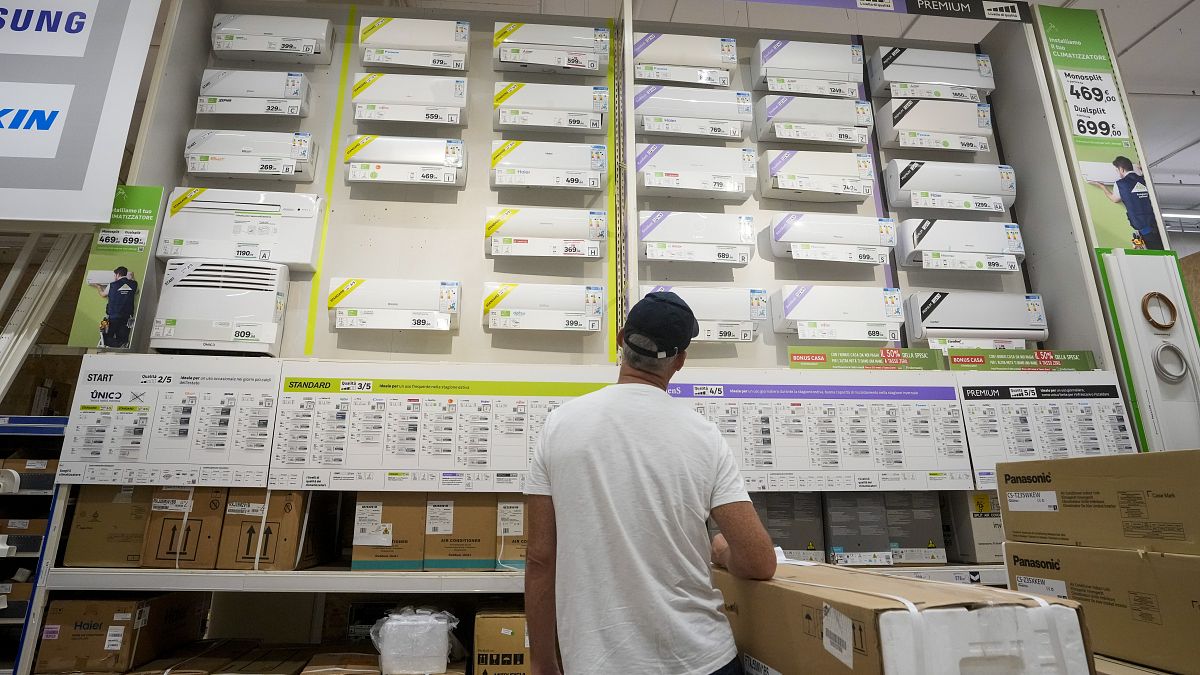
Fact-check: Is air conditioning making cities hotter?
A study found that waste heat generated by a city’s worth of air conditioners during a heatwave can raise the outside temperature by more than 2 degrees Celsius.
euronews
161 points · by elorant · 3y ago · 271 comments
The bulk of urban heat island effect is driven by the radiative absorption of non-porous materials of the built-environment. Other heat waste put into the area accounts for less than something like 5% of the additional heat added when compared to rural areas.
So whilst I cant find a copy of the study, and I recognise your comment on the modelling and approach being simplistic, the above also demonstrates that other factors like increased number of vehicles on the road, can be a factor as they contribute to ground level ozone and many also come with an air conditioning unit built into the car as standard today.
[1] https://uk-air.defra.gov.uk/research/ozone-uv/moreinfo?view=...
[2] https://en.wikipedia.org/wiki/Light#/media/File:EM_spectrum....
[3] https://www.gov.uk/government/statistics/air-quality-statist....
And a car engine is producing far more direct heat than the increase in ground-level ozone from exhaust pollution is increasing heat (from that same car).
Also the fact that cars have air conditioners is a total non-sequitur. The air conditioner in the car requires negligible energy compared to the force required to move 4000 pounds and 1-5 people at 70mph.
This link [1] suggests traffic jams can increase temperatures by 7 degrees Celcius.
Seems like a constant in doomsday "science": making a model that bear ressemblance to reality as much as SimCity does, run it to get the expected conclusion, then extrapolate and conclude with newsworthy title that X or Y is true in reality.
It's worth noting that this portion is generally done by science reporters rather than the scientists. It's quite often the case that alarmist articles refer to research with much more measured and less sweeping claims.
https://plato.stanford.edu/entries/simplicity/
Of course, you are more than welcome to voice concrete concerns about this specific study, if you have any (beyond what the GP already said).
Please don’t condescend people and definitely don’t go around arguing that science holds unrealistic simplicity as a core tenant.
A typical solar panel absorbs ~20% of the sun's energy blasted on to a city rooftop. If that's used to power air conditioning it's doubly effective. You're reducing the heat urban heat island effect from the sun's energy, and you're also not adding additional heat from external power sources in to the city.
On a large scale this would really help make cities more livable. On a hot summer day here in northern Kentucky I noticed a massive difference (I've roughly measured it at a 5-7F difference) going from less developed areas to the more urban areas.
https://creativelyunited.org/wp-content/uploads/2019/02/temp...
Of course, trees are great for many other reasons like air quality, but for temperature fundamentally they're just big evaporative coolers. I wish cities in more water-stressed areas would consider arcades + rooftop solar.
Leaves block the Sun relatively high off the ground, meaning people are in the shade during the hottest part of the day and feeling as much radiation off buildings and streets in the evening.
Beyond cooling they’re also good for water management. Most street trees don’t need any watering (at least in the Midwest) they live off rainwater. When it rains, water pools on the leaves and evaporates from there, reducing the amount of run off and keeping the street drier and less humid on days with light rain.
In cooler months (and places where this is relevant) the leaves fall and you can still get the warming benefit of sunlight.
It seemed a bit odd, because my roof is fully lit up, but only for a few hours a day- one half is covered most of the morning, and the other half most of the evening.
Sadly, it's not even really nice trees, just gigantic cottonwoods that litter leaves and twigs and sticky leaf pods like crazy.
Paint roofs white - and then go plant some trees.
Some modern neighborhoods are trying living roofs with grass. Haven't taken off and the grass hasn't survived either.
Lastly, other day saw post about leaving grass uncut reduced surface temps notable amount.
As always it's likely a combination of solutions, and rooftop solar is a good idea for more reasons than just heat.
Since the person you're responding to is talking about solar panels on roofs and you're suggesting trees instead?
Which makes it a good solution only to suburban heating.
You've just made a ~100% efficient heat capturing machine. The 98.1% reflecting paint will be much more efficient, with the added bonus of not being dependent on the grid.
It would be nice if the cells were highly reflective at a range of wavelengths between the range they can actually use and the range where they radiate waste heat.
Your reasoning is a bit like assuming solar panels stop flooding because they prevent the roof from getting wet.
As it turns out, solar panels are often more reflective than the typical roof of a house in North America. So solar panels can actually reduce the heat island effect. But it is mostly independent of whether they are hooked up at all.
Reflective of what wavelengths? Isn't that an odd characteristic of something designed to absorb electromagnetic energy?
By making the sun hit at a layer above the ceiling (and assuming you have proper air circulation below), your attic area will heat less, hence your house will get less hot.
(This is similar to the effect you get by staying under a tree shadow)
As per the article, yes, if everybody had air conditioners city wide that would increase the city temperature. But that would require everyone to blast it at the same time
Reflects 98.1% of the suns rays.
https://creativelyunited.org/wp-content/uploads/2019/02/temp...
Those nice trees take a few decades to grow, need serious pruning, will cause foundation problems next door, and increase building setbacks anyway. We also waste two entire lanes for street parking, have basically no businesses on either side anyway, and the street is still too wide. It might be urban, but it's still a car centric hellscape, just with some shade.
The solar panels will still absorb and radiate heat back so you won't get as much cooling as you would have just with passive radiative cooling paint, but it'd be better than just solar on a regular roof in both ways (solar output and thermally).
So just put the PV panels on top, and a reflective layer below.
Indeed it would be nice to power the AC with solar power, but how does this help the city to cool down? You would cool down the houses, but the heat from the houses would remain in the city, it would even get hotter.
As others have pointed out, you might do better bouncing the incoming radiation back out of the city with white roofs. And still others say you can do a bit of both.
Also, you could definitely do well to reduce your roof albedo by switching to white/reflective roofs. This point has been made endlessly over the last 30-40 years. No one actually does it. People are actually installing solar panels.
Black is hotter in the day and colder at night. In the desert you want light colors, which do the opposite.
You’re not reducing energy here. If you gather and then release the energy again (make it do work) it’s simply being re-released.
Do they behave like heat pumps in some fashion where that energy is converted?
Oh I see now you say 20% so okay, some but definitely not even half.
Still, we're going to need every bit of help and I guess that 20% might be 30 or even 40% decades down the road.
I think reducing the absorption of the roof and the walls would help, but even then you have still have a house sitting in 34C+ air temps for at least 10 hours per day, so it gets hot. But when I consider my dads house, which has 2m eaves all around, high ceilings, and massive roof space - it still gets hot. His house might feel nicer without a/c during early summer, but by mid+late summer it is hot too.
Maybe better insulated doors+windows would help? My house is double brick walls. Maybe the "outer layer" needs to be able to get hot, and then the "inner layer" insulated from the outer as much as possible. That's a lot of change though. Instead I just run the a/c all day "for free" off my solar panels.
However, plants also reflect a lot of energy, unlike black/asphalt roofs that most people in the US install.
The effect is stark and incontrovertible. There is the heat being removed plus some heat from the compressor and fan. Everyone in public and private spaces will be better off if we reduce AC usage as much as possible in favor of other solutions
In Asia, 7-Eleven is famous for its chilled air, but also has the walls covered with refrigerators for cool drinks, and there may be freezers for meat, seafood and ice cream.
It just makes no sense to me.
First, you are now pumping air from inside the building to outside. You aren't creating a vacuum inside, so all that means is somewhere else in the building the air is being replaced from the only place it can... from outside...
Second, the air you are pumping outside contains some of the air from the inside space that you just spent electricity cooling...
I use a mobile AC unit like this because it's really the only type of unit that will work in my apartment, but I use a dual hose unit. The unit has 2 air loops. Air from the room is drawn in from the back of the unit, heat is absorbed by the heatsink, and then cool air is blown out the front of the unit into the room.
Then to dissipate the absorbed heat as well as the heat from the electricity being consumed, air from outside is sucked in through 1 hose, runs through the other heatsink, and then is expelled back outside again from the other hose.
It just makes so much more sense, and if you can stick 1 hose in your window, it's really not that hard to stick 2.
"ASHRAE empirical research determined that "acceptability" was a function of outdoor (fresh air) ventilation rate and used carbon dioxide as an accurate measurement of occupant presence and activity. Building odors and contaminants would be suitably controlled by this dilution methodology. ASHRAE codified a level of 1,000 ppm of carbon dioxide and specified the use of widely available sense-and-control equipment to assure compliance. The 1989 issue of ASHRAE 62.1-1989 published the whys and wherefores and overrode the 1981 requirements that were aimed at a ventilation level of 5,000 ppm of carbon dioxide (the OSHA workplace limit), federally set to minimize HVAC system energy consumption. This apparently ended the SBS epidemic."
It's worth doing too - you'll normally get almost the double the cooling effect from a double hose unit of the same wattage as a single hose one, just due to the fact you aren't wasting coolness out of the window.
If you do this, note that it's important to use extra large and short (insulated) hoses, simply because the blower fans in your unit aren't designed for so many yards of hose.
Single hose portables are bad in countries where air con is practically essential, but are fine or even desirable for countries where only a handful of % of people have AC - the purchases will be for use cases like attics and top floor apartments where inside can be easily hotter than outside
In a way it's worse than seeing strip mining, or those people who fish with dynamite, or people who litter. At least all those people are benefiting from their environmental destruction.
There could be a short term spike as the AC rejects interior heat from buildings to the outside, but that will be balanced out later as outside heat is absorbed by the cooler buildings, or as cool air leaks to the outside.
Waste light and sound get absorbed by surfaces, thus, turned into heat (unless the waste light is in the right IR band to pass out through the atmosphere).
Moving an electric vehicle causes motion, but that motion is absorbed by the air and ground via friction with both, aka heat.
Light is just energy in a photon — when it hits a surface that absorbs it, it becomes heat. And it can be quite a lot actually! If you put your hand in front of a really bright flashlight, you’ll notice a warm feeling. If you turn off the flashlight, it goes away immediately, proving that is the light itself causing the heat.
Approximately all of the energy we use as electricity is just changing something into heat with some useful work in between
Eventually most of the energy for earth either becomes heat in the earth, gets radiated into space, or slows the earths rotation around the sun, or spin. Of all of these things the dominant two are heat radiating into space (this is by far the largest), and heating the earth, with a few things like the tides slowing the rotation of the earth.
A little bit of it gets stored as chemical energy through plants and animals, but eventually those get burned either through fire, or chemical decomposition.
To give you an idea of how much heat escapes, if the sun stopped, and we used our nuclear arsenal to replace it, we'd have about 30 minutes of sunlight.
The idea that AC causes heat in cities to any real extent is laughable, if AC was capable of changing the temperature of the earth to any meaningful degree we'd just water cool the heat exchanger and solve global warming by dumping the heat into the ocean.
It's all heat in the end.
Manufacturing products via endothermic processes does not turn all of the energy into heat, but then again exothermic processes can exceed the energy used.
https://www.amazon.com/Kiss-Ground-Reverse-Climate-Ultimatel...
Here is a downtown weather station: https://www.wunderground.com/weather/us/tx/austin/KTXAUSTI18...
This site allows you to check various weather stations and see temps as recorded at the location.
You can compare your location to others less or more urban and see this while its happening. Next time you're awake at 3AM with nothing to do check it out! Compare downtown Austin to the suburban area of your choice. I saw a 2-3 degree difference pretty regularly last I looked.
Heating up the 40 square kilometers of city outside by 2.4 degrees reduces 1 sqkm of inside temperature from a sweltering 30 to 23 degrees (note, made up numbers).
So whether there is temporary localised cooling depends on the quality of the insulation but overall and over time there is no cooling due to the additional input.
- you're always getting some "free warmth" through the sun, so on average you need to pump less energy to heat than to cool (for same temp difference)
- Hot air rises, cold air sinks, not sure how that works in a city environment, probably concentrates the cold more
So, yes if you consider the differential in-house current-target temperature yes, but difference of outside/inside temperature no.
AC is an individual solution to global warming, and actually making things worse. And deincentivizes us from fixing the actual problem.
Anyone has a reference about that? Last time I tried to research it, it seems like it was mostly fixed at least in Europe with the most harmful gases being banned for new sales.
R-410A, commonly used in Europe, has a GWP of 2088. Worldwide, R-22 still is the most common refrigerant. That’s a HCFC, so stratospheric ozone depleting, and with a GWP of 1960.
https://climate.ec.europa.eu/eu-action/fluorinated-greenhous... is the list of alternatives with corresponding GWP for EU.
Not saying the phase-out isn’t happening, but there are, and there will be for quite some time, millions of units leaking climate pollutants (which was the question).
These same smooth-brains are probably extolling the benefits of heat pump water heaters not realizing they have the equivalent of an AC attached to them.
If your unit leaks refrigerant it needs to be repaired. This is not normal.
Car air conditioners maybe, but it seems unbelievable for fixed systems of any reasonable quality…
AC should be as sealed as a fridge, and you don't hear people having to recharge their fridges every few years.
Even ignoring the environmental concerns of refrigerant leaks, it's wasteful of your money too.
They definitely aren't supposed to leak.
Obviously for a window unit or split where the compressor is on the building's wall -- those are going to heat the air in the street. Ground level units most of all.
But a lot of buildings place all their compressors on the roofs. And since hot air rises, does that produce any noticeable effect at ground level?
Meanwhile my parent's home is much cooler, no AC needed because they have trees between the blocks
Now, how did the air inside these structures get warmed up in the first place? Under normal conditions, is the air inside the structures WARMER than the ambient air? Does the structure itself somehow more efficiently harness the suns energy to warm the structure more than the ambient outside air?
If the same energy source is heating the ambient air and the air inside the structures - and it is - its the sun here, don't we have a constant amount of energy warming the area? Some of that energy warms outside, some of it warms inside, but the amount is constant.
So how could a device that removes heat from structures to vent it outside be responsible for a warming of the outside air? Unless the AC itself added some extra heat energy in the process OR the structures somehow more efficiently turned solar energy into heat, how could moving heat around cause a temperature increase?
For example - on a warm day in a little European village, everyone lights a gigantic fire and adds non-solar heat to their homes. The devices that remove the heat would then be adding new energy to constant solar energy heating the town. Ambient temperatures would likely rise. But did the AC cause the temperature increase? Didn't the AC unit just move heat from structure to ambient? The AC added no heat in this case.
"There is the heat being removed plus some heat from the compressor and fan."
Greenhouse effect + no wind.
The infrared emitted by heated objects are reflected by the glass, heating the room even more
The answer to the problem is a large increase in surface area of passive cooling technologies to reject sun energy during the day and to cool the surfaces at night through the atmospheric window.
You can use huge water mains to transfer the heat
Cities are hotter than outside because:
- they absorb more heat :: concrete, asphalt absorb much more than grass or trees and disperse far more slowly. Just go walking in a bush, measure temperature at 1.5 m from soil, do the same in grass covered area and the same over a road. You'll see and feel the difference;
- in cities there are MANY ICE vehicles whose engine produce much heat, much more than any electrical motor;
- in cities there is less air circulation than in the open nature due to the high and heat-absorbing buildings;
- in many cities glass coated skyscraper works like any other glass keeping much of Sun IR radiation inside.
These are the reason why cities are hotter. Another proof? They are ALSO hotter in winter, not just in summer. In winter you can count extra heat from badly insulated heated buildings, little cold pushed outside by the so far limited percentage of people heating with some heat pumps that have air on their exterior side, but look at the numbers and you'll see they are more hotter than mere heats spread outside by badly insulated heated buildings.
People should learn two things:
- cities WAS a necessity to evolve in the past, but with the '80 logistic revolution they lost one of their last reasons to exists, manufacturing became cheaper to do far from customers, so far from cities. With the remote work the last remaining reasons vanish as well. As a result dense cities and high rise buildings have NO REASONS TO EXISTS anymore. Try to keep them and sell them as green, good for the future etc is just a push toward intensive human farming to keep people dependent on service they don't own, living to operate them so they can pay them. Since in the modern era cities can't be sustained the push needs to makes people accept bad living condition as a new normal;
- we need to switch from a high density model, too dense for today state of tech and society, climate etc to a new less dense one, that's hard and that's means MANY will be simply "overflowing humans" to be put somewhere, since no one like that role, if told in such a crude way, some try to advertise such role with various "bells and whistles" but that's simply BULLSHIT.
If you try reasoning about the above you'll understand a thing: such move to put aside a significant percentage of humans can't really work, never worked in history. It does work if the set aside cohort is very limited, the poorest, very isolated and very dependent, but at modern scale can't work.
The populations of dense cities use fewer resources than the same population spread out in low-density settlements, especially when those cities are laid out to be properly walkable. It's just basic economy of scale.
> in cities there are MANY ICE vehicles whose engine produce much heat, much more than any electrical motor;
In cities, not having a vehicle is an option. Outside of them, it's basically required in most places.
Economies of scale aren't a goal on their own. Scaling something up will always have side effects... in the case of too dense urban areas, it's for example the sheer amount of traffic. For example, a quarter full of high-rises, no way you can get away without expensive high-capacity subterranian trains to handle commuters, and surface traffic is going to be a hot mess even with just shuttling the basic supplies for supermarkets, restaurants and the likes in one direction and waste on the other direction. In contrast, even a standard European mid-sized city can get away with cheap bus and tram lines. And it's harder to provide other essentials to meaningful life in a city as well, particularly where children are involved - land is too valuable to leave it as a park, and children can't have outdoor places to play either in kindergarten because it's too expensive, so you have even more traffic just from parents bringing their kids to kindergarten/school/playgrounds/whatnot.
Another effect of urban over-density that's often neglected is human health, both physical (we've seen that with COVID, just how fast pathogens can spread in urban areas) and mental. I mean, even here in Munich or Berlin we're not at the US levels of mental health and housing issues with people defecating on the sidewalk, but still it's noticeable how cities tend to have more anti-social behavior, as poverty and boredom are definitely contagious especially when not backed by the implicit social control that life even in smaller cities brings.
But that high-capacity transit more than pays for itself (just the land value increase alone is more than the cost of building it). Yes there are costs to building densely (obviously to build a skyscraper at all costs more per square metre of floor space than building on the flat), but the end result is that more people can live (and more productively) for less total cost.
> Another effect of urban over-density that's often neglected is human health, both physical (we've seen that with COVID, just how fast pathogens can spread in urban areas) and mental. I mean, even here in Munich or Berlin we're not at the US levels of mental health and housing issues with people defecating on the sidewalk, but still it's noticeable how cities tend to have more anti-social behavior, as poverty and boredom are definitely contagious especially when not backed by the implicit social control that life even in smaller cities brings.
Do you have any evidence for that? The last results I've seen are that suburban living is significantly worse for mental health than dense urban cores (and I wouldn't be surprised if that was true for physical health as well), and frankly that fits with my experiences.
Aren't trains much, much more efficient than individual transport? Compare the average urban train with everyone driving their own car and it starts to look pretty good.
No, that's just marketing try to convince people of that...
> In cities, not having a vehicle is an option. Outside of them, it's basically required in most places.
Again that's marketing
Did you try to think hoe many resources are needed just to build high rise buildings compared to an equivalent set of single family homes? Hint: their own structure need to be supported, just that and foundations impose MUCH MORE resources than light homes. Similarly for any implant inside, including elevators.
Sewage network? Metros and so on?
A city if you try to count raw material use MUCH more than an equivalent spread area.
Not only: single family homes can evolve, they can be wood based and rebuild every let's say 50 years. Meaning they remain aligned to contemporary needs and tech, while rebuild a high rise building is a nightmare.
If you have modern homes with EV in most part of inhabited world, WFH for eligible jobs, not suburb USA style but mixed spread are where your dentist is just a small building few km away, there is a small supermarket few km away and so on you can have small-battery EV mostly recharge via domestic p.v. in cities you can walk, sure, unfortunately groceries are not made there, they came from far away, as far as more dense is the area because anybody eat, but in dense area there is no local food production. As a result you consume less, comfortably ignoring the logistic behind anything you use locally.
Now enlarge yourself talking about soil sealing who kill humus, water cycle alteration due to the big impact of such large and concentrated usage and discharge and so on.
If you REALLY try to dimension a city you'll easy see that anything you believe is false, marketing pushed because dense cities means dependency on services, witch means big business for very few on the shoulders of many. Try just to imaging ready-to-eat food delivery in a spread are: there is no chance Uber Eat, Just Eat and so one model keep up. People have kitchen, stockpile of food and time to do whatever they like, far less waste, far less packaging. Oh BTW this was an ancient known scam in Europe: in the past schools have internal kitchen, then they was told to externalize to make anything more efficient. As a result food quality have dropped, costs ans waste and packaging use skyrocketed.