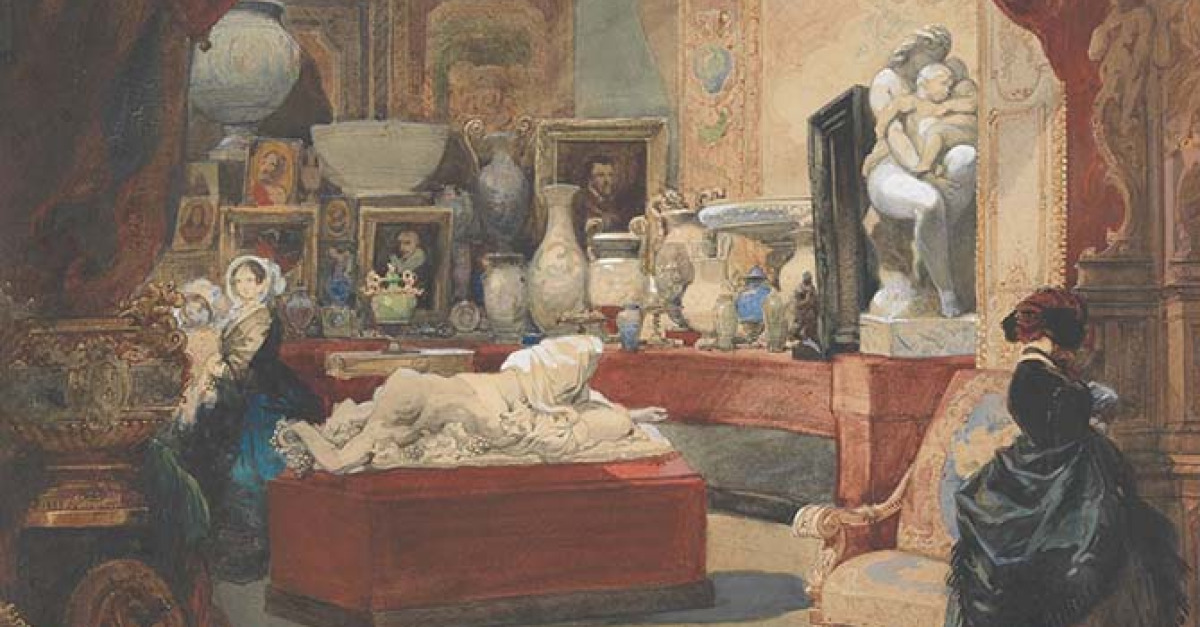
Do Not Suffer Him to Become a Bigot | Maria Edgeworth
How to raise a child with taste in eighteenth-century Britain.
Lapham’s Quarterly
79 points · by apollinaire · 3y ago · 57 comments
And I think that's possible with kids, first just by exposing them to the idea of making, that they can be a producer rather than a consumer of sounds and visuals. And then by modeling the behavior, giving them an example of an adult who sits down and makes something physical.
And finally by actually trying to teach them skills, one inch at a time. A lot of kids in America grow up without those things 1) the idea that they can create; 2) access to tools however basic; 3) the vision of someone actually doing it; 4) the support of someone who can put them on the gradual path of skill acquisition. Like most elements of culture and behavior, it starts at home, and it's hard to create effective institutional proxies.
PG gets into this a little when he talks about transcribing his younger son's oral stories. It's that kind of parental support that parts the waters so that a kid can see what's possible.
I'm not saying this was good or bad but did result in me never having any real exposure to doing music or art.
And I never had much in the way of music or art in school.
My kids were constantly drawing and coloring till their 2nd grade.
And there is a lot of emphasis on making crafts.
My older one who is 11, has projects - where they are asked to research a topic, make a presentation and speak about that in class.
But yeah, exposure, guidance toward the good stuff, and thinking about what makes it good. Totally agree.
This feels like an extraordinarily Modern view, in that it's not suffering from the idea of an ideal standard of divine beauty embedded in the universe, but rather that it is discovered by the viewer and their emotional associations.
It's also very pluralist, this advice to expose your child to the best examples of art from a variety of cultures.
Frankly, it's your take that feels extraordinarily modern. Do you really believe that people living at this time, being familiar with centuries of style movements (from Greco-Roman antiquity to Italian Renaissance through Baroque and Bronze age Egypt) that were all considered to be beautiful, would cling to an ideal standard of beauty?
Why do modern humans believe that for some reason, they discovered thinking very recently and that all their forefathers were obscure brutes?
And indeed it's what the original author from that time was arguing against, the "bigotry" mentioned. So it was clearly an attitude held by some people at the time.
And I'd call them imbeciles, why you think that "the people like that exist" is argument for anything ?
It turns experiences into thoughts. It separates you from your emotions by changing your priority from experiencing, processing, and accepting your feelings to trying to analyze them. And if you, like me, are prone to mental illness, this can be devastating - because emotions often do not have a reason, especially if your brain has strong natural tendencies.
When you're depressed or anxious, sadness or anxiety form of their own accord. You can feel terrible even when things around you are good, or scared even when there is no danger. And it is very easy to get into the habit of trying to justify these feelings after the fact. When you feel sad and the world around you provides you no reason to, the justification you can give - if you're trying to rationalize your emotions - is that the problem is you, and that is an abyss you can easily find yourself trapped in.
Worse, this habit leads to you being "on the side of" those tendencies. When someone tries to help you to understand that your view of the world is skewed, your habit of justifying and rationalizing makes that feel like an attack on your reason or intelligence. You're not depressed, see, because there's this logical reason you came up with for why you feel bad. And there is always a reason you can give, a justification for why you feel bad, because life always has problems that can be invoked to explain emotions that exist in their own right. But they're not why you're miserable, they're just the reasons you give for why being miserable is rational and right. Healing from that kind of illness requires recognizing your reason and your feelings are different things with different roles, and that to try to rationalize emotion is to make a category error.
Introspection can be good, but introspection must pair with experience, not replace it. You may like such a person because her voice puts you in mind of your mother's, but that origin or association is usually not what is important - the fact that you like them is. You may like the walk because you had a lovely day on it once, but what matters is that the walk brings you joy. The analysis is useful largely when your emotions misguide you ("I keep getting into bad relationships because they draw from X emotional weakness", for example), but even then, you want to feel your feelings even if you do not let them guide your beliefs. When I'm in a depressive episode, I can't not feel bad, but what I can do is recognize that my negative feelings are not truths about the world, so that they do not poison me into a factual belief that things can never improve. When I'm anxious, I can't not feel the fear, but I can recognize that it's not a sign of real danger and that I may need to endure it to make some personal progress. These things aren't about rational understanding of my emotions, they're about a recognition that I do not and cannot control them, only how I respond to them.
I tend to think this sort of thing is a pretty big "original sin" of Anglo-American (or perhaps more generally Protestant?) culture. It arises in a kind of guilt-based virtue ethics, one that I think was originally religious, that tells us that our moral value comes from our impulses and drives, not from what we choose to do with them. It told me, in particular, that my inability to force myself to be more motivated or calm was a personal failing, not a piece of me fundamentally separate from my reason or my virtue. It tells us, as a culture, not to listen to ourselves, not to accept half of what we are, in favor of suppression and repression and self-judgement, and it leaves us as half-people as a result.
> You may like such a person because her voice puts you in mind of your mother’s, but that origin or association is usually not what is important—the fact that you like them is.
Are feelings a black box? That seems like a sensible way to see anxiety and depression, which are bad feelings that happen for no (good) reason. But then how should we analyze art, which is what TFA is about, IIUC? Should we stop analyzing art because our enjoyment of it is as inscrutable as depression? That doesn’t seem right (to me) either.
Maybe art can only be understood in the context of groups of people, whose cerebral machinery and personal experiences will vary, but whose cultural context won’t? Maybe your personal feelings about art can only say a tiny amount about the art, but can say a lot about you, to yourself. I guess, if nothing else, knowing that you like a particular kind of art is good in that it gives you a way to make yourself happier.
I’m very curious for your thoughts if you happen to come back to this thread! Thanks!!
In the sense of "has internal workings that are not directly observable [at least in practice]", yes, emotions are a black box (or may be usefully treated as one, at least). But you can learn to predict the behavior of a black box, given particular inputs, even without understanding of its internals.
I don't perceive much difference between the dysfunctional feelings produced by mental illnesses and the feelings produced by everyday experiences, except that one is unpleasant and interferes with function to an unusual degree. But if a loved one of yours died tomorrow, those feelings would be unpleasant and interfere with function, too - it's only the normality of that unpleasantness and interference that separates the feelings of normal grief from those of depression.
When you say "feelings that happen for no good reason" in reference specifically to mental-illness-related feelings, I think you're sort of missing the point - no feeling happens for "a good reason" except perhaps in some broader evolutionary sense. Feeling and reason are wholly separate and incommensurable categories. If you say "I'm sad because my friend died", you are making a category error: you are sad, period, end of sentence. That is why, among other things, you become less sad as time passes after your friend dies - regulatory processes in your emotions are returning you to an emotional set-point, even though none of the "reasons" to be sad have changed (your friend is still dead, you still miss them, you still have things you can't do with them, etc).
It's not that being sad after your friend dies isn't a predictable emotional response, it's that the apparent logic and the response are separate, in the same way that the movement of a hurricane is predictable but carries no logic or intent. A hurricane doesn't weaken or strengthen, turn or move straight, because it's logical to - it just does so according to the particular dynamics that drive it. And while those dynamics may be analyzed by reason, they are not, themselves, driven by it, nor do they carry it. And so it is with emotions: any logic they carry is in our external understanding of the patterns of the black box, not something contained within it, and the fact that a black box may or may not happen to behave similarly to other peoples' black boxes is incidental.
I'm not arguing that you shouldn't or can't try to understand emotions from the rational side of yourself. I'm arguing that reasoned understanding of emotions is always "from the outside", while experience of emotions is "from the inside", and that the two are fundamentally different things. And I mean this more as a practical claim for living as a being with qualia than as any sort of philosophical claim - it's a way to understand and approach your emotions, not some claim about the Universe.
The notion that bigot is primarily synonymous with "racist" is a modern change; traditionally it was just concerned with intolerance of conflicting ideas. I think it was over the political debate about segregation that the idea bigotry transferred to racial attitudes.
(obsolete) One who is overly pious in matters of religion, often hypocritically or else superstitiously so.
the eighteenth century probably dates back to the more obsolete sense of the word
1820 Charles Robert Maturin "Donna Clara was a woman of a cold and grave temper, with all the solemnity of a Spaniard, and all the austerity of a bigot."
These days you can be bigoted against black or Muslim or gay or transgender people, but not really about Greek statuary or rap music or electric cars or PHP, no matter how strong your opinions on those.
Elsewhere, it's just used in its original meaning
I couldn't have managed a definition, but on its own I'd take it to mean something like the supposedly 'obsolete' meaning above.
I'm questioning whether I should say that now, based on your comment. Could you explain a bit more about what you mean by "intentionally hurtful"? Specifically, intentionally hurtful of whom?
The difference from my point of view is that the intent of using the word bigot is not to hurt but instead to judge and condemn.
And primarily a US-American one, it seems to me. I wasn’t aware of his change, and the definition marked as “obsolete” above is actually what I think of as the word’s literal, non-metaphorical meaning.
Not to me. Bigot is a wider term that encompasses racism, but isn't just about it.
Secondly, I can’t think of a contemporary national authority I would defer to.
I imagine people living in the developed world defer to many national authorities all the time. Being able to eat almost anything sold and drink tap water with near zero risk of getting sick, being able to trust doctors and medicine, safely flying from one place to another, minimal risk of being in a fire, having all these wireless communications devices work without interference, not worrying about electronic money and securities account balances suddenly disappearing, etc.
This piece is about matters of taste. So a national authority regarding aesthetics.
I’ve noticed myself falling into this more and more regularly. I’m shifting responsibility a little, but I think the internet makes this more difficult because everyone’s opinion is so public. I find myself reading what others have to say about everything I consume, be it books, movies, music, etc, and I think it impacts my feelings about that thing more than it should. How does one battle that practically?
You don't have permission to access this resource.
Google cache link http://webcache.googleusercontent.com/search?q=cache%3Ahttps...
Welp, there goes a generation fed on mindless content on screens