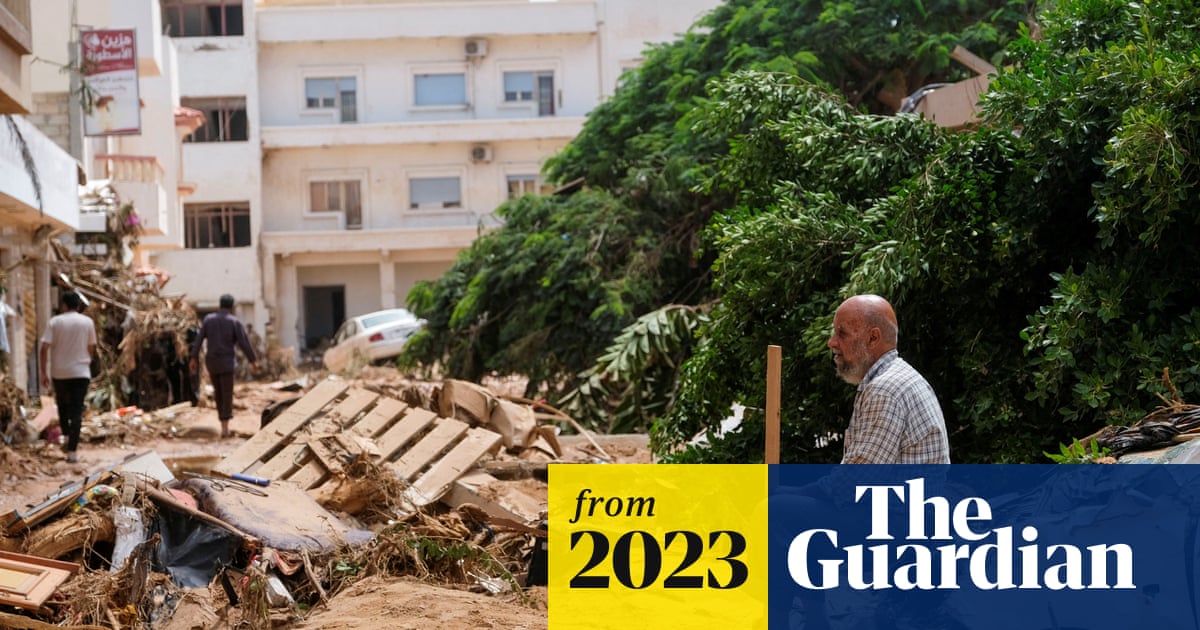
‘Sea is constantly dumping bodies’: fears Libya flood death toll may hit 20,000
Full scale of devastation in north African nation still not clear as aid agencies struggle to reach cut-off areas
the Guardian
127 points · by perihelions · 3y ago · 151 comments
As everyone who was at Burning Man learned, plumbing and drainage is the basis of civilisation.
Letting it go to rack and ruin is storing up misery, so it worries me that in the UK we've had 20 years of government that has effectively "washed its hands" of water management.
This doesn't sound remarkable in the sense that you could play industry roulette, and its just another industry could have bought what they wanted instead of the water lobby. The y seemed to bet on brexit and won big. There were likely EU lobby losers on the other side, likely buying influence for years for EU rules to favor them, and we don't know them because they did not happen overnight or they were bigger in scope.
So the questions are,
1) what are the flipsides ? Which EU regulatory captures became undone as a result of brexit , and are massively benefitting the brits ?
2) regulatory capture is not new. So what are the brits doing about it ?
Even the article itself states that the two dams were poorly maintained and the collapse is the result of their state as much as the storm itself.
Given how many places have infrastructure rotting from either corruption or cost savings, I wonder how many more news stories we will see in the future that follow the pattern of "severe weather event results infrastructure failure killing thousands".
Would this dam have failed eventually? Probably yes, on a long enough time-scale. Would it have failed now if not for that storm? Probably no.
Note that even in the developed West there are plenty of pieces of infrastructure at risk because of climate driven extremities.
I bet somebody knows this. And that is the question that imposes culpability, not the ones you asked.
But if you are not going for culpability and just assumes everybody is honestly trying to improve, the question to ask is "was it properly maintained?"
In my part of Germany we had a severe rain storm this week that caused local flooding in part because the sewage treatment plant could not process the intake quickly enough, resulting in the sewers getting backlogged while rain was still pouring down.
Even without outright neglect a lot of infrastructure simply can't handle situations significantly outside the standard range of operation.
Wasn't there a failure in Scandinavia recently?
interesting twitter thread here.
Just create a throwaway account, complaining won’t change things.
The poor of the region know little more than suffering, already. Worse than us all. If only we had the temerity to drop kettles, not bombs.
There are probably hundreds of bodies swimming in the sea right now just south from me. Sad, crazy, and probably a glimpse of new normal, as usually the poorest are most hit.
> It brought more than 16 inches (414 mm) of rainfall in 24 hours to Al-Bayda, a city west of Derna, a new record.
This is the top end of the distribution shifting; a powerful storm powered by warm water that would have been nearly impossible without all the heat our extra CO2 has trapped and has been absorbed by the ocean. It's definitely a consequence of climate change, and it will get more frequent and worse.
The Derna dam collapses, even with only partial death reports is already the second deadliest recorded dam failure, and is close on the lower-end range of death estimates for the worst, the 1975 Banqiao Dam failure in China, following another weather catastrophe, Typhoon Nina.
(If memory serves, Nina both stalled out over the Banqiao region and intersected with a more northerly cold front, creating a deluge effect similar to that of Superstorm Sandy over New York and New England, where warm tropical moisture was wrung from the atmosphere as it intersected colder air. In Nina's case, over a meter of rain fell within 24 hours.)
Dams are deceptively complex structures which appear simple, and can be built with relatively simple technology and persist for long periods of time with little ongoing maintenance and administration ... until they cannot. Most especially, dams are especially prone to governmental dysfunction in oversight, regulation, maintenance, and emergency planning. That last should include planning, risk assessment, risk mitigating, public education about risks and procedures, warning systems, crisis communications (between dam operators and government, and dam operators and downstream communities), disaster drills, and training in rescue, recovery, and relief operations.
Libya, a failing state divided by conflict, and for over forty years an autocratic dictatorship under a single ruler, lacks autonomous, independent, capable, and effective institutions for operating such infrastructure. It's all but certainly not the only such region.
Even what are considered to be rich and well-functioning democratic states see dam failures, or near failures. The near-failure of the Oroville Dam in California in 2017 followed mismanagement by the state water authority. The actual failures of the Edensville and Sanford Dams in Michigan in 2020 followed years of mismanagement by a private owner and ineffective regulation by the Michigan Deparment of Environment, Great Lakes, and Energy. In that case, property was damaged but no lives lost. Lake Dunlap in Texas suffered a spillway failure in 2019, again with ineffective management and regulation by this time by the Guadalupe-Blanco River Authority, though again without loss of life.
One of the highest-risk dams in the United States is Isabella Dam, on the Kern River upstream of Bakersfield, CA. The topography somewhat resembles the images I've seen of Derna: a mountainous upstream terrain, narrow canyon, and a city lying directly in the floodplain of both the river and any potential dam collapse.
The problem presented by such dams with ongoing climate change is that all the factors involved compound:
- Climate change increases risks of extreme weather events, including Mediterranean-basin cyclonic storms as with Daniel.
- Climate-related stresses, including reduced crops and increased food prices, stress already-straining marginal states. The Arab Spring protests which ended up toppling Qaddafi's Libyan regime have been blamed in part on food stress from reduced harvests and increased food prices.
- Governmental corruption and ineffectiveness raise all potential disaster threats. What would be a modest property-related disaster with preparation, warning, evacuation, and response becomes a mass fatality event where one or more element is missing.
- Decreased liberal freedoms also tend to restrain technical concerns and criticisms. This was certainly the case at Banqiao, seems to be the case in Derna, and can be seen in other recent catastrophes such as the 2020 Beirut ammonium nitrate explosion (which also exhibited several other factors mentioned here).
A core problem with disaster and risk planning is that often contributing factors which are treated as independent turn out to be strongly correlated and interrelated. I believe we're seeing that again here.
Peter Beaumont, a senior Guardian international reporter, has spent this week in the Atlas mountains and is a veteran of several reporting trips to Libya. He says: “Libya is a failed – or semi-failed – state that has been caught up in a protracted civil war since 2011, which has obviously had a massive impact on the country’s infrastructure and social cohesion.
“Morocco, on the other hand, is a functioning modern state. The place works – Marrakech, Tangier, Rabat are all modern cities. Ordinary people have been mobilised on a mass scale, and there is a very strong sense of nationhood.”
<https://www.theguardian.com/world/2023/sep/15/libya-and-moro...>
Concerns with these dams dates to 1986, 37 years ago, with engineering studies put off another 12 years, and an attempt at remediation finally committed to only four months before Libya fell into civil war in 2011. And yes, there are broader geopoliticial strategies playing out with multiple parties involved.
If the "alternate reality" didn't already erased it, you may recall something called "Arab Spring". It's not like Gaddafi was in a stable position at the time, and even less likely he would skate the whole situation until today.
Gaddafi was "assassinated" because there was a full-on civil war and the EU and America bombed the massive convoy he had sent to crush the rebellion in Benghazi and enforced a no-fly zone otherwise Gaddafi's planes would obliterate the rebel forces and the civilians living in those cities ( which started to happen, before the EU and US moved their asses ). Speaking of "assassinations", I don't think Gaddafi's forces would punish the offenders with only a slap on the wrist. Do I need to mention the shipping containers with bullet holes in the Sun at the desert full of prisoners?
Everyone's "performance" has been bad, but why don't we talk about Syria/Russia dealings in Libya in the last ~5 years? which coincidentally have been the worse and more unstable years since the 2011 war? ( Not to mention the usual bottom feeders of doom that appear in these situations, ie. the Islamic State, Al-Qaeda and every other "entrepreneur" group funded by the bored Sheiks in the Arabian Peninsula?
Right. "We came, we saw, he died! [lol]"
Gaddafi was "assassinated" because there was a full-on civil war and the EU and America bombed the massive convoy he had sent to crush the rebellion in Benghazi and enforced a no-fly zone otherwise Gaddafi's planes would obliterate the rebel forces and the civilians living in those cities
This is just revisionist nonsense. There was no "full on" civil war in Libya until NATO intervened and turned it into such. This video [1] (from 9 years ago) does a good job laying out the counterargument - the US took the opportunity of a small-scale uprising to regime change Gaddafi and plunged the country into now a decade of chaos and destruction with no end in sight, destabilizing most of North Africa and flooding Europe with refugees in the process.
Everyone's "performance" has been bad, but why don't we talk about Syria/Russia/[Al-Qaeda] dealings in Libya in the last ~5 years?
Why don't we talk about how the US illegally invaded Syria, allied itself with Al-Qaeda offshoots and tried to topple another antagonist Ba'athist government, failed, and plunged that country also into now an effectively permanent low-level civil war? Why is it the US and NATO can invade and bomb and occupy the territory of anyone they want by claiming "their leaders are bad" but if anyone else does it to our friends (many of whom are also bad) it's all "territorial integrity" and "national sovereignty" and "the rules based order"?
Because our foreign policy is run by utter amoral hypocrites and liars. We are the flailing, declining hegemon, leaving a path of destruction in our wake. And in cases like Syria or Libya its hard to avoid the conclusion our perspective is "if we can't have it we'll settle for wrecking it".
I notice your standards for US/EU intervention are very very high and basically nobody should ever being killed.
Why don't you apply the same reasoning to Gaddafi's regime and Syria/Russia/Al-Qaeda? You seem to have every problem existing in the Universe when the evil West does something ( and also a problem when it doesn't, also a problem that the West exists I suspect ), yet not a peep when these regimes torture and kill people by the thousands, or are you going to tell me that's just a fantasy? Or when they do it it's justify because it's the West's fault too, so those poor victims have no other choice than to kill everyone who doesn't agree with them?
Btw, I'm not even "defending" the US/EU track record in Libya. I think they did a really bad half-assed job, but I also recognize the context of it all.
Anyway, I've had it.
Again thanks to Hillary's emails, we can suspect that the CIA had a hand in eliminating the new candidate that france wanted to support (we had contact with both Kaddafi's son and the leader of a rebel group, both died), but i wouldn't put that war, then civil war, on US. Also, while France supported eliminating Kaddafi here, they supported the dictator in Tunisia with police forces and weapons (that are marked as non-lethal, but since we haven't found many nonlethal weapons after the revolution, either there was a kickback, or a lot were stolen/lost, or a part of what was sent were lethal weapons).
And for Syria it's the same, Obama's administration wasn't really focused on that part of the middle east, and Hollande (France) forced their hand.
Truly, i cannot believe France's reputation in Africa is that low. I wonder why.
No. Don't assume malice where ineptitude will be sufficient.
Our Foreign Policy is run by armchair, master-degree wannabe-generals in suits and ties, some dark triad, some not, but always away from real bullets, to instead being preoccupied with their own advancement, protecting their friends, and increasing the size of their portfolio, justifying their grand aims with real (or imagined) claims of good intentions
You won't get any sympathy for that opinion.
Other US military interventions have varying levels of righteousness, but this one is a pretty clear-cut case.
Egypt, Sudan, South Sudan, Tunisia, Morocco, and Less Rocco (sometimes called Western Sahara) are either stable or were not destabilized by the Libyan civil war.
The same story was repeated earlier with Bin Laden. It is like the U.S. never learns. Now once again in 2022/23 the Idlib mujahideen are being courted by the U.S. war apparatus to make problems in Syria as a way to divert Russia.
Of-course they did! If you recall, there was even an offer made by Gadaffi and his sons for holding elections and a step-down if he lost. They even agreed to international observers for elections!
Every single concession was rejected by NATO as a "ploy". They wanted Gaddaffi dead.
Got the article: https://www.aljazeera.com/news/2011/6/16/gaddafi-son-offers-... but there were also several other concessions offered - all of which were singularly dismissed. The Libyan friends I used to know a decade ago weeped after Gadaffi died.
A nation state in the middle east that used to offer free education for both sexes and free medical care is now dust and ashes - all thanks to NATO.
I'm not even sure who administered the city which was crushed by the flood in 2023 considering the free-for-all in Lybia ever since.
As usual with Western-induced rebellions, everybody ended up losing. I'm also not sure why you are confident that Gaffafi was going to "obliterate the civilians" (read - his own citizens).
Derna is in Eastern Libya, so it's under control of the Libyan National Army regime, the one run out of Benghazi. Pretty easy to look up actually.
1. Gaddafi was talking about war crimes but didn’t commit them in reality
[1] https://www.npr.org/2012/01/05/144637499/bahrain-the-revolut...
> what is happening in lybia now?
Nothing much. But a big problem of lack of governance is that critical infrastructure (like dams) gets neglected.
> What’s the plan?
No plans.
> Protect the oil pipelines and just don’t look too close anymore?
Clearly doesn't work but no one wanted this situation except for some people located across the Atlantic.
Gaddafi would have died sooner or later anyway, and he was a kleptocrat like all other dictators were and are.
> but really what is happening in lybia now? What’s the plan? Protect the oil pipelines and just don’t look too close anymore?
What would be needed is an intervention force that takes over the entire country and stabilizes it similar to the current setup in Bosnia and Kosovo - the warlords are in a stalemate. The problem is, NATO is too busy with Ukraine (and even that engagement is sadly controversial enough despite there being no troops involved), the US wants to focus on China, Europe can't be arsed to actually do anything (not that we could, we can't even supply Ukraine without seriously endangering the capabilities of our own armies), the French are even more reviled than Islamists are in Africa (see the recent putsches), the African Union is more of a paper tiger that's additionally focusing on the before-mentioned putsches, and China doesn't care as it's not part of their New Belt Road.
And even assuming that there would be someone interested in intervening in that shitshow, they won't get the UNSC mandate required for that, as either Russia or the US will veto such an operation.
The only way that any troops will deal with Libya is when Islamists make a resurgence because that is about the only threat that neither the US, Russia nor China really want to be able to rise.
An occupation force is not tenable in the modern era.
Per a Washington Post article from 2004[1], the post-WW2 occupation of Germany had an initial force ratio of one occupying soldier per 40 civilians. At that level, occupying forces could assume direct command of civil structures, without needing to sign deals with the least-bad bandits or warlords in waiting to act on our behalf.
Per Wikipedia, Libya's current population is a bit above 7 million. With a similar force ratio, that means an occupying force would require 175,000 soldiers. A Fermi estimate of cost is $100k/yr/soldier ($10k doesn't pay for salary, $1m is implausibly large), giving an occupation cost of $17.5bn/yr[2] before any special funding like (re)building major infrastructure projects.
This kind of cost is insupportable in a modern democracy, where voters will rightly ask why 'we' should bother. Libya was not and is not an existential threat like WW2-era Germany, and we're not in the imperial/colonial era where occupying forces could loot the country to pay for its own occupation.
[1] -- https://www.washingtonpost.com/archive/opinions/2004/05/09/a...
[2] -- This is also why meaningful intervention in Haiti will not happen, if you believe the calling-for-intervention reports that civil government has more or less collapsed in that nation.
Where you can't do anything, you do not need to want anything.
1. Perhaps one can say that this is already done, since we do not hear of any recent examples. Still, this was not very far back.> the French are even more reviled than Islamists are in Africa
That is pure propaganda BS.
Is it? Yes, a lot of what led to the recent putsches was Russian propaganda, but "Françafrique" has been collapsing for years now - understandably, given that France's attitude towards Africa hasn't been positive in any kind, it was mostly "we're happy to support whatever dictator is in charge as long as we get cheap natural resources".
France especially, but also the rest of the old European empires, never really managed to properly heal its relationship with its former colonies, and now it's biting us in our collective arses as these nations re-orient themselves to Russia and China.
It’s not like Libyan society was ripe for democracy. We see that those who replaced him aren’t democratic leaders, but savages. Was he a merciless ruler? I mean, maybe. More interesting question is whether his methods were appropriate for the challenges of ruling that kind of society.
I saw a heartbreaking report about the disaster region yesterday. One interesting aspect were hints that this disaster might have stimulated more cooperation inside Libya. May be this is a starting point for sorting out their internal political problems. I would really wish it to the people of Libya.
Gaddafi was assassinated by his own people. America and a few European countries gave military support to the rebels after Gaddafi had started trying to violently suppress the rebellion of his people, that is true. If they wouldn't have done that, he might have succeeded in murdering enough of his people to stay in power, who knows.
https://www.aljazeera.com/news/2023/9/13/why-did-dernas-dams...
[1] https://www.aljazeera.com/news/2023/9/12/infrastructure-in-l...
I need to invest in a better news supplier.
*ref: https://news.ycombinator.com/item?id=37509507
Response to the disaster is slow, partially due to disaster response being sucked into the massive need of Morocco earthquake zone.
I wish the West was set up where we could volunteer family members to relief efforts (without loss of income > homelessness).
This sounds insane so I surely must be misreading. Do you not mean "where we could volunteer [ourselves]"? I'm imagining a scene in the style of "The Death of Stalin" where I am woken up in the middle of the night and told "your brother has nominated you for relief efforts in Morocco, you have 10 minutes to gather your things."
Sort of. I meant where we=family could volunteer members of the family.
Me and 5 adult sons live together. Everything is shared (resources, decisions) and 'we' winds up supplanting 'I' a lot.
To reduce confusion, I can be more mindful of pronoun use. At least until the new economy makes our arrangement widely familiar.
Best of luck to you and your family.