43 points · by sieste · 3y ago · 65 comments
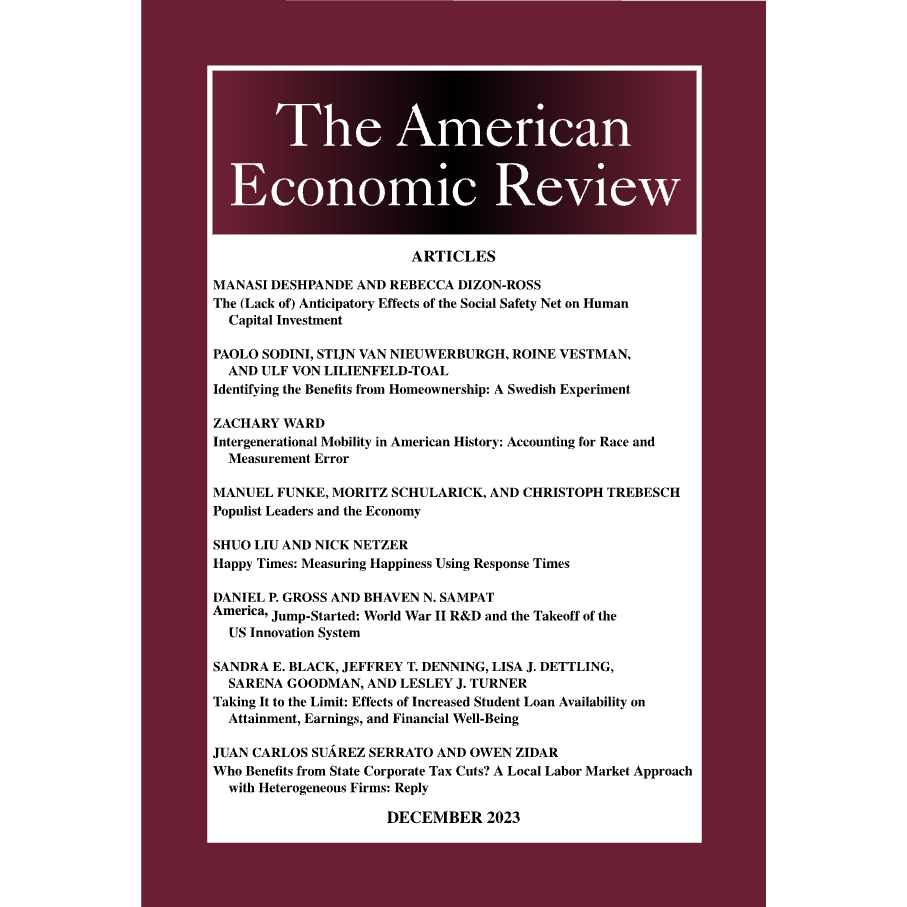
It's interesting to take the words in this abstract on face value alone.
Populism is a range of political stances that emphasize the idea of "the people" and often juxtapose this group against "the elite" [0].
An economy is an area of the production, distribution and trade, as well as consumption of goods and services [1].
So, when the people get what they want, they do less work and consume less.
Are we missing something?
The same Wikipedia article you linked to also says
> In popular discourse—where the term has often been used pejoratively—it has sometimes been used synonymously with demagogy, to describe politicians who present overly simplistic answers to complex questions in a highly emotional manner, or with political opportunism, to characterise politicians who seek to please voters without rational consideration as to the best course of action.
With this definition, it's not about getting people what they want.
So I think there are two "dirty" words in this abstract, 'populism' and 'economy', both of which assume meanings as the interpreter pleases, hence my distate at the prima facie "woollyness" of the research.
A (earlier) version of the paper seems to be here: https://www.ifw-kiel.de/fileadmin/Dateiverwaltung/IfW-Public...
My definition of populism is a political doctrine whose goal is to distribute power and decision making towards the people.
It differs from socialism whose focus is the distribution of wealth, traditionally done through a centralized decision making process.
It also differs from conservatism where an elite enforces strong moral rules and traditionally defers to big private institutions.
Populism is firmly opposed to demagogy. Demagogy is the practice of charismatic leaders to make fantastic promises if they'll be given more power. They do not empower the people, they empower themselves.
According to today’s workhorse definition, populism is defined as a political style centered on the supposed struggle of “people vs. the establishment” (Mudde 2004). Populists place the narrative of “people vs. elites” at the center of their political agenda and then claim to be the sole representative of “the people.” This definition has become increasingly dominant, and is now also widely used by economists (see Section 2, and the recent survey paper by Guriev and Papaioannou, 2020). Populist leaders claim to represent the “true, common people” against the dishonest “elites,” thus separating society into two seemingly homogeneous and antagonistic groups.
I'd take FAR issue more with the fact that the authors appear to have mixed up correlation and causation. e.g. the fact that, say, international conflict causes a bad economy and populism (the "war is bad" theory) appears to have flown completely under the radars of Manuel Funke, Moritz Schularick and Christoph Trebesch.
Also the fact that GDP is well known to be a shitty measure of well being for the average person. Nonetheless, it is a pretty good measure of how things are going for that particular country's oligarchy (the targets of those populists). There is a strong causal relationship between using GDP as a measure and getting published in the AEA, though.
As a side-note, it's interesting to see that their data shows that populists generally stay in power twice as long as none-populists and they are often removed from office in "non-regular ways".
The theory is that 'populist' got in by being 'popular' NOT being 'good at governing'.
Work Example: It's a form of the guy that gets promoted just because he is friendly with the boss.
The people are the boss, and he got in because he sucked up to them. Told them what they wanted to hear, but can't really do it, or do anything well.
Maybe populism’s disregard for democratic institutions resulted in more corruption which hurt growth?
Neither of us know.
One result of this fear play is that these people don't take the right decisions and thus fail to make their personal finances a factor in what they vote for, leading to economic losses.
Obviously these are hard to resolve in statistics, and people are biased towards their preferred pictures (both ways).
The Financial Sector(banks/insurers/real estate/stocks/bonds) has a much larger say on the allocation of resources (the economy) than anyone else including politicians and individual corporations.
The counter balance is not just people. It has to come from people+industry. The western industries have basically been hollowed out thanks to financialization.
Even Google and Apple bow to the shareholder. The shareholder doesn't do any actually work, but is sitting on his ass demanding greater rewards even if it means fucking others over, or even the entire system. Same thing with real estate and insurance. So we end up with monopolies.
Now the system is fucked, cause we have already peaked in terms of customers available to milk. Everyone is in debt to keep things afloat. The FED balance sheet has jumped from 900 billion to 9 trillion in mostly junk debt. People/Politicians we already saw during 2008 gfc folded, when they had a real shot at change.
Its in the interest of Google, Apple et al to use their influence to get on the right side of this.
The financial industry definitely has outsized power and charges excessive fees but the situation is not at all as simple as the financial industry owning everything. It’s a complicated web of ownership with finance being deeply embedded within it and controlling a lot of the hubs of the network effect.
Yes
H.L.Menken: For every complex problem there is an answer that is clear, simple, and wrong.
Populism is about revenge of the narcissistic dullards who are sick of the experts getting to say how things run and what to do.
Just because experts also get it wrong sometimes doesn't mean that they should be thrown out, yet the populists are happy to do it (usually backed by behind-the-scenes moneyed interests who want to destroy regulations preventing them from externalizing costs)
Their populist leaders throw out or disregard the experts, and start letting the moneyed interests externalize costs in thousands of frankly stupider (but popular) decisions. It also popularizes things like bigotry and anti-science aggression, which increases friction and bad decisions in the private sphere. These bad decisions seem great at first, but eventually accumulate to a far poorer performing economy & society.
Populism literally corrodes the foundations of a complex & successful society.
I'm not picking on a easy whipping boy, but isn't that a rather good description of Mark Zuckerberg, his well documented disdain for the establishment, authority and traditional structure?
Might it also encompass more of us "entrepreneurs" and hackers than we care to admit? All of us who regularly feel "all these so-called experts...they're doing it wrong! Let me show you"
Challengers to the incumbents aren't necessarily always destructive, simply iconoclastic. They're part of a dynamic [0].
Perhaps "populism" is a more complex concept than we, and the linked paper, are giving credit for (in a narrow political frame of "economics". Whose economics?
[0] A complex dynamic between "elites" and "masses" that is well analysed by Adam Curtis in many documetray projects.
Maybe. But there are two polar opposites to the "doesn't like existing solutions" approach.
Beyond that superficial similarity of conclusions, there is no similarity between a populist follower vs an upstart entrepreneur, scientist, etc. who puts in the massive amount of work required to gain the insight, and create a new and actually better solution to a complex problem.
Conflating the two is a critical error.
Are there even such experts with regard to the economy? The economic academia is full of competing schools of thought which prescribe completely incompatible recipes how to run things.
Which of those are experts and which are fakes? Which one of those schools would you choose to run things in your country?
There was an interesting example of Pinochet choosing the Chicagoans to run the economy in Chile. Chile certainly grew in GDP, but it also grew a bunch of societal problems coming from inequality, and once Pinochet was gone, the Left resurged, though arguably not to the levels seen before.
And again, just because the experts are sometimes wrong does not mean that you should bet against them.
The point is that when intelligent and motivated people put in massive effort to try to figure out how to understand the complexities and get it right, they are a LOT more likely to consistently produce better solutions than random opinion-holders.
It you have a software problem to fix, do you go to one of the developers, or just pick the loudest Karen/Kevin on the customer service line and have them fix it?
That is really the choice. Of course developers made the error that put the bug there in the first place, but that does not mean that the complainer has an actual fix.
Like turning to bank robbery to pay off the maxed-out credit cards. (Which works for a short while, right up until you hit a bank with a SWAT team waiting for you.)
As far as I can tell it means "people not voting how they are supposed to". Much like how we have ousting/coup, freedom-fighter/terrorist, government/regime, we have democracy/populism.
Sometimes, populists do really believe in what they are saying and doing. And the simplicity is what makes them popular - hence populism.
The problem is that reality doesn't care. I have yet to see the case when following a populist leader doesn't end up in a disaster.
So everything is populist. Again which makes the term meaningless.
Current state of society influenced by tech progress is what causing the current rise of populism.
There are politicians who are rooting for reality, but it indeed becomes more difficult for them to survive.
It probably comes down to a word count and what can be chanted.
Take immigration, very complex.
Populist "Build a Wall". Super simple, can be chanted.
A more Capable Leader might take several sentences, or paragraphs to digest such a difficult subject. Still simplified, still glossing over a lot, but trying to convey some concept. It can't be chanted, and it still takes the listener some brain power to process.
Basically Anger. If you can come up with a slogan, that people can chant angrily -> "Populist".
How did that ever not ended up in disaster and the worse calamities?
I would like to see the “happiness index’ for populist vs. non-populist led countries. Since counterfactuals are used in the abstract, I will add one: normalize for each countries’ naturual resources.
Not according to the authors of the study, obviously. To them an extra 80 cents in a homeless guy's pocket is worse for everybody than an extra dollar in Bill Gates' pocket.
Then there's the reversal of cause and effect - were those populists the cause of economic decline or did they get into power because they were surfing a wave of resentment caused by it? Were the economic decline and the populist leader both caused by external actors cough Ukraine cough?
Manuel Funke, Moritz Schularick and Christoph Trebesch say "we show that the economic cost of populism is high" so no, they clearly they don't think that this is a plausible explanation but they also don't seem to have accounted for it.
I mean only somewhat in jest this is precisely the debate going on since Plato's not so subtle critiques of Pericles' Athens circa 400 BC
Calculating based on vague terms like populism is so in the eye of the beholder.
Why is this even a thing?