Layoffs.fyi - Tech and Startup Layoff Tracker
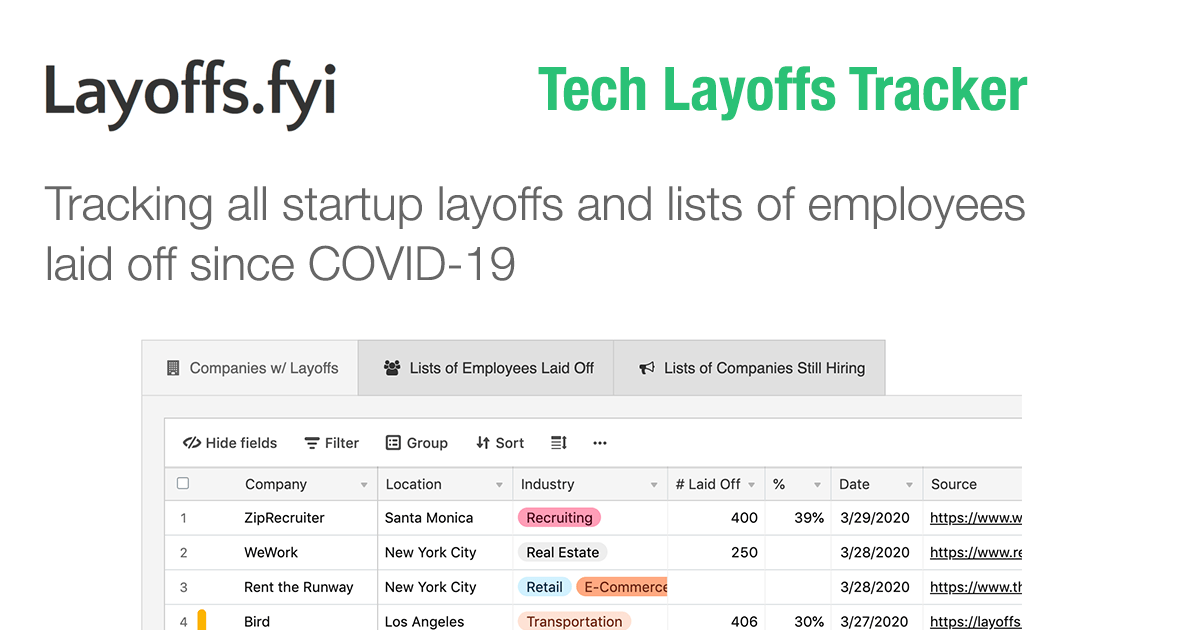
[LIVE] Tracking all tech startup layoffs — and lists of employees laid off — since COVID-19. This page is constantly being updated.
Layoffs.fyi
174 points · by hammock · 3y ago · 72 comments
Also I did some analysis on this dataset a few months ago, and it seems like layoffs tend to happen near the beginning of the month, but I'm not sure why that would be.
Also, as an aside, this doesn't cover all places and I'd guess smaller startups would be less likely to show up. My last place went from about 45 to 10 employees over the last year (layoffs, RTO bs, terminations for "performance," etc.) and isn't on this list, for example.
Do people remember how these companies were talking a year ago? Because I do.
Meanwhile, I just searched Google News for "[company] quarterly results" for the three companies with the highest layoff rounds and here were the headlines for the top result for each:
>Alphabet reports better-than-expected quarterly results driven by growth in cloud
>Amazon reports blowout profit, beats on sales and issues optimistic guidance
>Meta reports better-than-expected results and issues optimistic guidance for third quarter
It is almost like the "difficult economic environment" that was "forcing their hands" might not have been as real as they were claiming. I don't know if this was another example of active collusion among big tech companies, but it certainly seems like these layoffs were at least partially motivated by power starting to shift too much into the hands of labor for the liking of some of these companies.
A lot of the companies with layoffs had a "bad" quarter or so, but hiring continued during that bad quarter. So they correct for the past with layoffs, then resume hiring.
It makes perfect sense if you don't think about it.
In fact a lot of business strategy seems to be making 5 year plans from last quarters data and assuming last quarter will repeat for five years. Look at all the aggressive hiring. Look at all the aggressive layoffs.
For at least a few big companies, it's both big and scummy.
Possibly that's a short time help to the unemployed, but it is a factor that could successfully lower the going wage.
The downtick in layoffs is perhaps that many experienced tech workers even if jobless can apply at much lower rates or just sit it out so its hard for management to understand which positions will cost them a pound of flesh to fill again even as they stare at the holes they already have.
It's very suspicious that this "time of cost cutting" just so happened to coincide with increased office spending.
Typically if you are laid off, your health insurance coverage will run at least through the end of the current month as of your last day before COBRA would kick in. This isn’t a hard and fast rule necessarily, and some layoffs extend healthcare coverage longer anyways, but I know for a fact multiple layoffs I’ve been involved in over the years have timed for the first of the month for this reason.
Would these people immediately seek a new job, or would there be a lag between being laid off and seeking a new job, especially if you got a 6-12 month package. Wouldn't you want to take a few months off?
The flip side is impact to “zoom towns” that were booming with remote workers and whether a bunch of new listings from RTO workers will drag certain housing markets lower
I’ve been lucky to be fully remote for over a decade. I avoided talking beyond a couple screens with Amazon during Covid because the hiring managers were wishy washy about if “hired remote” meant that would be a permanent thing. Despite the hullabaloo I think most Amazon management knew fully remote had an end date.
If the company changes the terms of employment and you don't accept the new terms, that's not on you. The company is the one deciding to fire you, plain and simple.
Let's say your company has an idea that they are pretty sure can make a 2% return each year. If they can borrow money at 1% interest, it makes sense to borrow money to fund that project. When rates go up and loans now have 6% interest, borrowing money to fund that project no longer makes sense. On top of that, if they can park money in something like bonds and get a guaranteed 4% return, it actually makes more sense to just shut that project down and put the money in the bank since that's a higher return with lower risk.
The company in the scenario will actually make even more with less people since parking money in the bank doesn't require employees to get a return.
That's a super simplified version of what has happened. When the safe assets give small returns it makes sense to take risks because the alternatives pay so little. When safe assets give big returns appetite for risk goes down and money flows to safe investments.
To put this another way, if you put one million dollars in the bank for 10 years at 1% interest, you'll have a little over 1.1 million dollars at the end of ten years. That same million dollars at 6% interest will be worth just under $1.8 million after ten years. To justify taking that money out of the bank you've gone from needing a 10% return to an 80% return.
Anything new here?