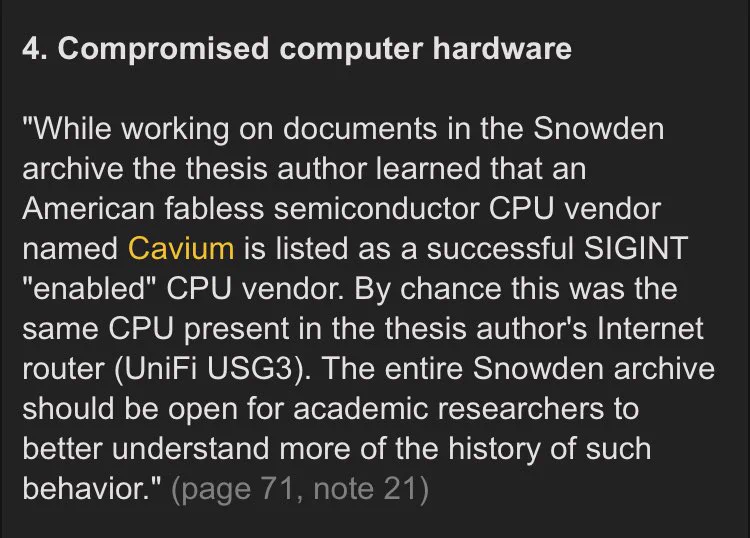
Matthew Green (@matthew_d_green) on X
New leak from the Snowden documents.
X (formerly Twitter)
1205 points · by moyix · 3y ago · 591 comments
From Wiki: >>> NIST SP 800-90A ("SP" stands for "special publication") is a publication by the National Institute of Standards and Technology with the title Recommendation for Random Number Generation Using Deterministic Random Bit Generators. The publication contains the specification for three allegedly cryptographically secure pseudorandom number generators for use in cryptography: Hash DRBG (based on hash functions), HMAC DRBG (based on HMAC), and CTR DRBG (based on block ciphers in counter mode). Earlier versions included a fourth generator, Dual_EC_DRBG (based on elliptic curve cryptography). Dual_EC_DRBG was later reported to probably contain a kleptographic backdoor inserted by the United States National Security Agency (NSA).
From Cavium's NIST FIPS-140-2, Section 3.3 [1] Approved and Allowed Algorithms:
The cryptographic module supports the following FIPS Approved algorithms.
*SP800-90 CTR DRBG Deterministic random number generation 32
1: https://csrc.nist.gov/csrc/media/projects/cryptographic-modu...
All I know is that Dual_EC_DRBG can be backdoored. And there are indeed suspicions, it was known from the start that not only Dual_EC_DRBG could be backdoored, but that it was rather weak to begin with. So, how could it be adopted as a standard?
Now it seems that everyone takes the backdoor as a given. Is there any proof? Ideally the keys themselves (that would make it undeniable), but more credibly, leaks that show usage or potential usage of the backdoor.
But what seems surprising to me about that story is that the potential for a backdoor was known even before the adoption of Dual_EC_DRBG as a standard. Any credible enemy of the state would know that and use something else, and be very suspicious of imported products using it. The ones following NIST recommendations would be allies, but why would you want allies to use weak ciphers?
The algorithm is bad: it's complicated and slow.
The competing algorithms were much simpler, much more secure by construction, and much faster. Most importantly, there was no obvious way to backdoor the competing algorithms, but there's a hilariously trivial way to backdoor Dual_EC_DRBG.
Ergo: the only reason you would ever devise or use Dual_EC_DRBG is to introduce a backdoor capability. There is no other believable benefit or reason.
But rest assured, the NSA promised that they destroyed all copies of the private key they used to generate the public key for Dual_EC_DRBG.
Oh wait, you thought you could generate your own pair and throw away the private key? Ha-ha... haaa. No. That's not compliant with the "standard", which the NSA forced upon the industry, and/or literally bribed companies with millions of dollars to accept willingly.
It's as obvious a backdoor as you could possibly have.
Even if the NSA didn't use it as a backdoor -- I'm crying with laughter now -- the Chinese hacking group APT5 definitely did: https://blog.cryptographyengineering.com/2015/12/22/on-junip...
I detest the only evidence being circumstantial and the _argument from ignorance_ being the one that you lean on. Make the simple observations and don’t try to oversell it.
It isn’t a back door in the sense of ‘poke the code in a certain way and voila’, rather ‘if you know the counterpart to this constant, you can guess what values the RNG spits out at statistically improbable rates’.
You’d never know if someone was doing so unless they admitted it or someone got arrested in a way that was only possible if they’d used it. Which good luck.
I think most people's source of proof is the Snowden leaks, but I haven't actually read it or corroborated, and most backdoors should be deniable anyway - it'd be real dumb if they weren't. I think strong circumstantial evidence is really the only thing one can go on.
The cryptographic module uses the CTR_DRBG, not the withdrawn Dual_EC_DRBG. The Dual_EC_DRBG was withdrawn in 2014, but this Security Policy for this module was submitted well past that for FIPS 140-2 revalidation, and the CMVP would not have let a testing lab submit it at all.
This isn’t the back door.
Having an SP 800-90A DRBG does not mean you support all of them, nor does it imply the user could change between the 3 (or, in that hypothetical, 4).
Outside of that, it is unlikely that this module had Dual_EC_DRBG at any point in time for three reasons: 1) Submitting a hardware module that has an entirely new DRBG would require a lot of low level work from Cavium, and the modifications made to the physical module would likely constitute more than an updated certificate (i.e., a new certificate). 2) Even though the DRBG was withdrawn, the CAVP lists algorithm certificates, and this includes historic certificates. Cavium doesn’t have a Dual_EC_DRBG certificate for any operating environment. A list of Dual_EC_DRBG certificates can be seen here: https://csrc.nist.gov/projects/cryptographic-algorithm-valid... 3) the earliest security policy for the module that I could find dates back to 07/22/2014, and it still uses the CTR_DRBG. Security policy here: https://csrc.nist.rip/groups/STM/cmvp/documents/140-1/140sp/...
Hard to tell what it is, more information is needed.
For example, these devices were validated for the completely appropriately named "SonicOS 6.2.5 for TZ, SM and NSA". Gotta appreciate the irony.
Cavium CN7020 Hash DRBG
Cavium CN7130 Hash DRBG
Cavium Octeon Plus CN66XX Family Hash DRBG
Cavium Octeon Plus CN68XX Family Hash DRBG
I don't know if that's hardware support or just a software validation - but it's still interesting that they validated it.
https://csrc.nist.gov/Projects/Cryptographic-Algorithm-Valid...
AES (128/192/256 CBC, GCM)
Triple-DES (CBC, 3-key)
SHS (SHA-1/256/384/512)
HMAC (SHA-1/256/384/512)
RSA (KeyGen, SigGen and SigVer; PKCS1 V1 5; 2048bits)
ECDSA (PKG, SigGen and SigVer; P-256, P-384, P-521)
CTR DRBG (AES-256)
HASH DRBG (SHA-512)
CVL Component (IKEv2, TLS, SSH)
CKG (vendor affirmed)
Does that imply that the NSA may have kleptographic (algorithm substition, or secondary key) attacks or something different for all of these?
This doesn't have to be backdoored.
It could simply be a bug in their hardware RNG that uses something that isn't public to break it.
Or something that Cavium did not realise was vulnerable.
https://www.prnewswire.com/news-releases/caviums-liquidsecur...
Now I gotta take this to our security team and figure out what to do.
I'm sure a few others here would like to see their response as well.
  The Intel Management Engine always runs as long as the motherboard is
  receiving power, even when the computer is turned off. This issue can be
  mitigated with deployment of a hardware device, which is able to disconnect
  mains power.

  Intel's main competitor AMD has incorporated the equivalent AMD Secure
  Technology (formally called Platform Security Processor) in virtually all of
  its post-2013 CPUs.
  Ylian Saint-Hilaire, principal Engineer working on remote management software
  including hardware manageability:
Hardware wise nothing changed, it’s just even harder for the actual owner of the hardware to use the legitimate management features while presumably easier for whoever could illegitimately abuse them.
I mean, you are already in US-based cloud, so if NSA is interested, they will just request information directly, no backdoors needed.
(This is a good test for your security team, btw: if they say anything other that "we do nothing", you know its all security theater)
Ironically, the data we're securing is because of US government requirements. So if the government wants to spy on itself, who are we to say?
you wouldn’t be cynical if you didn’t care, or felt able to do anything about it.
It would never occur to me to even suspect that. I assume that anything I do in the cloud is absolutely transparent to the cloud provider unless it's running homomorphic encryption, which is still too slow and limited to do much that is useful.
I would trust them to be secure against the average "hacker" though, so they do serve some purpose. If your threat model includes nation states then you should not be trusting cloud providers at all.
Also how Yahoo first refused but was forced to comply by the Foreign Intelligence Surveillance Court of Review.
https://www.electrospaces.net/2014/04/what-is-known-about-ns...
(Note that supposedly, "the companies prefer installing their own monitoring capabilities to their networks and servers, instead of allowing the FBI to plug in government-controlled equipment.")
The underlying architectures of our systems are not secure and much of the abstractions built on top of them make that insecurity worse, not better.
For nation state level issues, the solution likely isn’t technical, that is a game of whack-a-mole, it will take a nation deciding that digital intrusions are as or more dangerous than physical ones and to draw a line in the sand. The issue is every nation is doing it and doesn’t want to cut off their own access.
At my Fortune 250, our threat model apparently includes -- rather conveniently and coincidentally -- everything! Well, everything they make an off-the-shelf product for, anyway. It makes new purchasing decisions easy:
"Does your product make any thing, in any way, more secure?"
"Uh... Yes?"
"You son of a bitch. We're in. Roll it out everywhere. Now."
Welding your vault shut may make it harder for thieves to break in, but if your business model requires making deposits and withdrawals, it's somewhat less helpful.
For instance, Amazon has a staff of thousands or tens of thousands. To me, that means they can't possibly have a good grasp on internal security, that there's no way to know if and when data has been accessed improperly, et cetera. To others, the fact that they're a mega-huge company means they have security people, security processes and procedures, and they are therefore even more secure than smaller companies.
For one of the two groups, the generalized uncertainty of the small company is greater than the generalized uncertainty of the large. For the other, the size of the large makes certain things inevitable, where the security of smaller companies obviously depends on which companies we're talking about and the people involved. More often than not, people want to generalize about small companies but wouldn't apply the same criteria to larger companies like Amazon.
There's a huge emotional component in this, which I think salespeople excel at exploiting.
It fascinates me, even though it's a never-ending source of frustration.
True. But even if you trust your nation state 100%, having a backdoor means you now have to worry about it falling into the wrong hands.
> "Oh, yes... The law? The law is people. And people is politics. And I can handle of people."
Even when you are a nation state, you still have to worry about other nation states.
[0] https://cloud.google.com/blog/products/identity-security/new...
Narrative control and information modeling is so powerful it’s scary.
If nothing else, at Google/Amazon scale, I’d be concerned about a third-party HSM losing data.
Also, the Cavium one was the fastest one on the market the last time I looked at this. Thales, Safenet and IBM also had them..
I find the levels bizarre. Chromebooks are highly exposed to physical attack. Keys in the cloud are not nearly as exposed. Yet people seem okay with level 1 for chromebooks but apparently want level 3 in the cloud?
I’d rather see a level 1 or level 2 auditable cloud solution, with at least source available.
And tech support is horrible, incompetent.
https://cloud.ibm.com/docs/hs-crypto?topic=hs-crypto-faq-bas...
HSMs are mainly for compliance, where a customer needs to check a regulatory box, because some rules says you must use a HSM. The more standard it is, the easier it is to demonstrate to the auditor that you've checked the box.
https://www.marvell.com/company/newsroom/marvell-enables-ent...
It infuriates me the NSA actively works to undermine American security. Their brief is to protect us, not plant backdoors and then lose the keys.
It infuriates me that the NSA actively works to undermine International security.
Seriously.
I don't think china or Russia really have good offensive capabilities, so as long as it is the case, this helps the US maintain some form of cyberweapon supremacy.
As long as china or small black hats don't do harm, they will not raise security standards.
If they manage to put a backdoor in any software or hardware you use you are affected. They could spy on you and trade that with your government or just lose the keys and now anyone can do it.
PD:Also from outside US btw
You don't have to bow in order to be compromised. You can be compromised without even knowing it.
The majority (I'd say all) of the Eastern-European countries that are also NATO members do in fact bow to the US, and thus to the NSA/FBI/the Secret Service.
But now I'm thinking: Is it better that the US is spying on me in Europe, vs. having EU governments do it? I feel like I'd be somewhat more safe from the US, compared to if my own government decides to spy on me. Maybe I should look into Chilean network equipment, I can't imaging that they'd have much interest in my online activities.
https://en.wikipedia.org/wiki/Five_Eyes
> In recent years, documents of the FVEY have shown that they are intentionally spying on one another's citizens and sharing the collected information with each other, although the FVEYs countries claim that all intelligence sharing was done legally, according to the domestic law of the respective nations.
So in practice, it's entirely irrelevant: your data will end up Hoovered up by someone, coated with a veneer of legality, and provided back to your government to act on (or not).
Don't be too interesting to your government, I guess?
Are you a journalist working in a sensitive/dangerous area?
Do you often participate in discussions with dissident groups?
Do you frequently access content that is illegal in your jurisdiction?
if i were sniffing for outbound WAN traffic as root on the unix-like that the USG run, would i see the exfiltration traffic? or is this [supposedly/apparently] happening at a lower layer that an OS can't see i.e. some kind of BMC or BIOS layer?
wouldn't such traffic also have to navigate the varieties/restrictions of DOCSIS etc? or are they also compromised?
is the worst-case scenario here some kind of giant C2 network with waves hands tons of compromised lower-than-OS mini pieces of firmware exfiltrating data over waves hands compromised network providers hardware into the giant NSA AWS cloud?
"That's not the point! It's about privacy!"
Sure. I'll choose it ignore the fact that our civilization is somehow still functioning in a post-nuclear world.
A backdoor is an extra attack vector with often very unfavorable properties that you as a user are unaware of.
[1] https://www.hrw.org/news/2023/08/29/saudi-arabia-man-sentenc...
The average reader may be surprised by how far this cone can extend in some circumstances.
It has been established that the NSA conducts industrial espionage [0], under the cover of national security [1]. To what degree the term "national security" narrows down the scope of any surveillance measures is likely unfamiliar to the laymen, but an NSA representative gave a short description on the agencies views to that regard in 2013:
"The intelligence community's efforts to understand economic systems and policies, and monitor anomalous economic activities, are critical to providing policy makers with the information they need to make informed decisions that are in the best interest of our national security." [1]
While it affirms that it does not steal trade secrets, the NSA reserves the right to pass on critical information about economic developments towards policy makers, who then can use this knowledge in their decision making.
Notable examples of industrial espionage conducted by the NSA consisted of spying on EU antitrust regulators investigating Google for antitrust violations [1], alleged espionage of business conducted by brazilian oil giant Petrobas [2], international credit card transactions [3], SWIFT [4], and the infamous allegations of espionage against european defense company EADS [5].
It's noteworthy that this short list only comprises cases that got attention of the media, the actual list of targets in europe was much higher, about 2000 companies in europe, many of them defense contractors.[5]
So, to summarize, it may be much easier to fall into this cone, than one would assume. The agency is also at odds with it's own claims as this this excerpt from a Guardian article [2] clearly shows:
"The department does not engage in economic espionage in any domain, including cyber," the agency said in an emailed response to a Washington Post story on the subject last month. [...] "We collect this information for many important reasons: for one, it could provide the United States and our allies early warning of international financial crises which could negatively impact the global economy. It also could provide insight into other countries' economic policy or behavior which could affect global markets."
But he again denied this amounted to industrial espionage. "What we do not do, as we have said many times, is use our foreign intelligence capabilities to steal the trade secrets of foreign companies on behalf of – or give intelligence we collect to – US companies to enhance their international competitiveness or increase their bottom line." [2]
To me these statements are mutually exclusive: How is providing policy makers with insights from foreign politics and possible industrial espionage (i.e. not necessarily actual technologies, but research objectives of foreign companies) not giving an advantage to domestic companies, if those policy makers act appropriately?
[0]https://theintercept.com/2014/09/05/us-governments-plans-use... [1]https://www.cnet.com/tech/tech-industry/nsa-spied-on-eu-anti... [2]https://www.theguardian.com/world/2013/sep/09/nsa-spying-bra... [3]https://www.spiegel.de/international/world/spiegel-exclusive... [4] https://www.spiegel.de/international/europe/nsa-spying-europ... [5] https://www.theregister.com/2015/04/30/airbus_us_german_inte...
Let's imagine OpenAI was a Russian company operating mostly in secret. This RU OpenAI secretly discover and use GPT-4-like technology, and show promise that they are not done innovating. While these LLMs are often overhyped, these recent innovations no doubt present a policy issue, right? I'd say there are legitimate national security reasons to know about that technology, not just about making money or making a better product for cheap.
The distinction being made is that the NSA may steal data related to this, but they aren't just giving it to Google to make Bard better. They are getting intel and giving lawmakers the tools to fund research, write policy, or whatever else our elected representatives deem beneficial. Any side action or under the table dealings would make this distinction meaningless of course. So, for the example above, if we started funding departments to research the threat of LLMs/AI, inform the public of the issue, and inform companies that their data is being pillaged to train AI... that is all very different from just stealing a cool new widget design and getting it to market first.
I think there's no debating that this is morally gray, but I think it's a few steps off of what other nation states are doing by stealing tech and implementing it in "private" companies. It's certainly worthy of criticism, but I think it's unhelpful to bucket it with the other type.
If the LLM example isn't your thing, it also makes a lot of sense for the NSA to steal information related to weapon/defense tech, even if developed by a private company, and even if we use what we stole to implement countermeasures. I can't honestly be morally outraged about invading the privacy of someone developing tools of war against you. Fwiw, I wouldn't blame Russia or China for trying this against the US gov or defense contractors either, but it's not like I'd be happy about it. My point is that that is not so much economic espionage or corporate espionage as much as it is just plain old espionage. It saves lives and protects American hegemony - which I recognize may be counter to many people's ideal situation.
It's a nuanced thing. When you take two morally questionable things and reduce them down to both just being bad, the ones doing the worse things benefit. E.g. "all politicians lie" is a handy phrase for truly corrupt politicians because the ones who make small mistakes or half-truths are in the same bucket as them, and the outcome is apathy for the issue rather than being upset at all of it. Kinda the classic whataboutism trope - not to imply you are doing that, but just to say that's where it often leads.
The US currently has about 1.2M people in their gulags, comrade*
Since it was never working as advertised, do I contact them or Ubiquiti to get my refund / warranty replacements?
Or, alternatively, treat your LAN/WiFI like public internet and don't send anything unencrypted thru it
The SoC manufacturer is irrelevant.
If the USG wants in, it's just a click away in any case.
What's a legal and practical mechanism the US Government could use to do this? In almost any number of clicks, never mind one.
I'm still using the access points, since I can run my own controller still, either virtualised in a container or VM, or a raspberry pi and you don't have to connect it to the cloud. I haven't found anything better, TP Link seem to have some interesting looking stuff but I worry about the security given they're based in Shenzhen...
1. https://shop.opnsense.com/product-categorie/hardware-applian...
The specific issue I ran into was that I had a non-ubuiqiti router and AP on my network, and there was absolutely no way to set firewall rules on the Ubiquiti gateway for any clients connected through the non-ubiquiti equipment. This should obviously not be a problem. The gateway provided those clients IP addresses through DHCP and they are in its ARP table, so it should be supported.
Wonder if agreeing to enable NSA backdoors they agreed to be compensated when eventually that fact is leaked. "If nobody starts buying your chips, don't worry, we will! ... and then promptly throw them into the recycling bin"
Also interesting is if Marvell knew their acquired tech had this "cool feature".
If you comply we may help you with some tips occasionally to make sure our partnership is working well, or just not reveal your trade secrets to your competitors"
we already saw this happen in public once with Qwest: https://www.eff.org/deeplinks/2007/10/qwest-ceo-nsa-punished...
https://www.theguardian.com/technology/2016/oct/04/yahoo-sec...
Both she and Yahoo’s shareholders suffered greatly for complying.
There’s also Crypto AG, which was a foreign-owned CIA front that spied on US allies:
https://www.theguardian.com/us-news/2020/feb/11/crypto-ag-ci...
The Washington Post article is now bullshit-walled, but goes into more details.
One of my favorite parts of the story is that the intelligence agency handlers needed to make sure they only hired incompetent / mediocre engineers and mathematicians at the actual company (algorithm and backdoor design was done at a US government agency that employed competent people).
One day, a brilliant woman applied for a job. She aced the interview, and there were concerns she might be too smart, but upper management hired her on the grounds that the interview results were probably spurious. She was just a woman, after all.
She ended up exposing and fixing their backdoors pretty quickly, which caused a huge containment problem for them.
https://www.theguardian.com/world/2014/sep/11/yahoo-nsa-laws...
We treat these stories as if they were simple matters of politics and tech. But the blast radius is huge. When this happened to Cisco, and their value dropped to about 7% of the market they created, I passed massive dumpsters of Cisco gear in the car park, prematurely torn out of racks and consigned to crushing as e-waste.
Has anyone done a serious cost analysis of just how hard this hits? If a foreign entity sabotaged our industry this way we'd take the battle right to them.
The Ashley Madison leaks should have been one name a week and making it a big spectacle till this very day!
Same for the Snowden leaks
you can also get bigger bidders for the data by drumming up interest and suspense
hackers really suck at marketing, so far.
So.. what's your case here? It would be so expensive to host and publish the documents that they would be unable to recoup their investment based upon lack of interest?
> hardly anyone knows who Cavium are, let alone your average Washington Post reader.
Oh.. I don't know.. maybe that's because no one has reported on it and explained why it would be important?
There's a lot of circular reasoning present to create excuses for an entity that really doesn't need or deserve it.
Tangent, but we use Azure instead of OpenAI due to data-retention concerns. To ensure nobody's inputting anything classified or proprietary, Legal demanded implementation of an "AI safety" tool...so we demoed one that ships all prompts to a third party's regex-retraction API.
So you never know who ends up the recipient of your LLM prompt, where it's getting logged to, who's reviewing those logs, etc. Even some local models require execution of arbitrary code, and Gradio ships telemetry data. Uploading Snowden's docs into a black box is a good way to catch a ride in a black van.
However at the time it was the more sexy things like tapping google's fibre and backdoors in cisco's kits that were more interesting. This is because the public could understand those things and therefore it sold papers.
The difference between "cisco, dell and many other leading manufacturers shipped backdoors in their kit" and "cavium the small provider you've not really heard of" is large.
Most people reading the snowden stuff will have assumed that the NSA had put in backdoors to most things.
Like how NSA collects a shit ton of data on citizens... the vast majority of which has absolutely nothing to do with any kind of wrongdoing.
I'm only pointing this out because your comment has a negative tone towards what Snowden did.
That doesn't seem to be true. There are many court cases involving criminal conspiracies where you cannot find unrelated information about the involved people.
I don't know what the reason for the betrayal was. I'm pretty sure Alan Rusbridger knows though. He resigned as Editor-in-chief shortly after these events.
I don't get why whistleblowers rely on newspaper publishers to unpack their leaks for the public; it's not as if the press are known for either their honesty or their scruples.
They have an interest in drama and a platform to publish on.
>After creation of the CIA in 1947, it enjoyed direct collaboration with many U.S. news organizations. But the agency faced a major challenge in October 1977, when—soon after leaving the Washington Post—famed Watergate reporter Carl Bernstein provided an extensive exposé in Rolling Stone.
Citing CIA documents, Bernstein wrote that during the previous 25 years “more than 400 American journalists…have secretly carried out assignments for the Central Intelligence Agency.” He added: “The history of the CIA’s involvement with the American press continues to be shrouded by an official policy of obfuscation and deception.”
Bernstein’s story tarnished the reputations of many journalists and media institutions, including the Washington Post and New York Times. While the CIA’s mission was widely assumed to involve “obfuscation and deception,” the mission of the nation’s finest newspapers was ostensibly the opposite.
https://www.guernicamag.com/normon-solomon-why-the-washingto...
Support or criticism for the intelligence community became very partisan during Trump's campaign and presidency. Once something like this becomes partisan, the average political creature loses some degree of rationality for it. The IC becomes patriotic good guys, stalwart defenders of American democracy standing up to fascism; their past and present malfeasance goes unnoticed, forgotten, or simply ignored. This is how the WaPo's relentless pro-IC stance could be missed; they've been telling a lot of people what they want to hear and all people are less critical and suspicious of things that support their biases and prejudices.
https://www.amazon.in/Journalists-Hire-How-Buys-News/dp/1944...
So, the behavior you point out is enabled by politicians who show such bad judgment in such a critical area, and yet few if any lost their positions over their votes. I personalty have been wondering for the past few years how many of our leaders are actually there of their own accord, rather than put there by various backroom cabals of business leaders and intelligence (foreign and domestic) agencies that want to put their thumbs on the scale with a representative or dozen. How would you ever know, except by their behavior.
There's a lot of pontificating about the virtuous, important, selfless job journalists do, but when they're manipulated to such an extent not just by the Government and intelligence agencies but also by their corporate sponsors... It's hard to not be a bit cynical...
Fixed that for you
I'm often remind of PG's essay on corporate PR and the media: http://www.paulgraham.com/submarine.html
NSA didn't have to lift a finger. Wait a few weeks and people move on to the next story, this should not be a shocking revelation to anyone.
While the USA and the UK are different, I suspect there was a bit more difficult for the NSA than "didn't have to lift a finger".
>Primarily these documents remain unpublished because the journalists who hold them fear they will be considered disloyal or even that they will be legally punished
Whether that's true I can't say. But as a reminder, despite constant claims that Assange is being extradited over hacking charges, something like 17 of his 18 charges are over publishing documents.
Washington Post -> Bezos -> AWS -> Cavium
Pretty simple to understand, really.
Sure - it was a surprise to the public. But rival security services I'm sure would expect US controlled backdoors in US made technology.
[1]: https://www.theguardian.com/uk-news/2014/jan/31/footage-rele...
The FBI and CIA had agents inside Twitter and Facebook. Of course they have them inside news agencies as well. Part of it over time is access-media, the ones that play ball get the stories and info, the others get weeded out.
It's illegal for FBI or CIA to actively target a US company. Anyone doing so would be fired for cause.
"Why go out or talk to anyone when I can just stay home and be on twitter all day!?!"
It's the absolute worst outcome for journalism, and none of publications seem to care. If I had a publication the first thing I would do is ban twitter use (and probably go bankrupt because of it.)
I never do that, except when I do. What kind of soapbox are you trying to stand on. It looks more like a cardboard box collapsing under the weight of your own hubris.
I get the suspicion of news outlets of any kind. It doesn't matter what stream the journalists are fished out of, but they cannot all be subject matter experts in all subjects. This is also an expectation full of hubris on your part.
(2010) https://weirdshit.blog/2010/07/23/cointelpro-operation-mocki...
Which is fine I guess, as long as it doesn't go into the more abusive examples listed.
One thing that jumped at me when (re-?)reading the letter to MLK from the FBI : first you have some very informal speech :
"look into your heart", "you are done", "you are [] an evil, abnormal beast", "there is only one thing for you left to do"
Then SUDDENLY : "You have just 34 days in which to do it (this exact number has been selected for a specific reason, it has definite practical significance)."
Lol, talk about a change in tone, I wonder if MLK noticed it ? (The specific reason being Christmas, but still...)
No...the organization is behaving exactly as intended.
NSA also pays the owner of the Washington Post upwards of $10 billion for cloud services
That's not the only publication that had access to the documents. From wikipedia
>the first of Snowden's documents were published simultaneously by The Washington Post and The Guardian. [...] The disclosure continued throughout 2013, and a small portion of the estimated full cache of documents was later published by other media outlets worldwide, most notably The New York Times (United States), the Canadian Broadcasting Corporation, the Australian Broadcasting Corporation, Der Spiegel (Germany), O Globo (Brazil), Le Monde (France), L'espresso (Italy), NRC Handelsblad (the Netherlands), Dagbladet (Norway), El País (Spain), and Sveriges Television (Sweden).
Wouldn't be more likely that a plant would actually not say that, but rather come up with something else? Seems much more likely that a plant would promote some other aspect of a leak that would be less damaging as the story. Or even possibly making part of the document dump disappear.
Journalists knowingly report lies, acting as the mouthpiece of the government.
We know at least one news organization had the whole Epstein story locked down and they buried it because they were afraid they’d lose access to the royal family for future news/puff pieces.
You think you hate journalists enough, but you don’t.
sure, why not. and while we're on this deluded train: Julian Assange's legal problems are not political persecution
The rest of your post is quite the bullshit (easily probable with publicly accessible archives bullshit at that), but this is also wrong. The mythological god-like creatures that crafted America as their divine powers ordained it didn't "intend" for the press to be "the fourth power". That term was first used after the US revolution, and in the UK. You're just retconing stuff into your mythology, and everyone knows that doesn't work and leaves a poor taste.
if my network hardware is compromised, but all of my communication is encrypted, that leaves… traffic analysis? hoovering up the data and storing it to decrypt in the future when it becomes feasible? using the router as a foothold to attack the rest of my network?
The first two are already happening for data that leaves my LAN. Unencrypted data on my LAN is vulnerable, and there is plenty of unencrypted traffic on my LAN in practice. Is that the risk?
What data is encrypted on the router? VPNs, for one. So a VPN, and all the plaintext traffic sent over it, could be made vulnerable.
What sort of VPN are we talking about?
So I’d assume they could snoop packets and store that data elsewhere. Whenever they harness quantum computing I could assume they put that stored data of yours through it and decrypt it all.
You can see discussion on this going on as far back as 2015, explicitly in regards to what "SIGINT enabled" means and Cavium: https://www.metzdowd.com/pipermail/cryptography/2015-Decembe...
Am I missing something here? People are talking as if there is some new backdoor that's somehow avoided detection. Did everyone just miss this discussion in 2015?
Discussion of the "Sigint Enabling Project" goes as far back as 2013 on HN itself.
You should assume you have no privacy anywhere in your life.
Or are you suggesting that there no way for one of the aforementioned groups to recover your data remotely should they have a focused desire to recover it?
[1] - https://www.electrospaces.net/2023/09/some-new-snippets-from...
[2] - https://pure.tue.nl/ws/portalfiles/portal/197416841/20220325...
Suppose you were given a healthy budget, a team, and a few years. Would you be able to build network hardware that did not contain back doors? How healthy would the budget need to be? How skilled would the team need to be? I assume you’d have to assume most external vendors are compromised and rebuild whatever you needed from them. What would that take?
If you care about performance, then you need to start by building a fab. $100B+, and you’ll end up with government moles.
So, I assume you don’t care about performance. If you keep stuff under 100MHz or so, then you can avoid complicated signal processing.
Design for a old process, and tape out. Now, read up on decapping and reverse engineering old dies with garage-built microscopes.
Make many copies of your chips, then decap a random sample and verify they are to spec by hand. Use the rest to build a computer that can verify the output of the microscope.
You can print circuit boards using hobbyist kits on a laser printer. Since they are 1 or 2 sided, you can visually verify them.
If you can find commercially available chips that are primitive enough for you to decap, scan, reverse engineer and verify, then use those instead (following the random destructive sampling procedure above).
Good luck!
An interesting question I'd like answered: Are the TPM 2.0 modules that Microsoft is requiring for Windows 11 installs similarly backdoored?
https://www.theverge.com/2013/6/6/4403868/nsa-fbi-mine-data-...
I think it's a safe assumption that all American microprocessors have backdoors.
What does this mean for OpSec? If I am a dissident (or garden-variety cyber criminal), how do I evade my online activities being tracked by a sufficiently determined team at the NSA? We've known (or have assumed to know) for years that CPUs produced by AMD, Intel, and Apple have backdoors. If my machine lacks any personally identifying information, only interacts through the internet through a network device that uses a VPN and encrypted tunneling, then I should be fine in spite of CPU/OS backdoors. However, using a VPN with encrypted tunneling doesn't seem to be enough if my router also has a backdoor, and the data or encryption keys can be intercepted and tied to the personal information I've given my ISP.
Where do we go from here? Do I need a Loongson-based PC and a Chinese router on top of an encrypted VPN? Obviously we have to assume that these are all backdoored as well, but that shouldn't matter as my activities don't likely won't make me a target of the PRC.
What's the evidence for this?
>Obviously we have to assume that these are all backdoored as well, but that shouldn't matter as my activities don't likely won't make me a target of the PRC.
Elsewhere in this thread it was claimed that the NSA has hacked Huawei. The NSA could have stolen the backdoors then, or it could've analyzed e.g. Huawei's hardware independently.
Personally, I just forward all WireGuard traffic to another computer on my network and use https://github.com/burghardt/easy-wg-quick to setup a simple VPN.
So absolutely no way to know whether anything needs to be done or not, unless you expect you’re at risk of a nation state actor having a reason to specifically target you, in which case it’d be wise to stop using it.
It's another thing when it comes to resisting surveillance capitalism :
https://web.archive.org/web/20180919021829/https://www.alexr...
It's completely disproportionate that Hollywood is making people lose control of their own computers because they are worried about copyright infringement !!
That a boycott of Intel and Ryzen CPUs, "Trusted" Platform Modules, and Windows (8+) also probably makes the job of NSA/CIA/FBI harder (because they have likely backdoored them) is just a bonus.
(Of course there's also a potential failure mode that some much more hostile actors might get their hands on some of these backdoors, but it doesn't seem worth worrying about it until we get a high profile example of that happening ?)
Of course if you have the responsibility of, say, protecting your non-US company from industrial espionage, the situation is very different.
https://www.justice.gov/usao-sdny/pr/former-employee-technol...
MIPS and ARM.
And Linux MIPS doesn't even have DEP and ASLR.
And we need something better than just private keys.
What if that was theater?
edit: FUCK
“ Quad-core ARM® Cortex®-A57 at 1.7 GHz”
https://store.ui.com/us/en/pro/category/all-unifi-gateway-co...
People paying premium $$$ for this. UI better redesign and compensate users.
I guess I can spare myself the money
> Part of the purpose of Precursor is to validate the system-on-chip (SoC) design we hope eventually to produce as a custom ASIC for use in future such products. This SoC, which we call "Betrusted-SoC," is meant to be the central pillar of security for devices like Precursor. The version of Betrusted-SoC used in Precursor is based on a Xilinx FPGA and has the following features [...] [1]
As for the person who replied to you requesting LTE: won't happen, there's no completely FOSS stack for LTE. Always there is closed source firmware due to regulations. Oh, that wonderful world of transceivers. If you want FOSS, go wired. Tho it seems Precursor found a way to utilize Wi-Fi with a FOSS stack?
Hopefully there's a 4G version coming. This seems too good to be true.
The creators of the project suggest using your phone's hotspot if you need connectivity when not connected to Wi-fi (something I heard in interviews they gave).
They're carefully watching and cataloging any communications technology they can't compromise.
[0] https://www.theregister.com/2021/02/12/supermicro_bloomberg_...
What's your source on this?
* When I ordered the first generation Raspberry Pi, they were stuck in the toll a long time, and when they arrived all the warranty seals were broken. Consequently I never really used them.
* When I ordered the first generation Google Pixel, before it was generally available in my country, it was stuck in domestic mail for almost a week. The person who imported them sold and sent two phones the same day: the other one arrived after just two days and travelled a lot further. I used it regardless as I already considered phones a lost cause... (and could not with good conscience sell a possibly compromised device).
At this point I don't trust anything sent by mail.
> When I ordered the first generation Raspberry Pi, they were stuck in the toll a long time, and when they arrived all the warranty seals were broken. Consequently I never really used them.
If state have means to bug raspberry pi it has means to re-seal the box...
I believe the fewest are. But constant surveillance is an advantage if you need to monitor general opinions or if they find you interesting at a later point and want to check your history.
So if you talk about burning wood in your stove a lot and it later becomes illegal you might have a hard time denying you have a stove if they ask you to pay extra carbon emission taxes.
Or if you talk about chest pain a lot and later want to get a new health insurance you might find that your options are mysteriously more expensive than others.
That's a good point that I never made sense of. The most likely explanation is simply an oversealouz toll agent. It just left a bad taste in my mouth so I didn't want to play with them...
I had largely forgotten about it until the Google Pixel got stuck.
Basically, you can only trust things manufactured before "going online" became a thing.
Might as well make it difficult though.
Just assume you’re being persistently surveilled - if you use a computer or electronics then the likelihood approaches 100% over your lifetime.
Doesn’t mean we don’t do anything about it, just means we have to acknowledge reality
It's their job.
Let's all get back to reality now. They LIE and influence US politics to preserve their operations (not political, it's self-preservation).
If you see something like "100 former intelligence agents sign letter saying ..." then run, RUN!
>... this is not new... It states in the article that this thesis from Jacob R. Appelbaum was released March 25, 2022. The only thing that makes these 'new' (?) is that electrospaces discussed September 14th
https://twitter.com/vxunderground/status/1703995620250325405
Electrospaces article discussion: https://news.ycombinator.com/item?id=37562225
If you have the chip, you can find the backdoor... if you cannot find it, you can't conclude its actually there. There's ways to analyse chips to see if they are backdoored. Decapping, fuzzing and whatnot. Simply basing such of a conclusion from a few lines in a document seems a bit off to me...
Did anyone actually find the thing??
[1] https://www.youtube.com/watch?v=wwRYyWn7BEo
[2] https://www.wsj.com/articles/if-you-play-videogames-china-ma...
[3] https://gizmodo.com/tiktok-cfius-draft-agreement-shows-spyin...
[4] https://www.cnn.com/2019/12/30/politics/army-tiktok-banned/i...
[5] https://www.theguardian.com/world/2014/mar/19/us-tech-giants...
However, as interesting as this revelation is, it's unfortunate that Snowden decided to defect to the Russians and share his stolen cache of top secret documents with them and China, using Western journalists as ideological cover. I look forward to the day when he is brought to justice for treason.
Regardless of your thoughts on the guy, nobody deserves what Assange has gone through in custody. Same with Manning.
He did not do that. Instead, he's living a comfortable life in the bowels of a country that is committing vicious, daily war crimes. I don't hear him make a peep about kidnapped Ukrainian children, or the civilians that Russia tortures and kills. He's not a principled activist who's suffering for the cause of freedom at any cost, he's now just a loyal Russian citizen who opportunistically committed a massive act of espionage a long time ago.
Yes, Russia are the bad guys, but we have done some truly heinous things as well. Snowden revealed a little of the crimes we commit and you're ready to wash him away because it hurts your position that we are somehow morally superior to other countries?
> I don't hear him make a peep about kidnapped Ukrainian children, or the civilians that Russia tortures and kills.
Can you really not see why that would be a bad idea? He's kind of tied up here, if he doesn't want to end up dead by somebody's hands.
> opportunistically committed a massive act of espionage a long time ago
How exactly do his past actions go from heroic to a "massive opportunistic act of espionage" because of his actions in the present?
He's been arrogantly self-serving from the start, and it's rather disappointing that some people still haven't grown out of their juvenile phase of blind hero worship.
He would just be in solitary confinement for the rest of his life, and there's a much better chance the leak to the public would have never been completed in the first.
And again, I'm not saying he would've been protected as a whistleblower, just that he had to choose one or the other: take his chances as a martyr for freedom, or escape all consequences and with them, his legacy as a respectable historical figure. He chose the latter.
you'll be a loyal citizen to a nation state that spies on its people, while torturing and killing other people for no good reason.
why is going to jail for whistleblowing honorable? that makes no sense to me.
Personally I don't think it was intentional on his part to get stuck in Russia, just a bad error. But he is certainly living there by their "good will" now, and it shows in his public behaviour.
Not trashing your host is probably wise, but given his experience with the US government, he probably no longer subscribes to the naive worldview that Putin (or Xi) are uniquely bad, just bad in their own ways and responding to the world with their nation's interests (and their legacies) in mind.