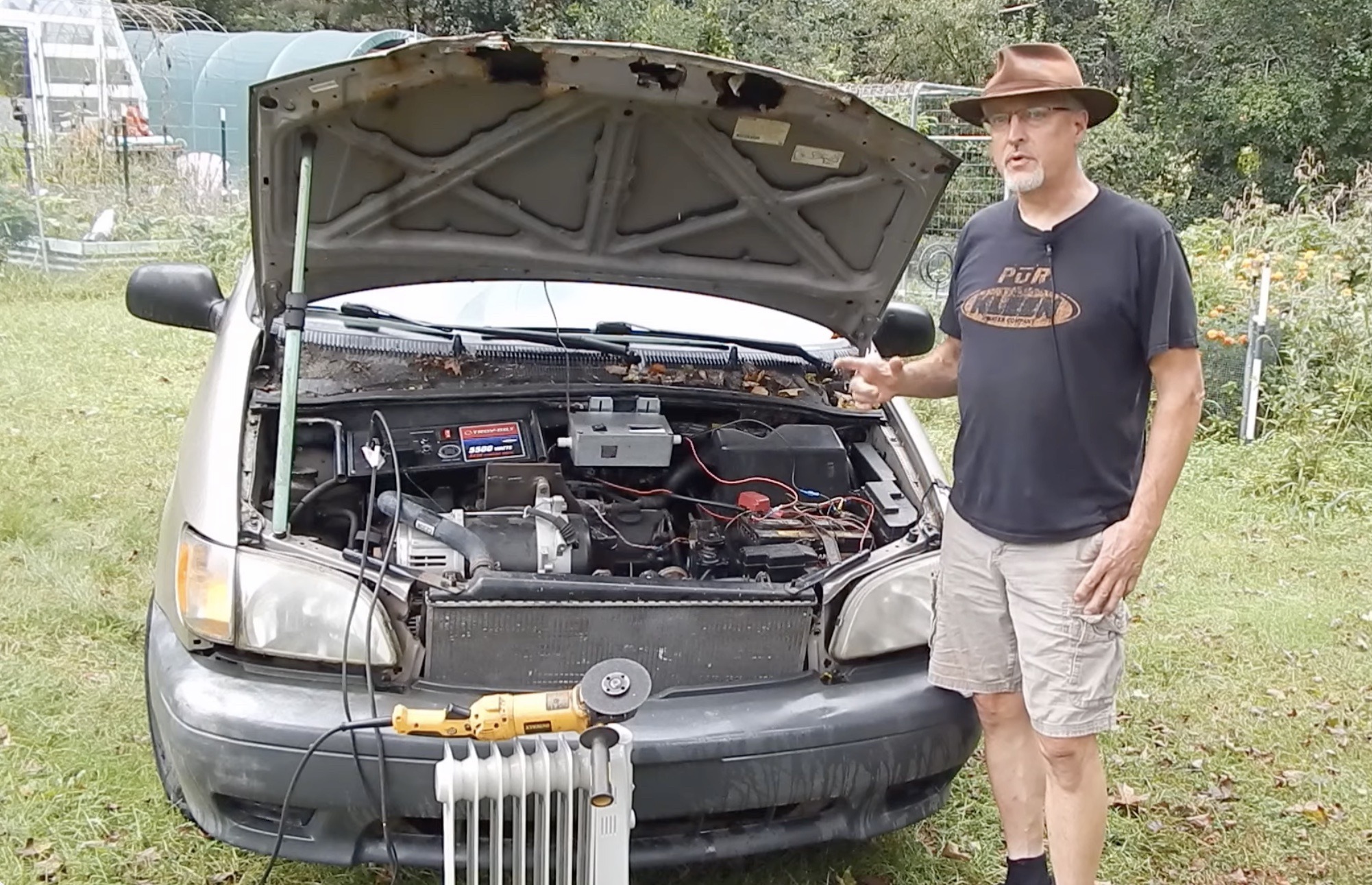
Turn an Old Car into a Powerful Generator | Arduino Blog
See how an old car is turned into a powerful generator, a DIY project that reuses a vehicle to produce electricity.
Arduino Blog
283 points · by jdmark · 3y ago · 287 comments
However, it probably doesn't matter due to the extreme mismatch between the engine's output and the generator's maximum power.
The generator appears to be rated at 5500W, which is 7.4HP. Efficiency of electrical generators is high, so we'll call the load 8HP maximum.
An Toyota Sienna engine has a peak power output around 200HP.
For reference, a car air conditioning system might consume around 4HP, or half of this generator's load. The generator is barely more than running the air conditioning.
So ideally, you'd pick a set of pulleys that let the engine basically idle. The goal is to minimize internal engine losses at this level, because you're nowhere near the peak efficiency islands on the BSFC map.
The limiting factor on early acceleration (0-60kph) today for all cars is now tyres. Beyond that air resistance might make more engine power matter but in general it's all about the tyres. Every car can spin their wheels at the lights if they want to. If you feel the need to floor it at the lights you're showing off your tyres not your engine power (and also wearing them out).
edit: By point of comparison, a good cyclist produces about 100 watts, probably less if they're on a leisurely cruise. That's about 2% of the wattage of a car engine.
This is a big difference to (piston) airplane engines because those are designed to give near 100% a lot of the time.
Also why I'd really like to have my car battery be usable by the house: storing solar or winter/night consumption all require a battery. You'll never need a bigger one for your house than the one already in your EV.
When rolling down a hill with regenerative breaking, the car is generating 50kW.
You can literally power many average homes with that.
This whole setup almost certainly isn't going to be able to supply "north america normal household power demand" volumes of power reliably for months at a time, but almost certainly do whatever a cheapo generator was doing before that cheapo's sketchy 150cc motor crapped out.
I thought you meant the car's gearbox
Didn't watch the video yet, but under normal conditions the car is flying down the freeway so (I'm assuming) gets some cooling effect from that flow of air. But that's not happening in this case. Might be a problem.
Cooling from running down the freeway is easy to replace with a bigger fan. However the radiator itself is not large enough to get all the power the engine is capable of. (I also didn't watch the video, but I'm guessing the donor generator had a 12 horsepower engine so the radiator should be more than good enough). Of course there are other trade offs - many mechanics have a sign "speed costs money, how fast do you want to go", this sign isn't referring to the initial cost to tune the engine for max power, it is referring to max power means your engine needs a full rebuild every 20 hours of operation.
Highway cruise for a compact car needs around 7 to 20HP, so a reasonable target output is in that range. That's 5 to 15 KWh. Seems small, but as others have pointed out, auto engines have peak outputs far beyond their continuous rating.
1800 RPM 60Hz generators are available, and larger generators tend to run at 1800 RPM. Or you could do something with belts or gears to keep the engine RPM down, as others pointed out. Running at low RPM is good if you want to run for a long time.
Probably a good idea to have the system disconnect output power until the frequency reaches at least 50 Hz, because this thing needs quite a while to reach operating frequency. Bringing up something like a refrigeration compressor (a likely emergency load) from 0 Hz to 60 Hz over the course of a minute may burn it out. Under-frequency operation is very bad for AC motors; they draw way too much current and overheat, because the inductance of the motor isn't able to oppose the lower frequency. Put an ohmmeter across an AC motor and note how low the DC resistance is.
My old 2004 Opel 1.6, 105hp could deliver almost full load (car fully packed with passengers and baggage, with roof trunk also packed, going 140km/h uphill with fully open throttle, fuel usage was reported as 16L/100km, typical road usage was 8L/100km) for about half an hour without any problems.
I'm no expert, but I can't imagine that this is true. I agree that is "average driving conditions", but there are plenty of times you're driving way outside of those conditions. That can't be how the cooling system is designed. I've never seen a car even tick up in temperature, under all kinds of tom foolery.
Top fuel drag racers need a rebuild after every run, which typically lasts 4-5 seconds. Their engines can produce 10,000 HP, which is about 7.5 MW.
(Why peak torque? Because that’s peak efficiency, for petrol engines at least. Makes sense if you think about it.)
Unless you're in Colorado doing 80 mph, uphill for ten miles, fully loaded with cargo - then you engine brake (ie dissipate your KE into the engine block) on the way down. Or you take you car to the track. In both situations your cooling system is still expected to deliver, and does, since its not that big an issue to size it properly and a massive reliability issue if it isn't.
Cars are already designed to run A/C and alternator almost continuously, and the AC not only generates load, it pumps a lot of heat into the air coming through the radiator because the condenser is in front of the radiator. They're designed (if the manufacturer did their environmental testing properly) to do that even in ~110+ degree weather.
Methinks you should stick to things you know something about.
PS: Many cars, even regular passenger cars - can handle being driven around a track, where you can go through a full tank in under an hour's worth of driving, and are either on the gas or braking during most of the session.
There are also things called hills and mountains, which may take minutes to climb, or more. Plenty of cars make it up the Mt. Washington auto road (where the challenge is making it back down without overheating one's brakes; engine braking must be used.)
There's something called "towing", which lots of people do the world around with minivans and passenger cars (not just pickups and SUVs.)
From what I was able to dig up[1][2], the generator (that the alternator came out of) has a 1-cylinder, 4-stroke, air-cooled, 305cc engine.
A Toyota Sienna minivan's[3] engine is around 3L, so it's basically 10 times as big.
---
[1] generator product listing: https://www.lowes.com/pd/Troy-Bilt-5-500-Running-Watts-Porta...
[2] similar engine: https://www.briggsandstratton.com/na/en_us/product-catalog/e...
This engine is capable of around 150kw of power, and the cooling system is capable of keeping up with that at highway speeds.
My guess is that if they are using the standard cooling system, it isn't even close to being taxed with a 5.5kw load even at 3600 RPM. That's less power output than you would expect while running the ac in stop and go traffic.
Best efficiency would be to use the fact you’re not moving to have more radiator surface area available but it’s probably not worth it.
One nice side effect of using car as generator - free heat in winter if you extend cooling loop to your home.
1. install larger fans on to the radiator.
2. use a big shop fan to blow air over the radiator.
3. remove the mechanical thermostat on the engine, so that it takes longer to get to operating temperature.
Modern engines are designed to work at preferred temperature. They have two cooling loops, one small which is constantly cooling cylinders and one big (with radiator) which cools the small one to keep engine at proper temperature, not too high and not too low, by mixing some of small loop coolant with large loop coolant.
Point 2 is the best solution.
2:1 could easily mean crank the gearbox into a gear that approximately produces that ratio.
> You've tried to inject something on your own accord for possibly a misunderstanding??
WTH is that supposed to mean? If I misunderstood anything it was a honest mistake. GP suggested a RPM reduction for fuel efficiency reasons, it would be counterproductive to offset that efficiency gain with a high-loss mechanical device. There was neither ill intent nor hidden agenda.
Similarly -- the concerns about how to cool the device if it s putting down 100hp -- that's 74570 watts; it's unlikely they're using a harbor freight generator's alternator to generate that kind of power.
I didn't specify what type of gear box because there are many different options. Belts of the front pulleys would work. You could rig up a chain drive system as well. there are pros and cons to each.
Correct. IIRC again (numbers from 2010ish, probably there were some improvements since but I bet physics limit those) the best stick were 15%-20%; slushboxes were 25%-30%.
Such loss is justified by making the car able to operate on a much wider range, from standstill to highway speeds, and solve the ~zero torque at <1000rpm problem. IOW without a gearbox the car is useless.
Without that requirement a simple reduction would be much more efficient.
One of the huge benefits of going electric is that - in addition of having stellar electric to mechanical energy conversion efficiency (90-95%, vs a very lousy number I can't recall for chemical to mechanic energy) - the engine can basically be put on direct drive because torque is immediately available starting at 0rpm and all the way to max rpm, so no additional loss.
> I didn't specify what type of gear box because there are many different options. Belts of the front pulleys would work. You could rig up a chain drive system as well. there are pros and cons to each.
Totally fair! I didn't want to sound dismissing, only complementary.
a) expand the workable range of the IC engine (1000-5000rpm for Diesel, 1000-9000 - at best - for NA petrol, turbocharging dials it down)
b) solve the zero-to-low rpm problem that causes stalling due to nonexistent torque
It results in a complex device where many parts are still spinning even on the non-engaged gear. Look at a cut out of a manual transmission. The irony is that an epicyclic automatic transmission is mechanically efficient, up to the torque converter which uses fluid coupling.
Efficiency is a secondary goal to the ones above, without which the car would be useless.
If having a vehicle is unsightly, you can remove the engine onto a stand and wire it up exactly as described in this video. The only thing you’d need to run an engine is a fuel line, a spark, and compression.
Most likely your engine also needs a computer, which implies an electrical system.
Old diesel clunkers not really, at least if you don't care about emissions control. Fuel injection / exhaust valve control is purely mechanical, all they need electricity for is the engine starter and, depending on age, the cooling fan.
Modern engines, on the other hand, these can be really hard to run on their own outside of a car, at least from hearsay - I only have had experience with an 1994 VW T4 van.
If you get an old enough diesel engine or can do the mod yourself you don't even need an electric starter. The first diesel engine I worked on used a gasoline engine as a "pony motor" to spin the diesel engine flywheel enough to generate the compression needed to start the diesel engine. From memory (probably wrong haha) you cranked the gasoline engine and brought it up to high rpm and then you started the diesel engine using a lever that gradually engaged the diesel engine flywheel bringing it up to operating speed. Once the diesel engine was running you backed off the lever and killed the gasoline engine.
An obvious disadvantage would be the necessity to maintain stocks of two fuel types. Other than that it is a near fool-proof way to handle cranking a diesel engine. The electric starter is replaced by the gasoline engine and flywheel linkage. You effectively roll-start the diesel using the gasoline engine.
Chances are you won't be running 4 YouTuber editing machines, 2 pots cooking on IH stoves, 2 air conditioners and a USB-PD laptop charger all drawing full amount inside the living quarter on a sailboat. That's before counting in 6x 12V/200Ah = 14.4kWh battery system which safely doubles, possibly quadruple instantaneous draw.
There's a plethora of stuff you can use with 12VDC to the extent that the only things I run off 240VAC is the vacuum cleaner and the TV (12VDC TVs are available but the cost vs quality payoff isn't really worth it).
The problem is that the ampacity in a 12V DC light circuit is 10x that of an equivalent-power 120V AC system. And worse yet, power dissipation in a resistive element is equal to I^2 R, so you're heating the wiring harness with power losses are 100x worse than in a 120V system and almost 200x worse than a 220V system. So you have to oversize the wires to reduce R, which adds weight and cost. And if you drop 2V to line losses in your 12V system, your device is seeing 83% of the nominal voltage, while if you drop 2V in a 120V system (you won't, because Ohm says voltage drop is equal to IR, and I is 1/10th that of a 12V system), but still, you're 98% nominal.
They're running 12V because that's the voltage of a classic 6-cell lead-acid battery, and you probably didn't want 220V in your Model T, even with felted asbestos insulation, but I'd be confident enough to lick a modern XLPE wire carrying 220V. A century of using those lead acid batteries (and worse, 3-cell 6V systems...can't endorse converting your classic car to 12V enough...) created now-entrenched economies of scale for lamps, and switches, and pumps, and radios, and fans, and most of the other things you need in a boat or camper. The only advantage of using those 12V parts is that their manufacturers put a little more effort into making them efficient. No one (sadly) will notice or care if the AC-DC converter that runs the clock on your stove burns 5W at idle even though your wall clock can run on one AA battery for years, but they will notice and care if their camper battery is dead after leaving it parked for a couple weeks.
Today, I recommend using LiFePO4 batteries in whatever series cell arrangement gets you the required watt hours, regardless of that output voltage. Then run a modern, high-efficiency (high-frequency) digital inverter to bump the voltage up to whatever your local AC grid runs at. You can go 220V AC in the US if you really want more efficiency and smaller wires, and are willing to deal with the hassle of finding the right lightbulbs and international power cords and so on.
It's a super cool learning experience, and that's the value.
electronics aside, you think fewer people can repair a toyota than a random generator? and i'm just talking about common-ase-tech-knowledge type stuff, to say nothing of the availability of parts.
Small internal combustion engines are super simple, and small engine manufacturers like those that make generators have an equally impressive dealer, spare parts and repair network to automotive manufacturers.
In this case it was a harbor freight generator. They have lots of replacement engines available for very affordable prices (starting at less than $200) https://www.harborfreight.com/generators-engines/engines.htm...
I always say, why buy a Toyota when a lawnmower engine will do do? It's not like Toyotas are more common.
When you disengage the cruise control clutch the car is still drivable, and he uses it to hoist around stuff and weld things.
The Prius's motor-generator might not be able to run at 100% duty cycle, but they're tens of kilowatts max output so you'd need a pretty big load.
Many car alternators also won't run at full load for very long, and can only do about 2kW, so definitely a risk. Either the windings overheat, or the voltage regulator will. They're sometimes thermally regulated, but not always. You can sort of band-aid it with forced cooling to supplement the centrifugal fan on them.
[0] https://fridge0.branchable.com/ [1] https://fridge0.branchable.com/thermal_mass/
You could probably get more power out with a custom inverter tied to the 140v hybrid battery, but this was quick and easy.
I tried to swap in the refrigerator for the heat, but I had grounding issues that was tripping the inverter. Fortunately it was cold out so I was able to manage. Just remember a DR plan isn't done until you have tested it all the way.
It was a bit painful watching that controller creep along.
> That did occur to me and I think it's a good idea. I'll likely circle back to this project as my coding skills improve, I left a USB cable connected to the Arduino so updating the code will be super easy!
Any idea why he did not opt for that?
Heck, he could have hacked the cruise controller itself to set the "speed" to 60 Hz.
And this really, really needs a proper RTOS and "software written by someone more professional than someone who tinkers with Arduinos", since malfunctioning software can destroy the engine and/or burn your house down.
For the same reason, it requires a proper PCB, not some yanky box of protoboard and wires.
Similar with the PCB's, many of the better dev boards are pretty decent, the problem comes with poor connections designed for easy access, etc. This can be resolved without spinning a new board though, or perhaps designing a simple extender.
he definitely knows it's a mad-max-by-way-of-something-awful "look what I made out of shit I had lying around" solution to a thoroughly solved problem. it's conceptually cool but it's a weird narrow use case and it's not an objectively good idea.
you could address cooling by using a motor with a big clutch fan and a well-shrouded rad, and you would probably be better off using the engine's idle control system to manage this at lower RPM to save gas, but it'd still be lipstick on a pig and you could go to harbour freight and buy a prettier pig.
Fuel effeniency charts need constant power lines to be useful or they fool people.
Is this an ideal setup? Not even close, but you'll find mechanical people love to tinker with this kind of thing, myself included.
https://academiccommons.columbia.edu/doi/10.7916/D81N8CPF
From the abstract:
> This thesis specifically highlights the value of small, mass-manufactured internal combustion piston engines retrofitted to participate in non-automotive system designs. The applications are unconventional and stem first from the observation that, when normalized by power output, internal combustion engines are one hundred times less expensive than conventional, large power plants.
And:
> The largest single component of this thesis is modeling, designing, retrofitting, and testing a reciprocating piston engine used as a compressor. Motivated again by the low cost of an internal combustion engine, this work looks at how an engine (which is, in its conventional form, essentially a reciprocating compressor) can be cost-effectively retrofitted to perform as a small-scale gas compressor.
That's quite the caveat because with the higher power output comes far lower efficiency. That's fine for an emergency backup scenario, or for spinning reserves as the paper mentions, but it's a very operationally expensive for normal power generation. The idea of modularity is good, but that's already a part of the VPPs that are being built now.
And 5500W is not powerful IMO. That is a standard portable gas generator head. The car engine is way overpowered and likely not operating near efficiency.
[
] AC motor or generator speed: RPM = 120f/p, where f is in Hz, p is number of poles.There must be 1000s of cars in scrap yards, though, with perfectly functional engines and front ends.
Both my wife and myself have had a car written off after being rear ended. It is a common story.
On the family farm, we had a PTO driven generator for use when the power was out.
I'm in the process of designing a Sprinter mobile office roadtrip starlink vehicle with an asston of batteries in it, and upgrading the alternator so that the batteries are always charging from the diesel engine whenever underway is like step #1.
Something like this: https://www.powerbastards.com/proddetail.asp?prod=Fitzall-22...
That way you can set the starter idle for high RPMs to get the system up to speed with the resistance from the alternators and then set the idle speed at the ideal speed for the alternator to produce the most power.
But even on a 4 cylinder engine you're going to have horsepower to spare, so you may want multiple alternators wired in series with beefy transfer bars, so build a custom mounting plate for as many as it takes to almost bog down the engine at 1200 rpm or so.
These $350 alternators produce 220 amps at 14.6 volts at 1200 rpm, or 3200 watts each. I imagine you could run at least 3 of them on a properly set up 4 cylinder engine. That's getting close to 10 kilowatts of power before conversion and you would probably still not be taxing the system.
On the other hand, at this point you've spent $2,000 or so and a month of backyard engineering time to build an 8000 watt generator when you can buy a 13,500 watt generator at lowes for $1,300 dollars.
If you have a good motor you can run on a stand and a bunch of cheap or free alternators, then you just need the mounting system and inverter. Typical alternators put out about 40-80 amps, or 580-1200 watts. That at least has a chance of being cheaper.
Also, that backyard looks like the least cluttered part of that neighborhood. I can't imagine being so scared of living in a multi story building that I'd do that to myself.
I was looking at powering the entire house more completly and looked at one of these: https://www.scintex.com.au/products/tractor-pto-generator
Basically you can connect this to the back of a tractor via PTO and you get significant power generation for a reasonable price relative to buying the equivalent standalone generator. This assuming you have a tractor... don't we all?
If someone was interested in backup powering a whole house type thing there is regularly older tractors going for cheap and those engines are really built to work. Might be worth considering vs a car engine.
One nice thing about alternators is they are constant voltage sources 14.4V DC over a wide range of RPM inputs after rectification by the trio from 3 phase AC and cleaned up with the VRM. This should be connected to a car battery with very short, very big leads because the voltage is low but the current is high (like a starter). From there, also use short/large leads to either use DC power directly or use a high efficiency inverter (smaller ones are cheap and ubiquitous). Congrats, that's your budget OTG setup.
The current rating of the windings, VRM, and of the trio will determine maximum current output. Typically, 2-10 HP will max out an alternator with a rating in the range of 40-200A (560 - 2kW). This is another reason why using a whole automotive engine is pointless: because it's oversized by 2 orders of magnitude.
The most difficult thing about powering an alternator non automotive use is increasing the gear enough and mounting it somewhere secure enough to put enough tension on the belt. Rarely will you ever direct drive an alternator.
Hydroelectric power with a high head, even with a relatively small stream, contains an enormous amount of potential energy. A Pelton wheel in direct drive maybe possible, but it would probably need slight gear reduction (smaller pulley than the alternator's under high tension with quality bearings on both) for maximum efficiency because the wheel would could be spinning 8k+ RPM.
https://www.energy.gov/energysaver/microhydropower-systems
You can remove the VRM and get ~28VDC but it's going to be ugly and un-regulated. A battery of some sort is required to energize the field coil or no power will be generated.
https://m.youtube.com/watch?v=SzKu9QBGI4s
I always think what happens when they fail to sync in time -- a bad day for a datacenter or worse
I like DIY stuff, but the convenience of not doing DIY for something like this is great.
Now… one thing that could be improved is there’s an 8 or so second loss of power while the generator spins up. If the whole house could run on batteries and the generator charge the batteries when mains can’t that would be awesome. But that solution would be very expensive right now.
Better to have 12VDC backups of whatever you need. Lights, refrigerator, fans, electronics. Like a semi cab. Then a wood stove for heat and cooking.
Then the 12VDC can come from solar, wind, batteries, car engines, bicycles, etc.
It isn't possible to run full-sized fridge on 12V DC with reasonably sized wires. It is more efficient to run 12V generator through inverter, 120V AC over the wires to AC gear, and convert back down to 12V for the things that need it.
The bigger issue is the terrible efficiency; alternators are about 50% efficient, whereas proper mechanical generators are 90%+.
The better solution would be to buy a "generator head" and connect it to the engine...but by the time you get done making a frame to hold the generator, engine, fuel tank, radiator, expansion tank, etc - as well as the necessary safety systems - you might as well just have bought an used generator.
The engine won't come apart in a dangerous way. It might overheat, which creates superheated water in the cooling system, which is designed to handle that. Although I sort of doubt it since they are basically using about 1/20th of its maximum power output.
The most dangerous thing about this is likely the standard risks of any generator, fuel and electricity.
If you are powering your home with a Toyota minivan, I don't think you are concerned with grid sync or accurate time keeping.
If you buy direct from the manufacture they probably have a custom computer code for generator use. This includes a pin, to select between 50 and 60 hz. If you are buying for a different use you won't get that pin, but might get some other controls not needed on a car (you will have to pay for custom programming of course). You have to check with your manufacture rep to see details - some companies are more interested in this business than others.
With a water cooled engine though all you really have to do in most cases is either put more fans on the radiator or hook up a larger radiator to increase cooling levels if the stock equipment can't keep up.
If you are running your house use a proper line/generator selector, and then your house grounds take care of earthing.
If you are running tools outdoors on a cord you don't want an earth, just make sure all your cords are in good shape. With no earth connection if you touch a live wire you won't get a shock as there is no circuit. Although this is safer for temporary use you can't do it for indoor/permanent use because you can't insect the wires in your walls to ensure they are in good shape, and so you can get a lot of failure modes that running good cords prevents, and earth protects against those.
Got a little electrical meter and showed that usually my office (I'm writing software) uses a grand total of 55 Watts, maybe 100 W if I do more, maybe 1000 Watts if I use the laser printer, boot my tower case Web server with several hard disk drives and an AMD 8 core processor, a little more in the kitchen for the refrigerator and occasional use of the microwave oven and toaster, a little more if I want to keep the winter heat, fueled by natural gas, going. For the hours of an outage, I'll f'get about running the air conditioner, oven, washer, and dryer.
Soooo, I can get by at 50 Watts and can do pretty well for a few days at peaks of 2000 Watts and an average over time of likely under 1000 Watts.
Okay, and I have a car! Yup, a car has an engine and generator, both very well designed!
A little shopping shows that I can get a box that will output 3200 -- 15,000 (in steps of about 2000) Watts, a different box for each step of 2000, of US standard 60 Hertz (Hz, cycles per second) A/C (alternating current, with a good approximation to the standard sine wave) at 120 Volts from any 12 Volt DC (direct current) storage battery. Just clip two leads onto the battery and run extension cords from the output of the box and keep the electrical loads I mentioned running.
So, I could get a box that can output 4000 Watts ...!
And I have a car! Hmm. Soooo, back the car out of the garage, raise the hood, set the box on a front fender of the car, attach the two leads from the box to the car battery, start the engine, just let the engine idle, run the extension cords from the output of the box to my office, kitchen, and, maybe, natural gas powered furnace, and, ..., check the amount of gasoline in the car's tank!
Since I don't need much power, the car and the box would keep me going for a few hours or ~2 days of an outage.
Uh, ..., don't have to be very inventive because there is something of an industry serving people with campers, trailers, off-grid cabins in the woods, etc. who do a lot with getting power from batteries, gasoline powered generators, etc.
In short, just clip two leads onto the car battery, start the engine, let it idle (the car knows how to keep the battery charged without overcharging), run the extension cords, and wait for the local electric power utility to get the outage fixed!
For the horrors of back feeding power to the whole house and maybe electricuting utility workers, etc., "no worries, mate": Are NOT trying to power the whole house. Instead, are just powering a few loads with extension cords. E.g., my office loads plug into the female sockets of a power strip which plugs into the wall. Soooo, just unplug the power strip from the wall and plug its male plug into the female socket at the end of one of the extension cords. Same for each of the microwave oven, toaster, refrigerator. For the electric power used by the natural gas powered furnace, that will have to be a little more involved. But, again, are just running the electric loads much like would on a camping trip. "No worries, Mate!".
If I run the battery down, then I'll just have to wait until the electric utility restores the power! Then I'll have to recharge the battery! For that, I do have a battery charger.
Curiously, the battery charger puts out only 14 Amperes!!!
The charger and a lot on this whole subject has lots of warnings about how fast should charge a car battery -- their advice is to charge slowly or damage the battery, ..., explosions, etc.!!!
Ah, they didn't get to college like I did: Had an old Chevy, stick shift. Somehow, too often, when I tried to drive to college for the first class, the battery was dead. Hmm ....
Well, the driveway went downhill a little to the street. Sooo, with the door to the driver's side open, I stood by the steering wheel and got the car rolling rolling backwards downhill -- jumped in, closed the door, and aimed the car in the downhill direction on the street. Again with the driver's door open, with the transmission in neutral, got the car rolling downhill, reached in, swatted the shift lever down to engage 3rd, High gear, kept pushing, and right away the engine tried to start but, with 3rd engaged, struggled. I jumped in, pushed down on the clutch, put the shift into Neutral, gave some gas, pulled the door shut, and drove to class! After about the 15 minutes of driving to class, the battery was nicely enough charged to start the engine -- the dead battery problem was solved until the next dead battery problem!
Lesson 1: If listen to the usual rules of safe operation of a car, won't get to class on time!
Lesson 2: Can give a battery a nice charge quickly, e.g., 15 minutes!
Another issue: At one point I did discover that the battery charger won't do any charging at all for a fully dead battery. So, I just got a laboratory style DC power supply and used it to give the dead battery an initial charge and then used the charger intended and finished charging.
At 4000W you are looking at around 300A on the 12V side. This requires chunky copper and clamps. Keep in mind the already quite big cables to jump cars are only rated for very short usage. Not saying it can't be done, but this amount of current certainly worries me.
Then you have the issue of protecting the 120V loads. You can get more than 20A of current out of the alternator, which pushes what you can safely put through standard extension cords. Usually running a single device off an alternator or generator is fine, but once you have multiple devices, hooked up to power strips, you can run into failure modes (with defective devices) that can cause shocks.
Yup. But that engineering issue is the responsibility of the designers of the DC/AC converter "box"!!!
> Then you have the issue of protecting the 120V loads. You can get more than 20A of current out of the alternator, which pushes what you can safely put through standard extension cords.
Naw!!! The car's alternator charges the car's 12 Volt battery, and the DC/AC converter "box" takes the 12 Volts from the battery and makes 120 Volts AC available at the female output sockets. So, if I plug the male end of an extension cord into one of those sockets and connect the female end of the cord to the male end of a power strip with female sockets and have my office lights and electronics, the "loads", connected to the power strip, no more current will flow in the extension cord than is requested, as usual, by the loads. A cord that can carry 16 Amperes, at 120 Volts, would be moving
16 * 120 = 1920 Watts
As I type this, my office is drawing 52 Watts. With my server with its 8 core AMD processor and my laser printer, still looking at a lot less than 1920 Watts. And the printer gets only occasional use and then for only seconds at a time.
The DC/AC converter has more than one female socket supplying 120 Volts, and from that and an ordinary extension cord could drive the refrigerator, toaster, and microwave oven -- again much less than 1920 Watts.
If I start to overload the DC/AC converter, not very likely for my loads and a converter that can supplyk 4000 Watts, I trust that the converter will have a circuit breaker. In that case, this approach to emergency electric power should be not much more of a safety challenge than normal usage.
Note in all of this, the circuit breaker in the house does not get involved, remains ON, and waits for the utility power to come back on. Then the lights in the kitchen, front hall, etc. will come back on, and I will plug my office and kitchen loads into the wall sockets again, disconnect the DC/AC converter, put the car back in the garage, wind up the extension cords, make some notes, and f'get about the outage!
One little issue is: If the Web server computer was running when the power went out, might there be a way to have power to that computer not be interrupted all the way until the power comes back on? Yup: With some shopping, can run the server computer off another box, not very big, that has a little battery inside that can keep the computer running for a few minutes while I switch over to the DC/AC converter and again while I switch back to the utility power.
For the Hacker News audience, this is conversation is drifting into kindergarten level talk: I'm SURE Hacker News has MANY very well informed engineers on how to have un-interruptible electric power to computers in a server farm and also to the whole farm.
For more, once I wrote a math paper on detecting zero day problems, gave an invited talk at the NASDAQ headquarters, and got a tour and overview of the engineering they did for un-interruptible NASDAQ service, uh, including a remote backup server location. Such magnificent engineering has long been available.
Here I am just trying to contribute to the issue of this thread, using the engine in a car to supply standard 120 Volt A/C electric power. I'm just mentioning that for short term power outages, maybe only a few hours at a time, should be able to do okay with just a normal car and a little box that can supply 4000 Watts of 120 Volt A/C power from a 12 Volt DC battery. That's all I'm trying to do.