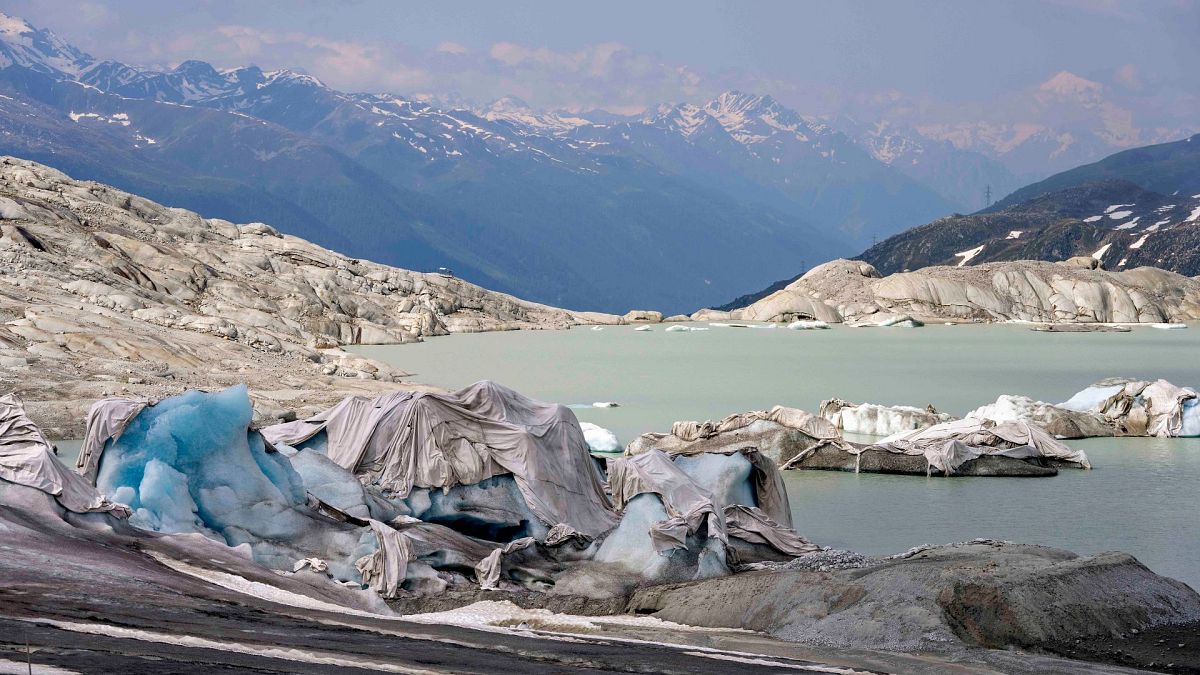
Switzerland has lost 10% of its glaciers in 2 years, research reveals
Glaciers across the entire country were affected, with those in southern and eastern Switzerland melting almost as much this year as in the record year of 2022.
euronews
75 points · by esarbe · 3y ago · 73 comments
For example the swiss mountains are quite heavily populated. Those areas are often protected from loose rocks using forests. If it gets to hot for a type of tree, they might die. Those protections need to be replaced by safety constructions, which cost millions. Also the construction takes time.
The same thing happens with water reservoirs. In other countries all water in the summer comes from glaciers. If the glaciers are gone, all rivers will dry up.
On the bright side, we currently have negated the next ice age that comes in 10'000 years. We wont get glaciers hunderts of kilometers long all across switzerland. If we survive that long...
It sounds like a theory that could be easily verified since Switzerland already lost 50% of its glaciers. Have there been deaths associated to it? Did rivers dry up? Did forests disappear? Did people lack time to adapt?
Tree are dying in a huge number in the Alps due to lack of water, and the wood production industry is still wondering which species to plant instead of the native ones that aren't reaching maturity anymore, so the answer to these two questions is a clear yes.
No. We are still coming out of a glacial maximum.
The cumulative impact of industrial scale human footprint cannot be undone in a hurry even if we were to commit economic suicide and return to the stone age. The process is autoregressive (alas more Swiss glaciers will melt) and may hit tipping points (permafrost melting accelerating temperature increase etc) before it gets controlled (assuming we even get to do the "right" things").
This kind of slow but steady and determined (over many decades) turning of the entire Homo Titanic to avoid the worst environmental disruption and settle into a workable equilibrium is an unheard of challenge. This is not the kind of game people know how to play. We are in uncharted territory, economically, politically and morally.
https://earth.gsfc.nasa.gov/cryo/data/current-state-sea-ice-...
Some skeptics says it's maybe an outlier and we need at least 2 years to confirm the start of a new trend...
We must do more to control unnatural pollution, water pollutants, forever chemicals, deep acquifer draining, lead pipes, go everywhere plastics, etc.
It's not like wealthy "green" western countries don't have their share of blame when it comes to global warming and environmental damage, they just don't do it in their own back yard, and instead mostly export it to poor/developing countries where most of the dirty manufacturing of the goods they buy happens and where much of the dirty hydrocarbures get burned.
It's already been documented through studies, that people in wealthy countries actually have bigger environmental footprint compared to people in poor countries (they travel, fly and drive a lot more, buy more stuff online and throw good stuff away more often, use a lot more AC and other energy hungry amenities like heated swimming pools, buy cars more often, etc.).
Also, Switzerland is the world's leading coal trading hub. So while they don't use it very much themselves, similar to green Norway making bank on selling its oil to others, they defiantly build their wealth off profiteering from environmental destruction, so Switzerland is not innocent here.
It's been quite liberating, actually. I got rid of my motorcycle, got a Nissan Titan, and now I fly everywhere. Knowing that no matter how green I become doesn't matter and that if I 10x my emissions means that I'm free to act in whatever manner I choose!
This is not a problem that can be solved with individual responsibility. It just makes you feel guilty. This is a systemic, a societal problem. And until this is addressed by policy, law and international treaty, no manner of individual do-gooding will solve the issue.
If no one ever takes the shitty public transit, how will politicians know that they should invest in better transit. Individuals pay the price of taking that shitty public transit and then demonstrate/campaign for better.
If fast fashion is to be ended, you don't keep buying the latest outfits from The Gap every year. You individually pay high prices for the lasting products from niche stores. Then you use your demand as material to go campaign publicly to change norms and/or ask politicians to tax/regulate fast fashion items.
Sure, there are some places where politicians can judge general sentiment and make laws ahead of public sentiment change, but in a lot of cases its the other way around.
Glacier was formed hundred's years ago. So it was not there before. If we going back to previous state, we are living in incredible times where we are able to see huge landscape changes during one lifetime. I will probably tell my grandchildren in future that I seen glacier that is no longer there. Which is fascinating.
Or can new glaciers be formed / frozen today?
We're technically still in an ice age because we've got ice sheets on the north and south poles.
Is it because glaciers are not reforming?
https://climate.nasa.gov/news/2948/milankovitch-orbital-cycl...
https://www.science.smith.edu/climatelit/the-effects-of-the-...
If we are expecting the world to stay the same and never change (homeostasis), then we expect what has never been before. Planetary history is one of heating-cooling cycles, occurring well before mankind existed.
a better number of glaciers is however many would indicate climate change which positively impacts humanity, or a lack of significant climate change
philosophical stoned-speak about nothing staying the same and stuff going in cycles doesn't change the fact that this is an indicator of current and future climate bad for humanity