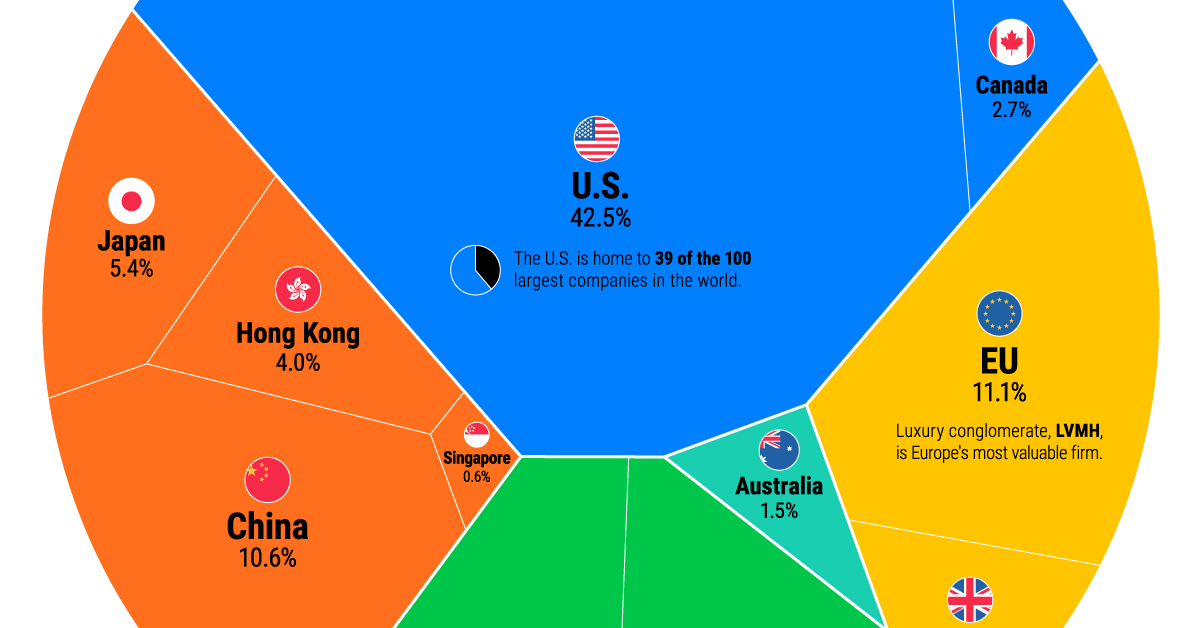
The $109 Trillion Global Stock Market in One Chart
We show the entire global stock market in 2023, illustrating the dominance of U.S. markets. But as structural dynamics shift, will this last?
Visual Capitalist
44 points · by jerryjerryjerry · 3y ago · 32 comments
[1] https://newfinancial.org/wp-content/uploads/2021/03/2021.03-...
MSCI World Index (the maker of the plot) is about 69% US as it leaves out emerging markets.
I wonder what's in this plot that's left out of the FTSE index that would to make it US 43%.
https://investingintheweb.com/education/ftse-all-world-vs-ms...
He reads headlines of UAW workers going on strike to ask a company making $10b/yr in profit to give them a bit more and he sides on the side of the company, you know what I mean?
Long story short, he's come to say "America has gone soft". He thinks anybody who works from home is doing blatant time theft, needs to be tracked, etc.
He thinks that what we classify as a $20/hr job in America is $2/hr elsewhere.
If that's the case culturally and the Chinese value working hard (where as in America if you scroll on Instagram you'll see 5-10 memes recommended to you about 'you are not your job, fck your job, fck your meeting'), why is our economy more successful than theirs?
"Higher market cap of equities" is not the same as "economy more successful".
First, much of the current market cap is due to past successes, which is not the same as current or future successes.
Second, market cap is denominated in currency, and governments manipulate the currency. In the case of the US, much of the "growth" in the market cap of equities is due to the US government printing money. For example, the article says that US equities grew by about a factor of 20 from 1990 to 2003 ($100 invested in the S&P 500 in 1990 grew to $2000 in 2023). But over the same time period, the US money supply grew by a factor of about 7. So the real growth (i.e., after factoring out the money supply effect) in US equities was only about 20/7, or a factor of about 2.9. Which is much less impressive--indeed, since the article says the factor of 20 was about 4 times the growth in other countries, the adjusted US factor of 2.9 might well be less than the real growth in other countries.
Inflation-adjusted CAGR over the past 30 years is ~~10~~7%. During that time, the average P/E ratio of the S&P 500 (that's what I could easily find) has hovered pretty consistently around 15-20. So the rise in equity prices is, as far as I can tell, directly attributable to increases in earnings (as it should be; after all, theoretically, stock prices are discounted future cash flows).
Directly adjust for money supply is not a particularly good way of measuring, well, anything. There's a reason talk about M1/M2/etc have mostly fallen out of favour: we realised that they don't really mean anything, and the numbers are mostly useless for crafting policy or analysing things we care about.
Adjusting for inflation is the standard metric for good reason. That's a much better measurement of real economic growth (real in this context usually means adjusting for inflation, instead of money supply. Almost nobody does the latter). Money supply should grow with economic activity; it would be strange for a much larger economy to be measured relative to a much smaller relative money supply.
By "inflation" here you mean something like "average price level", which of course is also skewed by changes in the money supply, according to standard microeconomic supply and demand. So it does not strike me as a good way to measure "real economic growth"; the fact that it is the usual method in all developed countries is a bug, not a feature.
The right way to measure real economic growth is to, um, measure real economic growth: the actual quantity of goods and services produced. Yes, that will mean there is not a single number for "growth", but so what? A properly functioning economy does not need a single number for "growth". The fact that government micromanagement requires such a number is, again, a bug, not a feature.
> the numbers are mostly useless for crafting policy
For crafting the policy of central government micromanagement, yes. But central government micromanagement doesn't work. The Soviet Union spent most of the 20th century proving that. The fact that other countries have not yet gotten the memo is, once more, a bug, not a feature.
> Money supply should grow with economic activity
I understand that this is a common claim among mainstream economists, but first, that doesn't make it right (monetary expansion is a common feature of failed civilizations in human history, and to just blithely adopt it as policy is not wise), and second, "grow with economic activity" is not how the money supply in any developed country is actually determined. (There is also the fact that monetary expansion is equivalent to a wealth transfer to those who get the newly printed money from those who don't, which generally means enriching the already rich at the expense of everyone else.)
From the numbers given in the article, that looks like a not inflation adjusted value. If I plug a growth ratio of 20 over 33 years ($100 invested in the S&P 500 in 1990 becomes $2000 in 2023, the numbers given in the article) into the CAGR formula, I get 9.5%. And the article's numbers are not inflation adjusted, they are raw dollar values. If I assume an average inflation rate of 3% over the same time period, I get an inflation-adjusted growth ratio of 7.54 over 33 years, which if I plug into the CAGR formula gives 6.3%.
(I also note that the article explicitly lists growth in the money supply as one of the reasons for the growth in equity market cap.)
Because of history of course. We aren’t more successful than them because of current day American sentiment. That’s silly.
If you want to know why we’re so successful, look at what America was doing 50-200 years ago. Which actually is pretty ruthlessly capitalistic compared to modern day. Along with a lot of bullying, war winning, slave labor, etc..
We shouldn’t want to emulate past America. But we also shouldn’t be pretending that our wealth today is a result of our modern day system being more efficient than China’s modern day system. If anything it’s the opposite, as China has closed the gap on the US in the last 50 years.
It’s often a few very ambitious and very hard working people who drive big changes in the economy. Ideally these changes create a new industry and suck up all the profits as a monopoly. Their economic output cannot even be compared with normal workers because.
Really ambitious hard working people tend to immigrate to usa, while those who want life style would prefer to stay closer to their home country.
Those people who aren’t working hard won’t improve the economy by working 50 percent harder.
America has essentially had peace for the last 150 years. In 1911, the Wuchang Uprising toppled the Qing Dynasty. China was then brutally attacked by the Japanese in the 1930s where in the fighting and subsequent occupation 14 million Chinese were killed. In 1945, China finally became free from Japanese occupation but the damage was already done, and in 1949 the country underwent a communist revolution. Things were going pretty okayish until the famine of 1960 that killed 10s of millions more Chinese people.
For the last 50 odd years, China's growth has been tremendous.
I tell him "you get what you pay for" and "Microsoft/Google pay some engineers $2m" and he jus says "that's dumb"
And if he knows where to find large numbers of skilled technical contractors familiar with engineering systems for scale, have excellent written and spoken English, who are able to travel regularly, are highly accountable and willing to work for well below the US market rate, I applaud him.
And if the more realistic case is true and he knows how to point some poor sap from Pakistan he hired from Upwork for $15 an hour at his swanky new mobile app, I wish him the best.
He makes a good point though. Ford's current return on equity is a bit north of 9%, there's really not much more squeeze to give. People like to think of companies as giant monoliths of money that can be freely diverted, but that's really not the case. The other big automakers are roughly around the same place I believe, so it's really not that far off. 10% is roughly the RoE you're looking at for the auto sector, going higher means they're somehow getting capital for cheap, too low and they're not efficiently deploying capital and should just return it to shareholders for better use elsewhere.
The current two-tier system doesn't make much sense and is mostly a relic of the 08 era, but the current union demands are just ludicrous. The union protected old members at the expense of new ones, and a re-negotiation of that makes sense, but most of the other demands are nonsensical.
> He thinks that what we classify as a $20/hr job in America is $2/hr elsewhere.
Seeing as low-skill service workers are making $20/hr in major cities, and $2/hr is literally what the exact same job gets you in developing countries, he's not wrong? The guy manning the Walmart checkout counter probably makes close to 10x what the guy manning the same counter in, say, Bangalore.
> If that's the case culturally and the Chinese value working hard (where as in America if you scroll on Instagram you'll see 5-10 memes recommended to you about 'you are not your job, fck your job, fck your meeting'), why is our economy more successful than theirs?
There are other factors of play, of course. Labour productivity is only one part of the economy, arguably not even the most important. If "working hard" is all that's required for a strong economy, then yes the Chinese with their 996 schedules would have the strongest in the world. So would the rest of the developing world.
The rest of the story is the boring economic stuff that nobody outside of finance thinks about: highly functional capital markets, low costs of capital, strong investor protections, strong disclosure regimes, existing structures around accountability, a managerial class that's somewhat aligned with investor objectives, etc. Things that many countries are trying to develop, albeit without much success.
The US model is not the only path towards success -- there are many others, and many are hard to replicate. Singapore was invited to try duplicating their success in China and it was mostly a failure. Export-led growth has served many other Asian countries well, but many get stuck in the middle income trap. Truly climbing into a developed economy is a hard task, one that not many succeed in.
"Pie charts are completely useless." — https://en.wikipedia.org/wiki/Jacques_Bertin
"Pie charts subtract from the world's knowledge." — https://en.wikipedia.org/wiki/Edward_Tufte , https://www.google.com/search?q=edward+tufte+pie+charts
> Pies and doughnuts fail because:
> Quantity is represented by slices; humans aren’t particularly good at estimating quantity from angles, which is the skill needed.
> Matching the labels and the slices can be hard work.
> Small percentages (which might be important) are tricky to show.
* https://scc.ms.unimelb.edu.au/resources/data-visualisation-a...
This visual seems to better preserve the size of smaller markets, like Singapore and Australia. In a pie chart, they'd be indecipherable.
It certainly works to optimize squatter triangles over long narrow triangles, and these shapes over arcs.
Does this even have any advantages over a pie chart? IIRC people are not good at judging relative area at all, even circles. How much does un-wedging the pie help?
At least with a pie chart you can try to compare arc length which may be easier?