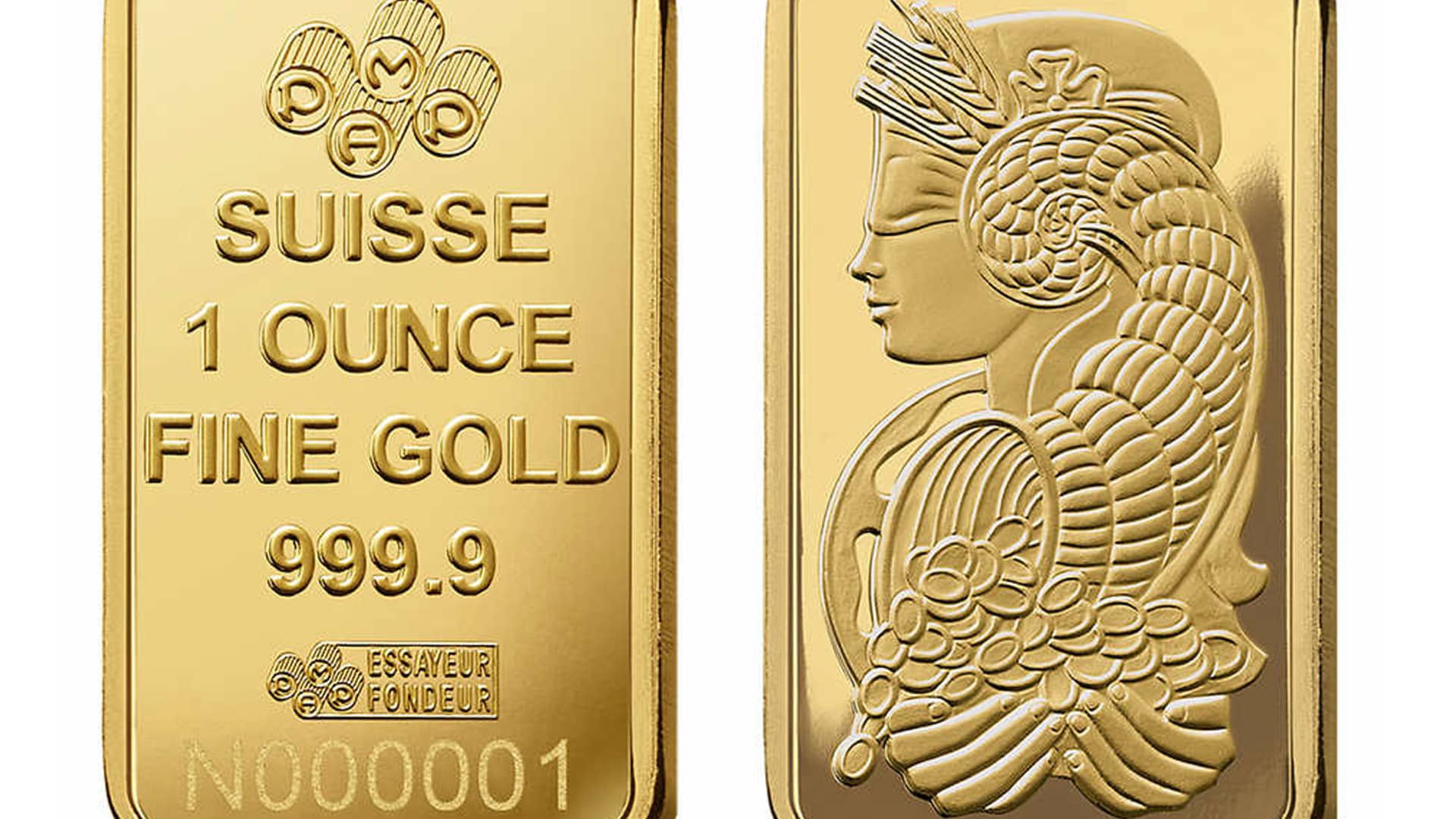
Costco is selling gold bars and they are selling out within a few hours
The retail warehousing giant is your one-stop shop for 1 ounce gold bars, handsomely detailed and ready for purchase.
CNBC
195 points · by walterbell · 3y ago · 489 comments
Investment gold is usually kept in vault, and you trade ownership arms length. Direct gold ownership is rife with risks: fineness, substitutions and overpriced purchase. Yes, you can always sell at a mall gold trader but that's way way off market price.
So it's an inflation hedge with a lot of cost and risk and demands huge upswing in gold price to pay off. And securing it at volume is a nightmare. Plus Costco wants to limit you to 2, and have a margin.
So gold isn't even a good inflation hedge: if you walked the streets of a failing economy (pick one: Argentina, Venezuela, Sri Lanka, there's plenty more) and tried to exchange gold for goods, you're not gonna get far (and will probably get mugged). You have to figure out how to convert that gold into something somebody will actually take, and that seems like the hard part.
I'm not sure what makes you feel that way. Gold and Bitcoin are up against the dollar in the past decade, and by a significant margin. Bitcoin is up ~225x against the dollar. Gold is up ~50x against the dollar going back five decades. The US dollar is pretty terrible at holding value.
Not because US bills are used in SE Asia or other places but because big transactions (like oil) are done in USD.
You must understand: Most Americans are not accustomed to shoving a third party currency under their mattress, or buying physical gold. The phenomenon of hyperinflation is foreign to them, and there's a steep learning curve.
The actual significance of this is that metal is being offered at a "blue dollar" rate by one of the three largest retailers in America. Prior to there being any concept of blue dollars here. This is going to influence spot prices. The people buying this are too stupid to even go to their local coin dealer. (Which I do, sometimes, go to my local coin dealer - and trust me - the people there to buy are generally pretty stupid).
If I had an hour, I'd like to expound on the significance of Americans buying precious metal at a loss through a giant vertical monopoly. But I'll leave it at the fact that they seem to be starting to alert themselves to the one critical thing that has defined Argentinian inflation for the past 20 years: Bullshit figures from the government saying the currency is stabilized, at the same time as the government takes obvious punitive measures to curb inflation. This leads to distrust which leads to the demolition of the currency.
Argentines can take a 20% drop in the Peso with a morning medialuna. Americans have no fucking idea what's going on. Americans have barely begun to put together the networks to measure it - and is evidenced by Costco taking advantage here, Americans have absolutely no peer-to-peer ways of negotiating the value of a dollar against value anymore. That's quite a dangerous situation, because it means prices are psychologically still thought of as an "act of God" as opposed to any true understanding of who is outpacing whom.
Like I said, inflation and hyperinflation especially are a steep learning curve.
If I were living in BsAs, I'd begin looking for something else to put under the floorboards besides USD. And voting for that clown who wants to tie ARS to USD as if it was 1983 is probably like trying to get tickets to the Titanic right before it sinks. You can do better than resurrecting Menem's economy. (Then again, the Fernandez are even bigger clowns, which is why I refuse to engage in anyone's politics in Argentina).
Costco occasionally sells gold below spot if Reddit is to be believed. Most of the time it's right around spot. These 1oz bars were going for $1900 give or take, which is spot give or take. It's fairly common to see a small ~$50 ish premium on small quantities like this, around 2-3%.
Costco is also not a monopoly, and it's not really vertically integrated - these bars come from PAMP, a Swiss company.
You can get gold for exactly spot if you have a lot of money - just buy a futures contract and stand for delivery.
The one thing that can reliably trigger inflation in almost any country is oil/gas shortages on the global market, and you can't hedge that with precious metals nor store a 20 year supply in your house.
Firstly the bars are being sold only a couple of percentage points above spot. This is a perfectly normal price for decent bars or coins in small sizes.
Secondly the 'blue dollar' concept refers to the fact that Argentines are restricted from buying more than a certain amount of US dollars. They pay much higher prices to buy dollars illegally. US citizens can buy as much gold as they like, and Costco is not an underground or illicit market.
There's been a huge increase in ads about "buying hold to protect yourself" instead of buying US government bonds, that will actually make you money, because these grifters feed off fear and there's plenty of people there that will believe in it. These people will all lose money on this gold when they decide to sell it.
LOL. What the US has is in no way, shape, or form hyperinflation. I've lived in a place with hyperinflation and less than 10% ain't it, chief :-)
Inflation in America is not, and was not anywhere in this post-Covid episode, worse than in any other developed nation except Japan, which has so many problems hardly anyone will want to use it as a point of reference. U.S. economy is in better shape than almost any other advanced nation (and poor countries may be doing better but exactly because they are poor, they are playing technology catch-up, once they are caught up they have no avenues for quick growth and are stuck on Eastern European level). It is both currently richer, and grows faster, and is more stable, and provides more ways for an everyday, layman person to invest. Europeans don't buy stocks of European companies - because they know those companies are ridden with protectionist rules and omnipowerful unions - in all of which they actively, and cynically, participate - and will never give a good return. They buy American stocks.
America is virtually insulated from global warming because it's so big and diverse: some places may be wrecked but others will even win - no other nation is like that. It is virtually insulated from potential wars or invasions due to protection of the oceans. It is safe from any demographic issues because it has a guaranteed stream of immigrants with a lot more brains and money than any other country can hope attracting. It has an attitude to politics where people don't expect politicians to do much, apart from entertaining them, an expectation current generation of politicians fulfils brilliantly. Because there is no way America can be wrecked by politicians NOT doing something (as everything was built from the ground up with exactly that expectation - the government not doing anything), only threat comes from government actuallY DOING very wrong things - but American political system is built to very effectively prevent that.
All in all, comparing America to other rich places, it is evidently the best place to be for the rest of XXI century, at least as long as you have cash.
As someone who is studying economics in Argentina... You're pretty much the polar opposite of Argentina when it comes to the economy.
I am more interested in when Costco got into the gold mining business.
Or, it’s a novelty item to get PR buzz.
Possibly being a reserve currencies adds an additional burden to US policymakers, so they can't always take the easy way out.
The only thing Costco has a monopoly on is $1.50 hotdogs. Also, inflation in the US has dropped by more than half in the last year. I think this is the opposite of countries like Argentina.
It is nothing like Argentina.
When I look at the search trends in Argentina, I see Bitcoin in a very volatile longterm uptrend, Gold in a longterm downtrend and the Dollar being constantly a distant third:
https://trends.google.de/trends/explore?date=all&geo=AR&q=go...
Over the 20 years which the Peso has been devaluing, Bitcoin has outpaced the others by far in terms of searches.
What other indicators could we look at to get a better picture?
Also in Argentina it's "dólar," not "dollar": https://trends.google.com/trends/explore?date=all&geo=AR&q=g...
It’s the same with dollars in places where it’s an actively used alternative to devaluating national currencies. You don’t search for “dollar” online, you just buy and sell in the street and use it to pay for things directly.
There are a variety of dollars, the one most people talk about is the "blue" (meaning black market). It trades for twice the official rate, but since you can also sell it at around that price it doesn't impact you that much when you're saving in it. It does hurt when you want to spend that money when for example traveling abroad.
https://www.bloomberg.com/news/articles/2023-09-27/chinese-g...
Not even "Messi" can beat the "dolar blue"
Dollar means liquidity, stability and "money in pocket". Dollar inflation is nothing compared to Peso inflation
Bitcoin can help with some of those aspects but with much less liquidity and more volatility.
Depends how you look at that picture. Let me ask this, if 100 people buy bitcoins and 100 people buy the equivalent dollar value, what proportion of each group will generally be checking how much their purchase is worth on a daily basis?
> and people are flocking to ... US Dollars. Not gold,
While I was there last year nobody wanted the local currency, everyone wanted you to pay in Euros.
>Turkey is richest country on the planet due to bitcoin ownership.
You need coins. You can't walk around with a gold bar. I would say silver coins to keep the value down, too.
As a "my government made our money useless" back up. USD cash are good too unless you are American, obviously.
I think that's where you first get into "some other governments money may be less useless" as a first stage backup. Precious metals in direct ownership are really a hedge against all or most other governments money collapsing.
Until you reach a global societal collapse, having gold in your possession seems like a negative ROI and I wonder if, should that case happen, would precious metals again become the medium of exchange or something else (peoples' opinions have changed and a fist full of diamonds might not be as valuable to me as say fresh drinking water should such a thing happen). It would likely depend on the cause of global collapse and what people consider valuable (obviously, but it probably needs stated).
Precious metals seem to be a good medium of exchange historically only at a certain level of assumed societal infrastructure, similar to our fiat currencies. Cavemen and small tribes cared little of precious metals and would rather trade land, access rights, livestock, etc.
They are for paying off the border guard when a family member does not have the right docs or the low level soldier checking lottery numbers to see if you can get on the escape vehicle or enter the bunker.
These are real “world is going to fall apart” hedges. I am not expecting a crisis of that level in my neighbourhood but they have certainly happened before ( crossing borders in WWII took a few diamond earrings perhaps ) and there are risks now that are bigger than ever.
Within 48 hours I can easily convert my precious metal to bitcoin, cash or get a check. People's general fear of holding and using gold seems to be very similar to the unfounded concerns with Bitcoin. I think people just don't trust themselves with money.
So imagine the cognitive dissonance when a sizable "team" picks a product that's not part of the perceived friendly and safe. These "alternative" products also require responsibility without anyone else to blame but yourself for mistakes.
You can own gold mines on paper, but gold, only in hand.
There is a belief that there exists a lot more paper gold than actual gold. So when the run on the reserves starts, the price of gold will explode as billions of dollars worth of gold in the market disappears.
Although I’m not sure if Costco buyers are thinking like that.
very good sales pitch!
Those cancel each other. The important number is how it compares to the net amount. I don't think anybody does fractional reserves of commodities.
an ETF backed by physical gold. Probably safer and cheaper than getting bars from Costco.
But, things will be pretty bad at that point from every viewpoint. As essentially global markets are crashing. On other hand, in even bigger crisis gold won't be that valuable at least for a while. If food and fuel are first priority people are unlikely to trade them for shiny metal...
If we stretch it back a few decades we see things like the Wiemar republic, complete anarchy during the Russian civil wars when blacks, whites, reds, etc all marched across the countryside, Chinese civil war, or even just recently we have Yemen, ISIS, Ethiopia, and in none of these cases have a zombie apocalypse-style "have to defend myself with my gun and ammo" societal breakdown occured and people bartered with gold. It turns out that people organise very quickly, and a every-man-for-himself-style situation like in stories just doesn't happen.
Maybe a civil war breaks out, maybe there are food shortages, but for the most part if violence breaks out, it's organised, mainly in the form of civil wars or local power struggles. One guy with a gun is not gonna help. Food protests are common, but rarely end violently. People keep thinking that "this time is different", and they're wrong every time.
Several times, I had taxi drivers refuse to accept fare when they picked me up from a bus stop late at night (both petrol/gasoline and buses were in short supply for a while). Once a motorcyclist literally stopped by and handed me his spare helmet saying "If you're heading my way, I can take you". Many people (including my wife and I) drove around distributing food and supplies to folks we felt were in need. It's hard to describe what came over us, but it seemed like a common phenomenon that affected a lot of people.
I still think if food became really scarce, selfish, violent behaviour would have emerged. But fortunately it never came to that and the country managed to go into a debt restructuring program with the IMF.
I would not be surprised if the US is one of the few countries to end up like Mad Max if the world order should fully collapse due to climate change or other large scale events.
And I think you're right; if you look at how people behave in times of flood or famine, they do tend on the whole to come together.
From the outside looking in, I think in part it has to do with the history of parts of the US as a slaveholding society. In a society where a large minority (or in some places even a majority) are under the thumb of coercion, when order breaks down, there will be reprisals and violence. And I think this history has formed a cycle in some parts of the US long after the end of slavery, and also informs a lot of the gun ownership self-defense fetish there. e.g. for me, growing up in rural Canada guns were just a rather boring part of life because people hunted or had farms. But since then the have clearly become a kind of shibboleth, or cultural marker. Gun ownership is apparently at an all time high but actual hunting for meat is at an all time low.
If you think the US is at risk of collapsing however I would suggest you buy a gun before gold.
The fact that society didn't descend into complete apocalyptic anarchy made it even better for the gold hoarders, because they didn't get robbed and murdered for their savings.
> Maybe a civil war breaks out, maybe there are food shortages, but for the most part if violence breaks out, it's organised, mainly in the form of civil wars.
If a war breaks out, the tradition is that the armies will raid you for food. The issue was never that other locals would do it. A war breaking out is what people are afraid of.
Yes, as we all know Sri Lanka, Argentina and Venezuela are all known for their low degree of violence.
I suggest reading Larken Rose - The Most Dangerous Superstition.
I feel way safer in places with a neighbourhood watch and local people banding together to fend off criminals over places where the police may show up some times, if they're done fining people for going 5km over the ridiculously low speed limit or jailing people for selling pot.
Source: the EU pays my government to allow into the country jobless economic migrants, males in their 20s-30s, and local people have to defend themselves because the police won't do shit.
secondly it is true that most short term instability results in people pulling together, but I do remember a study from about 30 years ago on long term multi-generational social collapse (I think it was Eritrea) in which the population became much less let's pull together to get through this and much more f* you I got mine.
What a bizarre interpretation.
To this date more than 20% of Venezuelans left the country.
What happens over and over is that fiat currency becomes worthless and that people who have the means to leave leave.
Obviously if you own some gold you have a better chance of being able to escape to another country.
Bank accounts gets frozen all the time and for a variety of reasons.
It only has value because we collectively agree it's valuable. But in itself it's not super useful, yes there are some industrial applications where it's better than other metals but if it was only valued on this basis it would be worth much, much less.
Personally I think the prices might be to high and a drop is coming. To keep the market moving someone is now trying to create a new market segment and is attempting to pull in new customers, apparently via Costco. This is either to prevent a slump in sales or to offload gold holdings before the price starts dropping.
Directly-held gold is mostly a scam. In good times, vault gold trades at a premium. (Like diamonds, try to sell your ingot of gold for anywhere close to commodity spot.) In bad times, someone will stab you for it.
Unless you have $100+ million, where you can charter your own logistics outside government-sanction lines to e.g. aerolift you [1], your family and your gold across national borders, directly-held gold isn’t doing anything for you.
There are vanishingly few cases where your vault-held gold certificates are valueless while your directly-held gold has value.
[1] Also, news flash, when dictators flee they carry dollars. Gold is heavy and traceable if you’re using proper bars.
Success in the market as far as selling it to retail is more a demonstration at how successful certain elements in society have been peddling fear.
Re inflation it has historically been good at being fairly constant in value in real terms which is not usually what you actually want in an investment - you want them to go up.
Here's the famous graph from Stocks for the Long Run with the 200 year track record https://occaminvesting.co.uk/wp-content/uploads/2021/01/Stoc...
That shows stocks as the best, though for a reasonably enterprising private investor rental property probably wins.
In any situation where it might be relevant, how are you going to sell your gold?
For example, if you bought one of those bars right now, how would you then sell that bar again right now?
And, if things really are completely collapsing, nobody wants gold. They'll want something much more immediately useful--food, clothing, ammunition, etc.
I did look at this to see if it was cheaper than any jewelrymaking gold I could buy, but the prices are bang on identical per ounce.
I'm not sure I buy that. Barter for an intermediary is fundamentally useful. In a case of societal collapse, people with food/clothing/ammunition--or people who can provide useful services (like driving me to the nearest border) aren't going to want more food/clothing/ammunition--they're going to want something fungible that they can trade for what they need!
So, sure, there's probably some rare scenario where gold (ideally in small, easily verifiable discrete units, not big bars) is useful.
But presumably if the shit hits the fan and the USD is worthless, it’s a form of trade.
I don’t disagree not a great one. My biggest issue is if you want to buy food what do you do with a $2,000 piece of gold? Buy $2000 in food? You can’t really divide it up (a random chunk of gold is much less valuable than a minted coin).
Because we live in very uncertain times: a land-grab war in continental Europe, a serious and credible threat of both the US and a lot of European countries to fall to fascism, the threat of the US government going into an unprecedented shutdown yet again, and if that were not enough, it's reasonable to assume there will be an actual hot war with China in a few years' time.
Historically, people have always fled towards gold in uncertain times.
Roosevelt seemed to care quite a bit: https://en.wikipedia.org/wiki/Executive_Order_6102
Apparently this lasted until 1974 (not sure about the details though, I always hear about the executive order in 1933 but never about the impossibility of owning gold between 1933 and 1974 - but that's what the articles seem to say) so a lot of mainstream economists have at least implicitly agreed.
https://www.nytimes.com/1974/08/15/archives/bill-signed-to-a...
Every fiat currency that ever existed collapsed at some point.
> Gold is not money. It’s never going to be money again. So why care?
Gold survived all of them. It’s still being used as a financial instrument, after thousands of years, countless wars, changes of government, complete societal collapse and reorganization…
Gold is definitely a safer long-term bet.
Every kind of ownership comes with "risks". It is stupidity not to own gold "directly". Buying a gold ETF is likely a bad idea like having your cryptocurrencies not under personal control.
Precious metals ETF charge a yearly fee. A buddy of mine once developed a financial instrument, where the ETF really owns the metal and does not mimic its spot price but also pays a dividend. (And yes, it was legit and a great idea)
They loan it out.
If the dividend were also a function of volume & prices of (filled) ETF orders, it could tolerate up to 100% loss.
But that doesn't account for the 'I said precious metals, not gold' hint.
People invest/collect gold like this and it clearly only profitable for the people who buy and sell gold who charge you to do both.
I also think it's a hobby. Like people collect this or coins or stamps or Pokémon cards. I think as far as things to spend your time on for entertainment, you loose the lease amount on this compared to collecting other things or spending the time you spend on this entertainment doing another form of entertainment.
It's not investment unless your scrooge mcduck and have a big gold factory, it's really entertainment like collecting baseball cards.
Why people are distrusting those institutions, and on the US for all places... that's a question for sociology or psychology. I strongly suspect the social network cultural bubbles are behind this, but don't have much to say there.
(Anyway, I'm not an economist, but I've studied it a bit. This question is quite simple anyway, and it's something that has happened before, so it's pretty well covered.)
0: https://www.reddit.com/r/Costco/comments/16tae6a/how_does_co...
Something you can actually do something with?
Televisions, video game consoles, etc.
A 1/2 oz gold coin is a superior investment to a PlayStation 5. Sure, it won't generate any yield, and has some degree of illiquidity, but it won't waste N hours per day of your limited, and rapidly expiring life, that you could have spent on more productive pursuits.
So unless you have a lot of aqua regia lying about in your house, it will remain exactly as is.
Ofcourse in the "developed world" the problem is, one fuckhead will show up, who wants to own all the cows, for no logically reason other than he just has too. Naturally gold wont work.
My friend in Vietnam was saying how it wasn’t that long ago (10-20 years maybe?) when property was purchased directly with gold talens.
You exchanged Vietnamese dong for gold, then transferred that to the seller.
I assume it was done to avoid the crazy inflation and concern over validating that a massive stack of bills didn’t include counterfeits. And the lack of foreign currency to convert to.
And a 1 oz Krugerrand or Gold Eagle is about $20,000. If you can afford enough volume of those that it’s difficult to secure them, you can afford to secure them.
We took it round to the old owners new house and passed it all over. They seemed happy. I think I'd have struggled to keep it the law not withstanding.
Three months later we found a box of (from what I am told, illegal, modified) small arms bullets hidden behind the wardrobe. We handed that into the police.
So if you really want to prepare for that (which should be like step 156 in terms of prepping), the right solution after you have all your direct physical needs (canned food, medicine, etc.) is simply a cash stockpile.
That is, it's not a hedge against inflation, it's a hedge against financial system instability/collapse of which severe inflation can be a harbinger.
E.g. maybe one day the CIA will believe very strongly that you are a terrorist. In that situation a kilo of gold might be extremely useful!
Actually this is probably an even stronger case - gold will lose almost as much value as money in the case of economic collapse. Whereas wanted terrorists can probably still get a fairly decent price.
I doubt you will find any unbiased opinion. Its important to remember that economists arent solely focused on the IS state. Its not a science, its perception management. The narrative is self fulfilling.
I really enjoy the npr article on the Brazilian inflation on this https://www.npr.org/sections/money/2010/10/04/130329523/how-...
The tldr is that the economy is what you think it to be.
Unless they are too incompetent or corrupt to keep the ship sailing. Which you could also reword into the problem becoming too complex and the process missing means to counter steer.
Especially with the later framing it becomes clear that one might have unrealistic expectations for the process the problem got delegated to. Stuff is complicated and checks and balances in form of the fourth estate are currently dysfunction due to a lack of a financing.
Current online price, $1930. Spot gold, $1872.59. So a little less than a $58 premium.
My credit card gives me 2% back, and my Costco membership 2% on top of that, for a total of 4%. I assume that Costco probably pays a bit more than 2% for card processing, and of course they're the ones actually paying me the 2% back from the membership.
So that's at least 4%, not including the minter's profits, shipping and security costs, warehouse worker wages and overhead, insurance, shrinkage, etc, which are surely at least a few percent more of the sales price.
But just 4% of $1930 is $77, meaning I would recognize a hypothetical profit in an immediate spot sale of $77 - $58 = $19 per bar. Costco's actual loss is certainly more than that, realistically probably more like $50+ per bar, or most likely $100+ per member.
Weird. The article mentions preppers, I guess they really want them as members.
https://www.fool.com/the-ascent/credit-cards/articles/why-do...
They actually secure a very nice low rate via their credit card policy
https://eur-lex.europa.eu/EN/legal-content/summary/fees-for-...
Credit card transaction fees in Europe are capped at 0.30%[1] and visa operates here.
[1] https://eur-lex.europa.eu/EN/legal-content/summary/fees-for-...
Costco's cashback is probably some variation of the same scheme, or a similar loyalty scheme.
So ultimately Costco only pays the processing fee of 0.4% or whatever.
But with the 4% you mention it makes a lot more sense.
Fake gold bars are common.
If you want to hold gold as a hedge against high inflation then you want "good delivery" gold, which stays in a vault with chain of custody records.
If the entire system collapsed then you should be holding food, not gold.
Or hoard bullets and high explosives to redirect food from the rubes who collected gold.
The things you do when you're young…
One of the strangest financial anecdotes of my life. To this day I wonder what the vendor thought seeing a literal child buying bars of silver bullion, then selling them at a 25% markup later.
Have you ever heard a precious metals ad? The line between cautious and paranoid can wear thin, and that's who the target market is.
While doing familial eldercare, I have to wear earplugs, to protect myself from the sensory overload.
India is a great source for beaten leaf gold - you can buy "books" of hand beaten tissue thin gold which is useful both for gilding idols and for other craftwork (eg: glassblowing).
With gold, IIRC, some 45% of annual extraction goes to jewelry {decoration | investment}, roughly 10% goes to actual 'practical' use, and the rest goes to pure investment hoarding.
In many ways the vast amounts of energy and resource spent on gold mining are wasted almost entirely just to have something shiny that is conventionally deemed 'precious' because it is shiny (and noble - doesn't react).
The total practical use of gold is about 12% of total gold (10% new gold per annum, 2% recycled gold) with 88% of gold going to some form of hoarding | possession.
Mother and Baby Kangaroo 2023 2oz Gold Bullion Coin
https://www.perthmint.com/shop/bullion/bullion-coins/mother-...
from the Perth Mint?
( Or Dillon Gage, Texas: https://dillongage.com/coins/perth-kangaroo/ )
Buy one for your mother and two for your girlfriend, they're so cute you'll want more!
Don't turn over if you're not into monarchies
Caveats when biting the gold: https://www.perthmint.com/news/media-announcements/corporate...
I can just imagine someone inheriting my coins and spending them for face value!
https://www.perthmint.com/shop/bullion/bullion-coins/super-p...
The regent on the obverse is a standard feature of all Australian coins.
There are probably similar rules in other countries.
Also handy for reducing transfer taxes on house purchases - you can have a higly qualified QC (fancy lawyer) swear affidavits that they witnessed the purchase of a house for an absurdly low amount and therefore the required tax is correct despite being so low.
You can't eat it.
You can't use it as a tool.
You can't even buy groceries with it (well at least today. Point is: it's not a liquidity).
But yes, maybe you'll be able to make a profit in the future, by selling it to people who can't eat it or use it as a tool either. Or I guess trade it to save your life in a hypothetical future scenario.
It's just a weird way of keeping value. Wouldn't you rather buy a piece of land? At least you can pitch your tent or grow potatoes there.
Am I missing something?
You can buy and sell gold anytime at the bank (at least here in central Europe) just like any other currency.
So if you don't trust your own currency it kinda seems like a logical next step. Should the dollar crash it's likely gold won't crash at the same rate, at least not for long.
Buying land requires maintenance, and probably comes with some ongoing tax implications.
Cash is how taxes, payments for state services, public workers salaries, and public investments are specified. If the goal of cash is to serve as money then those all on themselves already set very concrete measures of value.
As an aside, unfortunately for Bob they have him dead to rights this time, there's not gonna be a hung jury.
In case of gold, part of the store costs is the fact that its not legal tender and direct gold ownership has several large obstacles. Not to mention gold coin where the cost to take that non-pure gold and convert it is expensive.
If you are looking at this buy a meal for a commodity trader and use that meal time to get an education on these issues before jumping into it!
[ibid.]
"lost it"
"Mind if we search your house?"
"i've known you were going to ever since I bought the gold; knock yourself out. Just please don't disturb my antique collection of locked filing cabinets. They're all empty but the keys are in that big pile over there"
This is very popular here because gold sovereigns here in greece are traditionally given as presents from close relatives on very important moments like marriage, child birth etc (i.e when a child is born its grandparents will give a gold sovereign to its parents)
Ironically the plot of Goldfinger relies on something which no longer exists: capital controls. The evil Auric Goldfinger was trying to circumvent British control of the export of money by hiding gold in car panels.
>For example, the company markets a 150-serving emergency food preparedness kit that could come in handy, you know, just in case. Gold meshes with that type of product.
>“They’ve done their market research. I think it’s a very clever way to get their name in the news and have some great publicity
This is the crux of the trend. I actually pick up one of these food preparedness kits every time I make a trip to Costco. They have a 25 year shelf life and have 25 servings of food. At $60 each (in the store, the online price is higher for some reason), that's the cheapest insurance policy I can think of, I'll take it.
But really they are cashing in on the growing sense of uncertainty about the future that many Americans are feeling.
Shipping is included in the online price.
Over 100 years of the value being propped up by a social narrative alone. Boggles the mind. Reminds me of no-vote no-dividend stocks.
If you assume gold prices can fluctuate a few percent, one can imagine making profit purely through the credit card rewards.
Essentially credit card funded benefits.
I'm just imagining someone walking in and asking to return some items, then plonking five of these on the counter. Granted, From what I've heard, ~$10k sales/returns at costco are not that uncommon.
This is symmetrical / zero-sum, right?
Consumers are (allegedly) buying lots of gold for $x. And Costco is getting rid of lots of gold for $x.
If you sell the gold whole, I don't know of anyone that will buy it for it's true value in weight.
The best strategy for gold is buy and hold until the buyers will offer more than what someone bought it for.
IMHO, coins from reputable national mints are best b/c easy to verify w/o assay.
left with the knowledge of arguments about storing gold for collapse, and that i might be an idiot for preparing for a collapse. also have some knowledge of argument totally unrelated to "costco gold bars are selling out within hours"
luv u hacker news.
ps wut i do prepare for collapse ?
Going to wait for gold to drop as that's what always happens with HN topics like Bitcoin and Tesla and DropBox and so many others.
The next year buy it at half and hold for 10 years seems guaranteed.
Funny how Americans who voted Biden in probably still think they have 10% inflation when Inflation is almost 40%.
Going to be fun.
The price of a gold piece could be $1000USD or $100USD . But if it buys you a loaf at either point of time, has the gold changed in value?
I have a joke that I believe BTC is going to $1M USD. But my fear is that so is a price of bread.
To explain the joke, I'm suggesting that Bitcoin might hit $1M each, but that it will actually be nearly worthless compared to todays purchasing power (alongside the USD)
The industry could counter these misgivings, by making the holdings publicly auditable, but chooses not to.
The supply of new gold at least is pretty high: https://twitter.com/LynAldenContact/status/17066072297915888...
[citation needed]
[1] https://www.reuters.com/markets/commodities/central-banks-bo... [2] https://www.fiscal.treasury.gov/reports-statements/gold-repo...
Over a hundred years ago, that pan would have been something only for the most wealthy in the world.
Only a matter of time before the same happens to gold
https://en.m.wikipedia.org/wiki/Abundance_of_elements_in_Ear...
also in the article:
> Diamonds used to be exceedingly rare, until large deposits were discovered in the 1800s in South Africa. The British businessman and colonial government official Cecil Rhodes consolidated all South African diamond mining under the De Beers company, an effective monopoly which later was controlled by the Oppenheimer family. Over the years, De Beers managed to defend this monopoly against challenges from various upstarts, by hoarding diamonds when prices were low and flooding the market to destroy competitors
Gold is not hard to extract, so that won't happen with it. Instead it's hard to get in any form, so people can dig out more but the cost of extraction keeps increasing.
If you want to cite wikipedia, you might want to cite the article on the history of aluminium, where it says in no uncertain terms that aluminium was more expensive than gold prior to the development of industrial refinement methods in the 19th century.
Gold has an important economic role as a means of exchange should currency collapse. So I wouldn't see it going anywhere anytime soon. Until maybe i have a gold skillet that I'm throwing out someday!