Slovenia
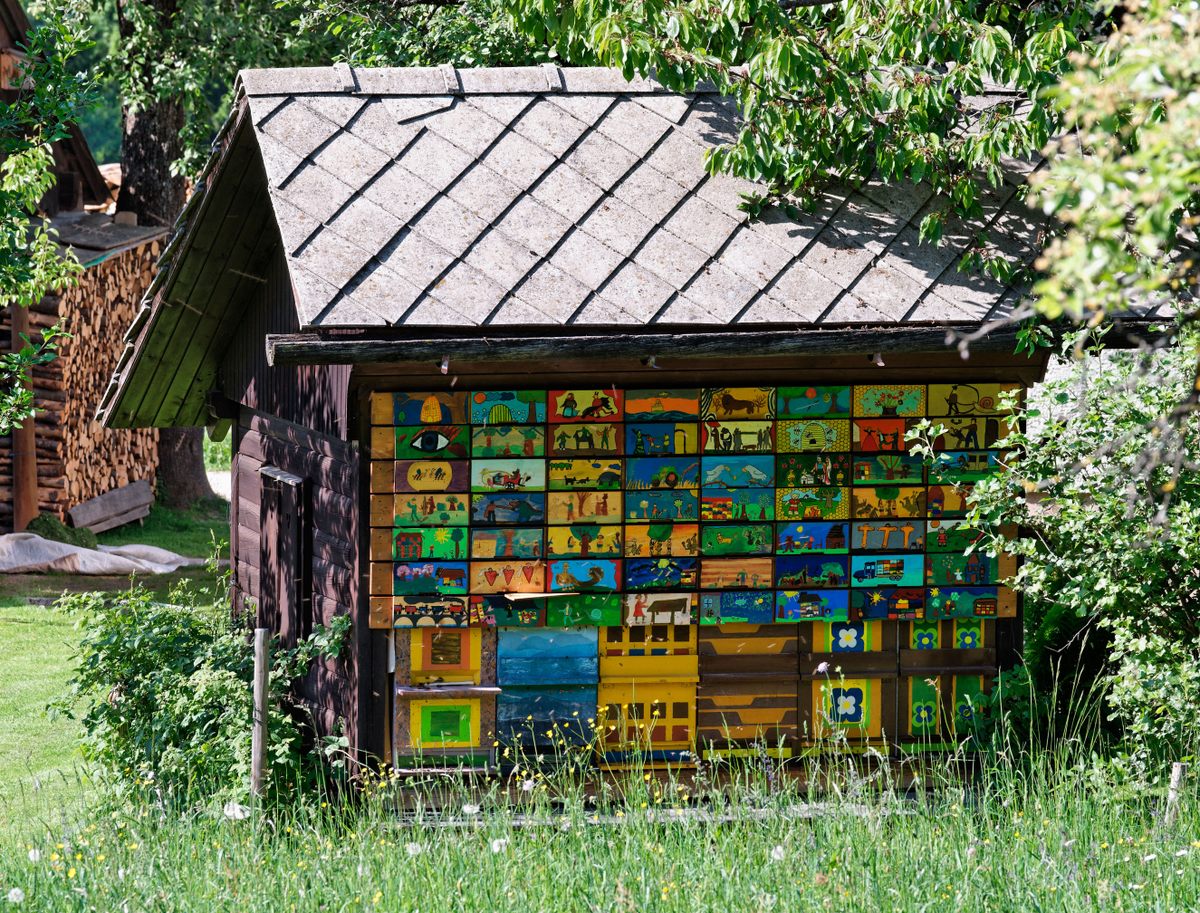
Dating back to the 18th century, AŽ hive panels depict stories of marriage, damnation, and daily life.
Atlas Obscura
191 points · by Thevet · 3y ago · 30 comments
I visited an apiary in Slovenia a few years back, and they were testing out "bee therapy". There was a room with a bed next to the beehive wall, and visitors could pay to take a 90 min nap surrounded by buzzing bees. It was thought to provide relief for depression. Wish I had tried it, the buzzing echoed really nicely when you were inside.
The sound of wasps compares to that of bees like the sound of a broken Vespa against a Harley Davidson.
But maybe it is me being a professional in the audio-postproduction field.
Vespa: pun intended?
The sound of a single wasp around me still triggers that fear, but I can mostly tell the difference from the sound of a bee now. Unlike wasps, who I still believe are just evil bastards, Slovenian bees are very friendly and will even let you pick them up and pet them.
For anyone surprised or unfamiliar, that’s the weight of an entire box with 8-10 frames, not the weight of a single frame—while that’d be delightful in terms of honey production, it’d be miserable when doing hive checks, etc.
During this particular trip I noticed early on, the constant presence of bees .. whether it was a small swarm moving en masse across the sunny sky, or a small lane of bees flying above our heads as we walked through their flight corridors.
It wasn't until later in the visit that I discovered that Ljubljana has a special relationship with bees, and in fact as a city has integrated beekeeping throughout the cities parks and public places.
It truly felt like the bees were just normal denizens of the city going about their day - with things to do, places to be, just like the rest of us (although I was in tourist mode) .. and the cities many gardens and flower fields made a lot of sense as I learned that Slovenians have a lot of respect for these wonderful, delicate, super important creatures.
If you get the chance to visit Llubljana, its an unsung gem of this part of Europe in my opinion. Be sure to learn about the Bee Path!
https://www.ljubljana.si/en/ljubljana-for-you/environmental-...
Another article about Slovenia's beekeepers: https://www.nytimes.com/2023/08/19/business/beekeeping-compa...
“If you overcrowd any space with honey bees, there is a competition for natural resources, and since bees have the largest numbers, they push out other pollinators, which actually harms biodiversity,” he said, after a recent visit to the B&B bees. “I would say that the best thing you could do for honey bees right now is not take up beekeeping.”
https://www.nature.com/articles/s41598-019-41271-5
Honeybees disrupt the structure and functionality of plant-pollinator networks
... results show that beekeeping reduces the diversity of wild pollinators and interaction links in the pollination networks ... High-density beekeeping in natural areas appears to have lasting, more serious negative impacts on biodiversity than was previously assumed.
https://www.frontiersin.org/articles/10.3389/fevo.2022.76795...
The Diversity Decline in Wild and Managed Honey Bee Populations Urges for an Integrated Conservation Approach
Using honey bees as an example, we argue that several management practices in beekeeping threaten genetic diversity in both wild and managed populations, and drive population decline.
https://www.ncbi.nlm.nih.gov/pmc/articles/PMC7708548/
Why bees are critical for achieving sustainable development
Bees comprise ~ 20 000 described species across seven recognised families ... Fifty bee species are managed by people, of which around 12 are managed for crop pollination ... Wild bees contribute an average of USD$3 251 ha−1 to the production of insect-pollinated crops, similar to that provided by managed honey bees
https://www.ncbi.nlm.nih.gov/pmc/articles/PMC5722319/
Do managed bees have negative effects on wild bees?
The majority of reviewed studies reported negative effects of managed bees
https://www.nwf.org/Home/Magazines/National-Wildlife/2021/Ju...
“Keeping honey bees to ‘save the bees’ is like raising chickens to save birds.”
https://www.nature.com/articles/s41559-022-01847-3
Greater bee diversity is needed to maintain crop pollination over time
Not to mention rock art of honey collection from bees dating back to 7000BC in Spain.
https://en.m.wikipedia.org/wiki/Western_honey_bee#Domesticat...
How does that compare to intensive agriculture and pesticides? Seems like the honeybees impact would be marginal then?