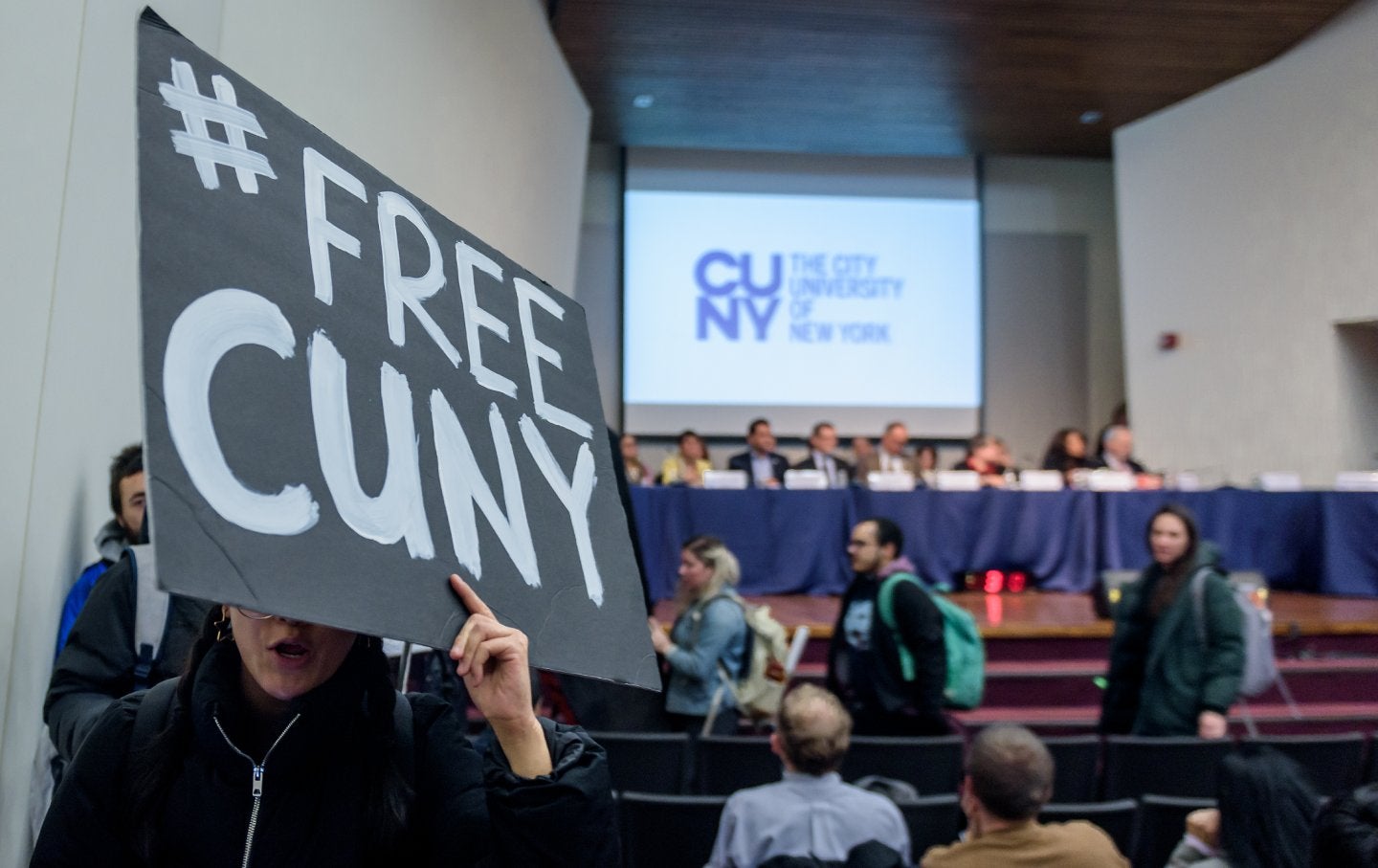
Stop Arguing Over Elite Schools. Just Make Public Colleges Free.
College tuition and fees have metastasized, hitting an average of nearly $11,000 a year for in-state students who attend public four-year institutions.
The Nation
177 points · by paulpauper · 3y ago · 279 comments
Wouldn't be here today without it. My parents couldn't afford anything but the closest and shittiest university, with no compsci program (they only had a business computing program, which taught only COBOL, in 1999). Instead I went to UL Lafayette, which had an actual program, got a room/board merit scholarship, worked through the summers, and graduated debt-free with two degrees.
It still didn't accomplish the state's objective of keeping college grads in state — the in-state company I lined up my senior year moved after the governor line-item vetoed a tax incentive, and I wound up in the northeast. But if not for that my career would've probably started working on legacy systems in Arkansas instead of startups in New England.
Not saying its the right way, but grew up without a lot of financial resources, no money specifically to pay for college, and I went to a private 4 year engineering program starting in 1999 by taking out boat-loads of loans. Going into school I had nothing and needed 100% of my tuition covered by loans, grants, or scholarships.
I was reasonably confident that having an engineering degree would allow me to pay back the loans (it did, but it didn't go as smoothly for all of my classmates).
Based on my experience, I don't really understand the idea of not being able to afford college (at least for degrees which will put you in reasonably paying positions). Am I an outlier? I doubt it. I didn't go to a particularly well known school, but was able to figure out employment and self-sufficiency. Now I have the pride of finishing a relatively difficult program and paying for it through my own labor.
Medical professionals, engineers, and the like have so many opportunities that it's not clear why we should subsidize their education. Educators, on the other hand, have to pay the same price for a degree, have to have continuing education, and then get paid crappy wages. While I'd rather reward them on the back end with better benefits, if there is a program worth subsidizing, it's probably educators.
Put another way: when everything goes right, you can just barely pay for private college yourself. As soon as anything goes awry, all bets are off.
You're right though, about increased tuition, and it's easy loans that cannot be discharged that are one of the major culprits, but living on campus at a public university costs as much as my private tuition plus room/board did 20 years ago. Inflation adjusted, it's 55% of what I paid and starting engineering salaries are 250% higher than when I graduated (it makes me a little sick to see what college hires make ;-) ).
This isn't true for maybe 90% of the degrees a university offers. I would never suggest anyone take out a loan for a degree that wouldn't pay for itself with low risk. This includes degrees that are undervalued (teaching, for example).
That was almost 25 years ago. A lot of things have changed since then, mostly for the worse. Being young today is intense. Massive student loans(unless your parents are wealthy), extremely expensive rents(unless your parents are wealthy), 10% inflation, etc, etc, etc.
Why you should subsidize their education? Because it makes your civilization stronger. You want an educated citizenship for every possible reason there is.
While I agree that the costs have been continuously ballooning and certain things got somewhat worse, their story isn’t just some “back in my day” tale. I graduated college 6 years ago with very similar circumstances to the ones described in that comment.
Georgia Tech, public state school, in-state cost of tuition was around $5k/semester (without any financial aid), got HOPE/Zell Miller scholarship that essentially covers full tuition at any public state college if you maintain a gpa of 3.0. And with some hefty nice gpa bump modifiers for STEM classes that were introduced closer towards my graduation. E.g., so if you got a B (aka 3.0) in your intro to physics, it would count as 3.5 for the purpose of the scholarship eligibility. This wasn’t a school-specific policy, this was the state deciding that for all schools, and it expanded access to the scholarship for even more students.
On top of that, I was fortunate enough to get an RA job after my first year for fall+spring semesters (while interning during off-season), which essentially provided free housing. And while this is not something everyone can do (as the number of RAs needed is limited), HOPE/Zell Miller scholarship covers absolutely everyone who qualifies.
And many states have somewhat similar programs. Can’t speak for all, but one off the top of my head is Florida with their Bright Futures program with somewhat similar requirements covering tuition too. Thanks to this thread, I learned about the Louisiana one too.
I have no problem taxing wall street or "the wealthiest Americans", but I don't see the connection between this proposal and this funding source. It feels like taking money away from people who don't vote for you, and giving it to people who do. That's a bad direction to go down, and I'm generally skeptical about politicians who do this (which is a lot of them).
My gentics and life experiences have shaped me into a person with the opinion that, for communities beyond Dunbar's Number of members (400? The point is that beyond a particular size for each culture and group of individuals things like laws, regulations, government entities, etc become necessary because we can't settle our differences well enough), taxes are generally a good thing, especially when spent on infrastructure, health care, housing, education, and food- basic needs that benefit everyone and reduce acute stresses that bring us all down, even if they're not in your backyard.
How much money or access to resources do you feel like is enough for you?
What's the value proposition in caring for, and lobbying for, the collective health of all people under the USA umbrella?
To what extent is it okay that we still, in 2023, benefit from legal slavery? The 13th Amendment keeps costs down for my military uniforms, for example, and keeps consumer prices lower than they might be if we paid workers a fair wage rather than assuming they're only value is as enslaved prisoners.
Wall Street money games are on the backs of people who help meet our basic needs. It is a height of entitlement to think that I should be able to benefit from their labor without paying for it with a progressive tax just because I want to play the game of "amass more and more money".
"A rising tide lifts all boats", and that sort of thing.
Is it due to lack of data? Politics? Greed? Pressures from business / "the rich" / orthodox academia to maintain the status quo? All of the above?
I just get the feeling that the world isn't necessarily a zero-sum game anymore, but nobody whose sum is currently far greater than zero wants to admit it.
https://youtube.com/watch?v=tMZ2j9yK_NY
I’m imagining the computer guru presenting his plan to Congress: “my 100% infallible computer model says here’s what the tax law should be. Please overhaul society now and make sure you don’t let any of your prior opinions cloud your judgement now that the computer has told you what’s best.”
Computational models are models: they work best with systems we already basically understand the rules to or can at least approximate. Like weather or physics.
Economics is a social science. Economies are incredibly dynamic systems because they’re made of people. Every change to the system causes the participants to change their behavior. People are significantly more complicated than Game Of Life gliders. A model that can correctly simulate the economy requires strong AGI or magic, neither of which have been invented yet.
But measuring wealth as a pre req to implement a tax is really hard. You can assume that wealthy people own the wealth generating assets though basically by definition. A 0.1% tax on financial transactions would affect very little in the average Americans life. It would matter immensely to people who derive their income largely by sitting back and collecting economic rent.
I mean, a 0.1% tax on financial transactions would kill day trading, and I'm not sure anything would be lost. But if your goal is to tax the rich, then tax the rich, not financial transactions.
Taxing the rich is incredibly hard because first you need to quantify how rich everyone is.
Someone going to night school to get a learn something and get a degree has large positive externalities .
So think of the the reverse of a pigovian tax where you tax people doing things with negative externalizes. Here you subsidize people doing things you do want and tax everyone else who might benefit to pay for it.
What we will end up with is higher cost of doing business and 100% for certain federally run universities will still need taxpayer bailouts every single year.
Lose lose all the way around.
I have an even better idea: get rid of all freebies. If someone wants something, they can get off their asses and work for it for a change.
you really do not want to live in a country where that is the case.
only education can lead to prosperity of the whole population. and the more educated people you have, the better off everyone is.
i am gladly paying taxes for education, because i know in the future i and my kids will benefit from everyone around us being smarter.
Yep, taxes are a little bit worse than that too because the cost also gets passed to the producer as well in the form of decreased demand.
The result is fewer goods and services exchanged - ie less economic activity - than there would have been with a lower tax.
Formally, it is called deadweight loss in microecon:
You might look at this from a national security angle. Did you know that the largest category of recruit disqualification in both WWI and WWII was malnourishment? Did you know that our technological 'edge' comes out of public universities? We don't want a small pool of healthy Americans to call on, we want the Roman ideal of a sound mind in a sound body for every citizen.
I'm trying to follow this logic, but I'm struggling. Do you think that people should be able to opt out of taxes by just not voting, or voting for a third party that never wins, or strategically trying to vote for the minority party in an area that heavily leans in a certain direction? I think your interpretation of this also assumes causation in a direction that isn't at all obvious; does he want to tax Wall Street because they won't vote for him, or does Wall Street not vote for him _because_ he wants to tax them? I'd argue that Wall Street isn't likely to vote for anyone who proposes a policy to tax financial transactions, but that's far from sufficient to conclude that such a tax is unreasonable.
It's easy to suggest taxing people who aren't in your target supporter base.
A bit on topic, if this trend is as strong as it appears to be (many people I talk to see the same thing) then it really shows an over valuing of elite schools and frames this entire argument a bit differently. It would make sense that this should happen too, as teaching positions are highly competitive so there's a strong trickle down effect. You routinely see at low ranked schools professors from high ranked schools (often in a soft retire, for location, or in a junior position). It would make sense that quality levelizes when a single top ranked school produces more PhDs than there are positions to fill nation wide. And on top of the general _trend_ that you can only work at a university lower in ranking than the one you attended (immediately post graduation).
The only things top school really do is gate-keep who is allowed to get in, providing as a consequence some sense of exclusivity. The quality of education does not seem to be that different. And even if it was, it doesn't matter that much in a field like CS that is mainly self-learned and gets reinvented every decade.
We collected several hundred resumes from each. Only the best resumes from UT Austin were as good as the worst resumes from MIT. But, talking to the students and interviewing them revealed that the quality distribution, in terms of what we wanted to see in interns and new grads, was much harder to tell apart. My conclusion was that the MIT admissions process did a great job of selecting for people who present themselves well on paper, probably because admission is so competitive. Both schools offer a great education for those who take full advantage of it. And we wanted to hire from that pool of people, regardless of school.
It gets worse because this metric hacking is everywhere. As a researcher I honestly believe that were I at a higher ranked university more of my papers would be published in conferences (instead of arxiv or dead), I'd have to refine less to get published, and I'd have double the citations (university evangelism. Just being a MIT student will get you more Twitter followers than being a UT Austin student, so more people see when you post about your work). None of these things have to do with the actual quality of the work. Though of course, they can also tend to do "better" work in the sense that they have more resources. In a world where we have ill-defined goals and metrics compute becomes a large edge because instead of performing nuanced analysis you instead perform a more exhaustive analysis (the sledgehammer approach). Which is not necessarily better, though can (often) have lower entropy.
As I posted in a sibling comment, measuring and evaluating things is insanely hard. Idk why as our world is increasing in complexity we've adopted to simplifying things more and more. Maybe the double edge sword of access to knowledge is feeling more knowledgeable than we are.
This way it aint as relevent where you went, but what your score was, so people from the "bottom" can bootstrap themselves easier.
In India there's such a thing
>Graduate Aptitude Test in Engineering (GATE) is an entrance examination conducted in India that primarily tests the comprehensive understanding of undergraduate subjects in engineering and sciences for admission into postgraduate programs.
I'm not sure exams are good at measuring actual abilities. Measuring things is an insanely difficult problem that isn't given enough credit. All too often people think it is just to perform an experiment and measure the outcome but this is really only a tractable when we have a well defined mathematical theory to test our results against. Most often in the real world this is done empirically and in these cases there are loads of assumptions that are being made and often not realized being made. Assumptions that are highly impactful. They come from the data that is being measured as well as the metrics being used to measure them. Remember, metrics are models too, and like all models are "wrong."
I'll give two points of evidence to why having a testing system is likely ineffective:
1) These elite schools already have exams that correlate strongly with who is admitted. This gives evidence that exams like SAT and ACT or even the GRE do not do a good job at filtering the issue given the downstream observation.
2) You mention India and the testing structure. Several other countries have similar structures. Personal beliefs aside[0], the fact that India and other countries do this already results in a baked in effect into the US job market. Presuming the effect that I and others are observing is real, then these too look to be ineffective metrics. Since these metrics are likely going to correlate strongly with university rankings as well.
[0] Side note, I do not think these systems are good for countries. They appear to be highly ineffective and just promote gate-keeping. They additionally create a lot of strain and pressure on the society because they result in career bottlenecks. Without these systems people have larger opportunities to change later in life. People make highly effective career changes even into their late 30's but these tests are usually performed on people under 18.
[1] Other note: meritocracies are flawed at the core due to many effects and this can be quite counterintuitive. First off is the well known Goodhart's Law, where systems optimize the cost function rather than the intended goal of the cost function. This is seen in India's famous Cobra effect, reinforcement (and other ML) learning models, bureaucracies, and so on. This is because the metric is not perfectly aligned with the intention behind the metric, which is often ill-defined and static in nature compared to the dynamic solution space. Aligning metrics is nearly impossible and has only been achieved in the most simple of cases. To learn more take any optimization class, learn about optimal transport and non-convex solutions. Metric hacking is quite common in the wild and we should be really aware of it. This even happens in the precise example we're talking about. I'm sure you've known people who are really good at taking tests but are not so good at generalizing their knowledge (using it in the real world or adapting to new situations). It is because they overfit the cost function. Remember, costs functions are models too.
So the question here is about how to properly evaluate things (distinguishing from measuring). Evaluation requires nuance and processing the data and metrics. Most importantly interpreting them (this is where bureaucracies fail and why everyone hates them. Lack of nuance). The truth is that this is always fuzzy and inexact. The only real way to perform this properly is to incorporate noise and uncertainty into your evaluation method. Not to remove it completely, but to acknowledge it and have it play a role in your model. You should of course remove as much noise as possible (reduce), but you can never reduce it to zero and if you remove it from your model you won't be able to capture your uncertainties. These problems only get harder as we move into multi-dimensional data (things we try to measure). High dimensional spaces are highly non-intuitive and the geodesics are not going to be what you expect. This is actually a relatively new area of mathematics and it would be extremely naive to think we have a good understanding of this. (not to knock on the great work that people have done in these areas, but these are fucking hard problems and we haven't had as much time)
Why somebody from $top_school should have an advantage just because he/she went there, not that they were better?
If I went to $no_name school, but put effort and scored well, then I advertise myself with "scored well", meanwhile now I cant.
No system is perfect, but at least there's minimal amount of bias in standardized tests.
You would think that there would be arbitrage here on the part of employers - find more people from non-elite backgrounds who are actually competent. And surely they exist, but they don't have a way to signal it. Application queues (for jobs, grants, etc.) are already incredibly long. Good luck finding the competent people in the pile who can't signal it.
That doesn't mean it should not be done - but the magnitude of the investment should be made clear.
Or, a mix of increasing the level of state/federal funding and closing down a portion of the roughly 1900 public colleges[1] around the country. Unfortunatley, as soon as this approach is used, then the "access" problem rears its head since public colleges that are shutdown require more students to commute/reside further away from their home towns.
Let them charge what the market will bear and let them accept students within the same framework that any other business follows when determining what customers to work with.
Part of what makes so-called elite schools elite is scarcity, so even if you completely rewrote how they operate, the number of actual students affected would be too small to move the needle anyway.
This doesn't mean that "people's biases are wrong, therefore the consequences are irrelevant." It means that the choices made must account for those biases. The choices we make regarding merit laundering, must account for people's biases toward graduates. We would be fools not to.
Eh, I don't know. Those schools transmute money into networks for sure, but the degree they do it for merit seems drastically less, perhaps it's even initially a negative at first. I mean, the lazy rich kid who got into Yale because of daddy is such a well-established stereotype now that it's almost the default expectation. :)
The reputation of elite institutions is a product of them mixing in just enough bad[sons and daughters of the elite[1]] with the meritorious[high student performers] that it's not worth it for us to sort it out ourselves and doesn't damage the reputation of the institution.
The lazy rich kid to you, may be the perfect candidate to a VP hiring for an influential role. I'd be hasty to generalize your own perspective to those who are filling those seats.
I brought up merit laundering for a reason: offering free public institutions reduces the merit pool for elite institutions in a way that reduces their efficacy in laundering merit.
The meritorious care far less about the reputation of elite institutions than the elite do. After all, the launderers gain more from cleaning the dirty money than they do from dirtying the clean.
The success criteria seems to be "enrollment", which leaves a lot of room for things to go wrong. No downsides are mentioned aside from cost, which is dismissed with a tax that sounds like free money.
i can think of two: one is the quality of the education. if it is to low and everyone graduates without having learned much then that would be bad.
another is having to many graduates without jobs.
but both can be fixed with more quality and being more demanding. one benefit: when you don't pay for education yourself there is no pressure to let you pass classes just to get your money.
There is no entrance exam required for students who have a Swiss high school degree that qualifies them to attend university at all -- they may simply enroll.
The trick is that the first year or two are made extremely difficult so many people drop out. However, tuition is so low that this is not really a disaster that derails your whole life.
The low tuition only applies if you enter before you turn 25 years old. And Zurich is very expensive to rent a room.
Even once in university, you only get one chance (you should see the crying on results day), if you want to redo a year, you can do it in Germany (closest) or France/Italy that do allow it. Which of course is anything but cheap, as a non-local you do not qualify for any kind of aid.
But sure, what you say is correct, tuition is not that high and if you really try, yes you can get through it as a very poor person. But one mistake and it'll take you a very long time to claw back, and a lot of money.
(this is about ETH Zurich, EPFL is similar, but not quite as bad)
Compare to MIT which is about $40,000 a semester, with the average student after financial aid paying $20,000, and is in Cambridge, a city where rents are about as bad as Zurich (although most students live in MIT dorms). if MIT failed out 50% of their class with $40-80k in debt, this could not be tolerated.
This does not consider that you'll need to actually attend this course, either in the evenings (min. 10hrs per week, for 2 years), during which you'll have living + ... expenses. Attendance is mandatory, and frankly it's the only part that I can imagine you'll fail.
Because passerelle is waste of time (look up the course ...) you're much better off getting a degree in Munich or Stuttgart, any will do (any bachelor degree also gets you admission to any Swiss university, regardless of language, but of course that doesn't help to get you your first degree). You can for example get a philosophy bachelor (which you can get for 800euro + attending the exam once, and while I'm sure it's possible to fail this course, you'll have to fail it a lot before you run up the 40000CHF bill it costs in Zurich to get admission to university, plus it's so easy I suspect a dead cat might pass. Can be fully studied in an afternoon). But passerelle is what you're supposed to do in Switzerland, as a Swiss. A lot of people do it this way. (note: a non-German bachelor will only get you admission if you also present a Goethe C1 or C2, or a some school finishing certificate from a German school)
That gets you ONE chance. If you fail any year in Zurich at any university, you can't continue studying at all.
This is ignoring the demands of the university itself, the one you want to get into (ETH Zurich), has extra conditions which they publish one year in advance.
And even that isn't the end of it. If you're studying a "desirable" degree, like medical doctor for example, there's many more traps to fall into. At that point you might want to consider just studying entirely in Germany, without even trying in Switzerland, even if by some miracle you actually satisfy the conditions.
Lastly, the government is looking to limit enrollment further. So I, for one, expect these requirements to become more onerous over time, not less. The goal of these regulations is not what the regulations actually regulate (there's funny idiotic parts to the rules. For example: German Swiss degrees count as proving your German language skills ... even when the classes are in English, like most scientific bachelors are). Also, for example Passerelle is effectively a local jobs program, at the expense of university students. You will not learn anything in the course.
But yeah, tuition is pretty cheap, even the auslander rate. Great.
course work is so easy that if school was largely free for applicable courses tye jobarket would get Very swamped.
My university only charged you for retaking exams (after 3 tries) and for redoing a year, if you didn't make a baseline of credits. 1 re-do was free. You can re-take any class for free as long as you're enrolled. I used this to take classes from past years that I didn't pass.
While I'm a bad example of using free schooling well, this is exactly the sort of thing taxes should pay for. If the world's richest country can't pay for schooling, ...
edit: I also remember various professors explaining how paid tuition and good education are opposites. You can't have good education with high standards, if people expect a return on their investment (a degree). How can you look someone who paid $100k in the eye and say "Sorry, you do not meet the bar. No degree"?
Good schools with high standards can be delivered with or without paid tuition, and the same for bad schools with no standards.
If you had good enough SATs, you can often get full scholarships to your state's public universities. Other states' schools as well, although to a lesser degree—it would be more selective, like scholarships for private schools, since public colleges obviously prefer to subsidize their own states' residents over others, given equal test scores.
This author wants to talk about broad access to education instead. They note correctly that there are really not that many people who are affected by these policy squabbles and far more who benefit from getting access to higher education of any non-elite quality.
The students who accumulate crippling debt usually attended second and third tier private colleges. Those are generally a terrible value.
In San Francisco, where I live, some in the community are challenging smart kids tracking into exclusive experiences in public K-12 schools.
Among people who are eligible for tracking, tracking seems really popular. But the plurality seems really unhappy with it. So there will always be XYZ, a word I cannot use, in communities to de facto track in public schools, or sometimes there will be legacy admissions, or whatever.
Maybe you don't believe these stylized facts. Like you already sound like the same people in this community who want to end tracking: us vs. them. I know you probably don't actually want that, but you're the perfect example of a tipping point, expressing an eensy weensy amount of resentment for "elite school buddies," that somehow winds up in "end gifted programs." Surely you see that.
Quality of education alone is hard enough to control for. What’s stopping the for-profit elite schools from just raising the bar until public schools simply can’t keep up?
If MIT and Stanford raise the bar on education, isn't that a good thing? Don't we want them to be giving the very best education that they possibly can?
Part of what makes a school "elite" is admissions selectivity, research output, and academic reputation. Making undergraduate tuition free for public colleges will still make private target schools still elite and put additional admissions constraints on top public colleges (UMich, UVA, UC Berkeley, UCLA, UT Austin, and the likes), and ironically make them more "elite".
Also the problem isn't just the affordability of schools - it's affordability of schools for certain classes and enrollment limits for desirable universities.
Rich students will be able to pay for elite universities out of pocket. Poor students will be able to afford through financial aid/scholarships at elite universities. I don't have the numbers with me top of my head but most elite universities often have financial policies that cap loans at reasonable amount and give grants to cover the rest. It's the middle class that gets squeezed because they don't make enough money/get enough assistance.
I guess this in the USA this is an insider/outsider problem where "elite" school insiders prefer other "elite" insiders over other, potentially equally capable candidates.
The difference is that most European countries didn't have private universities.
And if you go to Western US states, you'll see similar recruiting elitism from top public schools like UCB, UCLA, and UT Austin.
First off, make it tax payer funded is what they mean. And no thank you.
Second, we already pay for 13 years of school, why would I believe 4 more years would help? Who is out there championing public school is the excellent model of education?
13th grade is not a solution to anything.
It’s clear to me we are facing a complexity crisis and almost no one sees it.
People that don’t belong in college aren’t going to be better off when everything is too complex for them as is, and getting worse.
A tech at Jiffy Lube needs to know so much more than 20 years ago, but the kid isn’t any smarter at all.
The guy pouring concrete needs to know a lot more, paying for his degree won’t help, but it will take 4 years of experience away.
IDGAF about “elite schools” if you someone took those away, the rich would self-sort another using another method.
The issue here is we aren’t ready to say “we’ve made most of the world too complex for most people in it”. And so have no remedy for that.
That comes with its own suite of issues, of course.
Huh? How so? If the only change is that you no longer need to pay for college, but otherwise admission standards and education quality remain the same, then why would the value of a diploma change? Unless the diploma was implicitly a signal for wealth, of course...
If a job has a high wage because they require a specific college degree, then making the degree easier to get since you don't have to pay for it, then there will be more people with that degree, so the supply of workers is higher, making them easier to replace, so the wages of those workers goes down.
A lot of presidents have come from this public school. It shows that just making it public does not really fix the problem of lack of social ascension. With the fierce competition children that get access to private tutors and financial support have the edge.
The article argues that public colleges being free "[...] will alleviate the student debt crisis and enable low-income students, particularly those of color, to go to college."
Your point about elite schools still existing can (and will) be true at the same time in this hypothetical universe where US public college tuition is free.
The US also spends a lot of money on the military. Whether prudent or not, at least that spending produces an objectively superior product. We spend even more on education with ambiguous results.
It is high, but not exceptionally high[0]. It is then worth remembering that the US overcounts spending on primary and secondary education relative to peer countries because we lack most of the social welfare programs that exist in peer countries and effectively funnel welfare services through the education budget.
As an example, if you have a severely emotionally disturbed child the school district might spend ~$100,000 a year to house the student elsewhere[1]. In Norway, this problem would be budgeted under social services, rather than education.
Numbers are further inflated by increased cost of living relative to most peer countries[2]. This is effectively a dead-weight cost for which we receive no additional benefit. Since Labor is the biggest cost for schools it greatly impacts cost of education.
[0] https://www.statista.com/statistics/238733/expenditure-on-ed...
[1] https://lao.ca.gov/Publications/Report/4110#:~:text=Special%....
[2] https://worldpopulationreview.com/country-rankings/most-expe...
This view (https://www.usaspending.gov/explorer/agency) suggests Defense spending is $1.1 trillion in 2023 while Department of Education funding is $208 billion.
That does not include college funding.
You're comparing apples to oranges.
"The US spent $877 billion on military in 2022, a new report says — more than 10 times federal education spending"
https://www.businessinsider.com/us-defense-military-budget-c...
Nice. Didn’t think I’d see “bombs over books” argued so early in the morning.
Also the military runs training programs which are probably more practically results oriented and efficient than most college programs, so maybe the Army could take over the function of general public education :)
This kind of opportunity would have allowed me to finish my education sooner, or at least enjoy it more. As it was, I worked full time every summer since I turned 16 and then 30+ hours a week while I was completing my bachelor's degree and taking classes year-round. I got my degree from a private school, but transferred in about 25% of my credits which reduced the total cost significantly.
It sucked and I missed out on a lot of experiences during that time period BUT I had a minimal amount of debt when I graduated.
For better or worse, indebting people at a young age is how the "college educated worker" pipeline works and the class system functions and controls upward mobility. Not to mention military service.
If you are ok with mandatory military service and more stringent and competitive college entry exams as well as the government telling you based on your score what degrees you can pursue for free, now all you have to do is convince this union of 50 different states to agree with you and it is doable.
Even though college is paid, you can still get plenty of well paying jobs without college or work your way up by gaining experience to compensate for lack of college. This is only possible in America. It doesn't matter how much skills or experience I have, no one will hire me in the EU or Asia based on lack of degree alone for example, but even if it is 10+ years, I can make up for it in America.
I am just saying it isn't as simple as they're making it sound.
in germany this is solved by allocating a number of slots for each degree. those slots are then filled with the best students first, until all slots are allocated. the score that you needed to get in was effectively the lowest score of any student that did get in. this means that in one year it could be that you needed an A to get into eg physics and in another year a C was enough. so it's very much supply and demand, and better grades give you more choices.
Personally, I like free college but only for very specific degrees where is demand and having a degree makes sense. Like IT shouldn't be free but medicine or law should, because you can learn IT on the job and it is more close to a trade you can apprentice in. Where apprenticing or learning on the job makes sense, degrees should not be subsidized and pursuits like philosophy where there isn't any economic demand for the degree should be paid by the student.
especially for IT which can easily be learned in a school setting unlike some other professions where learning on the job is necessary.
learning on the job in IT would work if it is a formalized apprenticeship so that trainees are motivated to stay for the full three years that this usually takes and don't have an opportunity to run away for a higher paying job after the first year.
for your last point i pretty much agree with you here: https://news.ycombinator.com/item?id=37743011
Source: I teach college.
What if state schools offered free online tuition?
Cheating would be an issue, so we make the students take some tests in testing centers (like we did for industry IT certs before the reaction to COVID-19 started.)
We gradually automate as much as we can using tools like AI.
It would also be interesting to see how the government deals with the often-immense income from college athletics programs (football, basketball, etc).
Let's say public universities educate X students at a cost of $Y. If the government says "We can't pay $Y, we'll pay $Z", then the universities will almost certainly say "We can't educate X people for $Z, we can at most only educate $Z * X/$Y people for $Z". Then the remaining slots are for sale to the highest bidder, who will on average be able to pay more than the average of all X could, because they're the highest bidders.
More generally, those who have to pay for themselves are in general more price-sensitive than those who have someone else to pay for them. That's true of the students who have the government to pay for them, and it's also true of the government who has the taxpayers to pay for them.
They already have a close relationship with their political representatives, now imagine that plus large amounts of campaign donations and favors.
And YOU, you support this?! Why, it would degrade the quality of education students get now! /s of course
1. Young people should be able to get a quality education regardless of their families' financial situation.
2. Everyone should have an equal shot at attaining positions of power in society (not so much for their own good, since almost nobody is going to attain these positions anyway it's a small benefit relative to the total population, as for everyone else's good - we don't want to be governed by a hereditary caste).
For (1), you want high quality free public colleges (elite institutions are simply too small regardless of what you do with their admissions process).
For (2), you need to make sure admissions at elite institutions is equitable (most important priority: ban legacy admissions).
Colleges (public or private) are too good at absorbing any money that is made available to them, to be trusted as being fiduciaries of public education, IMHO. As student loans and public money are made available, they have raised tuition to fill the gap without providing any additional benefit for their increased incomes.
For the second one, the only thing that mucking with a private institutions admissions process will do is turn it into a public institution that is no longer elite. They're private, let them do what they want.
Do you also feel this way about public high schools? Personally, I just think that a world in which everyone has access to education is a better world for everyone.
> Colleges (public or private) are too good at absorbing any money that is made available to them, to be trusted as being fiduciaries of public education, IMHO. As student loans and public money are made available, they have raised tuition to fill the gap without providing any additional benefit for their increased incomes.
Agreed, but this is a problem than can and must be solved. Public universities are nowhere near as bad in this regard as private ones and are thus the best place to invest.
> For the second one, the only thing that mucking with a private institutions admissions process will do is turn it into a public institution that is no longer elite. They're private, let them do what they want.
Private universities are deeply embedded in our society as gatekeepers to positions of power and thus the public has a legitimate interest in how their admissions process works (not to mention that they receive large amounts of public funding). If getting rid of legacy admissions means that they are "no longer elite" (to be clear it should make them more "elite" in terms of actual research and academic performance, but possibly less elite in terms of controlling access to money and power) that's an outcome I'm happy to see.
Have you also bitched about private schools not being allowed to use affirmative action for admissions, or were you only too happy to read about the courts interfering with that as well?
Equality is the term you're looking for.
If you actually believe that legacy admissions are a fair and impartial way to decide who gets to go to Harvard, I'm not really sure what to say.
How do you make something equitable? You need to think through the process of how that works. It's every bit as "fair" to gift admissions to family members as it is to someone because they're a different skin tone. Which is to say, both are stupid.
How about we give people the resources and they can prove they deserve it through merit?
The article fails to make a case that the stated problem, "tuition and fees have metastasized," will be addressed by "tuition-free public higher education."
Second: If prices are out of control, so people aren't going there because it's too expensive, maybe the answer is to let supply and demand do its thing? This proposal takes universities that are too expensive, and looks for an alternate way to pay them anyway. That's not the answer - or at least, it's not the answer to the problem that they say they're trying to solve.
Find a way to lower the cost of college, rather than changing who pays for it. (We can also talk about who pays for it, but the solution to the stated problem is to find a way to undo the insane increase in college costs.)
>>[...] Last year, as enrollment stagnated or declined in other states, New Mexico posted record gains. From spring 2022 to spring 2023, overall enrollment grew by 6 percent, and it jumped nearly 12 percent at branch community colleges.
This entire article conveniently omitted the fact that another driver for plummeting undergraduate enrollment is the "enrollment cliff"[1] that has already started to affect colleges across the board.
Yes, affordability is a large factor, and it's great that New Mexico was able to increase their enrollment numbers (as the article stated, a true anomaly), but the demographic backdrop should have been at least acknowledged.
[1] https://www.vox.com/the-highlight/23428166/college-enrollmen...
The U.S. pubic universities are arguably superior to the private ones already in aggregate, we just need a few flagship schools to take the crown of "very best".
If someone has done well in school and wants to go into a stable, well-paying profession, it's probably the only area (besides a mortgage) that I'd recommend taking a loan. I paid zero dollars for four years to go to school and live and eat on campus.
Going into an engineering program, the risk was relatively low that I would not be able to pay it back while still in my 20s (which I did). 20 years later, while the cost of the degree was high the opportunities that it made available were beyond what would have been available without it and payback was amortized over time.
It just seems like there's endless excuses to write off empathy & countless "I did it and so can others" anec-data, that doesn't reflect on what has become of a social opportunity both for the student, and for society to invest in & improve itself, in the long term.
Think a world where colleges have to take more responsibility in making sure the loans they demand can by paid back would result in a better system where more people who leave actually end up earning amounts that justify what they loaned to go there.
funding of the schools can be made dependent on the taxes that the students pay once they are working. it's a long feedback loop, but i think it could be the right incentive.
Just create a subsidy and regulate the colleges that agree to be subsidized. Make it fully voluntary but also give the participant colleges a special badge to let people know that the college is federally funded and therefore has to provide various information to the students or possible put a maximum loan cap on the student, and if the student is making progress and reaches that cap then the remainder of their education is free of charge to the Bachelors level.
What you're suggesting would work well, for an industry not designed to milk every bit of money from their 'subscribers.'
Colleges are profit driven. Free doesn't drive profits.
Lots of people are redirected to trade programs. I'm definitely of the opinion that for a lot of folks, college doesn't really make sense. I would hazard a guess that also in Germany, lots of kids who might not be able to attend college are able to, because it is free.
That has a breakdown for you.
If tax dollars are to be used then you HAVE to use them appropriately and giving out free education to a lot people that'll just fail and waste it is not a good solution.
Where are you getting the idea that you need to have good grades to attend college in the US?
What is society for if not to serve the common needs of the people?
Yes, we know, it's not "free" and is paid for by taxes. Likely even increased taxes. Everyone knows this.
And we don't have a problem with it.
I live in Sweden, in Europe. For that I (and everyone around me) have free school up to and including university studies (actually I would get paid USD 330 in grants, up to 240 weeks, plus the ability to take a loan, neither which I have to use for tuition fees).
I have nearly free health care and medicine (max costs for 12 months $120 and $230 respectively). Subsidised child care, and more.
Cost of living is lower in Sweden [1] rather than in the US, as a comparison (partially because the Swedish currency has dropped in value). But I don’t have to go bankrupt just because I got cancer and didn’t have a good health insurance or sign up for a massive debt to get a university education.
[1] https://livingcost.org/cost/sweden/united-states
https://www.numbeo.com/cost-of-living/compare_countries_resu...
https://www.mylifeelsewhere.com/cost-of-living/sweden/united...
It's not free. You're forcefully taking money out of people's pockets to support the system.
I'm from Germany that also lived in the US. I paid 300-400$ out of pocket for a 30 minute surgery with just a local anesthesia. In Germany I paid 40 euros for 30 minutes with full anesthesia 3 days in the hospital. I also had weekly check ups for 3-4 months at no out of pocket cost.
An American coworker here at had a 3-4 month old kid that had a lump on her back. Next day pediatrician. Next day oncologist. First chemo within 10 days. Never paid anything out of pocket.
I have no idea why this is the default answer whenever this comes up. It seems like you're trying to sway opinions by gaslighting what's really happening. Why is it hard to admit the term free is obviously being misused in this case to present socially funding healthcare as better?
Unless you are saying "if everyone goes, and everyone pays taxes, it's a wash"? In which case, that's not close to the reality of the situation. As a percentage of the population, attendees of in state public universities is low and always has been. If you don't think that some subset is being subsidized by the general population is good, that's a reasonable argument, but to suggest it's a wash just isn't accurate.
It’s like immigration. If you say, “anyone who comes here can’t be kicked out and you instantly get access to healthcare, food stamps, and free housing” then your maximum payout is the entire planet and you are bankrupt once people realize this.
For public college to be free, I want to limit access, like happens in Europe. Sure college can be free… to the top N people in the state, with N being decided by the payers (i.e. democratic electorate).
Otherwise it’s just wasted money as we delay adulthood for a huge number of people who have no business getting degrees.
I can understand the reaction to the cost, and many people work outside of the degree they majored in, but I do value the general education of the population. It’s been a remarkably uplifting force in society, if you look back over history.
I also wonder what that means for the competition between nations, it seems like the countries that I think are doing well really lean in to general education of their populations.
I came to college a different way, I went into the Marines first and only attended college after that. I didn’t live in the dorm and didn’t have a traditional college experience, but I am glad every day that I didn’t just have engineering classes.
personally, I don't think that giving every 18yo a full ride to study whatever they feel like for four years is a great use of public funds. I would rather see targeted funding to fill in demonstrable gaps in the labor force.
If additional people want to pay beyond the cap, wonderful. But I don’t see how the financials make any sense otherwise.
I'm really tired of being told "we can't afford to give healthcare" "we can't afford to give higher education" "we can't afford early childcare" "we can't afford maturity leave" "we can't afford guaranteed sick/vacation"
Of course we can. The powers at be don't want that because it levels the playing field, costs them some money, and ultimately makes them less powerful.
The costs of immigration are not hidden, nor are its benefits. Financially speaking and from the point of view of the state, immigrant are net negative in the first couple of years - and then they are net positive for the rest of their lives. Immigration exists because market demand for workforce exists... I always find hilarious that it is the most free market advocates who tend to ignore that.
A lot of free market advocates don't seem to understand how markets work.
One of the main ways you grow an economy is to add people to it. You are adding jobs, by both creating labor supply and demand for goods and services. It's really very simple. The economy is made of people, stupid!
Otherwise, instantly applying government handouts to someone without any skills - language or otherwise - and often with kids and disabled relatives - makes the idea of unlimited open immigration a daunting cost.
The massive wave of migration the US is seeing from (say) Venezuela is due to market demand in the US? Are you sure there isn't a bigger factor driving this?
And by now, everyone south of the Mediterranean, or south of the Rio Grande, knows that North America and the EU are not the land of milk and honey. They know what to expect, the price to pay to build a better life.
Half of my friends here are sub-saharan Africans, most of whom came illegally, a bunch of which came on the dreaded pneumatic boats through Libya, Morocco and Turkey. One thing is certain: they know an opportunity when they see it and they'll hang on to it. They left their friends, their family, their weather and their food behind - they work to make the adventure worth that.
Most fun is that, in practice and not in theory, the French government recognizes that: come illegally, work hard illegally, prove that you don't depend on the state for survival and, in practice, you'll have residency within about five years. It is unwritten and cannot be expressed openly for fear of a xenophobic backlash, but that is administrative reality in France.
I could wax lyrical about "land of opportunity" but yes, it is about working to achieve potential, in conditions they don't find on their home market.
I don't know how it works in the EU, but one issue I see with that it has the danger of permanently locking people who grow up with worse early/middle/high school education into their socioeconomic status, i.e. it would prevent social mobility for those with less resources. Unless public schooling standards prior to college are also improved, limiting higher education to "top N%" students ensures entrenched socioeconomic inequity. I think there is already enough class-based discontent, and making it worse via limiting (one of the few) means of social mobility wouldn't help, I think.
You've also got to have a second option. If you don't qualify for the state school scholarship based on high school grades or maybe alternate qualifiers like test scores, then community college is still an option, and when you graduate from that with an approved program, it should qualify you for state school. Maybe something something GI bill, although dangling college as a hook to get people into the military feels icky to me somehow.
Edit: I should probably mention that I'm generally in favor of state-funded education, for a variety of reasons.
The United States is uniquely bad at covering the costs of health care and education, compared to its economic peers. Why is that?
Of course it works in other countries; public education, like public healthcare, is an extremely good idea. This having been said, there are currently heated debates in most of Western Europe about the economic feasibility of educating every citizen to a post-secondary level, let alone every immigrant. Moreover, in France (the European country I know best), you are generally permitted to obtain one state-funded degree, and not two. The point here is simply that a discussion of publicly-funded higher education has to be accompanied by some discussion of limitations.
When we say it works in other countries, most of the time we are referring to Europe. And most countries in Europe are tiny in comparison. The US is the 3rd largest country by population.
This is not to say that the US problems are unsolvable, but they will definitely require unique solutions.