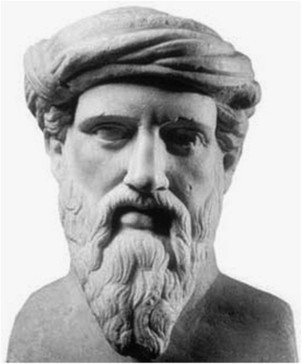
836 points · by samaysharma · 3y ago · 236 comments
Iamblichus’s “life of Pythagoras” [1] is worth a read as he had access to all the old sources now lost. The relationship between math and spirituality was very strong back then!
There are lots of fun stories that may be true but no one will ever know. In Diogenes Laertius’ “Lives of the Philosophers,” it is claimed that when Pythagoras made his discovery of what we call the Pythagorean theorem, he sacrificed 100 oxen (a hecatomb) [1]. As noted by Charles Dodgson (Lewis Carrol), “that would produce an inconvenient supply of meat” [3], especially for a vegetarian. Iamblichus, on the other hand, claims it was a single ox — and made of flour!
[1] Guthrie, K. S., & Fideler, D. R. (Eds.). (1987). The Pythagorean sourcebook and library: an anthology of ancient writings which relate to Pythagoras and Pythagorean philosophy. Red Wheel/Weiser.
[2] “he sacrificed a hecatomb, when he had discovered that the square of the hypotenuse of a right-angled triangle was equal to the squares of the sides containing the right angle.” DL, found in [1]
[3] Maor, E. (2019). The Pythagorean theorem: a 4,000-year history. Princeton University Press.
Hippasus, a member of said cult, however managed to compellingly demonstrate that the square root of 2 could not be a rational number. Pythagorus tried to swear him to silence. When that did no twork, he had him killed. Over the square root of 2.
[1] - https://sciencefocus.ust.hk/the-square-root-of-two-at-the-co...
“Aristoxenus (Fr. 90 Wehrli = DK I 109. 31 ff.) reports that Hippasus prepared four bronze disks of equal diameters, whose thicknesses were in the given ratios, and it is true that, if free hanging disks of equal diameter are struck, the sound produced by, e.g., a disk half as thick as another will be an octave apart from the sound produced by the other disk (Burkert 1972a, 377). Hippasus, thus, may be the first person to devise an experiment to show that a physical law can be expressed mathematically (Zhmud 2012a, 310).” [1]
Also in [2] this experiment is claimed to be the first documented scientific experiment in history. After all, Hippasus took a mathematical model for a physical phenomenon (how consonance relates to the mathematical ratios of a musical string) and tests the generalization of that model in a another physical medium (viz. bronze chimes with the same ratios 1:2 and 2:3 make the octave and fifth).
I wish they’d put this stuff in elementary math books when kids learn about Pythagoras.
[1] https://plato.stanford.edu/entries/pythagoreanism/#hippasus
[2] https://www.sciencedirect.com/science/article/pii/S240587262...
https://www.independent.co.uk/news/people/terrence-howard-th...
"How can it equal one? If one times one equals one that means that two is of no value because one times itself has no effect. One times one equals two because the square root of four is two, so what's the square root of two? Should be one, but we're told its two, and that cannot be."
Howard studied chemical engineering at the Pratt Institute in Brooklyn until he fell out with one of his professors over the answer to the 1x1=1 conundrum.
> Hippasus is sometimes credited with the discovery of the existence of irrational numbers, following which he was drowned at sea. Pythagoreans preached that all numbers could be expressed as the ratio of integers, and the discovery of irrational numbers is said to have shocked them. However, the evidence linking the discovery to Hippasus is unclear.
> Pappus merely says that the knowledge of irrational numbers originated in the Pythagorean school, and that the member who first divulged the secret perished by drowning.
It should be noted that such claims were made about many ancient sages to boost their "wisdom pedigree". Plato is said by ancient sources to have traveled to Egypt and Italy, but my understanding is that most modern scholars doubt that those journeys really happened.
Of course it’s hard to know. But Plato wrote several letters about his trip to Italy, because he was briefly enslaved there before being freed by his friend the Pythagorean Archytas (who is famous for creating a steam powered flying machine and wrote a work on mechanical engineering). https://digitalcommons.unl.edu/cgi/viewcontent.cgi?article=1...
On Seymour Cray:
Another favorite pastime was digging a tunnel under his home; he attributed the secret of his success to "visits by elves" while he worked in the tunnel: "While I'm digging in the tunnel, the elves will often come to me with solutions to my problem." [0]
Every morning, I get up at 5, and take a 5K walk. During that time, I tend to "triage" the day ahead, and often solve problems that were vexing me, the night before.
Part of my walk is around a local high school track. There is a small flock of killdeer birds, that hang out there, and I guess they give me the ideas I have, as they often come to me, at that point in my walk.
I enjoyed this part:
> One story has it that when Cray was asked by management to provide detailed one-year and five-year plans for his next machine, he simply wrote, "Five-year goal: Build the biggest computer in the world. One year goal: One-fifth of the above." And another time, when expected to write a multi-page detailed status report for the company executives, Cray's two sentence report read: "Activity is progressing satisfactorily as outlined under the June plan. There have been no significant changes or deviations from the June plan."
https://maps.org/2004/08/08/nobel-prize-genius-crick-was-hig...
> FRANCIS CRICK, the Nobel Prize-winning father of modern genetics, was under the influence of LSD when he first deduced the double-helix structure of DNA nearly 50 years ago.
> The abrasive and unorthodox Crick and his brilliant American co- researcher James Watson famously celebrated their eureka moment in March 1953 by running from the now legendary Cavendish Laboratory in Cambridge to the nearby Eagle pub, where they announced over pints of bitter that they had discovered the secret of life.
> Crick, who died ten days ago, aged 88, later told a fellow scientist that he often used small doses of LSD then an experimental drug used in psychotherapy to boost his powers of thought. He said it was LSD, not the Eagle’s warm beer, that helped him to unravel the structure of DNA, the discovery that won him the Nobel Prize.
„In it, he recounts his late-night encounter with a glowing raccoon that spoke to him, addressing him as "doctor" -- a raccoon that may or may not have been an alien. He tells of passing out after inhaling too much nitrous oxide and later learning that he'd been saved from a fatal overdose by a woman who traveled to him on an "astral plane."“ [0]
[0] https://www.washingtonpost.com/archive/lifestyle/1998/11/03/...
Seems to me this connection is having a resurgence now as people attempt to project the capabilities of computers beyond human capabilities, where the implications are necessarily bordering on spiritual.
Examples include transhumanism, Yudkowsky-style absurdly extrapolated rationalism (Basilisk etc), the simulation hypothesis, AGI salvation hopes...
George Boole (Who we get Boolean from), had a road to Damascus experience as a teenager and later wrote "An Investigation of the Laws of Thought" where we get our 0s and 1s from, and truth operations, largely to prove God is Good.
The concept of 0 and 1, absolute truth and false, was born from his spiritual views.
But those are all examples of ways to avoid spirituality.
Who runs the universal simulation? Another name for God. The eternal torment of Roko’s Basilisk? Another name for Hell. AGI will save us from ourselves with its incomprehensible intelligence? A cyber-Jesus. Moving your mind into a transhumanist body? Souls rising to Heaven. Etc.
Still going to read more. Thanks for the citations.
And in turn, his followers created a strange cult after him! [0]
But that's not a theorem, just an observation. It becomes a theorem when you prove (i.e. explain why) this relationship always holds, based on more evident things. The Babylonian tablet mentioned in the article doesn't seem to do anything like that, whereas the Greeks definitely did (we don't know whether Pythagoras himself did it, as no writing of his survives, but later Greeks knew how to do it, and attributed it to Pythagoras).
according to the article, this Babylonian tablet does come closer to theorem than you are suggesting. They weren't using Pythagorean triples, rather they figured out that the diagonal of a unit square is the square root of 2, and knew how to calculate that:
1 + 24/60 + 51/602 + 10/603 = 1.414213
But I agree with the second paragraph: there's a huge difference between a procedure that is handed down as part of "this is how we estimate a building project" and a theorem that is declared universal truth and base for all kinds of other theorems. Even if they are exactly the same thing.
And if you can determine that the diagonals are the same length, you have what you need to get close enough to a parallelogram in the first place.
I only see theorems as useful for complex societies. The son of a gem dealer would have the time to work out universal truths.
The reputation of everyone doing it without numbers would reveal the pattern of the universal truth.
Finally this looks like it was all done using cuneiform.
Which brings up questions of notation and the language to describe a square root.
As I understand Greeks invented proofs because "universal thruths" they exported from Babylon and Egypt sometimes explicitly contradicted each other.
I believe such contradictions may be a great nuisance when you try to get shit done.
Egypt and Babylon were sufficiently "complex" societies for proofs, but their tradition treated mathematics as a bunch of useful facts about numbers and shapes. New generation just memorized them. We should think it worked for them in most cases, and when it didn't work it was not so often for them to start thinking a lot of reforming mathematics. Plus they were indoctrinated by the math they learned (authority of a teacher is above of anything else, i suppose) and to reform math was not a natural idea for them.
Observing that something always holds and even having a formula for it is not the same thing as having a proof, and the proof is what makes it mathematics and geometry and not "just" engineering. The babylonians had a rule of thumb -- the greeks discovered the theorem -- and more than that, they seem to have invented the mathematical/geometrical proof as a concept, along with formal logic.
Without that mental framework, it's hard to say that the babylonians proved anything or had any theorems at all, only collections of rules of thumb. It's quite likely that lots of babylonians sort of independently and intuitively understood _why_ it must be true, but they don't seem to have ever written it down.
Not that there's anything wrong with having rules of thumb -- it's a huge achievement to even notice and collect and teach those things, all the stuff around you is built relying on them.
I encourage everyone to watch this series of videos.
I don't see why that was necessary. You can get pretty far with eyeballing it and custom cutting to fit.
But we're talking about groups of people, "they", who all build a lot. Such groups tend to have a few people who make these observations, and then the observations proliferate, because they are both way easier to use than the alternative hack-work, and yield much more aesthetically pleasing results. Especially in the stone age when you nornally don't have easy access to anything at all with a right angle (unlike in modern construction) and you build stuff out of clay bricks, where minor inaccuracies inevitably add up and make your life much harder down the road. Tying together three pieces of string with prescribed ratios, pull it tight was a very easy way to get a right angle compared to anything that came before.
It's necessary in the sense that stone age construction is so much easier if you know about it, and so much harder if you don't. Those who didn't come up with it didn't do such construction, because doing difficult things is harder than doing easy things.
1. lay out a straight line 2x in length.
2. find midpoint (easy by drawing an arc with a string from each end point. Basic compass & ruler technique.
3. draw another arc from the midpoint, of radius 1x. Try different spots on the arc until it is equidistant from each of the endpoints of the line.
4. voila! an accurate right angle. Laying out the rest of the square is now trivial.
I was chatting with the person that was in charge of marking the fields for the local youth soccer league. I volunteered to help one weekend, and one of the first things he asked was if I knew what a 3/4/5 triangle was since it was the only way to know you'll be squared. I never did figure out to what level he was dead panning his joke or if he was even meaning for it to be a joke. Either way, I laughed.
Everything becomes a custom cut, often in multiple dimensions and all earlier errors cascade all the way to the end.
Unrelated, but that sounds exactly like many software projects I've been unfortunately part of.
i'm not saying at all that I know the answer, but eyeballing and cutting is good for a patio, but on a ziggurat or pyramid scale it seems you don't do so much eyeballing or cutting, and more planning how much material and how many slaves you're going to need for how long, and where to put the doors so the passageways will meet up, that sort of thing.
Wait, really? I thought the proofs back then were geometric, so only proved specific instances. And so it wasn't until algebra, maybe trig, was discovered it was properly proven?
But I don't see how it proves anything if $a$ were say doubled, and $b$ kept the same.
A modern analogy: today, people are very happy to use LLMs and Transformers without anyone "proving" that they work. Right now, philosophically, they are at the level of empirical observations (perhaps not even that). Does that mean that today's AI researchers should get no credit when at a later date? I am not sure. Empirical discovery of a rule is also no trivial thing.
That's not in any sense a value judgment of the empirical work done at DeepMind. Nor does it stop anybody from writing a better article which explains that the Babylonians (and many others) used the empirical observations underlying the theorem, while explaining that this did not constitute mathematical proof.
If there's no proof, it's not a theorem, by definition. That doesn't make empirical observations worthless -- far from it!
> Pythagoras is immortally linked to the discovery and proof of a theorem that bears his name – even though there is no evidence of his discovering and/or proving the theorem.
Simply quoting. It seems like
> Greek definitely did
is not a universally held belief.
The Greeks definitely were able to prove the Pythagorean theorem, and the Greeks definitely though Pythagoras specifically knew how to prove it: e.g. Proclus II states this in writing explicitly, as does Euclid 300 years later, and numerous ancient sources inbetween. It would be hard for this not to be the consensus. We can't know if Pythagoras really did, simply because we have no surviving writings directly from Pythagoras - as I stated explicitly in my previous post.
That fact that the Greek could prove the theorem at some point is not unlikely even without evidence. It’s as likely as others doing it well before them.
It's based on the simple idea that:
Z = (a + b)^2 = (a^2 + (2a+b)*b)
=> (2a+b)* b < Z-a^2
Given an initial estimate "a", we need to find the largest "b" such that the term on the left is less than the term on the right. Therefore our estimate will always be slightly less than the actual answer and we can repeat the process to get slightly closer.For the first iteration, Z=2 and a=1. We choose b=x/60:
(2+x/60)*x/60 < 2-1^2
120x + x^2 < 3600
x = 24 ... 3456 < 3600
x = 25 ... 3625 > 3600
So our first term is 24/60.Repeat with a=1+24/60 and b=x/60^2:
(2(1+24/60)+x/60^2)*x/60^2< 2-(1+24/60)^2
10080x+x^2 < 518_400
x = 51 ... 516_681 < 518_400
x = 52 ... 526_864 > 518_400
Repeat multiple times.Writing this in code I can easily get: 1;24,51,10,7,46,6,4,44,50,28 = 1.4142135623730951
This whole process can be codified into the long division algorithm for square roots which works quite neatly with base 10.
Edit: formatting
> Sexagesimal, also known as base 60 or sexagenary, is a numeral system with sixty as its base. It originated with the ancient Sumerians in the 3rd millennium BC, was passed down to the ancient Babylonians, and is still used—in a modified form—for measuring time, angles, and geographic coordinates.
For example if you choose 2 you will get the binary expansion.
Confusing calculation with proof is an inexcusable mistake for any serious journal.
There can be little doubt that proving theorems is a cognitive tool that developed on the basis of observed regularities. But both asking the question why and, importantly, answering it using logic are highly non-trivial developmemts.
Our Western culture made Ancient Greek into the vocabulary root of our sciences.
We have a lineage of philosophy from Ancient Greece to the 19th century.
Only in the 19th century with archeology (again a neo-word made from Ancient Greek roots – it suggests to the mainstream that the Ancient Greek had a concept of archaeology, which they obviously didn’t have) we saw the truth: History goes thousands of years deeper, the origin of everything is thousands of years older.
Only 30 years ago the capital city of Hattuša was discovered; and only in the 20th century we gained an understanding of the multiple levels of the historic city of Troy.
Only recently we understand that "it didn’t start with Ancient Greece", but the mainstream still follows the tradition of medieval grammar schools and doesn’t look beyond Ancient Greece.
My understanding is that the “through line” of modern scientific progress begins in Greece because that’s where “trivially-legible to contemporary scholars” written history began.
Like, we always knew that it didn’t start with Ancient Greece (the Greeks themselves mention this), but because abundant primary sources prior to Ancient Greece don’t exist, there isn’t much we can do other than light a candle for their sake and use its light to read their thoughts as filtered through Plato, etc.
That's a simpler explanation but it's not necessarily right.
What we can say for sure is that Greek thought has been easier for Western scientists and pseudo-scientists to learn. Availability and language are parts of that for sure. Geography is, too - it's easier for Europeans to excavate Europe than Iran.
But what does it mean to say "the Greeks" disseminated their knowledge better when virtually all of what we have comes from Roman citizens living centuries later?
That Greek knowledge and culture survived the collapse of their prominence? Similar to the Romans after them and Babylonians before them.
Greek had been a lingua franca in the major ports of future empires for centuries [1], and Greek remained a spoken and written language in the Byzantine empire (the same was not true of ancient Egyptian or Babylonian – which were supplanted by Greek or other Aramaic languages during the hellenistic period).
I think at least as much credit is owed to the inheritors of Greek culture (Romans, Byzantines, the various Arabic empires), for preserving source material and references.
But I think Greece was seen as the original "filter" for civilization because it was both "successful" and comparatively extroverted to the great civilizations that came before.
Basically, it's what you said in your middle paragraph – wide availability, accessibility of language and culture. In other words, "better dissemination". :)
Culture of free thinking? Socrates, the most iconic free thinker of all time was forced to commit suicide by the greeks. So much for a culture of free thinking.
> They also sentenced some of their free thinkers to death for not worshipping the gods but that’s a separate issue.
It isn't. It directly contradicts and refutes your assertion.
See my last sentence.
> It directly contradicts and refutes your assertion.
Maybe Greek society was not a homogeneous mass, and some parts of it nurtured free thinking while others reacted against it?
Why is that obvious? The ancient Egyptians & Mesopotamians had a concept of archaeology, why not the Greeks?
Until we have better evidence, it still seems to be the case that (at least in the "West", I'm unfamiliar with e.g. Chinese mathematics) the Greeks were the first to come up with the concept of a mathematical proof that is valid deductively, and not inductively.
People typically wrongly attribute findings not to the person who first discovered it, but to the person who was able to most widely communicate/publish about it.
This is a particular difficult challenge in ancient times.
Knowledge was often shared verbally, not in written form.
Or if it was in written form, the material used has long since deteriorated.
So most of what we know about ancient thinking is based on knowledge that was so widely known and written that there's multiple copies of it; or the knowledge was communicated on a hard material like stone (egyptian hieroglyphics) ... but that doesn't mean it was the first ancients knew of it, it just means that the particular knowledge in written form has lasted the test of time the longest.
Just out of curiosity, which equations are considered the top three “most beautiful?”
e^(i * pi) + 1 = 0
It's considered incredibly elegant because it manages to combine multiple fundamental mathematical concepts into a single equation.
1 is the multiplicative identity, 0 is the additive identity, pi is the circle constant, e is euler's number, i is the square root of -1, the basic building block of complex numbers.
e^(i * tau) = 1
You lose the 0, but isn’t it a bit odd the 0 is there in the first place? Normally we’d reduce it to:
e^(i * pi) = -1
Which obviously isn’t as nice in this case.
And hey, if we’re allowed to break the conventions, you can have the 0 back easily.
e^(i * tau) = 1 + 0
e^(i*θ) = cos θ + i*sin θ
The formula loses most of its beauty when you just present it with a single arbitrary real plugged in. Y = λf.(λx.f(xx))(λx.f(xx))
https://en.m.wikipedia.org/wiki/Fixed-point_combinator“(-1)^0.5 2^3 Σ π.”
Pi ⋅ z ⋅ z ⋅ aThe fact that many contributions from other older civilizations for examples Indus Valley (Indian) where the original cuneiform alphabet was started and Phoenician (Arabic) where most of the modern alphabets (Latin, Greek, Arabic, Sanskrit) originated. The former Indus Valley script has not even been successfully deciphered yet until today (Nobel price in waiting for the ones who will deciphered them), perhaps they are some older proofs that are just waiting to be discovered upon the understanding of the Indus Valley scripts and languages.
But the nonsensical narrative of whom has the monopoly of contributions to knowledge will carry on until the end of time but the reality is that we are just standing on the shoulders of giants [2].
[1] What have the Roman's done to us:
[2]Standing on the shoulders of giants:
https://en.m.wikipedia.org/wiki/Standing_on_the_shoulders_of...
Someone above commented that just by building ancient peoples would have discovered this relationship.
>Note that quite a few descriptions on Babylonian tablets seem to cite a translation of a Pythagorean algorithm from a ca. 1900BC tablet by a Dennis Ramsey – I have not been able to find the original source of this anywhere.[0]
The linked arctile cites wikipedia and bible-history.com. This book[1] misquotes the supposed tablet as being ycb 7289, probably because these tablets are referenced next to each other on wikipedia.
This[2] website says it's in the British museum.
[0]https://craftofcoding.wordpress.com/author/spqr/
[1]https://books.google.com/books?id=XDBCEAAAQBAJ&pg=PT257&lpg=...
[2]https://mathshistory.st-andrews.ac.uk/HistTopics/Babylonian_...
https://personal.math.ubc.ca/~cass/Euclid/ybc/ybc.html
This site has a detailed analysis and explains that it's from the Yale Babylonian Collection.
>4 is the length and 5 the diagonal. What is the breadth ? Its size is not known. 4 times 4 is 16. 5 times 5 is 25. You take 16 from 25 and there remains 9. What times what shall I take in order to get 9 ? 3 times 3 is 9. 3 is the breadth.
That doesn't appear to be in your link – am I wrong? I only see numbers there and it appears to be talking about something else entirely.
Clearly because that makes the answer for the diagonal 42.
This is the original site about the tablet and has more detail and analysis than the Springer article.
Is there a theorem or conjecture like this ?
"For any irrational number, like square root of 2, we can always find the approximation of at most 3 rational numbers with just +,-,* and /" ?
Jefferson (3rd President) was quite fluent in geometry and surveying, designing his home in Monticello.
Herbert Hoover (31st) was a mining engineer.
Jimmy Carter (39th) was a nuclear engineer by training, having worked in the U.S. Navy's nuclear sub program.
https://www.snopes.com/fact-check/jimmy-carter-nuclear-meltd...
People will most probably learn that either Bill Gates or Elon Musk invented it all in one evening when an apple fell from a tree.
With "records" being any physical objects that outlast oral history: writings, clay tablets, the pyramids of Egypt, etc.
(and note the "surviving" bit!)
This says nothing of what really happened in the past. Only what exists in the present to support particular reconstructions of past events.
It's a parody but I wonder how close to the truth it is...
[1] https://www.brainyquote.com/quotes/shaquille_oneal_381872
basic geometry was probably fundamental to the architecture necessary to make civilizations
i'd bet that as far back as we can find large structure there would probably have been strong understandings of geometry to make them
plus, humans have been around for 200-300k years, what we can find is from ~12k-25k years ago at the very fringe of our investigations. no doubt people have been mathematically capable for longer than they've been able to take full advantage of the concepts they understand
I assume that should read relativity*?
This challenges the idea that ancient Greek mathematicians were always ahead of others.
It's probably just as well because otherwise just about everything would be named after Gauss which would make learning maths even more difficult than it already is.
The Pythagoreans did make a number of important discoveries to do with number theory, the ratios between string lengths for various musical notes (eg twice as long is an octave lower etc), cosmology and some other results in geometry to do with the properties of various 3-d shapes and stuff.
Link above is clickbait blogspam (like most things on IFLScience)
There was a point in time when I was very interested in ancient civilizations from Mesopotamia, but in more recent years I an way less interested in it. The scholarship in that field is just terrible. In my opinion, a lot of the stuff is on par with alien "investigators" and stuff like that, yet for some reason the general public sees the field as totally legit.
> It's very much a stretch to say the person who etched those markings intended to express the Pythagorean theorem.
No it isn't.
There are legit reasons to question a lot of the research on ancient civs, but that isn't one of them.
Some people's definition of "evidence" is different from my own. If somebody really wants to believe something, then just about anything qualifies as evidence. This is why UFO people consider literally every single fuzzy video as undeniable proof that aliens exist.
And if you could read it, you would find it contains a lot of relevant things, concluding with:
> … 1.414213, which is nothing other than the decimal value of the square root of 2, accurate to the nearest one hundred thousandth.
You might then think to yourself:
> The conclusion is inescapable. The Babylonians knew the relation between the length of the diagonal of a square and its side
Which is all clearly explained in the article you’re commenting on. Do you have anything else meaningful to add, beyond “it’s nuffin’ but squiggles mate” and “aliens”?