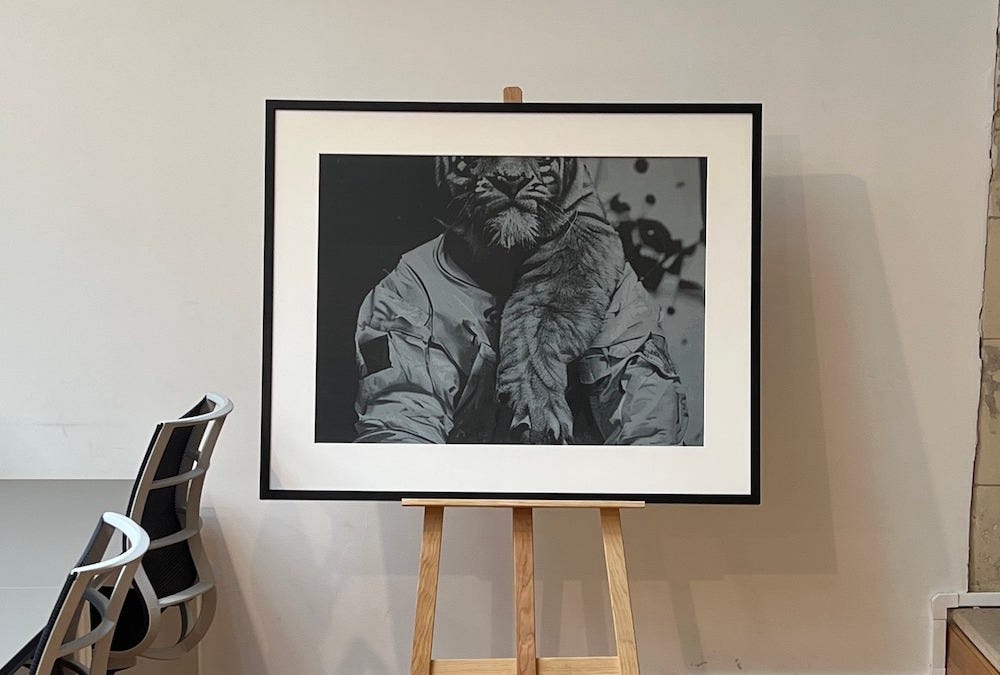
Building a 42-inch E Ink Art Frame
Recently, we wanted to find a way to display Generative AI art in our office at Photoroom.
eliot.blog
537 points · by ea016 · 3y ago · 204 comments
For comparison a 42" full-color 60fps TV with remote, speakers, wifi, etc. etc. is $140.
It seems like the patent holder could be making a lot more money if they dropped the price.
Because it's a lot easier and cheaper to manufacture large LCD panels at scale than E-ink film.
>It seems like the patent holder could be making a lot more money if they dropped the price.
I don't know any company or shareholders that would say no to making more money so if this would actually be true then it would, but that's not the reality.
The FUD that large e-ink displays are expensive because of some patent conspiracy needs to stop.
Large e-ink screens are expensive because manufacturing yields are very low and so are sales volumes.
Source: worked with e-ink on products with big and small displays
Edit: So I'm saying the truth and getting down voted for it? Fine, then feel free to keep believing whatever you think is the truth. No point in discussing it further.
That is to say, it’s not that they’re charging high prices out of greed, but that there’s no competition forcing prices down.
But first someone has to invent it. Nobody’s gonna spend a few thousand or million dollars to invent something unless they get their money and more back, so that’s the point of patents.
And if they patent something and don’t capitalize on it enough, that’s their loss, because they had to detail their invention in their patent application and that’s public information. Patents last only 20 years and for most industries, that’s not very long.
(That said, I think software patents are a different beast. Because 20 years in software engineering is like 100 years in civil engineering, for example, since software engineering is like a few thousand years younger discipline than civil.)
That is a really odd assumption. There are multiple companies making electrophoretic displays and multiple different technologies, of which only one is really commercially effective so far in a very limited niche space. Why don't you think physics is the limitation? I mean, don't you think above would be the equivalent of me saying that the reason we don't have daily flights to Mars is because SpaceX is the only manufacturer of Falcon Heavy.
What makes you think there would be so much competition on driving down prices of large 1Hz B/W displays that can't display motion videos properly and suffer from terrible ghosting, if patents weren't a thing? Do you think there's large display-tech manufacturers knocking on e-inks door wishing to enter the market for such niche displays and e-ink just keeps saying 'NO'?
If that were such a lucrative untapped market then someone like Samsung or LG would have swallowed up e-ink holdings already or drowned them in lawsuits to squeeze a cross lichenizing deal out of them, but it's not.
Here's the hard to swallow pill: The consumer market for large e-ink displays is incredibly niche that it's not worth entering by second players, and better just leaving one incumbent player deal with their niche little sand-pit.
You're looking for problems that aren't there while also grossly over-estimating the size of this super-niche market.
It's a nothing-burger that, due to lack of knowledge and understanding of the market and technology, HN loves to spin into an emotionally charged straw-man every few months outraged they can't buy TV sized e-ink displays at Wallmart for $199, without even considering the technical challenges, product feasibility, economies of scale and market situation of such a fantasy product, thinking e-ink must be evil or stupid for such a product not already existing.
The truth is, there is no conspiracy and the e-ink market has already self-regulated itself: The mass market e-ink displays like for price tags and e-readers have already gotten cheap enough, while big e-ink displays are very expensive because there's next to no market for them to warrant further optimizations of economies of scale or interest from other players to even bother competing regardless of patents.
I've never quite understood this sort of thinking. Companies aren't perfect omniscient systems - the people in charge of various companies make poor decisions all the time, based on the same human biases we all have. So yes, it's entirely possible they could make more money that way, but executives simply hear "Lower the price" and run away. I'm not saying that's certainly what's happening, but this implication that a company could possibly only do the thing that's most beneficial to it is... strange, and very common thinking.
Yes e-ink has high wastage, and yes demand is low, but having had a strong arming expensive patent holder didn't help the situation. The patents are actually expiring/expired but at some point the damage is already done.
A great corollarly to e-ink is 3d printers: they were very expensive, very low volume products that needed to recoup expensive development costs... but when the 200 lbs gorilla sitting on the market in the form of patents started to die down, a lot more players start to iterate, which unlocked advancements, which made things cheaper and more accessible, which improved demand, which then incentivized more advancements... and now we have $400 printers that outperform $10,000 printers from not that long ago.
Most display tech starts high wastage, low demand. Patents aren't a guaranteed death, but e-ink was just a bit too far off the path for absolutely required innovations to overcome the added resistance. In the mean time other technologies got better: sunlight performance of non-eink displays has improved dramatically for example.
Now the moment has probably passed and e-ink is doomed to stay a niche sideline product as a result.
Can you talk more about this? My phones and laptops are still as bad as ever in direct sun. Did I miss some major development...?
For the record, the "patents" think has no links to back it up either.
But to answer your question: E-ink screens are less than $100 (depending on the size), that's already pretty cheap. They're only expensive when compared to LCDs. LCDs are produced at a rate of billions per quarter*, with ~6 billion smartphone owners, and lots of them having multiple LCD devices e.g. laptop/desktop screen, work computer's screen, supermarket kiosk, tablet, smartwatch, car screen, etc.
In contrast, e-ink screens have basically three applications: e-readers, e-notes (which is basically just an e-reader with a stylus), and supermarket pricetags. E-readers/e-notes are a luxury item that you don't need if you already have a smartphone/iPad. There's just no economy of scale for e-ink; not compared to LCDs.
Because there's no economy scale or obvious new markets to expand into, there's not much budget for R&D, so the entire field moves slowly.
There are probably many techniques and processes that would be tried and developed if it wasn't locked up by patents.
Without patents, there is far less incentive to seek progress. What's the point for a for-profit organization to spend resources on Research, just to see your innovation immediately copied?
And if said for-profit organization still innovate, it has a strong incentive to keep its innovation as secret as possible. Patents by contrast, incentivize sharing, on one hand it makes the innovation public knowledge, and on the other licensing agreements usually exist.
And in the end, 20 years is really short compared to human history.
Are patents an ideal solution? Hell no, this system is too easily abused (patent trolling, patent thickets, etc), and feels really wrong at times (patents on life-saving drugs for example). But so far, that's the best compromise we manage to mostly agree on in terms of worldwide IP recognition.
But you still have a point. Even if a LED display has "only" a 2 or 3 day battery life, that's still pretty huge to mere hours.
How do smart watches (like the Garmins with 1-week batteries) do it?
Don't worry about that. Posts that go against the general opinion always get downvoted at first. But if it is insightful and not demonstrably wrong, the upvotes will win.
Then again, if that was really it, surely there'd be a market for people who want a 42" e-ink display and are willing to accept some proportion of bad pixels in exchange for a deep discount. Which really shouldn't matter much, particularly for applications where distance-viewing is the expectation.
Try $3000 :)
> Driving boards are not included in the display module package. E Ink Salt kit is designed to support this module
> Salt Driving Board - $500.00 - https://shopkits.eink.com/en/product/detail/SaltDrivingBoard
EInk doesn't have a backlight. So it's easy to see in glaring light. It's also not disruptive if so, you want to use it as a digital picture frame and you don't want light from the display bothering your eyes day and night.
EInk is a more peaceful display technology, and some people put a lot of value on that.
How is that a realistic feature? Who is losing power and being happy that they spent a few thousand more, nearly 40x, than a 36" photo quality print, just so the image can remain while their lights are off?
(and of course it is a lot easier to change than a printed photo)
Does Rakutan/Amazon/Pocketbook really pay a similar cost/size ratio for the panels on their ereaders? I hope not!
You just reminded me, a few years ago i wanted to buy a transparent screen for a DIY project. The company said they couldn't sell it to me because they're b2b.
I think it was both a volume thing and a tax thing.. and possibly a liability thing.
Edit: Someone has your dream display already :) https://www.etsy.com/listing/1463146123/43-4k-dnd-tv-table
Transflective LCD is other option bit also pretty hard/expensive to get a big screen...
[1] https://www.groglass.com/product/artglass-ar-70/
[2] https://www.framedestination.com/prod/sh/ultravue-uv70-pictu...
Some E-ink panels can be somewhat susceptible to UV light and perform better under a filter. You will sometimes find warnings in data sheets about refresh performance in direct sunlight, and danger of long-term permanent damage. Some of E-ink's signage products have, I think, filter layers built-in.
But also if you're using a passepartout like in this project, and the frame will hang in sunlight and you're not sure how the paper will perform, it's worth springing for the UV protection to avoid yellowing over time.
  ha-card::after {
    content: "";
    background-image: url(/local/visionect-dither.png);
    background-repeat: repeat;
    position: absolute;
    height: 100%;
    width: 100%;
    display: block;
    mix-blend-mode: multiply;
  }
Especially at night, I find the backlight makes it painfully obvious that it's just a TV and I'd much rather have something like e-ink which blends into the surroundings.
This doesn't get around all the other annoying bugs in the firmware of course.
Even the “explore technology” link has little extra detail. I don’t even know if it’s backlit.
I have the white frame on the bezel against a light-coloured wall and when displaying art it's much less imposing on the room than an empty black screen. Obviously it uses more power than standby but it's also quite a bit less than a dynamic screensaver.
Don't know that I'd get another one; the bugs in Samsung's software are annoying (I just want it to display the art, or a picture from a single HDMI input, how hard can they possibly make it?) but perhaps that's standard for modern TVs.
At about 300W of GPU + 120W of PC, that is 420W * 0.5hrs = 0.210kWhr. This is a rounding error on my monthly electric bill. About six cents.
I've spent more energy than that likely just sitting and reading HackerNews this week.
You can also have it not produce images at night or when you are not around the house.
Lots of ways to save energy. The impact of an image every few hours or whatever is nanoscule compared to your transportation and heating needs.
(Also if your apartment uses electric resistive heating, fire away with your GPU, you're just producing images in the process of producing heat instead of passing it through a resistor. It's no less efficient.)
You should upload a massively complicated where's waldo like scene and have waldo appear in different places each hour.
Have a portrait with lots of subtle details but they change slowly over time. Ex. girl goes from earing-less to small earings to big earings. Just have lots of small details subtly change but at a rate which makes them hard to detect.
The mfg from the article has a 13.3" screen that would be fun to try a mod with: https://shopkits.eink.com/en/product/detail/13.3''ePaperDisp...
and impressive 1600 x 1200 pixels
If you're into looking at different dithering techniques, there are a few interesting ones compared in this old CodeGolf question (disclaimer: I'm the one with the Fortran answer)
https://codegolf.stackexchange.com/questions/26554/dither-a-...
I imagine the game keeping track of whose turn it is and being able to give voice commands to make moves.
Then they could play games over a longer period of time, maybe make one move per day.
the Lilygo T5 with Touch screen + a lipo battery would have all the hardware you need
just need to port chess to the platform after that https://www.hackster.io/Sergey_Urusov/arduino-mega-chess-d54...
figuring out NAT traversal to get them talking to each other from each other's homes might be tricky/fun, but there may be ways around that...
https://www.lilygo.cc/products/t5-4-7-inch-e-paper-v2-3
It would be great to be able to buy this in a size that would mount easily into common photo frame formats.
Ideally with a battery that could last months and optional power.
If I was retired it's the sort of project I'd happily waste time on.
https://shop.invisible-computers.com/products/invisible-cale...
You could render the current state of the chess game to an image and serve that image on a URL on the internet. Then you can connect the display to that image:
https://www.invisible-computers.com/invisible-calendar/image...
Admittedly that's still a lot of work from your side, and a little applet to keep running...
For that price, you can buy a 42" color printer.
All you need is a high quality RGB light sensor or three and an accurate way to dim a backlight. None of this seems very hard. Sure, it wouldn't show the shape of shadows or whatever, but it would still be highly effective. Why can't the image just go black when I turn the lights off?
It was daylight in a well lit bright room. The frame and background were just right to look like modern simple poster framing. The minute sun set, of course it stopped looking right. Thats when I realized we had a TV after all.
My partner pointed out the art had changed at least two times across daylight hours. I had just blanked that out.
At one time there apparently was this: https://mono.frm.fm/en/shop/ But the price was crazy. There's not much out there in terms of appropriately priced digital picture frames.
My wallet stopped at 13.3" though :)
Update for those who saw me post it before: I recently charged the battery for the first time since hanging it in March, which met my expectations.
Shout-out also to the people at Halbe Rahmen, the best picture frames in the world.
Mine is still wired but I'm thinking of using ESP32 + deep sleep.
esp32 + deep sleep + external RTC is what this is using. I posted some of my experiences with getting it as low as I could here: https://news.ycombinator.com/item?id=37663913
Here's a few more pics: https://imgur.com/a/NoTr8XX
I found the mention of Blue Noise Dithering in this project quite interesting! I've not put a lot of effort into picking the nicest possible dithering method (just a basic Floyd-Steinberg) for the embedded article photos, partly because the whole newspaper look didn't seem to warrant it, but it might be worth taking stock of what the latest on dithering is.
Also the album link in the other comment.
When displayed on the frame you can barely see the dithering. Interestingly you see the jpeg compression artifacts a lot more
Some devices actually clear by outputting the invert of the image. Maybe this will be faster
https://dheera.net/projects/einkframe/
I really want to upgrade to at least 31" but it's rather expensive.
Separately in the next irritation of this project I'm hoping to use an ESP32 instead of an RPi Zero to power it, and use the deep sleep mode so it can periodically update but sleep through the rest of the time, allowing a few months of battery life with no wire sticking out.
Even more ideal would be putting a thin strip of solar panel on the top edge of the frame to keep it charged, and use some kind of supercapacitor to power the ESP32, though I don't know if the parts for that exist, especially solar panel that is 1cm wide.
The best option I found so far is a timer shield that can wake up the Raspberry periodically: https://www.pishop.us/product/sleepy-pi-2-power-management-s...
LED panels got cheap because we built factories that pump out a lot of them.
https://framelabs.eu/en/product/artframe-31/
I use the 31.2" panel because it is 40% cheaper and has higher DPI, but the 42" panel is also possible.
There's some projects that forego a driver ASIC entirely and drive the waveforms directly from a MCU, although I guess this large panel has a different voltage domain.
Or maybe you could hide a Qi charger into the wall?
Look to what hobbyists are hacking to find commercial opportunity.
er, what?
AI art is not generative art, it is reductive "art". It requires samples of the art style you wish to cop, and it always produces something artificial and less than the sum of its parts.
On the other hand, generative art is procedural, and represents the thought process of a human being.
Better luck making meaning.
But aren't the prompts used also representative of a thought process? The chosen network architecture and the choices of images used to train also represent thought.
Walking into a convenience store and buying milk also requires a thought process, but it's not creating art. Walking into a home store and selecting from various linens to assemble a complementary set requires a creative thought process, but it's not art. The closest analog is commissioning a piece from an artist-- that requires a creative thought process about art but that doesn't make the commissioner the artist.
Most commercial art directors have more granular control of their project's outcome than people generating their AI art have over theirs. While they are credited for their direction and curation of those multiple pieces to create a unified project, they are absolutely not credited for the individual pieces-- the artists that created those pieces are.
Maybe deliberately curating a collection or collaging AI-generated art that, through juxtaposition or some other method, elicited a response or communicated something emotionally that each piece individually could not. But that's not what's happening here. People are commissioning pieces of art from a computer which makes them out of other people's art.