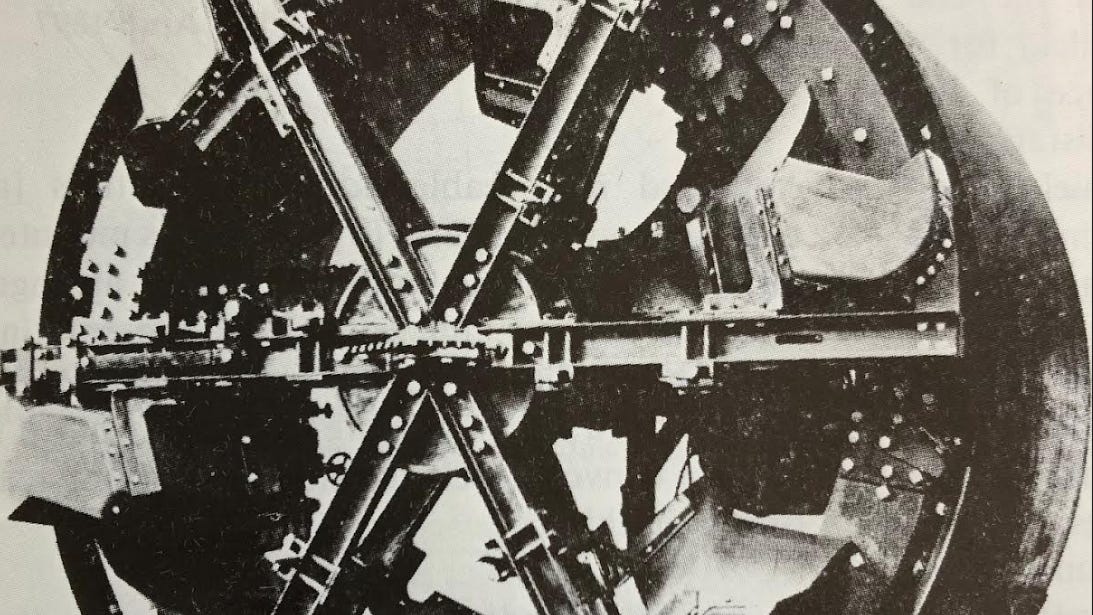
The Evolution of Tunnel Boring Machines
Tunneling is an important technology for modern civilization, as a tunnel is often the only reasonable way to create a direct path between two points.
construction-physics.com
149 points · by jseliger · 3y ago · 123 comments
The usual TBM setup has a two-track narrow gauge railroad behind it. Segment cars bring ring segments forward, and muck cars remove the spoil. Track cars bring more railroad track. Tool cars and worker cars are in the mix occasionally. All this is happening on an unfinished railroad, because the back end of the TBM has to lay the track and move cars from one track to the other. All the stuff for this takes up more length than the cutting part. A tunneling project is an entire construction site compressed into a long, narrow hole. So logistics in the tunnel are a big deal.
Now, this is where The Boring Company was expected to innovate. Something involving driverless Tesla chassis, maybe. But they never did. Others have built such systems.[1] But not The Boring Company.
[1] https://tunnelingonline.com/mobiletronics-demonstrates-auton...
At the other end of the line, outside the tunnel, there's a whole rail yard. The different kinds of cars have to be sorted out, loaded, and unloaded. So there's a need for a big staging area.
Here's an overview of traditional tracked systems.[1] I've tried to find a video of the back end system and yard, but nobody seems to make such videos. It's too boring.
[1] https://www.robbinstbm.com/products/tunnel-boring-machines/b...
[2]
A perhaps very stupid question, but why not make the cars self-driving the way we built self-driving robots from LEGO as kids? That is, line-following cars. It's effectively a virtual track - but I imagine painting a line or building it from cheap plastic would be cheaper than putting actual rail tracks in, and unlike generic driving automation, line-following is an old, well-understood and solved problem.
tired vehicles
I see what you did there.
Less interesting but of far greater value to humanity has been the innovation in heath and safety regulations.
According to this article [1] one worker died per foot of the Hudson River Tunnel.
> In 1906, attitudes toward the sandhogs changed after a series of accidents beneath the East River. Blown-out tunnels put the dangers of the profession on display in a way few New Yorkers could ignore, and the Progressive-Era press worked to publicize them. Suddenly, sandhogs were big news, and people started to complain about their high death rates.
[1] https://daily.jstor.org/the-sandhogs-who-built-the-new-york-...
IIRC for the Indonesian, voluntary workers the death rate was 80%. For the prisoners like my grandfather the rate was lower, simply because they started working later (and perhaps some racism from the leadership).
That's why "decompression sickness" is called "caisson sickness" in several languages.
When you are hiring new people each day, to replace the ones who died, knowing that a quarter will lose their life, ignorance around exactly how they died is no excuse.
Today in my country at least a single workers death is not acceptable. Accidents happen but prosecution happens if everything was not done by the book.
Tolerance for workers death is highly related to location and time. We used to have large families for a reason!
N=10, but nevertheless a comparison on the difference in location at exactly the same time was the Channel [0], of the 10 deaths, 8 were in Britain.
[0] https://en.wikipedia.org/wiki/Channel_Tunnel#:~:text=At%20th....
The latter is actually more likely but not really. There is no way the tunnel would have been finished if a quarter of the workforce was dying and the company just allowed it to continue happening.
Compare this to the Panama Canal which started construction under US supervision the same year as the Hudson North River tunnel. They didn’t know much about the spread of tropical deceases but they knew enough to supply their workers with mosquito nets etc. The French effort to build the canal totally failed, primarily because of the high death toll among workers. When the US took over preventing the spread of deceases was a primary concern. And this project now lives in our collective memory as one that costed so many lives.
Now there is no doubt in my mind that working condition for the Hudson North River tunnel were horrendous, and that far too many unnecessary deaths resulted from total disregard of worker safety by the construction company. That this number was 25% and that it was because they didn’t know about decompression sickness... That I don’t buy, dozens of workers dying from the construction company cutting corners, overworking their workers, setting harsh deadlines, not providing safety gears, and (yes) not treating sick workers, that is far more plausible.
> In 1890, 68 sandhogs died as they bored a gas tunnel under Welfare Island, now Roosevelt Island. A Manhattan coroner estimated that at least 50 sandhogs died in the first five months of 1906 in the construction of Pennsylvania Railroad tunnels. Thirteen sandhogs died building the Holland Tunnel between 1921 and 1924.
So they lost 10 per month building the Pennsylvania Railroad tunnels. The 25% probably refers to the underground workers, not everyone employed on the project. Either there was greater automation, or by the 1920s the numbers lost decreased substantially.
[1] https://www.nytimes.com/1993/11/28/nyregion/tunneling-into-w...
It is a lot easier to replace a few dozen men digging tunnels in New York, than find 30,000 replacements in a swamp and jungle.
Life was simply cheap. If you go back 75 years further, you had pretty similar documented death rates for sailors - especially in the slave trade where a 25-50% death rate during Atlantic slave crossings was pretty common.
I think technology is inherently linked with standard of living which is inherently linked to the value of a life.
He has been working in specialist civil engineering for many years and builds tunnels all over the world. He has told me many exciting and hard-to-believe stories about tunnel construction and tunnel boring machines.
E.g. during the work on the Eurotunnel. Here the British tunnel boring machine was diverted into the rock near half the length of the tunnel and left there. It was cheaper than somehow taking it out again.
Anyways, since my dad is always very stressed due to his job, I am happy to have gained a foothold in IT and not tunnel boring :D
Dara O`Briain has a hilarious stand-up about this: https://www.youtube.com/watch?v=uFglJ3DyqK0
There's one in New York. https://untappedcities.com/2017/02/09/the-200-ton-tunnel-bor...
AFAIK it was not just the cost, but the problem of two TBMs (British and French) meeting head to head. The british were driven out of the way so that the French ones could proceed.
Or maybe it was the toss of a coin? But then a franc or a pound?
If we assume the tunnels are being bored at somewhere near the average of ~100meters/week, and the snail is about ~1000meters/week, that's a 10x speedup in the time to dig right there!
The total length of the three segments is about 9 miles (~14,500 meters)[1], with the last segment projected to open in 2027. Digging started in Fall of 2018[2]. Los Angeles is using what looks like 6 TBMS, two for each segment, to dig parallel tunnels. Segment one completed digging in January of 2022[3], and as of August 2023 Metro has delayed full completion of segment one to 2025[4], therefore it appears that even though digging is not the end-all-be-all, it does take up >50% of the entirety of the construction timeline (~4 years digging + 3 years other construction for segment 1, including stations, track, electrical, and testing).
Using the article as a guide, then, somehow speeding up the digging by a factor of 10 would mean digging could take as little as 21 weeks or ~5 months months, rather than ~4 years, and reduce the project timeline by 50% from 7 years to 3.5 years!
This would be huge for when Los Angeles eventually begins to bore the heavy rail tunnel under the Sepulveda mountain pass, which would be 14 miles, most of it likely tunneled [5].
[1] https://www.metro.net/projects/westside/ [2] https://twitter.com/metrolosangeles/status/10458317962341130... [3] https://thesource.metro.net/2022/01/31/purple-line-tunneling... [4] https://twitter.com/numble/status/1709258555117777016 [5] https://www.metro.net/projects/sepulvedacorridor/
A very interesting youtube channel [1] I recently came across is Cutting Edge Engineering Australia - they do mostly heavy equipment repair/fab.
Some common tools used are air-arc gougers for clean and rapid removal of material along with mill/lathe machining. Had never really considered the conceptual transfer over to something like tunnel boring (air powered debris and rotational removal) but it seems similar.
[1] Repair & Upgrade DAMAGED Bucket for 30T Excavator | Gouging & Welding: https://www.youtube.com/watch?v=qzi7eOr-3lA
I wish we had the "Thunderbirds" Corkscrew TBM. Michael Moorcock writes about subterranian ground-melting craft too in his multiverse 'Oswald Bastable' series.
They worked though, and were very fast for their time, still quite fast even by today's standards.
- the main project site: https://hrbtexpansion.org/
- TBM page: https://hrbtexpansion.org/tunnel-boring/
I can no longer find the exact page there that has the details of the TBM but these are pretty close:
- good slide with diagram: https://www.virginiadot.org/VDOT/Business/asset_upload_file1...
- some cool stuff but lots of broken links: http://www.virginiaplaces.org/transportation/hrbt.html
Also the idea of adding grout between the rough bored tunnel and the tunnel lining - what a great way to create a full physical connection given the probable irregularities of the tunnel.
I tend to think they pretty heavily underbid how much heat input it would have taken? The design review for a 3m diameter tunnel going 30/m a day was 56 MW. I am not an expert, but a couple horsepower of thermal energy seems low to melt through the moon.
[0] http://atomic-skies.blogspot.com/2012/07/those-magnificent-m...
https://www.youtube.com/watch?v=TaYtrsvzfh0
better video, only German though:
https://www.youtube.com/watch?v=93O7YmBEb7A
The last video is also interesting to watch today because they mention a lot of the safeguards they put into the system (such as measuring the temperature of the train axles some km before they enter the tunnel and redirect the train to the old Gotthard track if the temperature higher than some threshold).
But still recently on August 23 there was this accident where a freight train derailed inside the tunnel.
People talk about colonizing mars but if we can't even do this on earth then how is that more practical?
Yes. Lakes as a concept exist. There are many examples. What are you proposing?
> I also wondered why not instead of recycling desalinated water after use, have it fill up a lake.
Okay. Just for the aesthetic value? Or to evaporate it?
Let me get it straight: you are proposing to pipe the output of wastewater treatment plants to an open basin (also known as artificial lake). Ones whose waste input was generated by humans drinking desalinated water. So your proposal is to desal, consume water, turn it into waste, clean waste, fill lake. Do I understand you well?
And you are asking “why not”. Let me turn it around: why exactly?
> People talk about colonizing mars but if we can't even do this on earth then how is that more practical?
It is not.
Or of course better public transit. The vast majority of what people are driving for could be done without driving if transit was better.
TL;DW No. Tunnels are hard to rapidly dig (esp. in the US where property rights exist underground), they require safety elements like proper ventilation, and they are still subject to congestion at the destination exits.
Climate change is correlated with worse crops because it brings more droughts and harsher weather extremes and this will become a real problem.