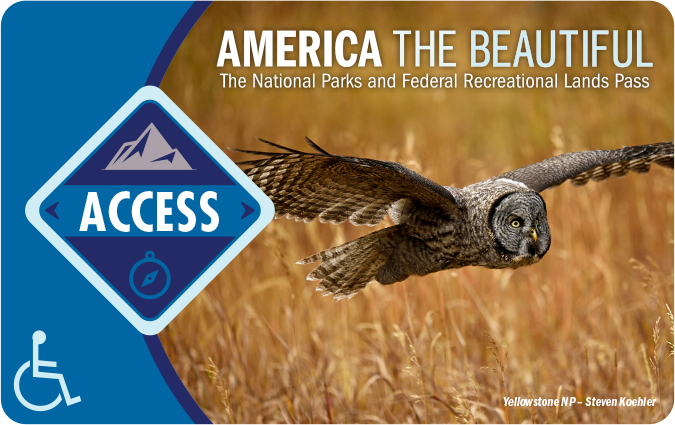
Access Pass - Accessibility (U.S. National Park Service)
how to get the Access park as a visitor with a disability.
nps.gov
430 points · by bookofjoe · 3y ago · 300 comments
I think it'd be great to encourage kids to visit the parks through passes like these. Sponsor a lottery/giveaway or a contest featuring children's park-themed art or creative writing as chances to win lifetime park passes for them and their family.
Also - fans of US national parks specifically can enjoy a game with some spectacular art called simply "Parks" [1]. and there's a simpler spinoff called "Trails"[2].
It’s a great idea, and if you’re one of the people here making SV tech salaries, you could make that happen tomorrow. You’re talking about $5000-10000 of direct philanthropy to run/promote the contest and buy those passes for the winner. Media coverage would come easy and you could get it to snowball through other contributors after driving it through the first time.
(Not being flippant. Sometimes people just need help seeing what they can actually make happen without too much trouble.)
Philanthropically, people do this scale of stuff for their own communities all the time. In the arts, people stand up and run themed contests every day.
There is absolutely time to be invested in designing or approving whatever online presence, reviewing submissions, becoming comfortable with whatever legal requirements, etc — but that’s the part that makes it a memorable life experience, not unlike the time spent on that trip to Belize or in those woodshop classes.
There are also free passes specifically for 4th graders (and their families) for some reason: https://everykidoutdoors.gov/index.htm
Edit: I was sort of right, but I found this on the website:
“We chose fourth graders because research shows that kids ages 9 to 11 are beginning to learn about the world around them. They're open to new ideas, and they are likely to connect to nature and our history,”
Original answer:
5th grade is the year that students learn about US History. I think the theory is that they get a chance to see the national parks before they learn about them in 5th grade.
I personally really enjoyed that game, and some reviewers have described it as "What Parks should've been"
Canada is beautiful. I guess I just wish more of the parks were accessible and well-supported by our government, in the same way US parks seem to be.
My personal favourite is strathcona park on Vancouver Island. My family spends summers and winters there. The geology is incredible, and you can find heaps of fossils in some areas. The lakes are stunning and cool throughout summer. The alpine areas are breathtaking. You really couldn’t see it all in a lifetime. I can’t think of a better thing to have a few hours away.
Joseph Sax is rolling in his grave.
Could you please elaborate, I don't know anything about Joseph Sax, and his Wikipedia entry doesn't contain anything that explains your comment. https://en.wikipedia.org/wiki/Joseph_Sax
https://www.amazon.com/Mountains-Without-Handrails-Reflectio...
It's been 20 years since I read it, but iirc he is musing about whether things like paving the trails around Niagara falls to make them handicap accessible diminishes our ability to be awed by the natural experience.
I may well be mischaracterizing it, so if you want to read it yourself the whole thing appears to be online here:
https://www.nps.gov/parkhistory/online_books/sax/contents.ht...
Interestingly during the pandemic some Nevada state parks moved to a mandatory pass pre-purchase system as a way to control the number of people in the park at a given time to aid in infection control and prevention. Nevada has some truly gorgeous state parks that are more akin to BLM managed land than NPS land. (To me, it’s all beautiful.)
For example, it's also free for current military and veterans, or if you volunteer for 250+ hours that year
Some states also let you check out state parks passes (NOT for the National Parks, but the state ones) at libraries.
Washington: https://discoverpass.wa.gov/148/Check-Out-Washington California: https://www.parks.ca.gov/?page_id=30806 Nevada: https://parks.nv.gov/about/library-pass
For us, the parents, we never know if today is a good day for our daughter to go on a hike and often times will buy tickets to things we don’t or can’t use. Happened with sesame park and that was expensive.
I imagine with other disabilities it’s the same thing or similar. Being blind or in a wheelchair (this park had paved paths) sometimes means having to turn around if external or internal conditions aren’t right. Combined with the fact that earning potential probably drops with many severe disabilities and you can imagine these spaces being rarely visited by an entire group.
I don't think disabled people deserve to go to the parks more than non-disabled, but get that there are logistics challenges.
I wonder if a time flexible pass would be better than just free access
I don't know this for sure but I wonder if that explains the "medicaid waiver". Someone with a disability (and only that individual) has access to medicaid regardless of parental earned income; so we got it for my daughter. And I thought it was weird because we're probably not going to need to use it? I'm not really sure yet...I know I have good insurance but don't think have tested its limits.
And that's when I realized why they don't factor in parental income or the presence of existing insurance. It's not to cover insurance gaps if I move jobs. It's because people with disabilities will probably hit insurance maximums, and at the end of the day, you do not want guardians foregoing necessary medical care when that happens. Because it will happen. You will create a population of disabled and neglected disabled people. And I think it's the same for parks. Some people won't even try going if they think they'll lose $30.
And I know someone reading this will immediately say regular people are also being neglected. I think everyone should have access to the same care, but from a budgeting standpoint and no lawmakers wanting to appear uncompassionate, this is an easier pill to swallow. Probably why the parks page linked also mentions veterans.
It’s more difficult for those of us who don’t see a wide spectrum of it up close to understand, but to individuals with the kinds of disabilities that impair mobility, the world is a shockingly different place. Sometimes leveling that playing field is best accomplished by eating the cost of a variable.
It’s difficult to imagine but some people are (for example) vulnerable to getting physically stranded in place just because a battery died. Not in terms of going without (for example) Uber, but being unable to physically move through the world the way it was built to move through. All the while cognitively being no more or less different than anyone else, and having to navigate life like that every day.
Yosemite has great disabled access FWIW. With a handicap placard we could drive on roads otherwise reserved for buses or rangers and get close to some of the best sights.
Yosemite is where we went last week. I was glad the government shutdown didn't happen. And yea, we were able to use their paved trails to push her around in a stroller because it would have been otherwise quite nearly impossible to go anywhere. She's getting a little heavy to hold for extended periods of time. But it made her absurdly happy, so it was worth it.
Edit: Source for more information https://www.nps.gov/planyourvisit/veterans-and-gold-star-fam...
Those of us who don’t need them have plenty of land to use.
Based on your statement I’d be surprised if you’ve ever interacted with a ranger. The only people I meet who dislike rangers are the types who feel entitled to do whatever they please in the wilderness and refuse to carry a bear can when hiking through Yosemite.
Take the mindless anti government sentiment elsewhere.
https://theconversation.com/us-national-parks-are-crowded-an...
http://www.doi.gov/ocl/overcrowding-parks
https://amp.theguardian.com/environment/2021/sep/10/overcrow...
Capacity challenges are being handled instead by denser transportation (e.g. Zion shuttle), by lotteries (e.g. Grand Canyon float trips), and by limited timed reservations (e.g. Rocky Mountain).
nope
If you get a Section 8 Voucher but the amount is too cheap, that isn't access to the market. https://podcasts.apple.com/us/podcast/the-fond-du-lac-apartm...
I think maybe this would be better solved by improving the financial situations of people with permanent disabilities, because then they might be able to afford a ride to the national park and not just entrance. One possible unintended side effect is reducing services given to visitors of national parks.
Edit: actually single payer seems to work in some places as a means to get access to the market for health care providers, rather than access to a Health Insurance Marketplace®.
A prime example of this is what happened to our mental health institutions. We used to have flawed, but fairly robust institutions to take care of individuals with extreme disabilities. Under reagan that all got yoinked away and people with severe disabilities were left with just about nothing.
But it doesn't end there, we do provide SSI and Medicare for people with extreme disabilities, but it's setup in the most draconian way imaginable. I have a child with severe autism, in order to not have them lose out of medicare I've had to get a law firm involved to setup a trust to ensure that my child never sees a dime of inheritance. My child can never own their own home, that'll kick them off of medicare. They can't own their own things, that will also eject them. It was an open question at one point if you could use trust money just to eat a restaurant (you can now, but this is certainly something that can be reversed as it was an IRS decision, not a law). This is all because if I want to give my child the best life possible after I'm gone, I have to make sure they have health coverage, and I simply can't save enough money to ensure that happens.
This isn't a question of what markets are available, but rather what quality of life should someone be entitled to? Should we all be entitled to have our needs met such as health, housing, clothing, and food? The current answer is no. I disagree. A good government is one that protects the most vulnerable.
https://journalofethics.ama-assn.org/article/deinstitutional...
The overall situation where we, as a society with the most abundant resources in all of history make living a decent life a puzzle for people facing difficulties, is quite the indictment.
I have dual citizenship so I plan on leaving the US at some point. EU is much more reasonable when it comes to cost of healthcare and living.
I do thing every American should have access to at least basic healthcare, some kind of affordable housing, food and clothes. Unfortunately, that is far from reality.
I myself have used food stamps at some point and everything about it was awful. The facilities were sad, employees rude and lines long.
I don't think Regan was the one to close all the mental health hospitals. I believe that started closing in droves in the 60s-70s.
And you can’t work on disability or you lose the $1200/month. Yes, disability is intended to provide income for those who can’t work, but why can’t it be a sliding scale, where more disabled (definitely can’t work) = more income? Work isn’t just for income, and the government should be encouraging people to work wherever they can even if it’s part-time.
EDIT: Forgot to mention, most disabled people probably have a lot of medical bills too, which is ironic because inability to pay can make it hard to get routine care. The saving grace is that the debtors can't extract any money from those who are only relying on the $1200/month.
However, money isn't the only way to have access to markets, though it's perhaps the only thing that gives full access. I think EBT/food stamps and Section 8 help a lot with having people get their basic needs met and not spending it on other stuff*. If they have a sufficient monetary amount, they give people a lot of choices of whom to buy from.
* There is a problem of people selling their food stamp benefits for cash https://www.fns.usda.gov/snap/fraud
Also, the SSDI payment is not always $1,200 per month. It can go as high as about $2,000. It can also be a lot lower than $1,200 per month, including $0 (for those that have never worked). But if it is lower than $894 per month, then the SSI program kicks in and makes your total income from both programs $914 per month unless your SSDI payment is $0 because you've never worked, in which case your monthly income is $894 per month.
The $894 figure is the lowest one would get. Some states decide to increase it, so actually a California resident would get at least 1114.21 -- plus food stamps adds about $100 per month. (Social Security ignores income from food stamps when deciding how much to pay you.)
Also, roughly half of recipients also get subsidized housing, where they pay only 30% of their income (minus medical expense) for rent even if they live in an expensive area like SF or NYC.
Someone on a different branch of this comment tree, i.e., a "cousin" of this comment, implies that as soon as Social Security decides you are no longer disabled, you lose the health insurance aspect of Social Security, but that is not true: you continue to receive Medicare for another 3 years or so. If you want to know the exact length, query a search engine for "grace period". (But if you've never worked at all, you don't get Medicare, so you have to rely on Medicaid, which might not continue for 3 years after you are determined to be able to work.)
No wonder disability rates are skyrocketing.
Very typical stuff though. I work in lot of lower income (NYCHA) buildings in NYC and see this sorta stuff all the time.
There are a lot of elements to this story that don't make sense. For starters, how did a felon qualify for section 8 housing so soon after release? Moreover, drug users are generally also barrer from section 8.
(minimum wage = $15USD x40 x4 = $2400 a month before taxes)
A disability payment will be around $1000, and one third of that will be taken for your free rent. As a side benefit you do not need to work at all.
The idea here is this that this sorta thing actively hurts the very people that deserve to be helped -- the honest working poor. Instead the benefits go to the people who can work the system, who have practiced it over their entire lives, with some even taking informal but advanced classes at the county jail about these things.
Then they think they’re pulling a fast one and would utilize it.
Surely there won't be enough people wasting their time like me to fill up the bus and make it unusable for others.
"Back and forth begging/busking" is another.
It’s to manage crowds and limit the amount of ecological damage the public does due to the huge number of people wanting to come, esp post-COVID restlessness.
I recall seeing an interview with either a state or federal park employee and they used the wonderful euphemism “Disincentive visitation” when discussing timed entry permits.
Translation: “Fuck off. But if you do come we’re gonna make your life as hard as possible and that will be 39.99 please (Fees not incl.)”
They really destroy less fortunate peoples chances to enjoy our beautiful landscapes.
If you didn’t plan your summer last February good luck finding a space that isn’t on the weekday. Then you have to plan kids out of school and two jobs and pets and their after school and…
You know what fuck it just drink beer and watch the game instead.
There will be just as many instagram models with tripods, just not the people who it would mean a lot more to than a picture.
Going off season or to side entrances finds miles and miles of … nothing.
An annual park pass isn’t that expensive. People who live in an RV would spend far, far more driving to and from the park for various things they need (gas, supplies) than they’d save on the park pass.
Regardless, having a pass doesn’t eliminate the rules regarding duration of stay. You can’t live in a national park even if you have a pass. If you try to do it in an RV, you’d get noticed and cited.
https://www.wired.com/story/meet-camperforce-amazons-nomadic...
The national forests OTOH, yes they are largely still free, but they are also heavily managed, frequently with commercial interests (ex, ski resorts at the top of the mountain, logging rights, etc). Which has resulted in the push to reclassify a number of them as wilderness, which has its own issues if you happen to be anyone but a birdwatcher (ex hunter, fisher, mountain biker, trail maintainer).
I'd been looking at my feet while peeing so I watched the billows blow by and then heard another big whoosh noise. My first thought was there must be some kind of little geyser around so I looked to find the source of the steam and saw it wasn't a geyser, it was a giant bull moose not more than 20 from me and it was snorting at me and basically telling me it was about ready to kill me.
Pretty much every year we hear about someone getting killed by bears there. I have spent many nights in many national forests and bushwhacked many miles off trail in them, but not Yellowstone. I'll leave that to the bears and those giant freaking moose.
But maybe you can drive right into Old Faithful; I’ve never been.
Technically, it's about 600 ft. from the parking lot, but half of that is the distance from the viewing area to the geyser (you never actually walk right up to the geysers, you always want to see them from a bit of a distance).
From what I remember of Yellowstone (it has been two decades since I visited), it's a national park where pretty much everything is pretty damn close to roadside, as the roads are designed to take you by all the interesting things.
The Grand Canyon is my favorite example. The rim by the visitor center can be packed but once you're a half mile down one of the trails you won't see a soul.
For those who naturally wander, it can be hard to understand. But a lot of visitors barely leave parking lots and pull-outs. I don't know about 95%, but I've definitely noticed this at my favorite California parks.
The road-bound will take pictures at the scenic viewpoint on the shoulder of the road and at various entrance signs, and maybe use the restrooms. Then they pile back into the car to go to the next pull-out, restaurant, or hotel parking lot on their itinerary...
I don't believe it and I certainly wouldn't encourage people to form opinions on national park policies based on it.
While many people with disabilities can’t go very far beyond their car, they represent a minority of visitors. The vast majority of visitors are people who are theoretically physically capable of walking further but just choose not to.
I don’t get it, but it does make the experience for those of us who are prepared to walk a whole lot nicer!
I don't know that I'd want to encourage people with little experience in the actual wilderness and not enough interest to read up first to go too far in any case. That's the group that contains the people who think petting the bison is a good idea or who never considered that their cell phone might not work everywhere.
More tourists getting killed just ends up making things worse for everyone, esp the people who get killed.
Random sidebar…and this is probably a state issue (whoch is unfortunate because my state isn’t very keen on non-private ventures) but one thing I would like to see is easier public transportation to national parks.
I reside in East TN and we have the wonderful Great Smokey Mountains National park but you have to have a car to get there. So, folks fly in to TYS and then drive up to Gatlinburg / GSMNP but once you get there, especially Gatlinburg, the city is pretty walkable. If I recall correctly, they have a trolley for parts of the NP but otherwise I have to burn fossil fuels to get there. I would much prefer a means of public transportation to get me up to the park and rely on public transportation once up there.
It’s probably low on the totem pole for problems to solve but I’d like to do what I can to preserve the area and for one of the most visited NPs, it seems like a win/win for getting people to nature while preserving it for future generations.
This is regardless of who owns the land in question.
I was lazy and auto-translated the first paragraphs of the law in question:
"Off-road driving with a motorized vehicle for purposes other than agriculture or forestry is prohibited throughout the country 1. on bare ground, 2. on snow-covered forest land with sapling or young forest, if it is not obvious that driving can take place without risk of damage to the forest, 3. on snow-covered agricultural land, if it is not obvious that driving can take place without risk of damage to the land.
Within the parts of the mountain area determined by the government, off-road driving with a motorized vehicle is prohibited, even on ground other than that specified in the first paragraph."
Banning electric bikes also seems like obnoxious oldster nanny-state behavior.
I have off-roaded in many national parks around the country. Vehicles are restricted to designated trails for off-roading. Many of them are challenging, rocky terrain and it's basically impossible to drive more than 10mph for a lot of these trails. There are some parks that are more intended for UTVs and ATVs where you will get more muddy flat land (more common in the southeastern U.S. due to climate and geography) and you can typically go a lot faster and it's quite fun, but these are again, UTVs that weigh about 1K-2K pounds and again, these are special trails designated for that purpose.
There are heavy fines and even jail time for people that try to break the rules and take vehicles into unpermitted areas. Nevermind that barriers are usually constructed to prevent or forest is too dense anyway to allow for.
FWiW the 2022 Toyota LandCruiser LC300 VX (4x4) is 2630kg (5798.2 lbs in obscure units).
Still, if you're going to cross a big desert area we can at least agree that lighter is better, (failing access to camels).
https://www.youtube.com/watch?v=OI3T_vM3VBI
https://en.wikipedia.org/wiki/Robyn_Davidson
NB. width of Australia is approximate width of mainland USofA: https://www.youtube.com/watch?v=fP4UcVbhR8o
See https://visitsweden.com/what-to-do/nature-outdoors/nature/su... for more.
Just my own opinion, but that doesn't sound like "everyone who abides to simple courtesy rules".
Pretty sure you wouldn't be able to do that in Sweden or the US.
How exceptional.
That said, the parent is being a bit too pessimistic. There's plenty of negligibly-policed and freely-accessible BLM land in the West that generally doesn't get abused all that much.
But in part because of the abundance of BLM land - the government owns nearly 50% of the Western states! - we don't really need to allow people to trespass on private land to recreate. There are some exceptions to that - mostly around access to water and beaches - but if you just want to go on a scenic hike, you're not out of options around here, and I'm not sure it's useful to hold Sweden as a role model.
As a private landowner, I'm thankful that I can post a "do not trespass" sign. Even well-behaved hikers leave a mark over time. Some trash is inevitably left behind or carried away by wind. Soil erosion is a problem on frequently-accessed trails. And that's before we get to the occasional drunk or rowdy group.
Can you have a family reunion with 30-40 people? Can you stay in one place for a week? Fishing? Hunting?
https://en.wikipedia.org/wiki/Freedom_to_roam#Sweden
Family reunion with 30-40 people? - Yes, if you don't disturb anyone's home or the land.
Can you stay in one place for a week? - Sure.
Fishing? Hunting? - generally no, unless you get a permit. Fishing permits are easy to get. Fishing recreationally in the ocean does not require a permit.
Stay away from peoples homes, and dont bother gardens/farms.
Other than that you can enjoy.
Not sure if you need a hunting or fishing license, but a family reunion is fine, so long as you abide by the above.
I would say irregardless is a word. It hasn't made it into dictionaries because it's been misused, it's made it into dictionaries because it's been in use!
Irregardless of your thoughts on the matter; people use literally differently than you do. Why are you correct and they are wrong?
I worked 80hr weeks for most of my 20s. I'm 43 now, fairly senior, but lost my youth. I have severe arthritis and most of my cartridge is gone. Walking is tiring after about a half mile and impossible after a mile. Dr says i'm too young for a knee replacement because you cant get 2 in your life.
Advice -- please enjoy some of your free time in your youth, you may not be able to enjoy your seniority/money once you have it.
They are a blast to seek out and find. We have been to so many random new places like wildlife sanctuaries in the quest to try and fill out books. Extra fun when mapping out paths on road trips to hit all of the parks in an EV, lots of constraints.
A good fan site with lots of info: https://www.parkstamps.org/
But, nope. Gotta buy one every year.
I'd expect this scheme to more than pay for itself pretty rapidly, regardless. Based on what I've read about improved physical and mental health outcomes for people on long term illness benefit here when the government started paying them to go on holiday once a year. (also heard it about other countries, we were certainly not the first)
4th graders can also get a free pass.
Typically you have to visit three parks within the year to pay for it. If you live in the East, it's probably not something you'd get every year. If you live in much of the West, it's probably something you'd be crazy not to get every year.
   - that the individual has a PERMANENT disability
   - that it limits one or more aspects of their daily life
   - and the nature of those limitations.
In my experience, the vast majority of public land (forests and BLM land) is free to enter and recreate on if you aren’t using services like a campsite. National parks are more likely to charge entrance or parking fees but you are also more likely to get things like trash service and paved roads.
That being said, it’s still pretty cheap. You can get an annual pass for $80 that covers you and everyone in your car.
BLM campsites are often a flat piece of ground that looks identical to the last seven thousand square miles.
I was shocked to find out that ADHD qualified as a disability that would let you get Paxlovid. To verify, go to https://www.paxlovid.com/who-can-take and click on "Disabilities". But having seen that, I'm tempted to tell my son that he might be able to get a free lifetime pass.
But that opens up a question. Have we as a society come to define disabilities so broadly that the term has basically become meaningless?
It is also supposed to be a "severe" limitation, but I doubt someone with ADHD would be interrogated about this, everyone involved just wants more people to visit the parks.
It's also possible that ADHD makes it more difficult to scrupulously comply with self-quarantine measures, in which case it's a good public health decision to make Paxlovid available and reduce community spread. I'm not actually sure if Paxlovid reduces transmission though.
Consider how it affects people's life trajectory through school and work, the opportunities out of reach due to the condition. It's essentially a situational cognitive impairment, when I think about it that way it seems profoundly disabling.
When I was living with family they were used to this stuff, and just let me be if I was obsessed with something. They let me satisfy those last-minute compulsions where I procrastinated and was unable to execute on my todo list earlier. etc etc.
I thought I had light ADHD but it effects my relationship, friends, and work responsibilities so much. I hate that I do everything at the last minute, with only a suitable stress to make my thoughts order themselves. And it appears entirely un-ordered when I'm doing x-y-z quickly.
Why couldn't I do it all earlier?
This also frustrates my wife, but I think less so than it would be to have the signal being an errand I'm already late for.
These are the "visible" disabilities. ADHD, amongst other conditions, are more invisible[1]. I have diabetes but "look" normal. I know a guy with epilepsy. They too, unsurprisingly, don't "appear" disabled. (I know this wasn't your main point but I think it's important for people to know.)
ADHD as a disability was never respected, there was a 2 year time period post 2018 in which people sort of took it seriously but not really.
Pre-acceptance period we had "Is ADD real?" articles on the regular, now post-acceptance we have "Are ADHD sufferers faking it?" articles on the regular. Nothing substantial has changed for people with ADHD, the common man still does not try to understand.
Because plenty of people say they are OCD too, but they don't mean the diagnosed condition. And it's quite different to "being tidy and needing things to be ordered" that the common vernacular makes it out to be.
Same as ADHD. Plenty of people who say they are "a bit ADD" mean something else.
But yeah ADHD can count as a disability, in some people. That's based not what you have, but if what you have substantially limits at least one major life activity.
You're free to guess whether the FDA is basing that on science, politics, or corruption. I've seen sufficient evidence that they do all three that I don't have a strong opinion. (In this case, I don't think that the science is there.)
I would say so. There ought to be a distinction between losing your legs and having ADHD. Most people with ADHD don't even know they have it. And it's also incredibly easy to fake.
As long as we have qualified doctors diagnose disabilities, I‘m quite sure the actual amount of faking or fraud will be negligible.
In other news, we have a national Adderall shortage because it was widely prescribed to kids whose problem was being unable to concentrate during lockdown due to stress and depression. As a result, by default teenagers lose their diagnosis when they graduate. I learned this when my son's psychiatrist had to give him very explicit instructions about how to document his disability so that the diagnosis he received in grade 1 will follow him into his adult life without having to prove it again.
> As long as we have qualified doctors diagnose disabilities, I‘m quite sure the actual amount of faking or fraud will be negligible.
There is a ton of people who get prescribed Adderall for its cognitive enhancement properties. It's incredibly easy to get diagnosed[0].
[0] https://www.psychologytoday.com/intl/blog/mouse-man/201007/n...
We’re getting close, but it’s okay. Expansion of the term has helped people and we’ll eventually come up with new common language to distinguish more and less catastrophic forms of disability.
If disability now means needing help, and help is something that everybody needs sometime, then disability really refers to everybody at some time.
And inasmuch as everybody should have the help they need, and statute already says that disabled people can get help, it works out well in practice. Everybody can claim that they’re disabled when they’re disabled and get the help they need. Sounds great!
But disabled used to mean something much more narrow and uncommon, and there’s still going to be need to find new language for that.
It's a truly awful condition that is not the "can't concentrate need to play games all day!" Condition the 00's characterised it as.
If you as an individual applied for this with a 30-minute ADHD diagnosis they might still give you the pass, because what's the point in arguing with you, but if a ton of people followed your lead then they'd probably start enforcing that criteria.
It might be a political non starter but sooner or later USA will have to consider selling off the national parks to more private entities. US federal government is needlessly sitting on vaste amount of land and not putting it for good productive use.
Roads in Yosemite remain terrible, poorly maintains, has horrible connectivity and fees are sky high. Not to mention there are hardly any proper resorts and recreational opportunities inside the park itself. Some of the national parks like Pinnacles appears to be government move to hurt some very specific landowners.
[1] https://www.perc.org/2015/07/20/back-to-the-future-of-americ...
These parks are our nation's shared treasures, they should just be free like the D.C. museums. The last thing they need is more privatization. The NPS does a fine job at providing the visitor services that AREN'T totally commercialized (rangers, upkeep, lotteries, etc.)
Some of those aspects of park operations have already been contracted out to a significant extent
https://www.wsj.com/articles/national-park-fees-booz-allen-6...
https://www.thebignewsletter.com/p/why-is-booz-allen-renting...
Edit: And this also totally misses the point of the parks to begin with. They're there not just to entertain visitors but to preserve these landscapes for posterity. Privatizing them would totally go against that. We don't need anymore land barons exploiting the masses and preventing them from experiencing the places they have a birthright to.
Having been to the Canadian ones, it is quite easy to see extremely well managed private businesses in parks. I didn't have a single poor experience (compared to the US ones).
Of course, making management of the whole park private? No way.
1: https://www.outsideonline.com/2404058/interior-department-pr...
I'm only ever a tourist in the US but I visit National parks and I'd hate to see public land go private for-profit, ads everywhere, and whatever else shit they can think of.
Let the vastness be vast and devoid.
[1] https://www.nps.gov/yose/learn/management/concessions.htm
Either way it'd be awful and likely just lead to bankrupted parks in disrepair.
Even the reservation system as we were recently discussing now has a corp entity eating the majority of the "profit".
And the NPS tries to put a positive spin on the whole thing, cause we all know big corps are more efficient (/snark) https://www.nps.gov/orgs/csp/index.htm
You MUST use recreation.gov and you MUST agree to the privacy policy which INCLUDES connection to Google's tracking servers. That is IF you want to use the public lands we are "preserving" for you to use in the first place.
It's utterly absurd and no one cares.