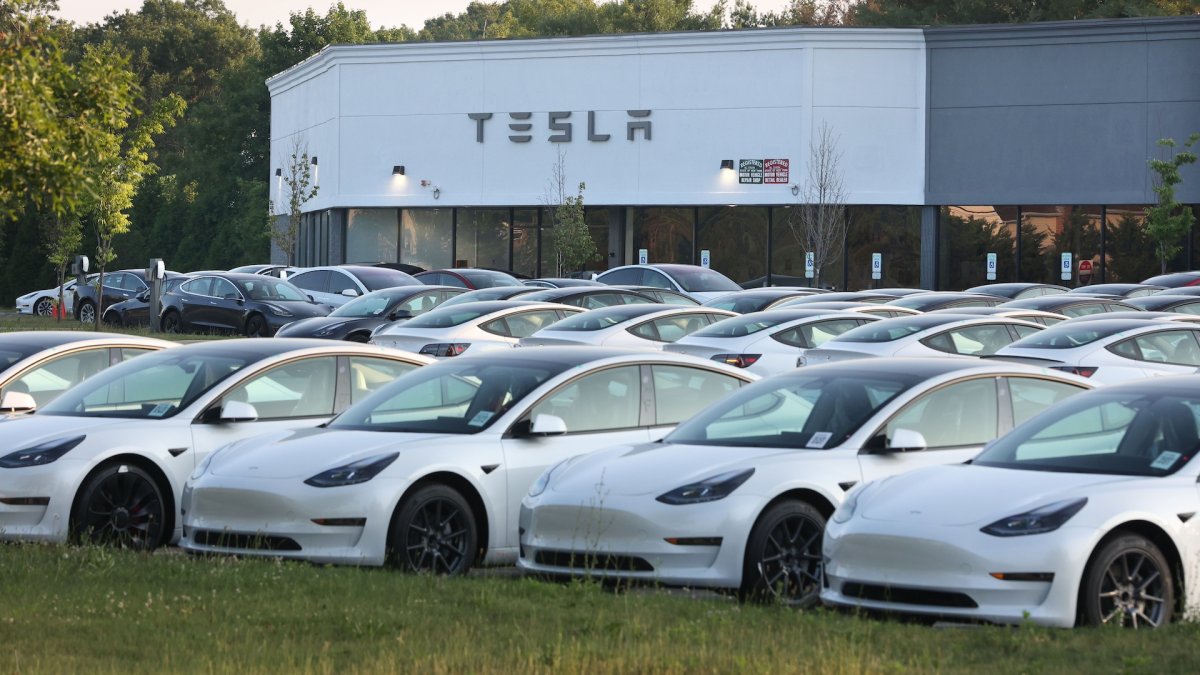
The Average New EV Costs $14,000 Less Than It Did a Year Ago: KBB
New car prices have stabilized since the start of the year, which is a sign that average car prices could be coming down.
The Drive
93 points · by ourmandave · 3y ago · 195 comments
A $14k drop is great, but what is the average price?
EDIT: $53,469, just shy of a $10k premium over ICE vehicles.
https://mediaroom.kbb.com/2023-08-09-Kelley-Blue-Book-Analys...
Most people finance a purchase like cars are paying it over 6-7 years. Today looking at gas prices the fuel cost saving can be anywhere between $100-300 a month depending on how much you drive where you charge. So even if an electric car that is 10k more expensive than ice is actually still cheaper today for a lot of people if you look at monthly expense. And each year it gets cheaper for more people to go electric as electric cars get cheaper. This is going to accelerate the price drops are too rapid for most people to understand cost analysis research from 2 years ago might no longer be valid today and today cost analysis wont be valid in another 1-2 years
Why does one need to present strong evidence that prices will rise by $7500 when the demand curve suddenly shifts right by $7500 due to government intervention? Surely this is just Econ 101.
It has precedent too, solar panel incentives, home building incentives etc. When government grants show up, vendors can take it into account if they want. If enough of them do, the market price has changed and so everyone can put their prices up. They are in a market that is not racing their prices to the bottom to drive demand so it works out.
I don't know about Ford, but most other major companies are only "losing" money because they have started a new vehicle platform and need a year or two to get the development costs back. Compared to previous CE platforms they are actually doing much much better.
I would guess the premium is closer to $5K, the difference from the $48K ATP for all transactions. Those are 90%+ of all transactions.
I mean, that's the comparison that matters to most people. The vast majority of cars are not luxury cars. Just because EVs target a little up-market, that doesn't exempt them from the reality that they're being compared to ICE cars in lower price categories by most buyers.
Gas is pretty expensive, and some EVs are cheap or even free to charge
How do total ownership costs compare?
A big difference is maintenance though. No oil changes, mechanical issues, etc. Just new tires when they’re worn out and occasional problems.
How are you getting a new Bolt (29K MSRP) for less?
How are you charging an EV for free?
I know some employers offer that, if you have a sweet deal like that I get it, but that is not the norm.
Here in Silicon Valley with daytime electricity being 73c/kWh thanks to PG&E, charging is pretty expensive too.
I can't find anything close to that on this rate sheet (current as of June 1, 2023: https://www.pge.com/pge_global/common/pdfs/customer-service/...
I'm guessing this doesn't account for the fact that you'll have to buy a new one every 5 years when the batteries go bad.
I see it all the time on Facebook and I’d love to understand what drives people to spout misinformation about EVs. Cobalt, fires, diesel powered charging stations, they simply can’t wait to spread some nonsense.
To carry stuff, I am looking at the 2023 hybrid Ford Maverick, a double-cab small/medium sized pickup truck goind for $22.6k starting msrp...which clocks in as the cheapest hybrid vehicle on the new market. 42 city 33 highway mpg.
I applaud these more modest and affordable entries into the fuel efficient market.
You’re also going to have to adjust for profit margins of car manufacturers back then to now, as surely productivity (use of labor and resources through automation) have allowed for them to do more with less materials.
The inflation calculation is also an average and stuff like cars made with steel might have more inflation due to scarcity or cost increases of making steel.
Then I’d say whatever left over is the actual increase in cost of making a car now vs then due to added functionality (including R&D for cars to be safer or more fuel efficient). Although maybe someone else can point out if I’m missing something else to consider.
From a EU perspective that vehicle is nowhere near the "small/medium" scale, even for a truck.
I recall watching some documentary about a guy who tried driving from the US to Brazil or something and cross some jungle. At some point he had to rent a car and all he could get his hand on was a Toyota Land Cruiser, which he immediately dismissed as being a small toy SUV barely any good for dirty roads and should be kept for suburbs.
> goind for $22.6k starting msrp
Is that because it's a truck? I seem to recall there's this weird US thing where trucks are on the cheap side because of whatever law or something.
And the “around 30k msrp” they quoted is so far a wish and dream. Chevy already dropped the bottom trim of their other new EV because they didn’t think it was profitable enough.
I got a golf thinking I’d rent a pickup when I need to carry something big, but so far haven’t come across anything that required it.
Trucks are useful but I do wish shared ownership were more convenient, because a ton of miles driven in trucks are not for any of those uses.
Pickup are useful for projects. Recently redid a fence, bought over 2000lb of lumber.
These weekends doing concrete walkway work, bought ~3500lb of concrete bags in one trip (way more than the weight of my commuter car!)
Although I'm still seeing $15K of "additional dealer profit" stickers at a Jeep/Ford dealer in Silicon Valley.
Dealerships may not be the _most_ contemptible rent-seekers in our society but they're up there.
Stellantis dealers are flush with inventory right now and it's a buyers market if you're interested in any of their products.
They have been doing it for over a decade. (Probably since they were selling buggies or whatever.)
Just go somewhere else.
Not just exhaust pollution eliminated but because of regenerative braking there is far less PM2.5 brakepad dust flying around at intersections.
Just like banning leaded gas in cars improved health for the next generation I think 51% EV will do similar.
https://www.theatlantic.com/technology/archive/2023/07/elect...
That has no relation to tire wear rubber dust.
It's not controversial that a heavier car that accelerates faster will wear out tires much faster (thus generate more rubber particles into the air).
Sure, EVs generate way less brake pad dust. But that's a tiny contribution to pollution. Brake pads are tiny compared to tires and in over 100K I've yet to wear out the brake pads on my ICE minivan but I've changed tires three times.
Tire particles are relatively heavy and don't stay in the air, unlike smaller molecules and emission from combustion.
If weight was a real concern, non-business pickup trucks and large SUVs should be banned regardless of the engine they use.
Depends on where you are. I'm in Shenzen right now and it's very close or at 50%. There are definitely more new electric cars than ICE cars on the road. For example, 90% of my Didi (China's Uber) rides have been electric cars.
I believe all of the city's buses are electric as well. Some people drive motorbikes here and they're all electric.
The difference in air quality between today and 6 years ago when I last visited is huge.
Something that depresses me is that a 1988 Honda CRX HF did 50MPG. Yes, 1988. Thirty-five years ago.
That's with extremely primitive engine management. If society had continued improving that line of development, I bet we'd have 100MPG cars today.
Instead, things went in a direction of extremely heavy cars which means much worse mileage.
Depends on the country. Also: not a chance for most of them. Main reasons:
- EVs are significantly more expensive
- There's no charging infrastructure to speak of in most countries
The point of the article is how that's quickly going to no longer be the case
> There's no charging infrastructure to speak of in most countries
Solvable in single-digit numbers of years, even the US which is a sloth at building infra is doing fine scaling up its charging and distribution network
US is much faster than, say, Sweden. And "single digit years" brings us to 2030 at least if the pace picks up.
I live in a Stockholm suburb [1]. In the past 4-5 years the number of charging stations remained at 20, and all the new construction in the vicinity has 0 parking spots fitted with chargers as developers claim it's too costly, and existing infrastructure doesn't permit it.
[1] No, it's not a US suburb. It's a European suburb with high-rise/multi-story apartment buildings, and new construction also being mostly multi-story apartment buildings. Thinks this: https://www.google.com/maps/@59.2775628,17.8994667,3a,75y,20... and not the American cul de sacs
Even the brand new districts like https://www.google.com/maps/@59.3066523,18.031298,3a,75y,152... have essentially zero charging stations in their underground parking lots.
We need to get cheap EV lease offers back out there if we want folks to keep switching.
Sure, you might say the average price is skewed by people buying expensive trucks. But even Camry costs like $35-36k after dealer markups - you can get Tesla model 3 for like 32k now after federal rebate.
Also, concerning the lower end of sales:
"But the news isn’t all good. Only one car sold for an average price under $20,000 last month. The Mitsubishi Mirage’s average transaction price in July was $19,205.
Every other car with a list price under $20,000 sold for over $20,000 on average. It’s not a large group. Automakers increasingly focus on building more expensive cars, trimming affordable models from their lineups. In December 2017, automakers produced 36 models priced at $25,000 or less. Five years later, they built just 10." [1]
[1] https://www.kbb.com/car-news/average-new-car-price-sees-smal...
I make six figures, never bought a new car in my life and don't ever plan to. Most I've paid is $19K.
[1] https://www.coxautoinc.com/market-insights/estimated-monthly...
[2] https://www.coxautoinc.com/news/cox-automotive-forecast-augu...
Yes, I'm in your demographic. Most I've ever paid for a car (a rare new one) was 20K. Nearly every car I've had (in over 30 years of having cars), I've bought for less than 10K.
I like cars and driving. But cars are a depreciating asset. Never worth spending much on. Buy the cheapest used one you can find.
Do not mistake the word "most" for "all", unless you want to muddy the waters.
7-year loans, now... that's new.
But cars also last longer as well as costing more so... eh. I don't know what to make of it.
So no, they cannot. "Most" Americans are paying for a car based on what monthly payment they can afford, and never thinking about how much they actually owe.
So yes. Most Americans can afford this.
Easily.
That's.... crazy!
Car loans should be no more than 3 years.
But really, to be responsible, only ever buy a car with cash on hand. If you need a loan, find a cheaper car until you don't need a loan.
Once I bought a car with a loan but only because the manufacturer had a 0% interest offer.
I do wonder if the manufacturers are leaving the door open for Chinese manufacturers. They may come to regret this policy.
In the UK there's MG4 that is a surprisingly decent BEV for £27K (that's a price without grants/incentives), but it probably won't be available in the US, since it's a Chinese-owned brand.
If you enumerate the ICE cars for sale, the mean and median is much higher than 30k, yes.
If you enumerate the cars purchased in a given year (and ESPECIALLY if you include used cars), the median price paid for a car may be well under 30k.
$30k is a lot of money for sure. But it does not get you much car these days, new or used.
Tesla you do online, and many people are shopping specifically for an EV, not going to a random dealer and considering it as an option alongside ICE vehicles.
Lots of great, reliable gas options under 25k.
When there are EV choices at reasonable prices there will be tons of demand for them.
It used to be not a huge deal to me charge on a road trip, a 20-30 minute break every few hours was actually really nice. But now, after the release of the Mustang, Ioniq 5 and EV6, I am regularly find chargers to be full and having to wait. My 30 minutes stops have turn to 45-60 minutes or longer because now I'm charging closer to 100% because I might need to the option to skip the next charger. And forget trying to take a road trip on a holiday weekend.
The article paint a picture of a broad industry trend, when I think it’s really mostly probably just one particular EV
The US government's policy of "encouraging" countries to sell their crude in USD (in a "nice country you've got there, shame if something happened to it" way) keeps them in effective control of the price of oil. The last time someone tried to sell in Euros instead [0], the US DOD spent more than $1,000,000,000,000 [1] proving their willingness to back up that threat.
[0] https://www.theguardian.com/business/2003/feb/16/iraq.theeur...
[1] https://en.wikipedia.org/wiki/Financial_cost_of_the_Iraq_War