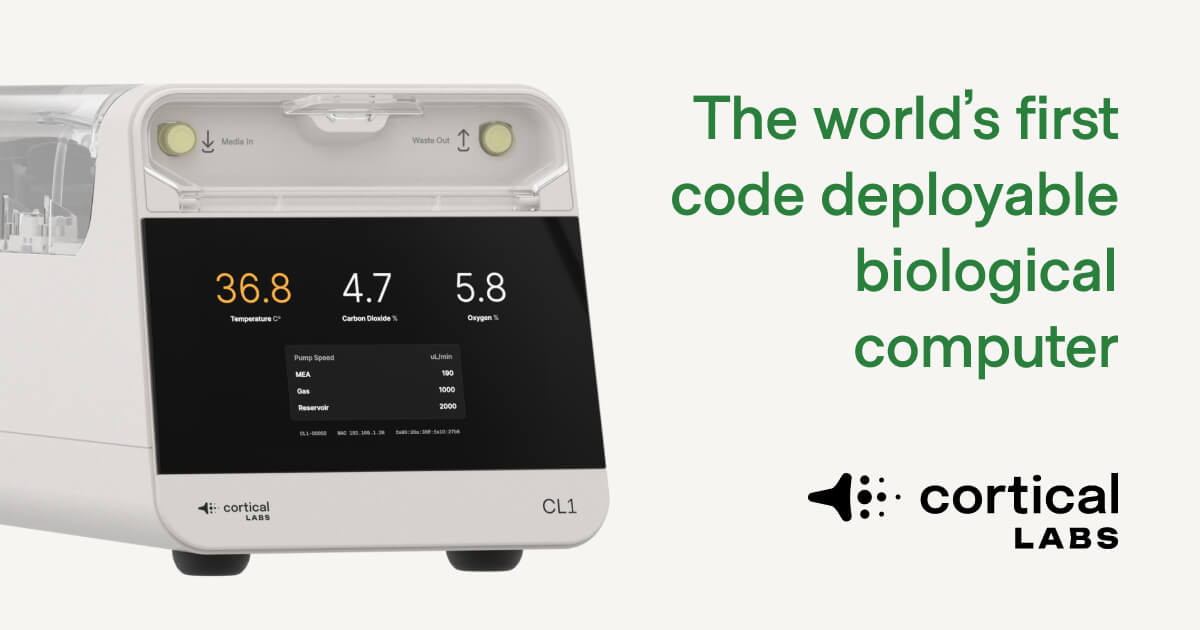
Cortical Labs
We've combined lab-grown neurons with silicon chips and made it available to anyone, for first time ever.
corticallabs.com
89 points · by pr337h4m · 3y ago · 126 comments
These are the guys behind Dishbrain, which is not really a brain but a patch of human induced pluripotent stem cells grown on the Maxone silicon chip [2] which allows recording from the entire ~5x5mm chip with high resolution.
[1] https://newatlas.com/computers/human-brain-chip-ai/
[2] https://www.mxwbio.com/products/maxone-mea-system-microelect...
Hopefully this will lead to brain implants that can help with solving a bunch of brain issues, and not to what we're all thinking of.
Honsetly if you're an 80yr old billionaire who has done 'everything', why not go for some mind encoding shenanigans?
maybe he WAS afraid of death, but didn't trust the modern stat-based medical methods?
There's a few people interested in the idea of (simplifying a lot) "brain as an antenna receiving the consciousness signals".
(The word for "ageless billionaire" is "corporation")
Note that in the "uploaded politician" case it's not nearly so relevant as to whether the person themselves believes it's the same person, as to whether everyone else believes they're the same person, and whether the upload has legal continuity in their job and position.
Do you think that is a sensible allocation of ANY resource??? Don't suck off a boot just to be a contrarian.
Don't carry water for them.
Depending on your sci-fi of choice.
Example:
Nothing we need to care about, as there is no such a thing. Mankind has put a significant portion of its limited attentional power on building interconnected silicon computers, that in a space whose scale is so small compared to human bodies that illusion of infinity is easy to fall into. In the same time, mankind went with global policy of massively draw on non-renewable energy stock, destroying vast sustainable life supporting environment in the process. There is nothing like unlimited resources and infinite space.
Now, obviously, this page is marketing idle talk, with a weak connection to the actual work in their labs.
From a purely scientific point of view, I wonder if that kind of device is just as vulnerable to magnetic storms as a pure silicon based device.
From a human perspective, without much more context, this seems just horrific and I wish them much ethical and legal barriers to stop them already.
Is the distinction between a protein-and-salt-water model versus an electronic-gates-and-memory model meaningful? From a computational standpoint, they both manipulate states and store data. Does substrate matter unless we're invoking metaphysical claims?
Regarding the video (https://twitter.com/Scobleizer/status/1716312250422796590), the device seems untypically polished but also a bit sus. Even if it contains living neurons, their functionality appears limited to mere survival rather than meaningful data processing. The claim that it's/can-be "more efficient than a GPU" (even if in the future) is premature at this point IMO.
I'd say the important part is "mind". That is what they claim they are setting out to create.
Our inability to answer questions like "Why do I exist? Why do I feel pain?" etc. conclusively is probably much less vexing than having a definite answer like "because someone made you to make profit off it and/or have an even bigger hammer to smash people and communities to bits with". Not to mention the following "changes made for the sake of change so someone can say they did a thing" that is already a blight on everything we make.
https://www.youtube.com/watch?v=M0CY4IThnmo&t=64s
^ We think we're Lisa, but I suspect we're Bart.
Now, one might propose that consciousness only arises when a computational process is physically run in certain ways but not others (this is what proponents of Integrated Information Theory (IIT) typically believe). Assuming this is the case, then implementing a potentially conscious process with biological neurons presents much higher moral hazard vs an implementation of the same process electronically, or safer still, on a Von Neumann machine.
I would go even further however, and propose that a conscious being (e.g. a being capable of generating the qualia of the color red for instance) cannot be simulated, i.e. conscious processes are generally noncomputable. Why? Well, consider what Chalmers calls the meta-problem of consciousness, which is to say the problem of why we perceive there to be a (hard) problem of consciousness in the first place (and why we are having this very conversation). A simulation of a conscious being would by definition present the same behaviours as that being (given the same stimulus, but for simplicity, we can consider the stimulus as part of the simulation itself without loss of generality). Therefore a simulation of myself for instance, would generate the same thoughts about consciousness itself, and this very same text. But, if we accept the proposition of my first paragraph —that a Turing machine on its own cannot be conscious— this would imply that our whole thought process surrounding consciousness and indeed our very belief that we are conscious is purely coincidental. After all, the unconscious simulation of myself would claim and "believe" just as strongly as I do that it is conscious while that is not the case, which means that the process by which it derives these thoughts and conclusions would be wholly unrelated to the object of these thoughts (actual consciousness).
As such, it is my fairly strong belief that there is some physical "device" in our bodies which allows us to generate qualia and get feedback allowing us to store a record of these experiences. If I had to guess, I would say that this "device" is very likely located in our brains, and that it is quite likely spread throughout our neurons and possibly each one of them.
It should be noted that although I do not believe I can be simulated in my entirety for the above reasons, I do believe that I could likely be emulated with a high level of accuracy from the perspective of an outside observer. Actually we see this already with ChatGPT being able to play the role of a conscious being. But unconscious objects appearing conscious is nothing new in a sense since even a novel (especially told from a first person perspective) can be thought of as such an object already. It will be very interesting to see whether AIs trained without reference to the concepts of consciousness (a hard task to filter that out of the training data!) will ever present signs of consciousness. That would certainly put into question my above philosophical reflections.
---
So to summarise and answer your question more directly, I think there is something about our universe that allows for the generation of conscious experience and that our brains, likely on the neural level, have a bidirectional interaction with this something. As to what this is and how it works, I have no clue. Roger Penrose for instance put forth the idea that this might be related to quantum mechanics and certain molecular structures in our neurons capable of interacting with the quantum world in specific ways, but this is still pure speculation.
More importantly, we know from our own experience that interconnected biological neurons processing information and put under stress (rewards and penalties) are capable of generating conscious experience including very negative ones. And, whereas I believe there is good reason to assume that Turing-equivalent processes such as electronic circuits are not capable of consciousness, I strongly believe that artificially created biological neural network are very likely to be conscious, perhaps even at a fairly small scale already.
So, yes, I think any work creating artificial information processing systems using biological neurons needs to very tightly regulated, if not stopped entirely. At the risk of sounding dramatic, we might accidentally create hell on Earth if we are not careful, at least if biological computing ever becomes competitive with transistor based computing, which until now I'm glad has not looked to be the case... but I'm starting to worry.
Applying this logic, heat is also fundamentally mysterious. What even is heat? Heat definitely exists, but is a mere description of it enough? If I run the simulation of a universe with heat; is that heat?
What makes you think that this relationship is bidirectional? AFAIK and experience, the relationship is entirely unidirectional. I literally have no idea what I am going to do next. Doing so would require me to think to think what to think.
Ignoring the metaphysical question is really frustrates me when people treat the brain as just a more complex version of a computer. The human brain and a silicon based computer are two vastly different things you can't and should not compare them.
Of note: This is an active test of the "Free Energy Principle" [1] with seemingly supportive results.
Their definition, in the paper, of sentience is as follows:
> It is proposed that these neural cultures would meet the formal definition of sentience as being “responsive to sensory impressions” through adaptive internal processes.
IRL If the masses of neurons start getting large this starts to be ethically questionable… in direct proportion to how large.
> Under this theory, BNNs [biological neural networks] hold “beliefs” about the state of the world, where learning involves updating these beliefs to minimize their VFE [variational free energy] or actively change the world to make it less. If true, this implies that it should be possible to shape BNN behavior by simply presenting unpredictable feedback following “incorrect” behavior.
Incorrect behavior is punished by pushing static, simulating an "unpredictable" environment, so that the BNN (biological neural network) acts differently. I really hope that if they continue this line of development that they find something other than "chaos overrides" to sensory input because at a certain level of intelligence, that would lead to insanity.
Imagine something like a Raspberry Pi with a neural network mounted on it that is significantly more powerful than an h100.
I get that brains are far more efficient than computers. What I'm wondering is how a business case can be made today for even considering an approach like this.
Amazing, scary, and perhaps absurd, all at the same time!
But the nuts and bolts of how neural systems give rise to reasoning or even what consciousness is... we only know that neural systems are responsible for reasoning, and we don't even know definitively that neural systems cause consciousness. We only know that if you suppress their activity consciousness is retarded, and if you damage them enough consciousness is snuffed out.
The latest article is "Critical dynamics arise during structured information presentation within embodied in vitro neuronal networks"
Neurons are considered organic entities that are satisfied with an healthy environment. It is supposed that nothing suffers.
The simulation argument asserts that "at least one of the following propositions is true: (1) the human species is very likely to go extinct before reaching a “posthuman” stage; (2) any posthuman civilization is extremely unlikely to run a significant number of simulations of their evolutionary history (or variations thereof); (3) we are almost certainly living in a computer simulation."
(1) is still possible - humankind is armed to the teeth, this tech could be a bunch of hot air, the breakthrough is still N years away, etc.
(2) becomes less likely with every headline. If we had the ability today to simulate a consciousness-filled universe thousands of instances would be spun up overnight.
(3) is looking more plausible than ever...
Let's say you have an input x and a step function f such that the sequence x, f(x), f(f(x)), ... contains (in whatever sense) a conscious mind. Once that sequence is defined, it doesn't (and can't) logically matter whether it is evaluated once, twice or a hundred times, whether it is evaluated on a slow computer or fast computer, or, in fact, not evaluated at all. There is always only one sequence, and the act of evaluating adds no information to it.
Or, actually, with Ctrl+U (the code is clean, just go to the <main>)
Well, for convenience:
==== ==== ==== ====
###~ What does it mean to grow a mind? ~###
The human mind is the north star for digital intelligence. But silicon can only do so much. Cortical is growing human neurons into silicon. Their reality is our simulation. We think these minds will learn better than any digital model and breathe life into our machines.
###~ Human neural networks raised in a simulation ~###
The neurons exist inside our Biological Intelligence Operating System (biOS). biOS runs the simulation and sends information about their environment, with positive or negative feedback. It interfaces with the neurons directly. As they react, their impulses affect their digital world.
###~ Our first minds ~###
The dishbrain is currently being developed at the CL0 laboratory in Melbourne, AU. We bring these neurons to life, and integrate them into The biOS with a mixture of hard silicon and soft tissue. Our first cohort have learnt to play Pong. They grow, adapt and learn as we do.
###~ Silicon meets neuron ~###
Neurons are cultivated inside a nutrient rich solution, supplying them everything they need to be happy and healthy. Their physical growth is across a silicon chip, which has a set of pins that send electrical impulses into the neural structure, and receive impulses back in return.
###~ A direct connection to infinity ~###
This creates the highest bandwidth connection possible between an organic neural network and a digital world. Our biOS composes their reality, sending information about it via electrical signals. It then converts the neuron's activity into actions inside that reality. Their world is mediated through our biOS.
###~ The Ultimate Learning Machine ~###
Those actions have a positive or negative effect in biOS, which the mind perceives, adapting to improve that feedback. The human neuron is self programming, infinitely flexible, the result of four billion years of evolution. What digital models try and emulate, we begin with.
###~ Why? ~###
There are many advantages to organic-digital intelligence. Lower power costs, more intuition, insight and creativity in our intelligences. But most importantly we are driven by three core questions.
###~ What will we discover if our intelligences train themselves? ~###
We know an organic mind is a better learner than any digital model. It can switch tasks easily, and bring learnings from one task to another. But more important is what we don’t know. What are the limits of a mind connected to infinity? What can it do with data it literally lives in?
###~ What happens if we take a shortcut to generalised intelligence? ~###
Machine Learning algorithms are a poor copy of the way an organic neural network functions. So we’re starting with the neuron, replacing decades of algorithms with millions of years of evolution. What happens as these native intelligences start solving the problems we’d previously left to software?
###~ How can we surpass the limits of silicon? ~###
Silicon is raw, rigid, unchanging. Our organic neural networks sit on top of this raw power, but the way they grow and evolve isn’t limited to the software they run on. There is no software, it's coded in their DNA. How will computing change as we shift from hard silicon to soft tissue?
###~ RFN: Request For Neurons ~###
The dishbrain is learning and growing in biOS today, and soon we’re opening an early access preview for selected developers. The biOS is our simulation environment, where you can program tasks, challenges and objectives for our minds. Join our developer program to get early access to our SDK, and secure training time with our minds.
###~ What comes next ~###
We’re not making smarter computers, more efficient data centers, or more personalised advertising. We’re doing this to see what happens. What happens if we grow a mind native to the infinite possibility space of digital computing? We wonder what it will mean for digital spaces, for robotics, science, personal care. To explore the delineation between the personal mind, the distributed mind, digital and physical realities. To blur those boundaries. We wonder what it means to grow a mind, born of the physical world, but a native of the digital world, where that mind will go, and what it will teach us. Wonder with us.
On the other hand, maybe the internet would be a whole lot better if everything was just a giant wiki, and we let our personal browser bots go scrape for the interesting stuff and report back to us.