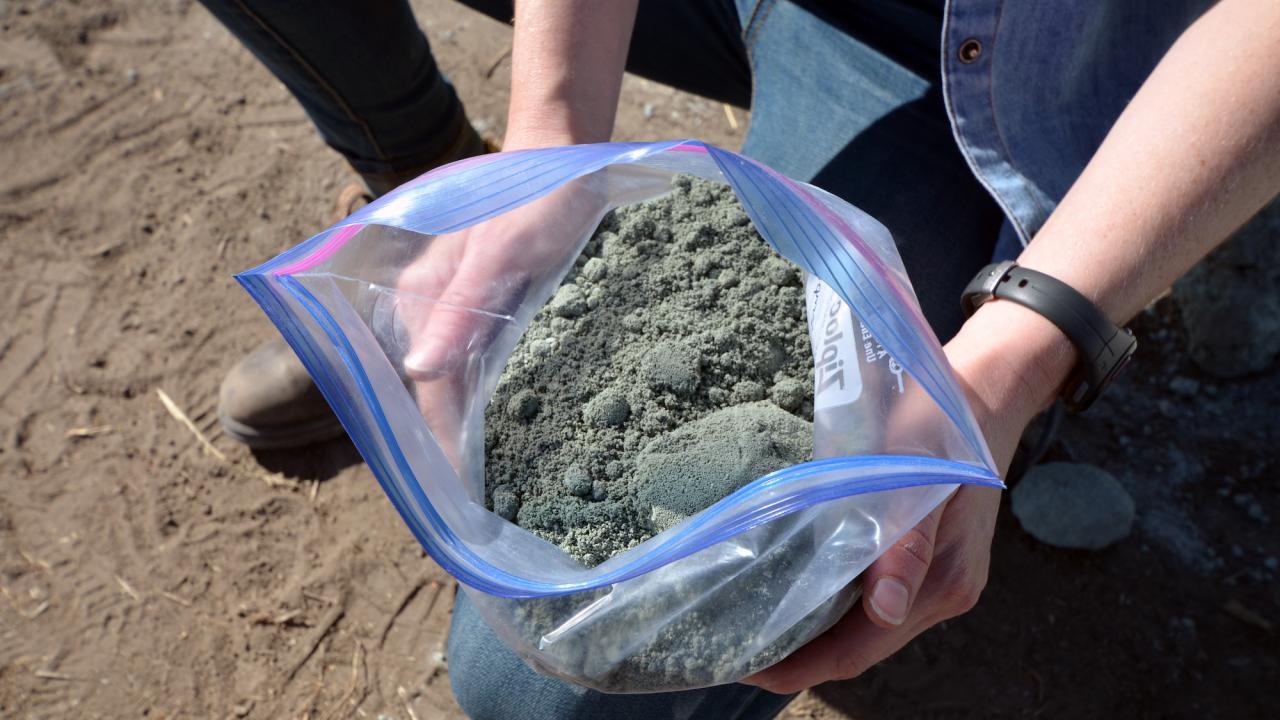
Adding Crushed Rock to Farmland Pulls Carbon Out of the Air
Learn from UC Davis researchers how adding crushed volcanic rock to farmland removes carbon dioxide from the air.
UC Davis
272 points · by geox · 3y ago · 278 comments
This is an average rate of 2.8 Billion tons of CO2 per year. We currently emit over 35 Billion tons of CO2 every year so this could potentially offset about 8% of global emissions. Obviously not enough to get us to net zero but that is very significant in my opinion.
I'm not certain how the economics of this solution would work. Is it easy to source, produce, and distribute this crushed volcanic rock? Would farmers get carbon credits for doing so? Or direct subsidies paid for by taxes on net-positive CO2 generating industries (which ironically is a lot of Ag itself)?
I used to work on SAG (semiautonomous grind) mills for fine grind on copper-bearing ore. Grinding rock is incredibly energy inefficient. I would suspect this entire process is carbon-positive despite the atmospheric capture.
It seems we will do anything to avoid the obvious - we need to reduce energy use and transition to green generation.
"A life cycle assessment (LCA) about the potential of basaltic rocks for enhanced weathering and soil carbonation (Section 5.1.) found transportation (related to the distance between the quarry and the place of application) as the major process negatively affecting CO2 sequestration, whereas grinding had less effects on the CO2 budget, which could however be related to the relative coarseness (<5 mm) of the particles."
A lot of companies doing this use fines or waste material, but it can still be done efficiently.
One thing you seem to be missing coming from the copper world is that the ore for copper is very low percentage of copper and has a maybe 3:1 stripping ratio, so you need to mine and grind and use 300-400 tonnes to get 1 tonne of copper out.
With ultramafic and mafic rocks, you can have huge continuous bodies of these minerals, with very high usage and efficient ratio. One tonne of olivine removes more than 1 tonne of resultant carbon based on its Mg cation content.
Transport is electrifying and so is the grid that powers those vehicles, therefore in the long run you can assume these will become more and more efficient.
Potential and costs of carbon dioxide removal by enhanced weathering of rocks https://iopscience.iop.org/article/10.1088/1748-9326/aaa9c4
Environmental life cycle assessment of CO2 sequestration through enhanced weathering of olivine https://legacy.projectvesta.org/wp-content/uploads/2019/06/E...
Grinding the olivine to this study's grain size of 83 microns[0] will consume roughly ~14 kWh/tonne[1]. One tonne of olivine absorbs about 1.25 tonne of CO2, so that's 11 kWh/tonne for grinding, which is indeed likely to be the majority energy consumer.
Clearly the solution is... build roads from olivine! :D Collectively, roadways are "naturally" subject to a huge amount of mechanical weathering, which currently mostly just generates asphalt microplastics.
No doubt the cost/geotechnics doesn't work out, but it's an amusing thought nonetheless. Maybe it could even be made workable, somehow...
[0] https://iopscience.iop.org/article/10.1088/2515-7620/acfd89/...
11kWh per tonne of CO2 sequestered is 2 orders of magnitude less energy per tonne than other DAC methods [1]. Assuming it is scalable (i.e. there is enough open land near the olivine deposits), then it is far cheaper.
1. https://www.mcc-berlin.net/en/news/information/information-d...
Nah, asphalt microparticles are in the end just very viscose oil and rock dust from the filler. The microplastics from roads come from tire wear and brake dust.
Haha. I'm glad you didn't include "solar" or "freakin'". ;D
The idea behind carbon capture projects is this: for years, we have been given warnings that "if we cut all emissions now, we will still be okay", to "if we cut all emissions now, it won't be too bad", and now we're at the stage where even if we meet our emission targets, things are still going to be bad.
If we want to avert disaster, we now need not only to cut emissions, but ALSO to actively remove carbon from the atmosphere. So, these projects are here to try and fill that unfortunate new need, because just cutting emissions will no longer... cut it.
Most of the world is doing just that.
It's much, much easier said than done.
Dig deep enough into any initiative that claims to be doing that and you'll find that it has far reaching consequences that negate whatever positive impact it has on the planet, and dealing with them would reduce profits.
I'm not sure how this is supposed to be obvious. It's using vague language that makes it sound as if this is a trivial lifestyle change. "reduce energy use" at the rate you're hinting at strongly means things like:
* Eat less food, and worse food * Wear worse clothes longer, perhaps until they fall apart * Live in smaller, cramped housing that is colder in the winter and hotter in the summer * Go fewer places, but not just as a tourist, also for practical needs, limiting the job opportunities of many * Have less entertainment * Use less water, the bulk of which for any given person is used for hygiene
Now that I have done the actual work of making it obvious what you suggest, are you still saying we need to do those things, and if you aren't saying that, just where do you imagine energy can be reduced?
Less than, worse than? First world people eat entirely too much, and unhealthily. Not hard to imagine diets better for humans and the ecosystem. Hell, 1.5 billion people are already vegetarian and doing fine. People will complain about eating less steak but it's a first world problem.
Worse than? Durable clothes are better for the environment, and classier. Disposable "fast fashion", made of plastic and sewn by quasi-slaves in sweatshops is the real problem. People will complain about losing a dopamine button but it's a first world problem.
Smaller than? It's completely possible to improve thermal efficiency without altering size. Maybe, if you live in a sprawling poorly insulated McMansion, you should invest in better insulation - or a better house - instead of powering through by burning energy. Apartment blocks are already far more efficient for climate control (square/cube law), so it's squarely a rich person's problem.
Fewer places than? Are people taking jet airplanes to work every day? Yeah, they should probably stop that. People taking the train are probably in the clear. This isn't even a first world problem, it's a superrich problem. Of course they'll complain...
What "entertainment"? This doesn't follow at all. "Entertainment" isn't a particularly energy-hungry category. Maybe if you're entertained by mining bitcoin? The most entertaining thing I own, besides my laptop, is a Synthstrom Deluge Groovebox, which runs for 9 hours on a single 18650 lithium cell.
Water: Another one that doesn't follow. I suspect the bulk of water for a given person is actually agricultural, so see point 1. But as important as it is to preserve freshwater ecosystems, I don't see the direct bearing on energy consumption. Most municipal water comes from reservoirs, not desalination.
That can significantly reduce CO2 in the short term. Sure you won't be able to buy as many widgets on Amazon - but we won't be on hackernews discussing silly carbon capture methods to make marginal gains that will never feasibly happen on a global scale.
Consider the napkin math. One mole of MgSiO3 reacts with one mole of CO2 to give MgCO3 + SiO2. The embodied energy in CO2 from C + O2 is 393 kJ/mol. One mole of MgSiO3 weighs 100 grams (almost exactly) and has a specific heat of roughly 1 kJ/kg-K. That works out to roughly the amount of energy required to heat the olivine by 3930 Kelvins, although this is well beyond the point at which specific heat becomes nonlinear and would most likely melt the sample.
Since it is uncommon for rocks to melt when grinding we can conclude that the embodied energy in the carbon absorbed is way larger than the energy required to grind the material. The inefficiency of electric generation certainly comes into play but even if we use a factor of 1/5 we still find a temperature rise of 786 Kelvin which would be extremely damaging to equipment if it actually occurred, and the actual temperature rise is probably less than 100 Kelvin. This still gives a comfortable margin of inefficiency for the carbonation process. And we have assumed that all of the energy is coming from inefficient coal-burning plants, which are in reality a minority of the global energy mix.
Consequently, we can conclude unequivocally that olivine grinding absorbs more carbon than it emits even under relatively pessimistic assumptions, and dramatically more carbon than it emits under realistic assumptions. While the energy of grinding is large, the embodied energy of CO2 is very large — this is why carbonaceous fuels became popular.
There are downsides to the process — most obviously but with a distant horizon, sequestration of carbon in this manner is precisely the process expected to eventually destroy the biosphere by carbon starvation in a few hundred million years, and using olivine to stop global warming is slightly accelerating the inevitable doom of all life on Earth. Also, it takes up a lot of space and costs a lot of money. And inevitable doom. But you know, priorities.
There will be specific curves for the ore they are grinding. They will look something like this. https://www.researchgate.net/publication/43497937_Milling_cu...
Obviously this is not related to olivine, so we would need to call around to get the appropriate ones. This isn't like computer work where you can just google it.
Take the grain size you're looking to end up with, compute the surface area and mass, combine it with the fracture energy, and you should have a pretty decent estimate for the energy required to grind a particular substance to a particular size.
Fortunately, there is a relatively cheap way of producing that energy with solar or wind installations. Your rock grinding machine can actually improve electrical grid by using excess energy and being a first candidate to be turned off in case of electricity shortage.
Another way of looking at this is that a rock grinding machine is a way to convert excess renewable electricity into oil. By converting renewable electricity into sequestered carbon you can allow amount of oil being used for net zero carbon footprint.
Yes, it costs more (but not as much as some people think -- excess energy is actually much cheaper and in some cases can have negative value). We kinda now there isn't going to be a solution that will be as cheap as what we have been doing up to this point.
It may very well make sense under those conditions.
It's been in use for a long time and is great for fragmenting large rocks and boulders. It does still need grind after the main fragmentation is done.
SAG Mills use the same concept to grind rock to a finer level. Most of the abrasion is rock-on-rock inside the mill.
1. Knock things down that are already high up and hope they break at the bottom. Or,
2. Haul things up and then knock them down.
#1 only works in an extremely limited number of cases and gets exhausted quickly. #2 spends more energy hauling up than it gains.
/s
Well if you haven't noticed yet, that's the hard part and some emission is inevitable at least for near future. We won't get rid of fossil fueled planes or cargo ships anytime soon
Regarding economics; there is plenty of olivine rock already available as a mining by-product. Disadvantages are that it takes up to 1000 years to fully sequester however this is logarithmic with a large portion of this achievable in the first century (why they mention 75 years in this article). This can be accelerated with further grinding to increase surface area.
I would imagine that regulations for net-zero will push for carbon removals to be sold similar to carbon credits have been (as net-zero can only be achieved with removals, not credits). These could either be sold as they are created annually or pre-purchased as the mineralization is a pretty sure thing to happen.
Whether this (as in CO₂ removal, not limited to enhanced rock weathering) evolves into a public service equivalent to garbage collection or a utility like water is yet to be seen.
https://www.businessinsider.com/sargassum-turning-smelly-sea...
This is the problem with some of the geo-engineering approaches. We've shown that we can't really change how society and industry operate enough to reduce emissions, so what makes us think we can do the same for carbon capture? How do you actually get every farm to do this?
Don't take that too far: there is a lot of work to do. However we have a good idea what that work is we just need to apply it.
If someone finds a plausible way to reduce a major part of global greenhouse gases that costs merely, say, 10 or 100 billion, then that's something that a few major countries can do (and fund) unilaterally and doesn't need global consensus, unlike major emissions reductions which have the tragedy of commons problem where if you do that and other major emitters don't, then you've crippled your economy but haven't prevented any of the bad consequences.
Well, yes, a lot of farmers (not all, probably most) are interested on adding those to their soil and will do it if it's cheap enough.
I'm not sure we can mine, pulverize, and distribute it in a carbon-negative way. But yeah, coupled with large scale implantation of renewables and decarbonization of transportation, it may be enough to even roll climate change back a little bit.
For basalt, it's around 200kg net, so the supply chains have to be shorter.
I checked my math with the DOE's experts, and it checks out.
The required reduction in emissions is 99.9% (net), which is approximately "everything everywhere except maintaining grassland"[0] if done by reducing gross emissions; the last percentage point of a problem is usually the most difficult, so if we can get a whole 8% by making a cheap sink, that's probably for the best.
Just so long as it's in the sweet spot of "cheap enough" without crossing over into the realm of "people can make money mining the CO2 out of the air", because if that happens then the same economic pressure that means we have too much CO2 now will become one of too little CO2.
The crushed basalt they use is already a byproduct from quarries they partner with from what I understand.
So this should not be used to offset new emissions, but thought of as a way to claw back the damage we are still creating today.
"Remineralizing soils? The agricultural usage of silicate rock powders: A review"
https://www.sciencedirect.com/science/article/pii/S004896972...
IIRC the soils that benefit the most include:
- Soils depleted in micronutrients
- Acidic soil
- Silica depleted soil (significant for rice farming and other silica-sensitive crops)
Most of the world's acidic and depleted soils that could benefit the most are in warm tropical regions with heavy rainfall. That's also where fresh mineral applications would weather most rapidly to draw down CO2. Unfortunately, it may also be harder (logistically and culturally) to encourage silicate applications on those soils than on the temperate climate soils of North America.
After a certain point adding more silicates doesn't help increase soil productivity. The one thing that I haven't found any reporting on is where the "too much" point is reached for soil amendment with crushed silicates. I have seen that yields stop increasing with ever-increasing addition of ground rock. I haven't seen a point where they go down. I would guess that there's some point where yields actually start dropping, and that would mark the upper limit for agricultural soil amendments.
Up to the point where yields keep increasing, you could expect farmers to spread crushed silicates on their fields for their own benefit, depending on the cost. In the high-application case where yields flatten out but carbon sequestration continues to increase, you'd need to pay subsidies to get higher application rates. You'd also need to pay subsidies in the lower-application-rate cases if yields increase but not enough to justify the expense on a yield basis.
Rolling stones; fast weathering of olivine in shallow seas for cost-effective CO2 capture and mitigation of global warming and ocean acidification https://esd.copernicus.org/preprints/2/551/2011/esdd-2-551-2...
In fact, terrestrial enhanced rock weathering (ERW) was created to replace the cost of liming fields for farmers, which leads to the release of carbon. Many farmers are open to it because they need to balance their soil's ph. Which as you said, is important to farmers because the land "is the tool the farmers use to make their living" therefore, you can consider ERW/liming as the maintianence on their tool...
That’s a big if! Reminds me of “the market for comics is $32 billion a year. If NFTs can capture just 1% of the market that’s $320 million per year.”
Also what are the CO2 emissions of transporting all these rocks??
There are three aspects relating to its feasible application - as distinct from theoretical considerations.
1. Is the process feasible? The slow reaction rate seems to be a significant obstacle. Additionally, these minerals are rarely pure and may vary significantly in quality from source to source, leading to a QA/QC problem.
2. Can the process be scaled-up? Contrary to earlier comments, there is no wide availability of these minerals, not at the scale needed to make an impact. Moreover, the material-handling side of the issue is not well addressed. It isn't a simple question of drawing a distribution network on a diagram: it's working out the economics of the mass mining, transport, distribution and application of these materials. People are working on this, but I have not yet heard a compelling solution.
3. Are there undesirable side reactions? This is what farmers will worry about. It'll be good if these amendments increase soil fertility, but that has to be demonstrated. Do these amendments alter the physical structure of soils or reduce their capacity to retain water, especially after carbon is absorbed? Do they form concretions over time that would make soils less permeable? Does the exposure to plant exudates release contaminants in soil?
I was involve in a project at a Canadian diamond mine in which the host rock - Kimberlite - absorbed CO2. This caused a decrease in its alkaline pH and allowed small quantities of sulphides to oxidize and release contaminants. Clearly, this is the kind of undesirable outcome that must be avoided.
Lots more to say, but perhaps some EW experts will chime in.
If I go to a beach in the US Pacific North West, I can pick up basalt rocks/boulders/pebbles, but they last were in contact with an active volcano millions of years ago (approx 12mya is the usual number given locally, if memory serves)
See Potential and costs of carbon dioxide removal by enhanced weathering of rocks https://iopscience.iop.org/article/10.1088/1748-9326/aaa9c4
Environmental life cycle assessment of CO2 sequestration through enhanced weathering of olivine https://legacy.projectvesta.org/wp-content/uploads/2019/06/E...
Enhanced Weathering: An Effective and Cheap Tool to Sequester Co2 https://link.springer.com/article/10.1007/s10584-005-3485-y
Both the low and intermediate IPCC scenarios, SSP1-2.6 and SSP- 2-4.5, rely on it. It will be essential to keep our planet recognizable by 2100.
Luckily the jittery/cyclic output of renewables is ideal for this. In the grand scheme of things it also solves the storage issue to a large degree, since massive overbuilding of (peak) capacity is necessary.
This is a huge issue that people do not understand, there is currently no plan for this CO2 removal and I was horrified when I realised that all our climate projections assume that a massive industry will just spring into existence
Maybe mixing the crushed rock in with seeds when they’re already being planted?
Windmills were used to crush grain too, but wind turbines are orders of magnitude better in terms of a solution.
I'm not kidding either.
Also worth noting that life cycle assessments take into account the gray emissions produced while sequestering CO₂ so the removal should be the net CO₂ removal (although not sure if that's the case in this article).
> The study found the plots with crushed rock stored 0.15 tons of carbon dioxide per hectare (2.47 acres) during the study compared to plots without crushed rock. Though researchers expect different weathering rates in different environments, if this amount of carbon was removed across all California cropland, it would be equivalent to taking 350,000 cars off the road every year.
So, if they use more than 15 gallons of gasoline to mine, crush, transport and spread the rock over 2.47 acres, then this process emits more CO2 than it captures.
I think they'd need to use electric high-tonnage dump trucks and electric tractors to make this process actually capture carbon. Electric tractors are stating to become available, but I don't know of any high-tonnage electric truck manufacturers.
You could just mix the fertilizer and the rock together at the fertilizer factory, and automatically a large chunk of the worlds farmland gets this added.
The paper provides a very course estimate that what they measured over the year was only 0.15% of total weathering potential, which if we handwave a little turns into 6,000 lbs CO2 over 20 years, or 300 gallons of gas offset, which is probably a net gain. Though there are a ton of "it depends"es in there and it probably only makes sense with further electrification.
(Obviously, the weathering would go on for a lot longer than 20 years, but the unknowns get large there and I'm assuming we're mostly interested in a shorter time frame)
https://www.ford.com/commercial-trucks/chassis-cab/models/f5...
That can move 14,870 lbs (minus the weight of the driver and the dump truck bed) per trip, so it would take more than 6.7 trips to deliver rock to treat an acre. At 6.7 trips per acre it would have to use less than 44 gallons of gasoline per trip for breakeven. It should use significantly less than that for fields that are somewhat close to an appropriate quarry / rockery.
The lightning can only move 7000 lbs per trip, so it would have to make 13.5 trips per acre.
I found this[1] link from the EPA with a number similar to yours, 8.8kg per gallon of gas, but they say it "creates" rather than "emits." I'm still struggling with this creation of mass out of thin air...
[1] https://www.epa.gov/greenvehicles/greenhouse-gas-emissions-t...
The CO2 contains mass from the atmospheric oxygen consumed during combustion. 12 grams of carbon becomes roughly 44 grams of carbon dioxide when it burns.
Your point stands, but it was 600 lbs.
They quoted figure is a rate, not an absolute amount removed:
> 0.15 tons of carbon dioxide per hectare
Per hectare. They spread it over 5 acres, or roughly 2 hectares, for a total of 0.3 tons, or 600 lbs.
"IPCC Report: Carbon Removal is Now Required to Meet Climate Mitigation Targets"
https://www.carbon-direct.com/insights/ipcc-report-carbon-re...
Also see this IPCC fact sheet about carbon dioxide removal, which includes enhanced rock weathering (the technique under discussion here):
https://www.ipcc.ch/report/ar6/wg3/downloads/outreach/IPCC_A...
[1] https://www.bgs.ac.uk/discovering-geology/earth-hazards/volc....
Why does it even have to be on farmland in the first place? If it's such a great idea with no environmental downsides, then dump the crushed rock onto other land instead. Then you can dump more of it without being limited by whatever is optimal for farm yields.
"Climate tech startup Silicate is set to start the first-ever enhanced weathering trial in the United States. The trial will involve applying 500 metric tons of milled returned concrete to 50 hectares of farmland in Buckingham, Illinois. According to company estimates, this project has the potential to remove as much as 100 tons of carbon dioxide from the atmosphere annually."
As in - you pay the carbon to crush it, ship it and spread it. Then it captures carbon exactly once, and then what do you do with it?
That does make some sense, thanks for replying and elaborating!
1. Rocks
2. Ants! https://www.scientificamerican.com/article/ants-may-boost-co...
There are many rocks under the surface of the soil, and over time they work their way upward and pop out of the ground. Every spring when the fields are being tilled for planting, these rocks get in the way and they need to be removed (for the convenience of the farmer and his plow). Today's New England forests are all 2nd or 3rd growth; the land was previously completely cleared for farmland, before the farmland of the Great Plains opened up and was found more efficient for scale farming (and not least because the human population there was smaller).
If you walk through the New England woods today, you will periodically/frequently come across old "abandoned" stone walls among the trees. Farmers built these stone walls to mark their property from the stones that were handy because they were removed from their nearby fields, where these stones had "floated" to the surface. The reason these stones are under the surface is because the grinding and bulldozing of glaciation, and then the subsequent outwashing of ice-melt carrying stones and sediment.
All of that (from memory, apologies for any mistakes) to ask: won't adding crushed rocks to farmland result in a lot of those rocks popping back out of the ground? Will plowing just keep them turned under, but even so, wouldn't the population of rocks keep increasing?
You didn't mention what size these rocks/stones are (to my non-native ears, a rock is at least several centimetres), but if you can build walls from them, I take it they're not sand-sized. If you click the link in the first paragraph of the article, leading to the source, it mentions in the introduction
> Crushed metabasalt and olivine soil amendments were used to investigate changes in soil pore water alkalinity as a proxy for bicarbonate production. The metabasalt (median grain size: 102 ± 22 μm) was selected because of its benign elemental composition and modest weathering potential (the parent volcanics includes felsic facies, yielding an overall silica content in the intermediate-to-felsic range). The olivine (median grain size: 83 ± 12 μm), in contrast, was chosen for its potential to weather rapidly
TL;DR the remains of the crushed rock they tested is measured in micrometers
The Bill Gates-associated method of spraying fine lye in a hyperboloid tower seems the most effective, perhaps at a slightly higher pressure of 2-3 atm to both increase the temperature and reactivity. The lye would be produced in a closed carbon cycle process using renewable energy sources.
But for how long does the rock 'function' before needing to be replaced? I'm doubtful that it would work at the same rate over just a few years, let alone 75.
With the need for massive mining, transportation and application of the rock at regular intervals I wonder if it would erode what ever gains this gives us.
According to the article it took several months of winter. Say, even though there is less rain in the summer, it is 0.3 tons per hectare per year.
To put into perspective - trees sequester more than 6 tons of carbon dioxide per hectare per year.
Highly recommend looking into Louis Bromfield. A very accessible book: The Planter of Modern Life: How an Ohio Farm Boy Conquered Literary Paris, Fed the Lost Generation, and Sowed the Seeds of the Organic Food Movement
Will it turn my soil acidic? Will it kill off bacteria? Will reduce drainage or will my soil suddenly be unable to hold water? Will it harm the nematodes, will it create a nutrient imbalance that is only corrected by some monsanto/bayer patented soil amendment?
See: The role of soils in the regulation of ocean acidification - https://royalsocietypublishing.org/doi/full/10.1098/rstb.202...
And geology is fascinating, so that’s another reason to learn more.
I didn't notice any mention of how long it takes powdered basalt to weather down. Is that over a year?
https://en.wikipedia.org/wiki/Basalt#Weathering
It seems that basalt consists mainly of metal oxides, predominantly Fe, Ca, Mg and Al. How does carbonic acid from rain get bound into basalt, without dissolving in the next rainstorm?
(My knowledge of chemistry is restricted to "A" level, what Americans would call High School; and I've forgotten it all, because it was 40 years ago).
The article says that basalts weather down into clays, which aren't carbonates.
> "adding crushed VOLCANIC ROCK to cropland" ... "by crushing the rock into a FINE DUST"
Emphasis mine.
So...
  - Mine massive far-away lava fields
  - Generate massive amounts of CO2 through this process
  - Cause serious environmental damage
  - Transport what you mined
  - Generate massive amounts of CO2 through transportation
  - Crush it into a fine dust
  - Generate massive amounts of CO2 through this process
  - Transport massive quantities again
  - Generate massive amounts of CO2 again
  - Likely need for massive amounts of chemicals as part of all of the above
  - Use a high carbon footprint process to distribute the dust
  - Use a high carbon footprint process to bury the dust to the required depth
  - Hope and pray for enough rain
  - Hope and pray you don't destroy the fields for agricultural use
And that's not even a full accounting of what the process at scale would look like. It is far more likely to add massive amounts of CO2 to the atmosphere than the opposite. Not to mention potential ecological damage across every region the project might touch, from mining to deployment.
We are not going to surface real solutions until we are willing to be honest about the full and real accounting behind proposals. Most so-called solutions barely pass basic high school science and economics tests. That's where we are. Still. I mean, we are still talking about stuff like huge fan-powered filters? Have we gone mad?
All we are doing is wasting time and money looking at false supernatural solutions to a planetary scale problem that requires real solutions.
> if this amount of carbon was removed across all California cropland, it would be equivalent to taking 350,000 cars off the road every year.
OK. Then forget volcanic dust and focus on the infrastructure and power generation required to enable a million electric cars per year. If this volcanic powder nonsense is good for 350K cars per year, well, doing THREE TIMES BETTER with electric cars is a realistic objective that isn't in fantasy-land at all and does not create the potentially horrific ecological danger of mining and spreading volcanic dust. One is realistic and attainable. The other is, at best, a dangerous fantasy.
Bottom line I'm not sure it MUST be a C02-generating process once bootstrapped.
Also no reason we can't focus on both electric cars and this soil method.
None of these proposals qualify as solutions, because they are never aligned with reality. Or, another way to put it: Reality is always far more complex than recognized by these experiments.
I do remember stories from undergrad engineering about the development of the first moon landing and the associated technologies. That and maybe the Manhattan Project.
In both these projects, budget was essentially unlimited, and ultimate success absolutely required planning around yet-to-be-invented technology. I see enough similarities to think something like this is possible. If, for instance, we thought seeding farmland soil reduced emissions by 99%, we'd probably do it. It's a leap of faith, but there is absolutely precedent.
Are they trying to reverse that?
Certainly destroying the farmland and letting people starve would result in decreased carbon dioxide emissions.
Bringing it everywhere where it could be useful, though, is unlikely to happen without subsidies to cover the transport costs, but the need for carbon capture might support that.
Even if we covered all the possible area we could with trees we couldn't capture enough CO₂. And that ignores the fact that climate change increases the chances of wildfires.
To compare with your pebble, which wikipedia says is
> A pebble is a clast of rock with a particle size of 4-64 mm
> Crushed metabasalt and olivine soil amendments were used to investigate changes in soil pore water alkalinity as a proxy for bicarbonate production. The metabasalt (median grain size: 102 ± 22 μm) was selected because of its benign elemental composition and modest weathering potential (the parent volcanics includes felsic facies, yielding an overall silica content in the intermediate-to-felsic range). The olivine (median grain size: 83 ± 12 μm), in contrast, was chosen for its potential to weather rapidly
TL;DR scan for the digits in that quote. This stuff is measured in micrometers.
> Why would you even study such things?
Because if everyone were willing to read sources and get to understandings, we would probably not have climate problems in the first place