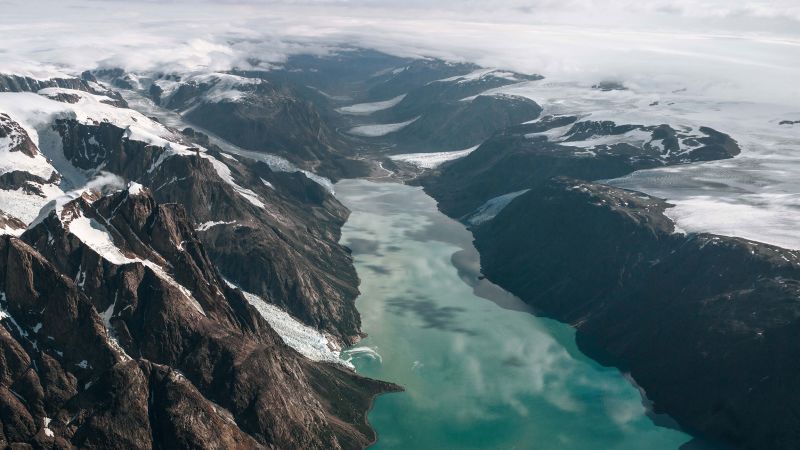
Before-and-after photos of Greenland glaciers reveal decades of change | CNN
The comparison found that the rate of glacial retreat in Greenland during the 21st century has been twice as fast as the retreat in the 20th century.
CNN
144 points · by vinnyglennon · 3y ago · 87 comments
Same story on the Tasman glacier, which is now mostly a lake which sometimes has a few icebergs floating in it.
Rural folk emit about 20% more CO2[2] than city dwellers in the US, so if OP lives in a city, even flying to NZ and back once a year puts him at less climate impact than an average rural American.
[0] https://www.carbonindependent.org/22.html#:~:text=CO2%20emis....
[1] https://www.statista.com/statistics/1049662/fossil-us-carbon....
[2]https://www.anthropocenemagazine.org/2020/02/the-unexpected-....
[1] https://alaskapublic.org/2023/08/07/crammed-with-tourists-ju...
For glacier complexes in parts of Canada and Alaska, you are looking at big-city sized areas of ice that are completely gone.
The really alarming thing is when you notice a big change after just a few years.
Everything down slope is impacted. Water volumes, soil moisture, vegetation, etc in the entire watershed can rapidly change once the glacier dries up. Farmers and municipal water authorities are most acutely aware of these changes, but it touches everything.
I think what’s especially hard to grasp from pictures is not just the areal loss, but the massive amount of volume that has vanished. For example, the Aletsch glacier, (at a length of 23 km, the biggest one in the Alps) has lost more than 100m of thickness in only 150 years. If you stand on its surface as it is today, it’s impressive to realise what a sheer amount of ice there used to be above your head and around you just a few decades ago.
They also have the raw data since 1840 if you would like to look at that.
It's not like they can't take the photo from the same position and location as the original, and the retouching makes it especially hard to tell how much photoshopping was actually done to possibly fit an agenda.
The article makes it seem like we'll see some huge thing, but we don't. Some of the photos have tire tracks, and the change in ice is like the size of a few cars - that's not really much.
I'm not saying there isn't a change, but these photos certainly don't show it.
You're looking at an 'ice scape' in one version and in the later one there is running water everywhere to give but one example.
One notion I've read is pumping out the hidden rivers of snow melt. This would minimize movement of the ice on top (towards the sea).
What other crazy ideas should we try?
Some how increase the albedo by counter acting soot?
Create massive snow machines?
Envelope ice fields in fog during the summer?
Cloud seeding perhaps, but only if the moisture is there in the air.
Fog is a fun thought… ablate the outer millimeter to create an insulating layer.
You could bore tunnels in the ice and circulate coolant, but you would accelerate melting of the upper portion to fight melting on the lower.
Stop using fossil fuels would be one.
The loss of glaciers and polar ice is already locked in.
Atmospheric carbon continues to affect the climate for > 100 years. If humans stopped emitting all carbon today, climate crisis will continue.
For natural glacial formation to resume, lower than 350ppm?, we have to go beyond net negative to net negative.
We've kicked off multiple negative feedback loops. We have to remove carbon faster than the tundra thaws, the oceans acidify, and the forests burn.
I'm certain you know all of this.
Are we just going to sit back and watch all the ice melt?
It gives a nice perspective, and it’s a visceral reminder that the planet has been through far worse than us. I find it comforting that even if we drive ourselves to extinction, life itself will continue on.
And in the multicellular era, too. This is important, because whoever (or whatever) comes after us might still have a shot at colonizing Mars. It may seem like Earth has lots of time to do it, but the video shows just how precious our tiny slice is.
That means that there may not be anything to 'come after us' depending how much of a mess we make, and any complacency regarding all this is dangerous. We stand to lose a lot, possibly everything and there may simply not be an 'after' for intelligent life on Earth. Life will go on, but not in a form that will ever even be able to contemplate colonizing Mars, let alone to act on it.
I haven't checked the veracity of that statement recently though, I'll see if I can't find it again.
… What is this fixation people have on colonising Mars? Like, why is _that_ the reason that civilisation reemerging would be important?
It ultimately comes down to whether you think that is good.
BTW I too am skeptical about Mars but for wholly different reasons. The Moon makes far more sense for a first step for numerous reasons, and beyond that I think settling space itself would be better than settling down in another gravity well. Become truly and permanently spacefaring.
None of this helps climate change though. I consider them unrelated issues.
With that in mind, many view human settlement of Mars as something as an insurance policy against decades-long periods of stagnancy like we saw from the late 70s up through the 2010s. It’ll apply strong pressure on the parties involved to continue to improve the technologies involved in getting out there and back and living there in ways that a human presence on the Moon won’t (you can’t get away with a lightly modernized rehash of the Apollo missions; that’s not good enough).
No, honestly I don't know either. I don't know what it even changes without mentioning Mars at all, and that's what all the "the Earth has been always gone through that" or worse advocates do not get? Besides it comparatively not being true at least at that timescale or with that population.. it all does not matter: It has never been about Earth in general or what may survive or reemerge at some point, it has always been about us (and our children)?!
Say we ran with your perspective. Mars doesn’t matter. Ok, that means it’s guaranteed that you, your children, and the descendants of everyone you know will die as our sun heats up. This is not so far away, as the video illustrates.
So then, what do you get out of this? A few dopamine hits and some nice chemical reactions before the eternal void? What’s all of our work even amount to?
We have the privilege of being the only life form ever to use technology. Technology! We can do things. Most life can’t do a damn thing. They live, briefly, and then die, gruesomely. And till the asteroid hit, that might have been the story of our planet until the sun gobbled it up. (Though imagining dinosaur astronauts is fun too.)
Would you say that asteroid is all about you and your children? It’s what even made it possible for you to be here, along with the unbroken string of cells from billions of years ago till the present day. Me and my children? We’re nothing, in that perspective. We are here thanks to everyone that came before.
And we owe it to those who come after to let them live an even better life. So unless you want the descendants of everyone you know to die horribly one day, colonizing space is our only way out.
But that’s just what I get out of it. After all, my own chemical reactions are unlikely to change a thing, over a single millisecond of that video. There’s nothing wrong with focusing on yourself and enjoying the ride. But personally, I end up a lot happier trying to make life be about more than little ol’ me. (My daughter says "gaaaa!" as I write this, which is either a salute of agreement or a firm rebuttal. Time will tell.)
(the earth itself might also become less habitable all by itself over time, but i don't know enough about that)
Speculating is fine but you can’t use pure speculation to justify things in the real world. That’s the problem.
Truth is that we have no idea about anything much past our own slice of time. In 2000 years we may be extinct, reverted to hunter gatherers, settled across the solar system like in The Expanse, or extinct or kept in zoos by superintelligent posthuman AIs that have expanded out into the cosmos. Or none of the above. Who knows.
If the point of colonization of Mars is to diversify where life is to avoid full extinction, we really need to think bigger. That channel is filled with examples of nearby Supernova and Quasars that could extinguish life in the solar system.
That timeline also opened my eyes to how long it took for the Cambrian explosion to occur.
I used to worry (as one does) in my 20s about quasars, but those are basically sniper rifles being fired in random directions. The probability of one scoring a critical hit is far less than a giant rock hitting us, which is probably the more pressing concern.
I’m sadly bearish on us ever getting out of our solar system. I think AIs will be able to, but flesh and blood is ill suited for the journey. And as much as I love our mechanical overlords^Wfriends, they’re ill suited for colonization via reproduction, unless you buy the theory that swarms of nanites could really become viable.
Given that the Universe is probably infinite, and certainly so stupidly big that there's no way this planet is unique, life will always continue on.
No idea why you should find this comforting. The condition of this planet, to humans, should always matter to ourselves.
> might still have a shot at colonizing Mars
Or we could just choose not to wreck this planet.
https://electroverse.info/how-the-greenland-ice-sheet-really...
https://electroverse.info/increases-in-polar-bear-population...
Your first link doesn’t seem to show this. It shows that the rate of loss has slowed over the past few years, but it’s still losing mass every year.