Low current around roots boosts plant growth
It speeds up photosynthesis and increases stress tolerance
nature.com
222 points · by bookofjoe · 3y ago · 90 comments
Fun fact, JC Bose was a teacher of Satyendra Nath Bose (the boson/Bose-Einstein condensate guy).
> Seedlings were grown in 3 kg pots, filled with the mixture of red soil, sand and treated with fungicide for inhibiting the fungal infections
It would be very interesting to take the next step and try this in different soil types especially what would generally be considered as 'better' or 'more normal' (say no-til farming with rich soil-life, balanced amounts of minerals, etc - not 'red soil mixed with sand'). Just thinking out loud, but it might be possible that this 'convert the voltage into a low current' actually happens in such less sterile soil type automatically because it already has anodes and cathodes.
1. https://www.nrcs.usda.gov/sites/default/files/2022-10/Soil%2...
I wonder if we tune into just the right frequency plants are already using for communication, we can send more “grow, please” signals.
So there is certainly a way to say "do not grow". If anyone works out the opposite encoding, I am sure there will be a lot of interested parties who would like to speed up their growth processes.
Can't remember if a uni mate told me that or John Sullivan the telecoms lead of the Auckland skytower construction.
From how many meters away can a human walking in a forest be detected with such an organic signal network?
FWIU mycorrhizae networks all broadcast on the same channel? Is it full duplex; are they transmitting and receiving simulatenously?
Also some herbicides work on the principle of making the plant grow too fast in order to kill it.
It does seem these electrical effects are well established, and seem to mostly have positive benefits: https://www.ehow.com/list_7531004_effects-electricity-plant-...
Cannabis as well, it's selected to smell strong, since people make their purchases based on sniff tests, at the expense of the quality of the high.
I read about the "gene for better flavor also leaves green around the stem" a long long time ago, long enough that those tomatoes would be in supermarkets if it were that simple.
Readily available so-called heirloom tomatoes explore all sorts of colors and gradients, and they sell well, and still they aren't that good. Gotta be more to this story.
On top of that they're often picked before they are firm red (because they are more firm), with the knowledge that they will turn red over time after picking anyway.
On the other hand, I'll never forget the one time a Dutch colleague went on a trip to Italy, and when I asked him afterward how it was all the talked about was one time he went to the market and bought and ate a fresh tomato there, with just a pinch of added salt, as if it was a religious experience.
"You don't understand, it was like I ate a real tomato for the first time in my life! A real tomato, vanderZwan!"
These are the three most common in consumer broadleaf herbicide ingredients (usually combined) that actually work. They mimic a growth hormone:
https://en.m.wikipedia.org/wiki/Auxin
Between application time and death the plants really do just grow out of control in weird uncoordinated ways. You can see a treated dandelion here:
https://turf.purdue.edu/wp-content/uploads/2015/03/Slide16.J...
Another interesting broadleaf herbicide mechanism is overloading invasive plants with chelated iron. Broadleaf weeds absorb iron rapidly and without regulation until the point of toxicity, whereas grasses will only absorb what they need to turn a nice healthy dark shade of green.
I wondered about electrode material too. But both questions remain unanswered because sci-hub hasn't added new articles since the 2020 attack in on them in Indian courts. I have no way to access the full text to make an informed comment. The only detail in the snippets and abstract was that it was 50mA of current. That'd be about a watt of heating for typical hundreds of ohms volume resistances of damp soil.
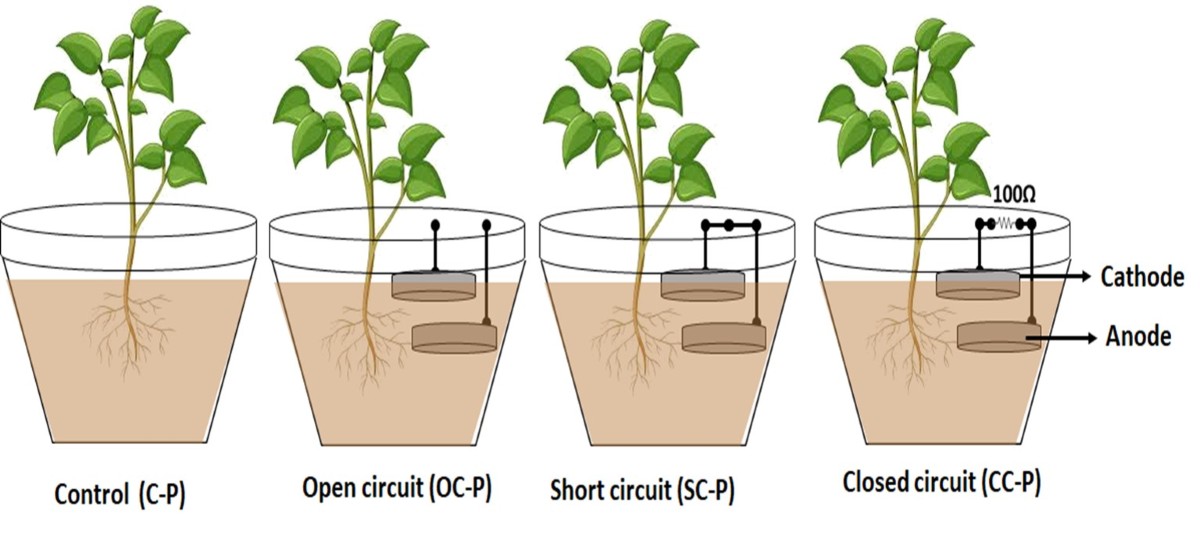
The other two are more interesting- presuming the short circuit had a lower effect than the one with some resistive load (labelled closed circuit), I presume there's something changing in the soil chemistry itself once sufficient potential is reached by microbe activity. Ions being knocked loose from the dirt itself, rather than the anode or cathode, which wouldn't happen when there's a direct short / no load other than the wire.
> The open circuit and control having a similar effect show that it likely isn't ions from the anode or cathode.
When you apply current between two electrodes in an electrolyte, you do a few things:
1. Create an electric field between them.
2. Create an ionic current through bulk electrolyte.
3. Cause chemical reactions at the surfaces. This has to happen: the current in the electrode is made up of electrons (or, equivalently, holes), but the electrolyte doesn’t conduct electrons — it conducts ions. [0]. So, for charge balance to be maintained, every electron that exits the anode into the medium needs to somehow turn into an ion, which happens by chemically adding an electron to something, thus reducing it. Similarly, the cathode pulls electrons from the electrolyte, and they come from something in the electrolyte, which is oxidized as it loses the electrons.
If the cathode in particular is not inert at the voltage used, the cathode itself can be oxidized. A copper cathode can, for example, produce copper ions much faster than it it would naturally leach them without an applied voltage.
[0] I’m sure that exceptions exist. Solvated electrons are a thing. And you could use an electrically conductive substance as your medium, e.g. carbon or metal powder.
"A diet rich in proline was linked to an increased risk of depression in humans in a study from 2022 that was tested on a limited pre-clinical trial on humans and primarily in other organisms." https://en.wikipedia.org/wiki/Proline
"Electroculture Gardening" (09/2023, 53 comments) https://news.ycombinator.com/item?id=37320780
https://news.ycombinator.com/item?id=37351816
I'm not 100% convinced, as from my gardening experience a lot of plants will grow as tall as they can with unlimited space and resources (tomatoes are a great example of this). However maybe it's not the above ground growth that is affected. Bigger root systems give access to more reasources so maybe it is the same mechanism there.
https://www.abebooks.com/9780840213099/Talk-Plants-Gardening...
I read this book as a kid.
And an electric current through the dirt near roots is a flow of cations near the roots
So I'm wondering if they controlled for mass transfer - Maybe some of it is just making mass transfer of something in/out of the root vicinity less of a rate limiting step
https://www.smithsonianmag.com/science-nature/coral-restorat...
There are all sorts of purported health benefits, and a lot of questionable "electric grounding" claims.
I've mostly dismissed it as yet another pseudoscience fad, but this research makes me wonder if I've been too hasty.