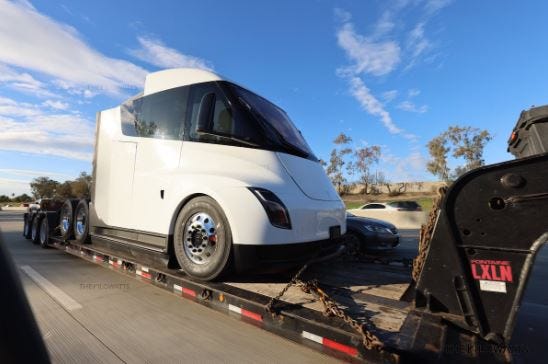
[SCOOP]: The Tesla Semi from an Insider's View After One Year: "Hot Mess"
PepsiCo employee says the Tesla Semi is a "disaster" & does 400 miles "at best" with round-the-clock servicing by Tesla engineers
bradmunchen.substack.com
162 points · by jojobas · 3y ago · 262 comments
I'll note that in another article[1], the author claimed that the delay in GigaMexico would push the next-gen model to 2027 and possibly bankrupt the company. According to Isaacson's Musk bio, Tesla moved initial production of the vehicle to Austin so their new production line and their engineers for the car would be in the same place.
[1] https://bradmunchen.substack.com/p/teslas-next-gen-model-may...
Short sellers obviously are incentivized to be uncharitable and focus on the negatives, but that also serves to bring the negatives to light where they might otherwise stay buried.
We benefit from hearing both sides, especially if we're holding TSLA or considering trading.
"Not provably false" isn't the standard for believing anything either. Claims require evidence. Evidence requires corroboration, and where that's not possible it at the very least requires trust. Neither is present here.
I don't understand what your point is - the accuracy in question is in a linked article submission, not an HN comment, no?
Which account would be getting labeled as such? The link submitter? I suspect that's too diversified to really be effective.
Jay Leno did an interview with one of the Tesla Truck engineers the other week, I believe he mentioned each axle is geared differently. One specifically for highway speeds and the other one disconnects for optimal efficiency once up to speed.
Then stop marketing yourself as though you're not. I don't care if the little asterisk in the corner of your website makes it clear that "it's just beta mode, bro", they clearly prefer to put out an image that suggests otherwise.
Also, who cares? Sometimes products take longer than usual. Especially ones that have never been done before, like a practical electric semi truck for chrissake!
Plus, they also had to move a lot of people to rework existing models to accommodate supply chain issues from Covid for like several years.
It's already been six years:
https://www.theverge.com/2022/12/1/23488040/tesla-semi-deliv...
https://en.wikipedia.org/wiki/Tesla_Semi
And almost one year since the first delivery.
One year from now will you say wait another year? Is this another "full self-driving" situation where the "updated, improved, it will work as advertised, this time for real" version is always one year away?
He's in finance, and is probably short/looking to short TSLA. It's not sinister.
Many people here dismissing the article, that's totally fine. It's unsourced. Other people may have interest in the struggles. The fact that this vehicle was supposed to be in production by now is relevant. Why isn't it?
>Also obviously the taxpayers aren't paying for this vehicle program somehow
If Pepsi is getting any kind of subsidy, then yes, the tax payer is paying for it. This would be surprising to you?
Hybrid systems on heavy inner city vehicles make a lot of sense. As do hybrids in mountainous areas.
But long distance hauling? BS. Semi engines are large with very low power to displacement ratio -> they are very fuel efficient. Truck builders' customers are very sensitive to fuel consumption.
I find it very hard to believe that marginal grid power (ie thermal plant), through all the transformer and transmission losses can beat a semi's diesel.
EDIT: even if the semi's electricity came from magic, the opportunity cost of putting so many batteries on a EV semi vs. a small fleet of hybrid commercial vans more than blows the comparison in favor of hybrids.
The highway where trucks work like electric trains: https://www.youtube.com/watch?v=_3P_S7pL7Yg
And, there is electrification happening along highways, producing energy. German highway PV could generate up to 200 TWh a year: https://www.pv-magazine.com/2023/04/11/german-highway-pv-cou...
Also, battery swapping will become a thing. You don't have to haul a ton of batteries, you can swap them in seconds along your route. There will be (eventually) a ton of battery plants replacing peaker natural gas plants, these will be built along the highways, also serving a second function of battery swap stations.
Also, it doesnt matter if you can swap a battery, or charge a fixed one in a microsecond. the problem is the opportunity cost of using a lot of battery to electrify one vehicle instead of hybridizing many more
EVs by taking away batteries from hybrids are bad.
Already is a thing for trucks:
https://www.youtube.com/watch?v=9eYLtPSf7PY
Janus Trucks converts your existing trucks to battery electric and provides swap stations.
And I don't think it's a huge cost to have a gas and electric motor anyways, it's certainly not as heavy as a 1000KWH battery.
Note that "need" here is in the context of meeting the climate goals we've chosen to impose on ourselves. I'm not going to debate the wisdom of that choice here.
It’s still worth doing but we should understand the true cost.
ICE never will.
Ditch your car.
Ok, how?
In Americas case you might aswell shout yourself. As you cannot live without a car.
Saying Ditch your car is as good solution as 'Just stop breathing in pollution'.
I specifically point out that rapid adoption of EVs at the expense of hybrids given limited batteries is slowing the decarbonization of the transportation sector even if we assume EVs run on fairies' farts
This is because an EV has many many times more batteries than a hybrid, so (if you do the math) it ends up being much worse to run EVs even assuming their energy doesnt come from anywhere than it is to replace regular cars with hybrids.
The smart money is on perishing.
It's tempting to imagine they could all run on electricity, but it's probably hard, as many routes go through hundreds of miles of rugged nothingness. This is quite different from rail transport in Europe.
(Disclaimer: Non-expert, but Tesla owner since Q1 2018) I think EV trucks, as a concept is fine, but battery-swapping makes much more sense than using a nonremovable battery-pack that's 5-10x the size of a sedan-sized battery-pack.
Compare this too semis which spend most of their life on the highway with drivetrains optimized almost exclusively for constant highway speeds. There is far less gains to be made converting to a hybrid system.
A Prius without a hybrid drivetrain and with an engine optimized for 25 mph driven constantly at 25 mph would actually exceed the standard Prius's mileage since it doesn't have to carry batteries, generators or electric motors.
Big trucks often have other systems that historically can be dependent on having a good consistent power draw source.
Also, air brake systems; The brakes on a power unit are designed to 'fail safe', so rather than using hydraulic fluid to close the calipers, uses air pressure to keep the calipers open. There's a bunch of efficiency implications here but in general you either have to make a work around to that or take efficiency losses of a PTO or electric compressor. Also, not sure whether a different approach requires DOT approval or not. 'What about all those wheels and regen braking' one might ask? Then you'd be talking replacing/retrofitting trailers which has a bunch of implications for an owner/operator.
Oh. Transmission losses, and the realities of a diesel; One thing that really helps the Prius (and vehicles that use similar arch) is that it (and many/most of the more efficient hybrids) use a Fixed-Ratio transmission; The engine uses various techniques to maximize efficiency at a wide band. Diesels, on the other hand, are often most efficient within a (relatively) much more narrow power band... Also in general, rig diesel engines aren't exactly designed for 'stop-start' patterns.
Then, you've got the delta-V problem; The more weight you add the more energy it takes to move stuff. My SWAG (i.e. completely uninformed and friday night math) is that a power unit would have to have a battery with the capacity of a plug-in hybrid to provide meaningful value.
Then, drag coefficient. A truck has a much larger profile from every angle which has a sizable impact on efficiency.
Oh, and make it all with expectations for long service intervals.
They can have a tiny gas engine because the electric helps acceleration from a standstill.
The batteries are just weight on the highway
Weight is only relevant to acceleration (which is partially recovered), hills (partially recovered), and rolling resistance which is only ~5% of energy usage. Even with a consistent load on the highway the batteries can help by removing parasitic loads on the engine like alternators, a/c compressors, and power steering pumps. Depending on torque demand and specifics of the engine/transmission, thrashing the battery could also be more efficient than ICE alone.
I'm sure there's stuff I've missed, but I think those are the main reasons why a number of hybrids have highway EPA ratings 10-15 mpg higher than the highest MPG ICE car ever produced.
It is much more sophisticated than you let on.
Not quite. Diesel engines are most efficient (~40%) at full throttle, low-mid revs, and drop to <30% at low throttle. With some battery trashing you could see the engine work at some 20-50% duty cycle on the highway.
(Which is not to say you couldn't make some improvements, but you're never going to get 50 mpg while hauling 40 tons.)
Fine.
EV vehicles generally, and EV semis in particular, are a massive impediment to the rapid decarbonization of the transportation sector.
Why?
1. A large EV semi has a gargantuan amount of batteries.
2. Batteries are a finite resource, limited by our ability to produce them.
3. Semi engines are very fuel efficient, as far as thermal cycles go.
4. Cities have very many, very inefficient small vehicles undergoing start-stop cycles Most of these vehicles run on straight gasoline.
5. More carbon can be taken off our transportation network by keeping diesel semis and using the batteries an EV semi would have used to hybridize vehicular traffic.
Go ahead, do the math and see that N5 is correct. For representative numbers compare the F150 that comes in regular, hybrid and EV. When opportunity costs are considered, the hybrid F150 kicks the teeth out of the EV one in carbon emissions.
I can't wait to get rid of the damn thing.
As sibling comment said, lemon it.
I've literally had Tesla service people yelling at me, telling me that I am a liar about the problems my car has been having. There's no way I'm voluntarily talking to anyone from Tesla that I don't have to.
I believe this is what they call, in the legal industry, "Hearsay". Pepsi person tells friend person who tells the author. A lot can get lost in that chain of telephone.
But yea, you're right. A lot of it is kinda nonsense statements. Or it's otherwise meaningless. For example
> There is a team of Tesla engineers on call 24 hours a day, ready to fly out and fix anything wrong with the Tesla Semis. No one at PepsiCo is allowed to fix the Semi.
Well, duh? These are preproduction units that Pepsi is probably getting for a song, with the understanding that there are going to be teething issues. Of course no one is allowed to "fix" the semi other than Tesla, no one is qualified to fix them. Hell, Tesla Service Centers aren't qualified because the only people who know enough about these machines are the engineers who built them.
The author likes to repeat things that are clearly non-sense as well.
> The batteries completely burned out
What does "burned out" even mean? Driven until failure? That doesn't make sense. Tesla, if nothing else, understands EV's and battery packs (if maybe not Semi's). They know how to build batteries with protection circuits so they can't go too low and permanently damage themselves. So what this probably means is driven until the battery went flat/dead/0% SOC. And that's, once again, not a shock. Drive a vehicle that isn't ready to do 500 miles, more than 500 miles and its going to go dead. There are a total of ZERO megachargers out in the world that the Semi could use, so... of course they are going to die. If you drive a gas vehicle somewhere there are no gas stations it'll also die.
> The constant use of the battery pack is unprecedented and is causing reliability problems for Tesla and other EV truck makers
There are, what, a half dozen preproduction units out in the world? How can you even come to a statement like this that makes sense? The announcement of the first public delivery of a semi was December 1st, 2022 - so they've not been in fleet hands for even a year yet. I would be shocked if the first unit that rolled off the preprod line WAS reliable overall, if anyone remembers... the roadsters had more than a few issues too.
> All Tesla Semis and other electric trucks are subsidized by California state
Where are the sources on this? If Tesla was actually getting subsidy to build these, it would be in the news. Easy to prove. I cannot find any articles other than one mentioning the hope to get a federal grant to build a megacharger corridor from CA to TX.
Do I think the tesla semi's are the most amazing thing since sliced bread? No. I'm sure they have tons of issues. But shitty writing (I won't even call this article "reporting" since it is basically some dudebro's blog) based on hearsay without any sort of proof or corroboration is just shitty fantasy. Might as well read some of that rule34 fanfiction about Elon that the fanboys write, if you want equal levels of accuracy.
I did a little digging and it does sound like Pepsi is taking advantage of subsidy programs. I didn't see any indication that they were Tesla specific, though, so presumably they could have bought any other electric semi with them.
[1] https://evmagazine.com/top10/top-10-electric-bus-companies
That was always the challenging part. Still is. Freightliner is nowhere near the 450-500 mile range you'd need. They're half that.
That said, electric trucks are absolutely a thing; they're just made by BYD (and to some extent Volvo), not Tesla.
My previous comment at the time: https://news.ycombinator.com/item?id=37935293
Respectfully, what generation are you? (Approximately how old are you?)
I ask as there are really big difference in how it appeals to different demographics. And all the guys who saw the vehicle with me thought it looked really good. (Admittedly we're former engineering students, so your milage may very...)
He doesn't actually do much with Space X. That's why it's successful.
Meanwhile, he's very micromanaging of Tesla and X... and it shows.
That said, I cannot wrap my head around some of these engineering decisions. It does seem like the engineers are fundamentally misunderstanding the problem itself, and this truck simply isn't engineered to work as a truck.
If car grade parts are really being used, that is wildly inappropriate and unsafe, for a vehicle that needs to control two orders of magnitude more weight down the road.
That said, it could actually be revolutionary to move some car tech into the truck space, if done properly with heavy duty parts. For example, an independent suspension can make the ride much smoother.... which could result in less driver fatigue, and less damage to cargo.
For example, traditionally nobody would ever consider a dual wishbone independent suspension for an offroad vehicle, but, many modern purpose engineered offroad vehicles such as the VW Touareg and Porsche Cayenne have proven themselves capable offroad (including winning many famous offroad competitions) with four wheel independent suspension. It is in no way a "car suspension," but a purpose engineered offroad truck dual wishbone suspension, and it works excellent. "Old timers" will dismiss these vehicles as just a lazy attempt to sell passengers cars as offroad vehicles to customers that never go offroad anyway, but the real world reliability and performance shows that to be an incorrect perspective.
My work involves direct interaction with truck drivers on a near daily basis and I have been saying this since Tesla debuted the interior design. I am completely unsurprised to hear this
The amount of hubris Tesla has when it comes to so many things like this is mind-blowing.
It seems like either it isn't as big of an issue as it appears to be... or they 100% knew about it and went ahead with it anyway.
Given that this is Tesla, it could easily be either.
A little bit tangential, but 2035 marks the ban on new passenger ICE vehicles. Given the average age of cars in the US, California probably won't even be at 50% passenger BEVs by 2035, let alone 100% of ALL vehicles. Kind of a troubling oversight for an automotive long/short manager seemingly specializing in EV companies.
Now as gas stations start to thin out, that would put a damper on people buying gas cars as they would have to go out of their way to fuel up. Which downward pressure on resale value of cars, making people not to want to buy a brand new gas car if it looks like they won't get any trade in value in a few years.
The only hope that I can think of is when it gets to this point, there would be another "cash for clunkers" type of program to make the transition easier.
Don’t worry, there will be a huge supply of like-new cars that have been titled in Nevada for 3 months and driven 10 miles.
The conspiracy: the manager has an axe to grind that aligns with incumbent auto-makers' business strengths, suggesting that the analysis is debased in one way or another.
The "mind explodes": the manager is talking their book; behind the manager is a team using mountains of data to design messages that optimally push the market in the direction they want. The purpose of the message is not to be logically coherent to nerds on the internet. The point is to convince a few portfolio managers to behave in one way or another, and perhaps also to signal sentiment analysis algos.
https://electrek.co/2023/11/14/two-years-after-buying-a-2000...
LOL, most golf carts could tow that tiny little boat.
Even just being able to pickup appliances and furniture + run stuff to the dump would be enough to justify it at that price. Of course… they’d have to get it licensed in the US which would probably raise the cost a bunch
> It was listed at $2,000, and I just knew I had to have it ... The price ballooned as I added a bigger battery and accessories from the factory, not to mention the exorbitant sea shipping freight ... Though to be fair, that A/C cost me extra for the factory installation.
I wish they listed the final cost, at least the final cost with the bigger battery and accessories they added. Seems much more than $2,000 based on their wording.
> like an alternative to a UTV ... It topped out at 25 mph ... it’s not technically street-legal (it doesn’t meet the safety requirements for LSVs)
A UTV is a great comparison, especially for their uses. It will almost certainly beat UTVs that are common in the US on price (again, they didn't tell us the final price, spec'ed out), but it's hard to find a good comparison given the minimal details.
> I’m not sure I’ve seen a golf cart that can tow a boat
At marina I used to frequent, the owner would move 20+ foot boats around the property using a ~30 year old ride-on lawnmower without any trouble at all. He even launched and recovered a few large boats with it, though that was always dicey.
Overall this looks a nice vehicle to have on a hobby farm, but it seems to have a long (and expensive) way to go before it's something to buy for driving on roads.
If that’s honestly their design philosophy I have serious doubts about their ability to contend with any serious competition beyond what they’ve gained so far from being a first mover in the less rigorous world of end consumer cars.
But itoesn’t tell us anything beyond that. It simply comes down to what Tesla is really trying to do. This could either be a “pump”, or it could be the normal shortcuts and growing pains that are part of an ambitious beta product.
A couple of years ago I would’ve leaned much further towards beta product scenario, but I’m still not willing to rule it out at this point.
For example, proto systems usually don't have power management written, or fan control at the beginning. This means the machines run hot and noisy, consuming extra power and (safely) spinning the fans at full speed. maybe next proto will have a fan controller/firmware. You get prototype memory sticks. software is buggy.
given that, I can imagine that batteries are probably ignored by the chassis and software guys. I'm sure the battery guys are in a lab somewhere writing firmware and working on charging/discharging and managing the batteries.
also, I remember that tesla is spending a lot of work on the factory that builds the product, not just the product. These trucks are one-offs and probably assembled by hand, or poorly assembled by a prototype factory line.
Now, that said I may be giving them too much credit. I remember talking to a guy who had worked at microsoft in the early dos/windows days and I said "the engineers at microsoft probably don't know the new release broke this other software, etc" and he told me I was naive, that ms had meetings where they said "how can we OWN this?" these were the days when starting windows you typed "WIN" at the C: prompt.
All you can really do is smile and nod, which, it's much more useful to spend your time not listening to this sport of speculation, and, if you must speculate, speculate on if the idea of an electric semi is viable in the first place.
Personally, I think it is. It's a much harder engineering problem than a car though, so, it's likely to take awhile to become really viable, and longer still to get to a place a reasonable person would call "good". I'd also go sofar as to say, tech wise, we're probably not there yet. We need better batteries, and a means to charge them. That's been slow going so far, and likely needs some significant investment.
Something like a billion dollar X-prize, or, make it 2 billion, for inflation reasons, for the first group that can demonstrate a battery tech suitable for mass manufacturing that's 2x current lithium ion cells at 1/2 the cost. That'd probably get us there in the next 5 years or so, give it another 5 to scale out, and the parallel tech developed trying to attain that prize probably sees things developing relatively quickly after that.
>>>The constant use of the battery pack is unprecedented and is causing reliability problems for Tesla and other EV truck makers [similar claims coming from Uber drivers who use their Teslas over 300 miles per day, i.e., their batteries are dying quickly.
Meaning the batteries are not meant to use more than few hours per day because they heat up ?
>>>PepsiCo did a 500-mile trip with the Tesla Semi from California to Phoenix, but it was just for PR purposes. The batteries completely burned out, which is why on PR trips like this, they bring three Tesla Semis, with two being towed on a diesel Semi truck, only to be swapped out when the battery dies the other two Semis on the 500-mile drive
As usual a demo product like other EV semis ?
TBH, it sounds like it might be temp related... but it could be as simple as overly conservative software. These are in such early stages of development, that I'm sure they are being very conservative about going into limp mode at the first sign of a potential problem.
While there is a lot of damning evidence in this mumbo jumbo of he said therefor I'm right There is something to be said about the advancement in technology. We need alternative to petrol, diesel. And while it might not be purely electric, it might be hydrogen, who knows, the move to Semis is vital.
The problem is the baboon leading the pack with lies and deceits, might actually do more harm than good to the industry.
And then, there is the the tax payers, who are signing blank cheques to the baboons...
You don’t have to agree with every (or any) opinion of his to acknowledge this lol
Yep. We had the Nissan Leaf and a couple other minor contenders. And then we got the Bolt just before the Model 3 was released, and the Bolt is still by far the better value.
The Model S made EVs sexy for a time, and that's nice, but it's hard to say that it meaningfully accelerated the transition overall. EVs were in the pipeline already, waiting for battery prices to get into the right range, and that's exactly what has happened.
I love my OG RWD Model 3.
Let me read a review for the RTX 4090 from pc-gaming-sux-cox-n-dix.com lol
https://www.youtube.com/watch?v=LMKySYs-hCg
Say what you want about FSD but automation in more controlled enviornments will help exploit performance.
They also talk a lot about on ramps and city traffic, situations drivers HATE being behind a slow truck and these you dont have to worry as much about.
The average US household consumes around 10,649 kilowatt-hours (kWh) of electricity per year, according to the US Energy Information Administration (EIA). This translates to an average of about 888 kWh per month, or about 29.6 kWh per day.
Can these megacharger stations really output 828 mWh of power per day?
Engineering is what humans do pretty well, and given how successful we've been so far at delivering big power for EVs, I don't see why we can't continue that progression into the future.
I don't understand why this is a surprise and why they think they can muscle through it. I didn't think our current battery technology is built for this scenario.
> During the installation process, the Megachargers took down the power grid for a good chunk of the city
This is my fear with everyone eventually plugging in their electric vehicles at 5pm
If I plug my car in at 5pm, it won't start charging for 7 hours, when it's economically rational for it to do so. Time-of-use pricing seem to solve this. EV load is among the least time-sensitive of all power consumers. Set up your pricing right, and the EV charging will follow.
If I'd driven 300 miles earlier in the day, and know I need to drive more in the evening, I'd override the charging schedule. This literally never happens.
First off, it said during the install. So evidently it wasn't load related anyway.
Second, I used to live in a little town of well under 50k people. The local coop gave a couple hundred dollars in rebates for the installation of load management on their water heaters. I'd expect this would get solved in basically the same way. The total gwh isn't a problem, the gw is, and that's fairly easy to solve problem.
It's fine to say that electric is simpler to deliver and more efficient in theory, but our grid is not even a fraction ready for that, and heat pumps and induction ranges are a whole order of magnitude up the tech ladder from boilers and gas stoves, and by going all electric you lose the multiple sources redundancy which is literally a life saver.
I do actually welcome the cleaner future but I hate how people are pretending it's already here and making regular people deal with the discrepency.
Anything less, and you are losing something you currently have. Which is what will hapoen of course. And idiots will tell each other "this is better".
If every house had a fast charger, that would be a sensible concern. But everybody turning their dryers on simultaneously during off-peak hours isn't something worth worrying about. Especially since it's not going to just happen all at once some day.
Household- or neighborhood-scale battery banks make a lot of sense in the near term. Because they are stationary they don't need to emphasize light materials and can focus more on cost efficiency and charge/discharge rate than mass or energy density using more readily available materials and cheap production methods. With relatively simple BMS you can charge your EV now and recharge the battery at off-peak times if you need to use it again in the evening (lots of people do).
Right now people are buying charging systems that do things like only charge when there’s a surplus of self-generated rooftop solar, or offer a big discount on EV charging if you’re prepared to have it interrupted at peak times.
This is a huge burden on the electrical grids, and Tesla or EV's get to hand that problem to someone else.
The only way this makes sense at scale is if we had nuclear power, and charging was done at night.
They don't exactly get to push it onto someone else. Large loads like this come with demand charges. In some areas, they might be $5/KW, in others I've heard of >$10. A single megacharger would be $5-10k on top of the actual energy used.
It is high enough that I'd expect them to start thinking about battery buffers at charging sites to mitigate the cost.
That already happens at a smaller scale, with things like Freewire.
BTW my car charges at midnight. Super easy to set up that way. I override if I have to but 99% of the time midnight is just great.
Kudos to Tesla for having the guts and endurance to try. This is relevant for Tesla and for the industry.
When you're actually doing something barely possible, it's hard.
[1] https://www.reuters.com/investigates/special-report/tesla-ba...
They're clearly making progress. Not sure what more you want in real terms.
Not being able to stick to self-imposed deadlines isn't ideal, but its also not a crime.
Perhaps worded so SEC can't get his bum, I don't know.
If they mess up the launch of the semi in terms of early adopter customer satisfaction they may not get a second chance.
Only Tesla thinks of this as a regular consumer product with a "launch".
In reality, the competition is already offering electric trucks of various sizes, today, not in beta, not pre-production, but actual products you can buy. And since their competition understands the trucking business, they already know exactly how to slot EV trucks into existing fleets, complete with logistics systems and maintenance contracts and a billion other things that Tesla has zero clue about. They're doing the usual Silicon Valley "winging it", thinking it'll work in this market as well.
Pepsi accepted the pilot program because of
1) Free publicity, although with Elon's recent public political statements, the value of that is quickly turning negative, and
2) Free trucks they're not paying for, California taxpayers are.
And yet a lot of people still believe Tesla is the market leader and that everyone is just waiting for Tesla to come and disrupt the trucking business.
https://www.freightliner.com/trucks/ecascadia/
https://www.mercedes-benz-trucks.com/en_GB/emobility/world/o...
Ironically those are not the people in the trucking business.
Another thing that Tesla likely hasn't gained a lot of experience with is the longevity requirements on truck chassis. Those things undergo a ton of harsh treatment with a smile and 750K miles+ between rebuilds isn't all that rare, with 500K or so probably around average depending on whether you look at short-haul or long-haul or a mix. In the diesel world the chassis get two or more engine rebuilds. Total lifetime is crazy, check these out:
https://www.commercialtrucktrader.com/Peterbilt/trucks-for-s...
That's 1 million miles and up.
Then of course there's the "driver is only there for legal reasons" video attempted over multiple days including an accident.
It's interesting how they keep getting away with it compared to Nikola
The sourcing here is a bit spun. "An insider" turns out to be a random driver someone found at a truck stop?
> This is why it was with great fortune to receive the details below, which were told to a trusted automotive source of mine by a PepsiCo employee who happened to have time for my friend’s questions about the Semi at a charging station the other day
Note carefully the weasel phrasing: the actual source is not trusted, just the intermediary!
I mean, the details given seem plausible. But would you trust your cab driver as an authoritative source for the business value of their employers rolling stock?
"My friend found a driver who knows super-secret business details" my butt, basically. Never trust an opinion site to break news. Ever.