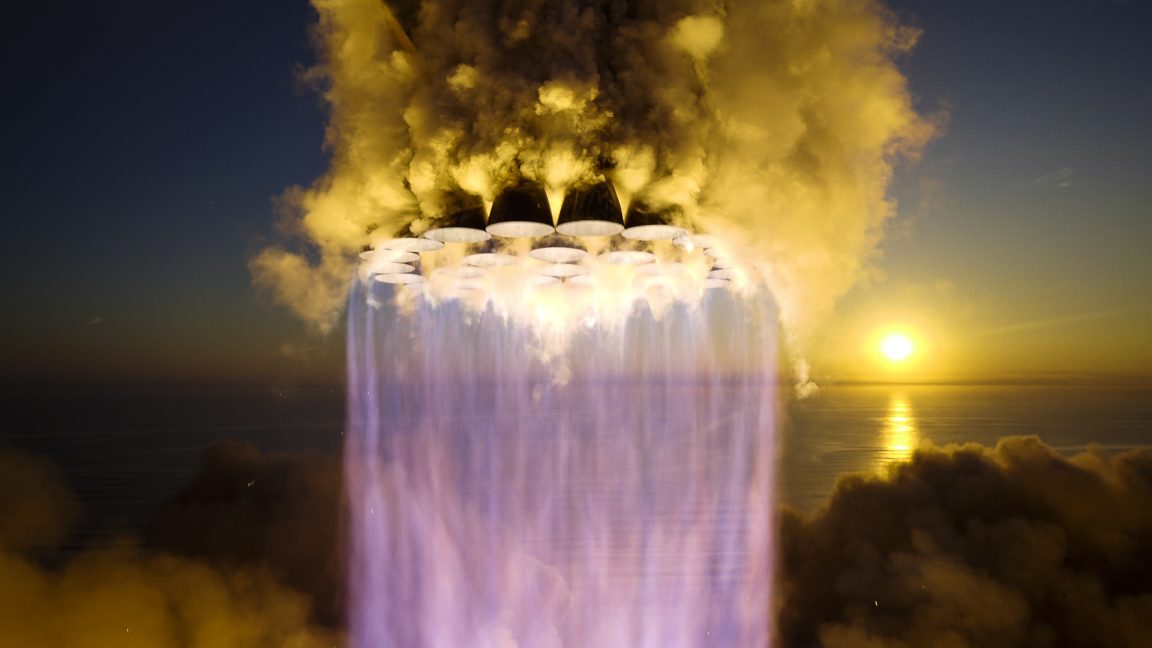
Sorry, doubters: Starship actually had a remarkably successful flight
On just its second flight, Starship now is arguably as successful as NASA's SLS rocket.
Ars Technica
60 points · by mlindner · 3y ago · 55 comments
On the other hand, you clearly can't call it a complete success. There were three goals that weren't met: water-landing the booster, reaching orbit (or whatever you call where it was trying to get to), and water-landing Starship.
So maybe we should think in terms of a score out of 10. Like with gymnastics, there are degrees of difficulty. SpaceX aimed very high, and delivered...ok. Maybe give them a 6/10?
More broadly, SpaceX prioritizes low total cost and speed of development over everything else. That means they'll have more test flights than NASA and not all of them will be totally successful, and that's fine. The overall program will be.
NASA never before used a vehicle as reliable as Falcon 9, so... You can't compare crazy ambitious development program to established vehicles, and as Falcon 9 shows, given enough time, SpaceX can achieve something close to perfection.
I’ve followed starship development for a while now. A year ago starship was doomed to fail because 33 engines firing at once would tear the rocket apart. Now it’s a failure because they screwed up the landing. I know this sounds crazy, but I think the rocket company known for landing rockets might be able to fix the rocket landing issue.
Well, fine, but that's a bit of a silly goal. I don't think there was any doubt that that would work, after the last test in which they all worked except for the ones that got damaged by concrete.
Also, they were already tested on the ground, so...technically already achieved.
> Now it’s a failure because they screwed up the landing.
They didn't "screw up the landing". Something went badly wrong with the booster shortly after separation. And Starship went off course.
Landing both the booster and Starship isn't some small "nice to have", it's fundamental to the operation of these craft. They didn't even get a chance to test landing either part, because both failed too early.
I’m unsure what you mean by “screwed up the landing”, both stages exploded in flight.
Scott Manleys analysis and reasoning seems sound: that the error was likely due to hot staging burn causing damage or being mistimed causing propellant sloshing.
https://m.youtube.com/watch?v=hF2C7xE9Mj4
Lots of data from this launch. Definitely a successful test.
Falcon failed 3 times.
Looking forward to seeing if starship beats or matches or if bigger means more.
The people at SpaceX are largely all scientists, engineers and the like and they build the best they could do with available data. It got them a lot further this time based on the previous data. That is the only metric that really counts. If they got good data they can use to “debug” the rocket (to speak in HN familiar terms) that is a great thing for them, and very valuable.
I love it when opinion pieces open with the equivalent of "What follows now is the truth. If you disagree with the truth, as presented by me, the arbiter of the truth, you don't know shit."
Berger must have really good faith in his arguments, if he feels the need to begin an article this way. And, unfortunately, what follows sounds more like a letter by an angry SpaceX fan than a quality analysis weighing the successes and failures of the start.
Feel the need to “win?” It’s easy: report on your fancy like an adult, lending it an air of legitimacy and maturity.
> Since its heady days during the Apollo program, NASA has steadily become an agency filled with checkers, rather than doers... Part of the magic of SpaceX is that it's filled with doers, with relatively few checkers
SpaceX, whatever you think of its CEO, is chock full of people whose brilliance glows in the dark.
And yet every news for the past 5 years or whatever has been "wow it's a runaway success and basically done". Something flies? Great! Something blows up? Ooh actually that's even better because [convoluted argument] and Starship will fly in 6 weeks time.
I wish them well. The crazy optimism still strikes me as a bit mad.
Exploding is not a virtue, but the stuff they accomplished before exploding is quite remarkable.
But it's not a done deal and the I find the sickly sweet optimism jarring - as it seems many other people do.
That is the entirety of my point. I'm not dumping on SpaceX, Starship, or on this particular occasion, Musk himself.
SLS? If in 10 years they're still spending money on it to launch it once every couple of years - if it's still in some sort of weird limbo between success and failure - I wouldn't be surprised.
Starship is a crazy idea. Completely nuts. And it could actually work. That's the crazy part. This was only the second launch. It took four attempts to get the first Falcon rocket to space. What we saw a few days ago was a rocket that nearly worked and only developed issues very late into the launch. Next time, they might get a little further. At this point it looks like there are a lot of challenges but none that look like they can't be overcome.
One thing is clear. SpaceX is very well funded and they should not have any budgetary constraints doing this over and over again. There are no 100% guarantees they'll get it right eventually. But it looks like they have a very decent shot at it. If they fail, it won't be for a lack of trying.
The point is, these things may still fail. No shame in that. The fact that Musk rolled a 6 on a die ten times in a row doesn't mean he always does that.
But the narrative around it completely denies it. Any outcome is an unmitigated great success and yet another proof that Starship will succeed and we will colonise Mars.
Good luck to Starship succeeding, but the crazy optimism, denialist of even a chance of failure is unbearable.
Humanity, from now until the sun explodes, will only get one chance to check mars for life. Right now the first samples are still waiting in tubes to get picked up from the martian surface. Musks' solution to the problem of contamination is to fire as many rockets as he can as fast as he can and hope to contaminate mars completely before anyone can red tape his ass.
We owe it to all future generations to make sure he never lands a single payload before the question can be thoroughly resolved.
[0]https://www.forbes.com/sites/carltonreid/2020/12/29/elon-mus...
We don't call increases in demand 'induced demand' unless we're trying to throw shade on the thing being demanded. The classical case is road use. Add lanes to highways and folks will utilize the capacity to do whatever it is that creates value to them. And we call it induced demand.
If transit headways shrink and there are more riders because the service got better, we don't call it induced demand. Or if milk or eggs get cheaper and consumption of those items grows, it's also not induced demand.
It's a very interesting question. Much like StarLink, I suspect he has some other plan for monetising this lift capability. I don't buy the Moon base/Mars base plan at all.