69 points · by geox · 3y ago · 84 comments
Operational automated refueling is likely in store sometime in the next few decades, but like everything DoD-procurement-related (at least in the US), will be a slow rollout.
How does changing from a window to digital video improve performance? A window seems to reduce complexity, though a window + zoomed video might plausibly help. It would be too bad if a plane couldn't refuel and return to the fight (or make it home) because a connection or camera or screen failed.
BDS is, in general, having a hard time adjusting to a post-GWoT world of fixed cost, versus the oh-so-coveted cost plus glory days in the Aughts.
Then again, maybe the problem runs deeper. If anyone can name me a unqualified-no-doubt-successful new Boeing project - something that isn't someone else's IP or sucked up in an acquisition - from the last twenty years, I'm all ears. The USAF tossed them a softball project to bolt wings and a GPS on a Mark 82 iron bomb . . and they couldn't figure it out without bringing in Kratos.
And yet they are still favoured to win the KC-Y competition (the successor to the KC-X, which picked Boeing's KC-46A as the winner) either (a) by default since Lockheed Martin has left competition (with Airbus saying they're going it alone), or (b) the USAF just cancelling the competition and ordering more KC-46As.
(a) https://breakingdefense.com/2023/10/lmxt-exit-lockheed-to-sk...
(b) https://breakingdefense.com/2023/03/air-force-leans-towards-...
Meanwhile Canada (which all sort of issues with military procurement themselves) found that Airbus was the only qualified bidder for their tanker replacement program and picked the A330 MRTT (of which deliveries have already begun).
Edit: Maybe if the alternative is building and maintaining an airbase for refuelling stops.
Aerial refueling, if it can be fully automated, and made routine, and supersafe, could be revolutionary for civilian aircraft.
I feel like the fuel economy savings are probably technically there because of the different aircraft characteristics, but again, you need to circuit an entire second plane and crew to “save” that fuel.
I’m sure someone’s done the analysis.
Are you proposing to refuel it at cruise speed? If not, one would think that the refueling would use up a lot of fuel in itself.
It makes it more likely, not more consequential.
You know how on the ground they sometimes tell you to not wear your safety belts while they refuel the plane? It is because every refueling has a risk of fire. An inflight refueling probably even more so.
> The second plane is autonomous so no additional people are lost.
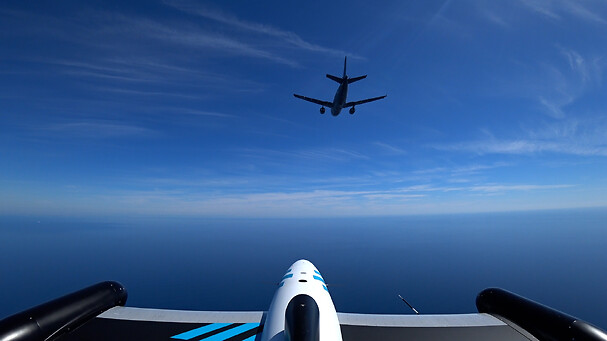
Worth noting that in these experiments the tanker plane was not uncrewed. It is the act of connecting the hose which is automated here. (And they also tested with autonomous receiver planes.)
Wow, that's quite an accident.
Palomares is in Spain. Fifty years later, it's still an issue for the people living there.
They eventually were forced to land because their engine was down on power from lack of maintenance.
There's probably a better reference for this.
https://en.wikipedia.org/wiki/Boeing_MQ-25_Stingray
Using UCLASS platform:
https://en.wikipedia.org/wiki/Unmanned_Carrier-Launched_Airb... (aka X-47B demonstrator)
Edit: (Although Airbus’ demonstration shows substantially greater capabilities than previous demonstrations) Surfaced to demonstrate advancement velocity.
In the Airbus system, the refueler plane takes automated control of the receiving plane, and maintains formation using controls on both planes.
Video: https://youtu.be/F-Y7fhIasjM
Conversely, small aircraft are more subject to turbulence, so they also need more correction to see stay in a straight line
On a 4-engined aircraft, one engine could be powered down at a time for maintenance.
But if perpetual flying became a real need, indirect cycle nuclear aero engines would quickly be developed.
Then ballistic missiles made the need for such a thing disappear...
Also: the old VC-25A did/does have it, but it was never used in ~30 years of flying.
This sounds like piston engine advice. I’d be surprised if jet airliners are going in for oil changes twice a week.
Neither that or the plane powerplant are unsolavle problem, it's more of a "why would we invest this much to solve something this silly". Apparently the russians are trying to resurrect their SLAM clone and tested one. How much of this is a realistic military project versus propaganda isn't super clear to me. It's up there along with the manned military space stations in the scale of pointless deterrent PR.
AFAIK, no airliners can do that yet, though some are getting close. Some of the business jet variants can (e.g. BBJ 777-8, BBJ 777-9).
The longest duration 'scheduled' airline flights to date were the Qantas 'double sunrise' flights during WWII, which were ~32 hours long [0], though the Graf Zeppelin (airship) made passenger flights longer than this [1].
https://simpleflying.com/robert-timm-john-cook-endurace-reco....