110 points · by 1970-01-01 · 2y ago · 36 comments
https://spaceweathergallery2.com/indiv_upload.php?upload_id=...
The video in a sibling comment by bscphil also seems to show it decreasing by ~2 orders of magnitude (compare it to the stars in the "sword") - do you think this is highly processed?
There are 3 bright red dots that I use as sign posts, and it is fairly easy to narrow down which one it is. Is it part of Orion (easily ID'd by the belt and sword), then it is Betelgeuse. Is it part of Scorpio (ID'd by seeing the pinchers up and to the right), then it is Antares. Else, it is Mars. The fun thing about Scorpio is that it is a guide to finding the central portion of the Milky Way. You could also add winter/summer as filters in that as well.
Found this source quickly that says more like a half-moon, but it's all just estimates really. https://www.astronomy.com/science/when-betelgeuse-goes-super...
I think it's safe to say it would be unlikely to cause any damage to your eyes if you happened to be watching.
There are a couple of other factors. Supernova "light curves" only reach their maximum gradually over several days. Also, your eye doesn't focus an arbitrarily small light source to an arbitrarily small spot on the retina. Instead it's something like an "airy disk". At some point, the relationship between apparent size and the size of the (blurred, "diffraction limited") image on the retina is appreciably non-linear. I think it matters in this case, because Betelgeuse is a lot smaller than the eye's "resolution" of about 1/60th degree. So its light is concentrated that much less (squared). In a supernova, the "size" of the star increases over time, though maybe not enough to matter, even for Betelgeuse.
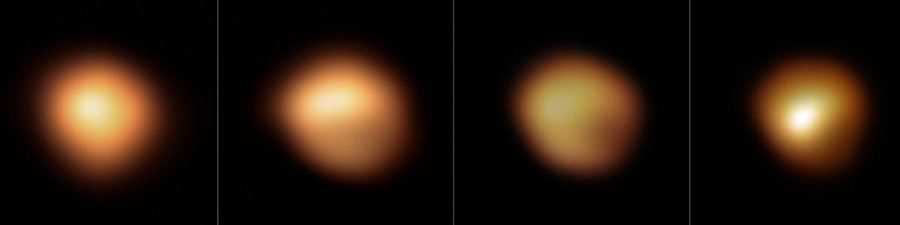
So your eyes would have time to adjust.
Even if the ISS is in the shadow once - which would require amazing timing and last for fraction of a second - it is not fast enough to have a second interception.
The paper says the current generation of CCD detectors aren't fast enough to detect that change in light flux with >1% accuracy, as they integrate the light collected over tens of seconds.
The next generation of CMOS-based detectors might be fast enough.
There are some issues to handle, like the complex light curve of the satellite itself affecting the detection, and the relatively low density of bright-enough stars along the path between telescope and ISS.
The paper suggests using the tens-of-thousands of satellites in upcoming launches to improve the odds.
We detect the presence of planets in other systems when they pass between us and the star, marginally decreasing the brightness.
Not a great way to send messages long distances