#25. Why Hunter-Gatherers' Work Was Play
Hunter-gatherer economics defy the principles taught in Economics 101.
petergray.substack.com
68 points · by dev_tty01 · 2y ago · 116 comments
Now, living life is what you do with about 5-15% of your time. The rest is work/red tape/...
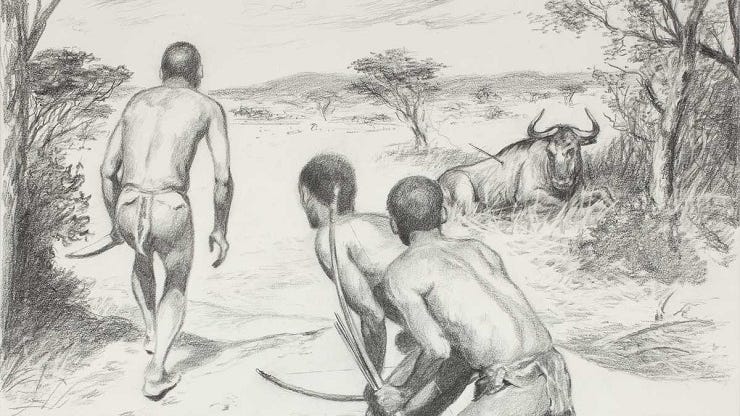
One contributing factor to the play-like quality of hunter-gatherer work is that the work was not excessive. According to several quantitative studies, hunter-gatherers typically devoted about 20 hours per week to hunting or gathering and another 10 to 20 hours to chores at the campsite, such as food processing and making or mending tools (e.g. Lee, 1972; Sahlins, 1972 ). All in all, the research suggests, hunter-gatherer adults spent an average of 30 to 40 hours per week on all subsistence-related activities combined, which is considerably less than the workweek of the typical modern American, if the American’s 40 or more hours of paid employment is added to the hours spent on domestic chores.
One anthropologist, Marshall Sahlins (1972), famously characterized hunter-gatherer societies collectively as “the original affluent society.” An affluent society, by Sahlins’s definition, is one in which “people’s material wants are easily satisfied.” Hunter-gatherers were affluent not because they had so much, but because they wanted so little. They could provide for those wants with relatively little work, and, as a result, had lots of free time, which they spent, according to one observer of the Ju/’hoansi (Shostak, 1981), at such activities as “singing and composing songs, playing musical instruments, sewing intricate bead designs, telling stories, playing games, visiting, or just lying around and resting.”
Spend a day endlessly walking (roaming), searching in the forest for berries, mushrooms etc., doing hand-to-hand combat, hunting...
Spend a day in front of a computer.
Which one do you think will end in a feeling of happiness?
> Spend a day endlessly walking (roaming)
We can already do that at leisure, but most would not care to go a whole day (let alone every day) trudging around by necessity.
> searching in the forest for berries, mushrooms etc
You seem to be framing the search for food as a low-stakes endeavor.
> doing hand-to-hand combat
Between tribes (or even within your own), it can easily be more fatal than that.
Not only are you worried about calories, you're also concerned about not being outright murdered.
And there are no do overs.
If you break your leg, you’re dead
If you have a tooth infection, hope it doesn’t spread to your blood
if you get attacked by a wild animal, hope you can survive your wounds
If someone stronger comes and rapes you or your loved ones, maybe you can gather your buddies together for a revenge attack.
You can't be serious.
Hand to hand combat?
Just because you're depressed doesn't mean you have to bend reality to pretend "hunter gatherers had it best".
Hell, no one is forcing you to use work with a computer. There's many avenues to do a more "in line with nature life".
But I suspect you want your internet and amenities and all that jazz.
Notwithstanding, creating tools and arranging supplies is work. But the banality of this is that people spend plenty of time socializing at work today, in office or elsewhere. It's not like we stopped doing that. Are we going to start putting double quotes around the "work" that we do because of idle chat?
Work is good for us. Some jobs are just not as good as others.
1. Utter bullshit - completely useless to everyone; unjustifiable.
2. Actively evil - work that may be respected in society but is killing the world. Suits with BMWs selling weapons, insurance, oil, corporate tax loopholes etc.
3. Honest, but with most profits funneled upward, creating an ever more unequal society.
Even artists, musicians, beadmakers etc are forced to do grisly hustly things to survive - the fun gets sucked out of it for most. Our society is deathly ill.
Isn't part of what you're romanticizing of these traditional societies the utterly useless shit they might do with some of their time? Our work pays because someone values it, that is tautological.
You say that as if it helps your point?
I'm talking about "bullshit jobs" as in those described in the book 'Bullshit Jobs' by Graeber. Think Wally from Dilbert; sinecures without the dignity. Here:
> Bullshit Jobs: A Theory is a 2018 book by anthropologist David Graeber that postulates the existence of meaningless jobs and analyzes their societal harm. He contends that over half of societal work is pointless and becomes psychologically destructive when paired with a work ethic that associates work with self-worth. Graeber describes five types of meaningless jobs, in which workers pretend their role is not as pointless or harmful as they know it to be: flunkies, goons, duct tapers, box tickers, and taskmasters. He argues that the association of labor with virtuous suffering is recent in human history and proposes unions and universal basic income as a potential solution.
It seems the opposite: toil makes us human. Our inability to accept what can be foraged has pushed us into working.
I always took this to mean precisely what you said. "From the sweat of your brow," you eat because you chose to define for yourself "good and evil" with respect to nature's provisions.
I like to connect it with Douglas Adams' answer to the meaning of life from Hitchhiker's Guide: 42. The number itself is shaped like a human bent on their knees toiling in a field.
It's more that foraging limits population size, and when people have to compete for resources they end up killing or starving each other. Humans have a drive to grow and reproduce, and they have been more successful by working together, then by industrializing (e.g. agriculture). Because they got so good at it, one person could do the work to feed nine others, meaning the other nine didn't need to work in food production anymore and could do other things.
(oversimplified, you know what I mean)
Everything's been abstracted away to things-exchanged-for-money though, nobody needs to forage or build their own homes anymore, just fork over cash and it's there. Getting said cash, there's myriad ways to do so and we keep inventing new ones, like... recording oneself queueing up at Disney World, or dressing up in a maid outfit and doing NPC emotes for money.
I believe it was in here, its a quick interesting read in any case.
http://public.gettysburg.edu/~dperry/Class%20Readings%20Scan...
I'm sure the people invented agriculture didn't think of it as a mistake. It's not like they decided that they liked eating cultivated grass seeds more than wild nuts and mammoth steaks. They did so because that's what they had available.
> which in turn forces their neighbors to do the same to survive
Until gunpowder, tribal societies were at least a strong as their hierarchical contemporaries. The Huns destroyed the Roman Empire and Mongols conquered China.
Also, sharing of work was already a thing back than: hunters hunted, others went gathering, again others built tools...
Damn it, and I swore I wouldn't read stuff from substack again...
What you described is a pop-culture idea of pre-history, nothing like what the actual research and literature shows.
I suggest you start with Claude Lévi-Strauss' but that's only if you're interested in spending years learning, The Dawn of Everything is more recent and more accessible most likely.
Edit: There is archaelogical evidence from the stone age of shared work, namely in the form quarries in which the stone for the stone tools, axes, spear and arrow tips and the like, have been collected.
- Agriculture: 10,000 years ago - Hunter-gatherers: 200,000 years ago
That's the wrong part. I believe there's no known history of famine in hunter-gatherers. That only really became a thing with agriculture.
Hunter-gatherer populations were small; there was plenty of food generally speaking. Which is why relatively so little time had to be spent acquiring it, in comparison with the back-breaking worth of agriculture.
Of course, once agriculture started using up all the land that was previously being used for hunting and gathering, well then hunting and gathering was no longer viable. But that was something new with the introduction of agriculture.
carry on.
Violence has been attested to in many of the remains that made it to modern people for study.
Division of labor in hunter gatherers is the only real way to explain Gobekli.
Contemporary evidence puts figures of about 25% of Hunter gatherers men dying violently and 15% of women and children: https://onlinelibrary.wiley.com/doi/full/10.1002/evan.21446
"Small- and medium-scale collective violence, in the form of confrontations between neighboring groups, may be as old as humankind [e.g.,1, 2]. By contrast, larger-scale organized and sanctioned lethal violence between sociopolitical groups (i.e., warfare), seems to be associated with certain socio-economic conditions that generally accompanied the shift to a farming economy,3 such as higher population densities and greater degrees of sedentism4, 5, in parallel to the increasing importance of resource ownership and property that led to the concentration of resources and power [e.g.,6, 7]."
[1]https://www.nature.com/articles/s41598-023-43026-9
The references above:
1. Fry, D. P. Cooperation for survival: Creating a global peace system. In War, Peace and Human Nature: The Convergence of Evolutionary and Cultural Views (ed. Fry, D. P.) 543–558 (Oxford University Press, 2013).
2. Kim, N. C. & Kissel, M. Emergent Warfare in Our Evolutionary Past (Routledge, 2018).
3. Fibiger, L., Ahlström, T., Meyer, C. & Smith, M. Conflict, violence and warfare among early farmers in Northwestern Europe. PNAS 120(4), e2209481119 (2023).
4. Ferguson, R. B. Archaeology, cultural anthropology, and the origins and intensifications of war. In The Archaeology of Warfare: Prehistories of Raiding and Conquest (eds Arkush, E. & Allen, M.) 469–523 (University Press of Florida, 2006).
5. Fry, D. P. & Soderberg, P. Lethal aggression in mobile forager bands and implications for the origins of war. Science 341, 270–273 (2013).
6. Golitko, M. LBK Realpolitik: An Archaeometric Study of Conflict and Social Structure in the Belgian Early Neolithic (Archaeo Press, 2015).
7. Bogaard, A., Fochesato, M. & Bowles, S. The farming-inequality nexus: New insights from ancient Western Eurasia. Antiquity 93(371), 1129–1143 (2019).
8. Chenal, F., Perrin, B., Barrand-Emam, H. & Boulestin, B. A farewell to arms: a deposit of human limbs and bodies at Bergheim, France, c. 4000 BC. Antiquity 89, 1313–1330 (2015).
When I lived in the Yukon working as a Software Engineer I got into moose and bison hunting, I help friends build off-grid log cabin houses, I harvested wild berries, caught a freezer full of salmon every year and tried to live the "homestead" life as much as possible. I packed these adventures into weekends and time off.
These activities are physically demanding, cold and arduous. They were also some of the most enjoyable experiences of my life, and they are extremely strong memories that I often talk about and long for.
There is something about working for my own survival that is way, way more deeply satisfying than simply going to work to earn money to pay for my survival.
I wrote about my first ever moose hunting experience here: http://theroadchoseme.com/yukon-moose-hunting
Salmon fishing always involved grizzlies: http://theroadchoseme.com/salmon-fishing-with-bears-in-haine...
Edit: Nor do they have sponsors and the financial means to build multiple overland jeeps and go travelling around the world for fun.
This doesn't mean HG work was play or that they had it better than you.
It just means that you love that type of thing. Same as many people love different sports or physical activities and nature experiences. Specially in contrast with dense populated towns/cities.
There's a difference between larping survival and having a real net and having absolutely no choice. Adrenaline can be fun but life or death constantly is absolutely different.
Of course it doesn't, and at no point did I remotely say anything like HG people had it better than me.
I was simply offering my life experiences that I find working for my own survival in our modern world to be much more enjoyable than going to work to earn money to pay for that survival.
Often hunter gatherer societies practiced polygyny. Women were mainly valued for their ability to bear children. Women were often seen as a possession - first to their fathers who would sell them (bride price) to their husbands. Often there was no consent.
In addition, the modern states that these hunter gatherer societies are a part of don’t allow them to practice unrestricted warfare quite like they used to. So bands can’t go around killing all the males and taking the conquered tribe’s women and supplies. Because of this, looking at hunter gatherer societies that exist now is not necessarily reflective of how it actually was.
Gathering nuts is not as much fun when you have a infected foot and an infected tooth.
Of course Peter finds play in everything because that's his frame of looking at things.
The entire thing is a bit of a joke in how simplistic and fallacious it is.
Work is not play because it's unpleasant but the HG work is play because it's fun (not much, it's social, is challenging/not routine/boring and it's optional). It has to deliberately dismiss the need of survival as "well, but they were many so some could avoid working for a month and all would be good " so the reward (food for survival) was not the goal and the goal was play.
If there's an abundance of resources that allow you to survive and you don't have a high demand, then you'll have less stress than in other scenario. How is that not Economy 101?
There's this fetichism for "the simple life" from people that, I'd conjecture, clearly don't like theirs that much and project it unto others, where they get surprised at "those basic people" having skills, proficiency and actual culture and the capacity to be happy. How can they be happy without competing for a Tesla to make the neighbour jealous, seems to be the silly type of thinking. One of "ignorance is bliss".
Extremely poor article in every sense. He should read more or actually engage in anthropology. Surveys don't cut it, I'm afraid.
The cherry on top is: "machines should work for us, I don't want to have to produce the drivel for my work, please someone release me from my 'toil' so I can just drink wine with my friends."
Secondly, the whole point of being a nomadic forager is that you move. If whatever region you're in runs out of food, you leave to somewhere with more. The pastoral version of this is called transhumance. It's been made more difficult in the modern era, so we see much greater reliance on local productivity today.
There was constant foraging occurring, but modern foragers definitely don't believe themselves to be on the edge of starvation and they spend enough time socializing around camp with each other that they could easily spend foraging more food if they saw a need to.