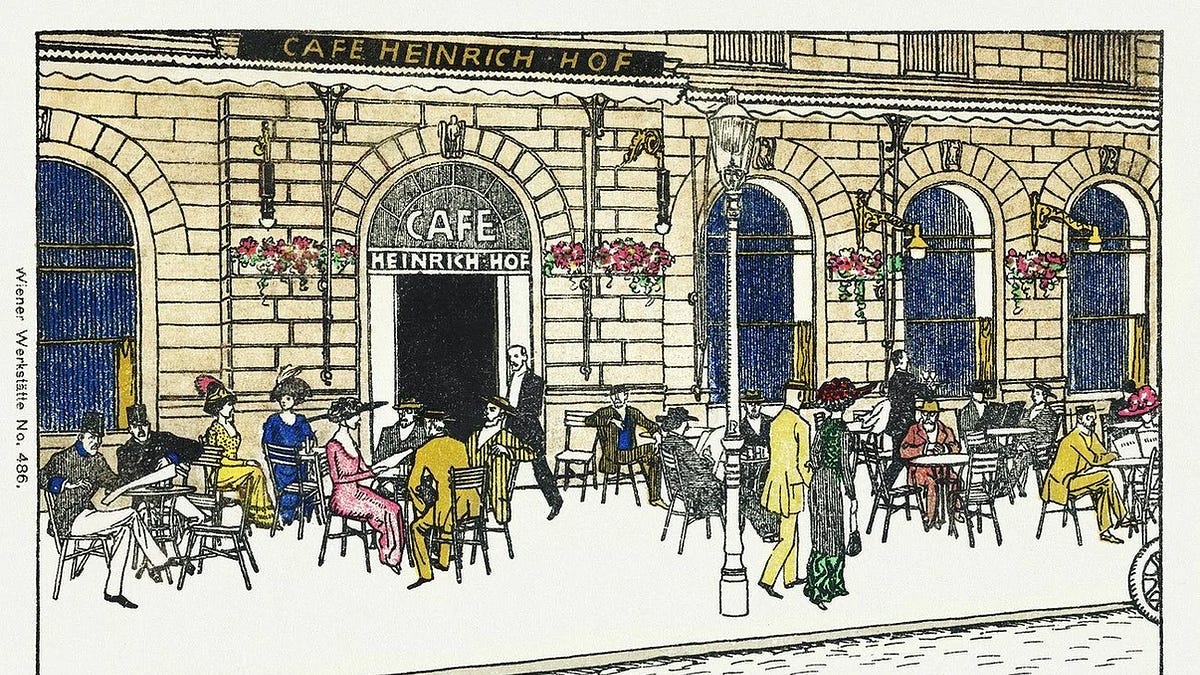
There Once Was an Empire
Over a century ago, Austria-Hungary collapsed and a generation of writers wrote about what it was like to have your whole world melt away
novum.substack.com
93 points · by apollinaire · 2y ago · 118 comments
Similarly, Marinetti’s proclamations of an imminent techno-utopia (electricity will make crops grow faster and planes will make landowning irrelevant because we’ll live in the sky!) if we only give Italy an itty bitty bit of fascism should be required reading in Silicon Valley.
The parallels you allude to are... unsettling, at the very least.
Alas, I have a nagging feeling that the problem in Silicon Valley today is not so much that its very smart, highly educated people are ignorant of history, but that being blind to it is currently in their best interest.
Never attribute to malice that which is adequately explained by ignorance, especially when such ignorance is motivated by financial interests.
---
[a] https://www.goodreads.com/quotes/21810-it-is-difficult-to-ge...
Occam's Razor makes the cutting clean
All this to say that those were complicated times.
I think the lesson for a modern western person is that a movement can seem kind of vague while it is happening, and therefore be idealized by people from very different points of view. But beware because the movement may crystalize into something really terrible.
    I met a traveller from an antique land
    Who said: Two vast and trunkless legs of stone
    Stand in the desart. Near them, on the sand,
    Half sunk, a shattered visage lies, whose frown,
    And wrinkled lip, and sneer of cold command,
    Tell that its sculptor well those passions read
    Which yet survive, stamped on these lifeless things,
    The hand that mocked them and the heart that fed:
    And on the pedestal these words appear:
    "My name is Ozymandias, king of kings:
    Look on my works, ye Mighty, and despair!"
    Nothing beside remains. Round the decay
    Of that colossal wreck, boundless and bare
The lone and level sands stretch far away.London (note: not Central London, that's another planet) always had this vibe to me of greyish-grimeyness mixed with a chaotic sense of unity -- like the bleak greybrown visuals coming from above and below bound everyone together under the same dull (sometimes suffocating) blanket of boredom and dysfunction, dotted with moments of spontaneity that would lend a friendly cheer or jeer alike before people hurried on to their next destination.
After Brexit, the blanket got lifted and I started seeing teeth. Sure, people used to shout at each other, but there was usually no substance to it, merely just a short disagreement between two people. Now there was something larger behind it, and I was seeing it everywhere.
Over the years, every time that I came back, the city would just get worse before my eyes. Public transport had always been bad and always been grotty, but it had never been this bad and this grotty, had it? Homelessness too had always been a problem, but I'd never seen these levels before, with what seemed like an entire community sleeping under a bridge, only to be swept away the next day either on their own volition or by the authorities. Watching my friends and family go from vibrant people with cheeky humour, to tired and vigilant individuals with a bitter edge to everything said.
Maybe it's just me getting older, but I always feel like I'm witnessing the loss of a badly defined culture/vibe that I had taken for granted before my entire life, vanishing before my eyes.
The lack of vision has slowly turned into a lack of hope. The huge industry marketing "fear of the other" is succeeding. Britain's always had its "community solidarity" feeling, but it also has uniquely British kinds of sullen jobsworthness, disengagement, complaining with no intention of fixing anything, resentment, and parochialism. Those are surfacing more.
The retreat of the Empire has left the governing structures intact, but on a shrunken scale. The devolved nations are treated like colonies which must be reined in from the centre periodically. London has abandoned the idea of travel to distant Manchester as too expensive, in favor of hoarding resources for a shrinking set of blue non-urban counties.
Couldn't have said it better. Lack of Vision, Lack of Leadership, and Lack of execution.
Everyone talking about immigration, unfair housing and poverty. It's gone from being a friendly place to a suspicious one in a handful of years.
Central London actually feels very good to me when I go there. I think there is a lot of who you are and where you are involved too, and when you compare it to.
If by immigration, you mean the refugee crisis, that's a pan-European affair.
Another commenter here said:
> I think it's the revelation that a shared culture and experience whose existence you took for granted really never existed. You feel untethered.
I think that may have happened to you.
While it might be pan-European, the sentiment in Dublin is certainly new. People seem... fed up. Now there's been a far-right riot, the rest of the world is also aware.
https://www.youtube.com/@FallofCivilizations/videos
Maybe it will be some solace that's excellent work done by one your countrymen :)
I live in Northern Ireland and I get this feeling when I come upon a street festooned in Union Flags and painted kerbstones. It's like stepping into a different country.
I’d hazard a guess that many British felt that same feeling long before Brexit, and that’s part of what caused Brexit in the first place.
There's no single date for the end of the British Empire, but a lot of the strife of the 60s and 70s was dealing with the economic and psychological effects of that. For many European countries with empires.
I’ve seen that same regression here in the U.S. It started in late 2016, and got significantly worse with the pandemic.
We’re in a very dangerous period in history. It’s not that long ago that one group of men were cheerfully annihilating another group of men, and I worry quite a bit that we’ll return to that. I think that it might even worse than before, because there is so much less love and beauty in the world now than before.
Surely there's an even closer comparison within living memory: the fall of the soviet union.
I think one piece of media that summarized the general feeling of it all for me was the song "The Truth of the Twilight"[0,1].
It seems to me we are not too far from witnessing the next one falling.
Edit: although come to think of it, the British Empire so beloved of Brexiteers actually made it through the Great War (unlike Austria and Russia), hanging on right up until 1956.
As someone born in a former colony who voted leave, I was definitely not nostalgic for the empire. If anything I feel the EU is more nostalgic for the heights of European power than the UK - all the multipolar world stuff they love.
We are going back to a two super-power world, and China is the other super power.
According to [1], in 2020 "A third of people in the UK believe Britain’s colonies were better off for being part of an empire, a higher proportion than in any of the other major colonial powers, a global survey has revealed."
And "Brexit-supporting leave voters were more than twice as pro-empire than remainers."
Further, 39% of Leave voters vs 16% of Remain voters answered yes to "Would you like Britain to still have an empire?", while 40% of Leave voters vs. 66% of Remain voters answered "no", so in that sense you could well say it's not "beloved" by Brexiteers - given they to on the balance prefer no empire, but it's beloved by a significantly larger portion of Brexiteers.
[1] https://www.theguardian.com/world/2020/mar/11/uk-more-nostal...
(I had been under the impression that the choice on offer was between being a rather weighty part of the EU and, under the guise of "independence", playing Airstrip One to the US' Oceania, but perhaps I am mistaken?
China is playing Eastasia, of course. Not bad for 1949 speculation, even if it was based on 1920's-1930's nonfiction.
In a different fictional universe: "Always two there are")
The sun will not set on it as long as it holds Pitcairn: https://what-if.xkcd.com/48/
He discusses at some lengths parallels to Brexit and broadly the feeling you describe here
The British empire fell way before Brexit. Swinging demographic changes, neoliberalism, decolonization, globalization, delegating policy to Brussels, etc. The same thing is happening in most western nations. It doesn't have to be this way but it is.
More interestingly, when, where, and how did nationalist thought begin to rise in the Austro-Hungarian empire? Was its dissolution organic or were midwives involved? The war famously began because of an assassination by a Serbian nationalist. (Wikipedia has nationalism modern root in the French Revolution but as a non European I find that unconvincing.)
This is just an armchair theory of mine: the seeds were planted by Luther who insisted that every nation should have a Bible in their native language. This naturally forms a strong identity. Those sprouts were then nurtured by westphalian nation-state system. Which then got infused by ideas of French revolution via a short period of Napoleonic empire throughout Europe. And in Balkans too. Any references to older events of identity in history should be regarded upon as suspect of revisionism for current political purpose.
This was really only true in German-speaking circles which were trying to ape the German Empire with its saber-rattling Kaiser. In places like Prague or Laibach, it was the local German-Austrians who staged the excited parades, not the Czechs nor Slovenes. Most other nationalities were apprehensive about going to war, especially on such a weak pretext.
The Hungarians had to be pressed into agreement (they had veto power in the Dual Monarchy), because they knew that the Hungarian part of the monarchy was ill prepared for war. (In fact, so was the Austrian part, but the deficiencies in Hungary, such as very bad railway infrastructure, were even worse.) They also did not want to add more minorities into the mix in case of a successful conquest, given that they were already outnumbered by non-Hungarians in their kingdom anyway.
Slavic nations disliked or outright hated the very idea of waging war against the Serbs and Russians, but didn't have veto powers and were forced into participation anyway. This contributed greatly to the latter disintegration of the empire. The first military of future Czechoslovakia, the Czechoslovak legion, was mostly composed of POWs and defectors willing to fight against Austria-Hungary, even though they faced execution when caught.
Weak pretext? Serbia had funded the terrorist assassination of the heir to the throne of Austria-Hungary. It’s difficult to imagine a stronger reason to go to war.
Germany’s misbehaviour in Belgium leads people to forget that the bad actor at the very start of the Great War was Russia, followed shortly thereafter by France and tailed by Britain.
Sure there were ugly events with the red riots of Bela Kun, and white terror mostly aimed against Jews, to counter it, in Hungary, but that did not impact an average citizen, it was a political terror relatively normal for the era (not much different from KKK actions in the U.S. at same time).
There has never been a revolution in which elites were removed where the average person didn’t suffer horribly. That transformation necessitates value destruction. That destruction must be allocated away from the new elites, which by definition places the burden on the average.
Coming from a successor states that's not what our history says, so I'd love to hear your better sources.
So yes, the average people suffered a lot from Austria-Hubgary's collapse.
Before you could move goods from Prague to Ljubljana without encountering a hitch. Now you had three separate borders in your way. This led to decline in virtually every sector, as things previously available on internal market suddenly became exports. Currency was the next catastrophe. Before 1918 you could buy bread with the same kroner in Vienna, Brno, Budapest and Krakow. Now you had to handle multiple currency swaps.
Finally, war erupted almost immediately between successor states. Poland against Czechoslovakia, Council Republics in Slovakia and Hungry, Poland against Ukraine ... And to top the list you had domestic repressions, like in Czechoslovakia against Germans.
So yes, it was a crisis. After crisis, after crisis. The only reason we in central Europe don't see this era as one of horror is because things got even worse afterwards. General economic collapse by end of 1920s and well into early 1930s, followed by WWII, genocides, communist takeover etc.
Well, there is one other reason. Nation states were seen as "progressive" and "modern" for most of the 20th century. The propaganda is kind of pervasive.
Just some of the wars I mentioned:
https://en.wikipedia.org/wiki/Polish%E2%80%93Ukrainian_War
https://en.wikipedia.org/wiki/Polish%E2%80%93Czechoslovak_Wa...
https://en.wikipedia.org/wiki/Revolutions_and_interventions_...
That must have been pretty tough on people who lived their lives constantly travelling between Vienna, Brno, Budapest and Krakow but I suspect most people weren't like that.
?
You.re very wrong about this. Austria had a massive economic crisis. Hungary had 98% inflation per month for.over a year (their second worst ever recorded, but surpassed big time by the one recorded after WW2, which ended with all the Hungarian currency in circulation being worth less than 0.01¢), massive uprooting and a refugee crisis, communist revolutions in Hungary and Slovakia, wars between the successor states (including between Czechoslovakia and Soviet Hungary, then Romania and Soviet Hungary, events which you ridiculously imply didn't impact the average citizen, or were in any way comparable to what was happening in the US at the time), not to mention millions of people ending up living under the jurisdiction of countries they previously fought against. Things didn't go back to any sort of normal until 1922 in any of the successor states. The situation was very much comparable to (and in most aspects worse than) early Weimar Germany.
It's also not true that aristocratic privileges were abolished everywhere: the Habsburgergesetz abolished them in Austria in 1919, but Czechoslovakia and Hungary retained them until 1947 (even the Soviet republic didn't formally abolish them, although there were no noblemen stupid enough to try and use them in that brief period).
All that said, I do agree with you on one thing: interwar nostalgia for the Empire was pretty much limited to a small Vienna elite (a fact that the article elegantly forgets to mention). Even the populations of Austria, Czechoslovakia and Hungary were overwhelmingly against its restoration, and against the return of the Habsburg monarchs, when the opportunity presented itself.
My own Hungarian grandparents got stuck in Yugoslavia, pretty much an enemy nation, so they didn't have a choice in the matter. I also don't know what they thought about it at the time, but it's telling that 50 years later they had nothing good to say, no fond memories to mention about A-H at all.
The economy of A-H collapsed so thoroughly that there were famines and bread riots. Too many men and horses were sacrificed in war and the relatively backward agriculture could not be sustained by the women, kids and the elderly who were left. Hunger was one of the immediate reasons for the collapse - it was impossible to prevent the soldiers on the frontlines from knowing that their loved ones back home were starving, and by October 1918, mutinies and mass desertions were widespread.
The countries that emerged from the collapse were often hostile to one another, which not only led to border skirmishes, but to introduction of wanton tariffs and regulations that broke precisely the economic ties that you mentioned.
For example, the textile industry in German-speaking Bohemian borderlands (Sudeten) used to export its products into a 55-million common market freely. Suddenly, this market shrank to 14 million (Czechoslovak population after 1918), some 30 per cent of its former size, as countries like Hungary, Poland and Romania introduced protectionist measures.
The resulting unhappiness of suddenly-much-poorer Sudeten Germans was later expertly exploited by Adolf Hitler.
Also, in many places, there was hyperinflation that wiped out life savings of the middle class, contributing to growth of political extremism.