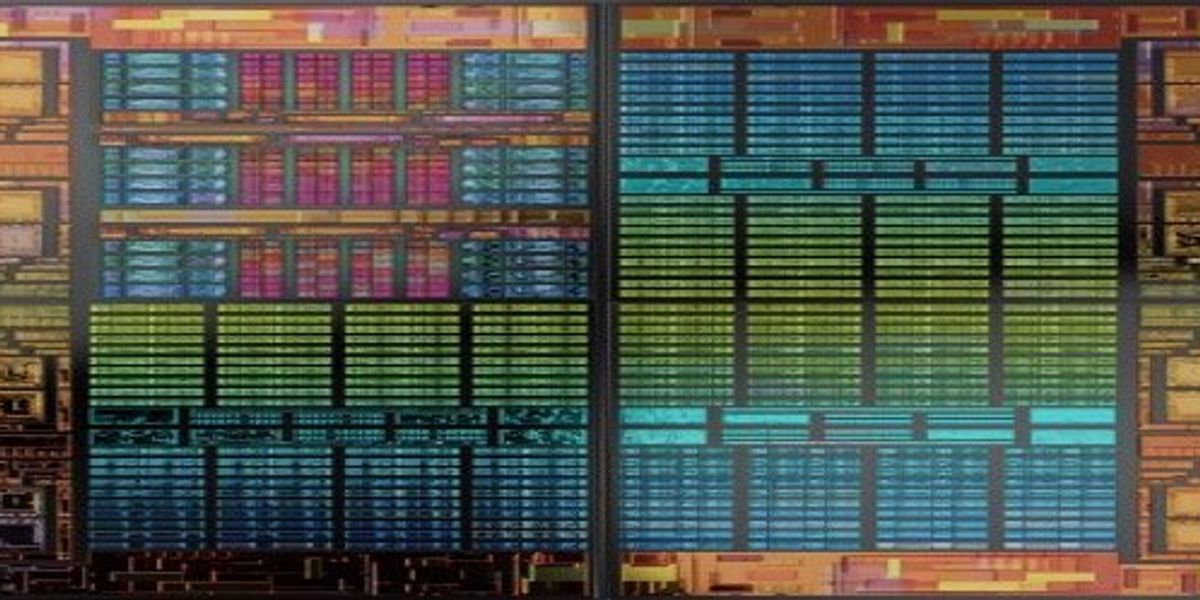
AMD's Next GPU Is a 3D-Integrated Superchip
The MI300 makes 13 pieces of silicon behave as one chip
IEEE Spectrum
183 points · by viewtransform · 2y ago · 124 comments
It's 24 x64 cores and 228 CDNA compute units on a common 128GB of memory. Personally I want to run constraint solvers on one. The general approach of doing lots of integer/float work on the GPU and branchy work on the CPU, both hitting the same memory, feels like an order of magnitude capability improvement over the current systems.
AMD is coming out with a "strix halo" APU somewhat appropriate for compute.
You would save money on improved yields of chiplets and on using cheaper nodes where appropriate. I imagine that would help offset the increased packaging costs.
However, they are moving to compete in a market where the profit margins are so obscene that a small increase in the cost of materials really wouldn't be an important factor.
> Nvidia Makes Nearly 1,000% Profit on H100 GPUs: Report
https://www.tomshardware.com/news/nvidia-makes-1000-profit-o...
There are some existing APU systems - I use low wattage ones as thin clients. Currently thinking it should be possible to write code that runs slowly on a cheap APU and dramatically faster on a MI300A system. Debug locally, batch compute on AWS (or wherever ends up hosting these things).
(Or maybe that's TSMC's secret)
https://3dfabric.tsmc.com/english/dedicatedFoundry/technolog...
Older explanation, but lots of this stuff is just now shipping: https://www.anandtech.com/show/16051/3dfabric-the-home-for-t...
Not that AMD doesn't deserve any credit, they have considerable multi chip experience under their belt and undoubtedly served as a guinea pig/pipe cleaner for TSMC's advanced package.
You can check if you correctly patterned the wafer almost immediately. You won't know if the layer is any good until many process steps later. Maybe not for sure until EDS. Tuning the interactions between manufacturing processes is the actual secret sauce that all the manufacturers are trying to protect. How much dose on the EUV machine depends a lot on how you intend to etch the wafer. Imagine iteration cycles measured in months for changing individual floating point variables.
The chiplets need to stay aligned as temperatures change. Much more difficult.
The contraints all depend on the scale of the alignment required.
I wonder what is the wavelength range used for their interferometers, and what kind of mecanical engines they use (probably piezo electric based engines).
Or do you mean the profiler tooling?
I hear everyone say that AMD doesn't have the software, but I'm a little confused --- have you tried HIP? And have you tried the automatic CUDA - HIP translation? What's missing?
CUDA runs on pretty much every NVIDIA GPU, this year they dropped support for GPUs released 9 years ago, and older binaries are very likely to be forward compatible.
Meanwhile my Radeon VII is already unsupported despite still being pretty capable (especially for FP64), and my 5700XT was never supported at all (I may be mixing this up with support for their math libraries), everyone was just led on with promises of upcoming support for 2 years. So "AMD has the software now" is not really convincing.
But if we're talking datacenter GPUs, the software is there. Data centers is where most GPGPU computing happens after all.
It's not ideal when it comes to hobby development, but if you're working in a professional capacity I'm assuming you're working with a modern HPC or AI cluster.
The SW story has been bad for a long time, but it is perhaps right now better than you think
Why don’t they position the SOC to have the HBM in the center with the CCDs and XCDs on the perimeter?
Seems to me that would yield lower “wire length” through the interconnect for each CCD/XCD to all of the memory.
Also, the physical interconnect between the XCDs is different than the HBM.
The core systems of interconnect are at the base most center-most (well, there's a passive interposer too, but it's just wires): the IOD. These intermediate connections across the chips on top of them, the IOD next to them, and the memory.
The die-to-die links, on the other hand, have extremely short wire length limits (less than a centimeter iirc for UCIe). At the physical layer, you just waste a bunch of power and area driving a high voltage to make the signal go further. Do that enough and you basically wind up with a PCIe PHY.
This is just for AI? So not for gaming PCs?
That is exactly what did happen. The year was 2006 and it was called the AMD Fusion project. AMD launched the chips, that they call "APUs", in 2011.
Nowadays, this configuration is common in both AMD and Intel "CPUs".
After you transfer 17 terabytes of data, it is worn out and you can't use it any more
The literal interpretation of the article is funnier though.
ROCm, which is AMD's equivalent of CUDA. The thing is you don't have to directly interface with CUDA or ROCm. Once the framework you want to use supports these, you're done.
AMD is consistently getting used on the TOP500 machines, and this gives them insane amounts of money to improve ROCm. CUDA has an ecosystem and hardware moat, but not because they're vastly superior, but because AMD both prioritized processors first, and NVIDIA played dirty (OpenCL support and performance shenanigans, anyone?).
This moat is bound to be eaten away by both Intel and AMD, and compute will be commoditized. NVIDIA foresaw this and bought Mellanox and wanted ARM to be a complete black box, but it didn't work out.
Ethernet consortium woke up and got agitated by the fact that only ultra-low latency fabric provider is not independent anymore, so they're started to build alternatives to Infiniband ecosystem.
Interesting times are ahead.
Also there's OneAPI, but I'm not very knowledgeable about it. It's a superAPI which can target many compute platforms, like OpenCL, but takes a different approach. It compiles to platform native artifacts (CUDA/ROCm/Intel/x86/custom, etc.) IIRC.
When you look to latest list [0], #1 system, Frontier, is a Nukeputer, but it's not only a Nukeputer. #5, LUMI is definitely not a Nukeputer. They are very close to us, we work together under a project with them (we're equals. They operate under a different consortium, we have stakes on another computer which is also very famous and also in top 10 in TOP500, and is not a Nukeputer). We also have our smaller systems in our own datacenter.
We operate mostly in the long tail of science, and this means we see heavy use of popular software packages, and many special software packages optimized for these long tail problems. ROCm was invisible in this niche before, but with Frontier and LUMI, and with AMD's announcements, this started to change very quickly.
ROCm libraries are more open w.r.t. their CUDA counterparts, and they started to land to mainstream distribution repositories directly. This is important for our niche. AMD is sponsoring integration of their libraries to popular packages and it started to payoff already.
Also, small-guy-programmers start to optimize LLM training routines for AMD cards, getting 99% of the performance of NVIDIA counterparts with way less power consumption.
As a result, AMD is already much more visible and more capable position when compared to last year.
Cool, that sounds interesting. Anything you can point at? :)
(this is literally what the El Capitan supercomputer mentioned in the article is for)
Compare to switching from x86 to ARM.
Currently they seem to have a particular focus on AI frameworks and tools like PyTorch/Tensorflow/ONNX. They have sponsored and helped with a lot of PyTorch development for example, so PyTorch support for AMD is much better than it was this time last year².
I guess those chips are for the movies/video industry, online or not. Because for the "consumer", the CPU is already very efficient, and I don't think we would save interesting about of battery usage in a "real usage" perspective. I may be very wrong, but I don't watch hours and hours in a row of ultra high quality videos on a small screen, that off the AC plug, the battery is unusable in a matter of a few years anyway... it not less.
https://owehrens.com/whisper-nvidia-rtx-4090-vs-m1pro-with-m...
Summary: they cherrypicked legacy nvidia sdk's and used llama batch sizes that are not used often in production...
https://twitter.com/karlfreund/status/1735078641631998271
https://developer.nvidia.com/blog/achieving-top-inference-pe...
What AMD did was a true comparison, while nvidia is applying their transformer engine which modifies & optimizes some of the computation to FP8 & they claim no measurable change in output. So yes, nvidia has some software tricks left up on their sleeve and that makes comparisons hard, but the fact remains that their best hardware can't match the mi300x in raw power. Given some time, AMD can apply the same software optimizations, or one of their partners will.
I think AMD will likely hold the hardware advantage for a while, nVidia doesn't have any product that uses chiplets while AMD has been developing this technology for years. If the trend continues to have these huge AI chips, AMD has a better hand to economically scale their AI chips.
The entire industry is motivated to break the nvidia monopoly. The cloud providers, various startups & established players like intel are building their own AI solutions. Simultaneously, CUDA is rarely used directly, typically a higher level (Python) API that can target any low-level API like cuda, PTX or rocm.
What AMD is lacking right now is decent support for rocm on their customer cards on all platforms. Right now if you don't have one of these MI cards or a rx7900 & you're not running linux you're not going to have a nice time. I believe the reason for this is that they have 2 different architectures, CDNA (the MI cards) and RDNA (the customer hardware).
Except they have been given time, lots of it, and yet AMD is not anywhere close to parity with CUDA. It's almost like you can't just snap your figures and willy-nilly replicate the billions of dollars and decades investment that went into CUDA.
To get a picture of the current state which has changed a lot, this MS Ignite presentation from three weeks ago may be of interest. The slides show the drop in compatibility they have for higher levels of the stack and the tools for translation at the lower levels. Finally there's a live demo at the end.
Rename it to batch_size/sec if you don't see the issue.