140 points · by philipkglass · 2y ago · 170 comments
So instead of new, safe, carbon neutral nuclear power (like thorium reactors, passive cooling, etc), we're are continuing to running literal old-timer nuclear plants (Diablo Canyon was built in 1981).
Most folks would not drive a car from 80s, but somehow we're cool with running powerplants that old.
IMHO The best for our carbon footprint with safety would be new nuclear plants.
What stopped these new nuclear builds, and doomed future new nuclear builds, was fraud on the part of management, unconstructable designs, incompetence in EPC, etc. these are the challenges with nuclear.
If somebody could build cost effective nuclear that didn't bankrupt those building it, there are roughly 100 reactors in the US nearing their end of life that local populations would love to keep running.
Nuclear didn't die because of public outcry in the US, it died because of cost overruns and bankrupting utilities. No buyer wants to take on that risk.
Combine that with the complete rewrite of regulation and the whole governmental structure in regards to nuclear, making them much tougher to build, killing much of the research, limited political support from either side and so on and so on.
They had to essentially rebuild plants according to newer standards stopping all new construction. While some of those changes were worthy, its also objectively true that coal plants were not subjected to nearly as much additional regulation despite them being much less save both for the workers and for the population around.
So if you have one standard of safety applied to one thing, and a completely different standard to another thing, then of course nuclear can't win in a market situation.
Large scale nuclear is successful if you can do it at scale. But that needs a top down approach or at least government approval and support.
Had nuclear received the kind of support wind/solar had in the last 20 years, the US would have transition to nuclear at a rate comparable to the adoption of oil.
"Regulations" are the excuse of people that didn't do their homework or prepare for the serious work of large construction projects. All of which have huge overruns in the US, regulations or not.
In truth, it's a labor and productivity problem. Advanced economies have far more productive uses for workers than sitting around construction sites, waiting for something to arrive so that they can finally do a small amount of work before waiting some more.
Worse, these are coupled. The result is often that people say x -> y! And stop there. But it's not an acrylic graph so narrow views don't work and simply trap us in this circular argument we've had for 40 years now (not unique to nuclear either). Truth is public outcry influences regulation which influences cost which influences outcry and so on and on. There is no root to point to as the start and there are arguments you can make about any of these being the start because influence doesn't mean sole contributing factor. As an example, you can argue cost is related to regulation and even that lack of innovation have been "caused" by public outcry (or claim regulatory costs/lack of innovation are confounders). Certainly it is a causal variable, but multiple causal variables can contribute to something. Truth is there are unique costs to nuclear independent of regulatory concerns. There's a reason you'll find far more physicists actively managing a nuclear power plant than a wind farm. There's also different dangers and uniquely there are proliferation concerns which do impose unique regulation. Can all this be better optimized? Certainly! But we can never do that if we are just going to endlessly have these circular arguments.
I know the weeds and details often don't matter for many subject matters (actually I think this is naive) but can we at least admit that nuclear power is at least a little bit complicated? And that there's a unique history? And that any opinion that is not formed through years of schooling and experience in the field is de facto naive? No matter how many youtube videos or articles you read from science communicators and even if you have a degree in physics because there's more to the problem that simply nuclear physics?
Most importantly, can we also admit that it's perfectly okay to have naive opinions? Literally nothing wrong with them unless high confidence is placed in those opinions. We're all smart people here, right?[0] So we recognize that the modern world is built via specialization and no person can really be an expert in all things, and realistically only in a few? Fuck man, I think one of the great filters is when a species gets to the point where approximate/naive solutions are no longer effective and they just fucking kill themselves because evolutionary pressure makes these solutions incredibly effective in the beginning but makes those same species ill equipped once a certain level of complexity is reached. I just wonder if we're intelligent enough to overcome these limitations in more than narrow settings (sure, you're smart in x, but are you okay being dumb at y?). Certainly the capacity exists.
[0] If we all know what you're (ambiguous) going to comment in response to this line, are you proving you're "better" or demonstrating your lack of intelligence? Please, just don't. Respond to something more substantial.
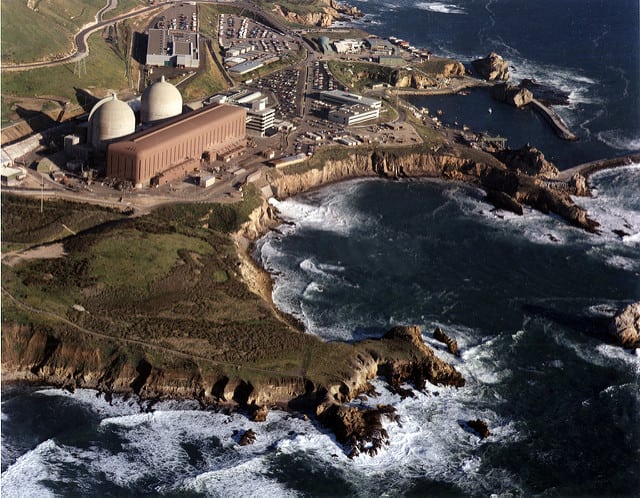
What I don't like is that Diablo Canyon is built on the shoreline, which is ripe for another Fukushima-like disaster in the event of a tsunami that hits California.
Even if that cliff edge is high it may destabilize with a high enough wave.
What is the connection between car longevity and nuclear power plant longevity?
More relevantly, if you're talking about the age of the design, construction started in 1968.
Not that I am opposed to new nuclear construction but its a completely wrong to suggest these old plants are to old.
Renewables are simply much easier to build. They mostly affect people that can see them and especially solar can be built in a lot of places, that don't really bother people, unless they don't like how they look (like a roof or to shade parking spots). Wind is a bit more difficult, but apart from the shadow and in closer distances the noise, the look isn't actually that bad. Kids tend to get about as excited about them as when they see a fire or dump truck. It is mostly that we prefer to look at peoples cars and streets than a spinning wheel on a wind turbine.
That's probably the big benefit renewables have. They have relatively few downsides to people and failure modes are mostly predictable as well (electrical faults or falling over would probably be the worst case and feel much easier to run away from, when you try to imagine them). So there shouldn't be as much resistance against them, apart from people living directly next to them even when people are unreasonable.
If a 100% electrical grid with renewables is possible (and I think it is), I think it is simply the better option, because it really shouldn't bother anyone (and probably also is cheaper and quicker to build). But maybe I am overestimating how much people care about looks or the coolness factor of nuclear.
I think it's perfectly fine (and smart) to keep Diablo Canyon running longer. $6B over five years doesn't seem crazy at all for a plant rated for 2.2GW. And shutting it down when our generation mix still heavily relies on burning natural gas would be a step backward.
But renewables are here now, today, and are cost-effective, much more so than building new nuclear plants, which are huge capital undertakings, that take many years to build, and the disposal of nuclear waste is still fraught with political and NIMBY issues.
I think you are incorrect to suggest that building new nuclear plants (even the new safest, cleanest designs) is the best bet for our carbon footprint. It seems pretty clear to me -- at least in a place like California -- that solar is miles ahead the better choice.
> Most folks would not drive a car from 80s, but somehow we're cool with running powerplants that old.
C'mon, that's just disingenuous. You can't just throw out a random machine and try to compare it apples-to-apples with a nuclear power plant.
Then your healthy dose of reality had to bring me down
This does not appear to be a serious attempt to help the environment with carbon-free electricity.
It looks more to be a PR move to satisfy people who have been boosting nuclear, without regard to costs.
$6B for a mere five years is highway robbery. Installing $4B of solar and $2B of batteries will result in 20-40 years of carbon-free electricity, and far far far more of it.
Those who have been boosting nuclear without a hard nosed look at the costs of technologies have a lot to answer for here. This is just a PR game.
The average price of electricity in California is 27 cents/kWh, or $270/MWh [1]. Some of this go to middlemen, but some to producers. I don't know the split, but let's say it's half and half.
Diablo produces about 16000 GWh of electricity per year [2]. At $135 per MWh it comes to $2.2 BN/year, or $11 BN for 5 years.
So $6 BN is not quite highway robbery.
[1] https://www.eia.gov/electricity/monthly/epm_table_grapher.ph...
Incidentally, $0.13748/kWh in generation costs, with an increase of only $0.01/kWh for exclusive wind/solar sourcing.
Even the $6B here amounts to roughly $0.08/kWh, which is far higher than the alternative uses of the money.
Electricity is expensive in California not because we use renewables, but because we have not switched to them, and because PG&E has astronomical costs for its grid. We need CPUC to start pushing back harder here.
Price in the middle of a sunny or windy day can be way less.
Beginning when? Diablo Canyon is already on line today, and just as importantly, tonight.
Where is the land going to come from to support $4B of solar panels? How many times will those batteries need to be replaced over 20-40 years? What are the ongoing maintenance costs? How will all that solar be connected to the grid?
Alleging "PR move" and "PR game" without similarly considering the motivation for your comments weakens your position.
The desert. https://www.kqed.org/news/11935070/solar-energy-farms-are-bo...
Doesn't take as much as you'd think.
https://landartgenerator.org/blagi/archives/5535
> The land area required to supply 100% of projected U.S. electricity demand in 2050 with PV installations is roughly half the area of cropland currently devoted to growing corn for ethanol production, an important consideration given the neutral or negative energy payback of corn ethanol and other complications associated with this fuel source. That same land area - i.e., 33,000 km2 to supply 100% of U.S. electricity demand with PV -is less than the land area occupied by major roads. The currently existing rooftop area within the United States provides enough surface area to supply roughly 60% of the nation’s projected 2050 electricity needs with PV...
You could power California off a solar field roughly the size of Andrews Air Force Base.
In theory it's so easy to build lots of huge solar power plants. We all know that solar is dirt cheap, because we've all seen the Lazard report with the levelized costs of energy.
In practice, here's the list of solar power stations in California [1]. None is close to 1 GW. Only 3 are above half a gigawatt nameplate capacity. But their capacity factor is on average less than 30%.
Or to put it differently, 20% of the electricity generated in California comes from solar, and 9% from nuclear (i.e. from Diablo). If you want to replace nuclear with solar, you need to increase the current solar generation by 50%. That's doable, but it's not something you do overnight, it will very likely take a few years. Meanwhile, guess what you'd use to replace Diablo? Of course, it would be natural gas, which, by the way, accounts for 47% of the current generation.
We've heard the story of nuclear being replaced with renewable in my state, New York. Two reactors, with a combined capacity of 2.1 GW were shut down in 2020 and 2021. But instead of renewables, they were replaced with natural gas [2].
> As a result of the permanent shutdown of the plant, three new natural-gas fired power plants: Bayonne Energy Center, CPV Valley Energy Center, and Cricket Valley Energy Center were built, with a total capacity of 1.8 GW, replacing 90% of the 2.0 GW of carbon-free electricity previously generated by the plant.[6] As a consequence, New York is expected to struggle to meet its climate goals
[1] https://en.wikipedia.org/wiki/List_of_power_stations_in_Cali...[2] https://en.wikipedia.org/wiki/Indian_Point_Energy_Center
How long would you expect the planning process to go, buying up the land, permitting, the construction process, connecting it to the grid, testing, and then finally energizing it? A couple years? More? (Also remember that this is California, where people will put up stupid roadblocks even for construction out in the desert, away from anyone's home.)
Now, they absolutely should be doing that in parallel! It's dumb that they aren't. But this nuclear plant is running today, and will continue to provide much-needed electricity, and that'd still be needed if we got this (unfortunately only hypothetical) solar project going right now.
A small fraction of land used for ethanol (40M acres) is enough to supply all the electricity that US needs.
But, I agree with you, Diablo Canyon is ready now, we should keep it online. We can't deploy new nuclear anyways, might as well keep the existing ones as long as possible. Besides, it might cost a few billions to decommission anyways.
(1) California Is Ideal For Highway Solar: https://cleantechnica.com/2023/09/05/solar-along-nations-hig...
Except how easy is it to build a plant to connect panels installed there to feed back into the grid? It’s not just a matter of throwing some panels down. Don’t you need ancillary large equipment to manage all that power safely?
> A small fraction of land used for ethanol (40M acres) is enough to supply all the electricity that US needs.
Are you sure that’s including capacity factor because solar panels don’t run in ideal conditions at all times vs assuming the rated panel output is what you’re always getting? Also I feel like that’s missing the storage requirements which is frequently ignored and would take up some non trivial amount of space.
Installing your proposed $4B of solar will get you 4GW at peak, which will produce about 5840 GWh per year due to variations in sunlight over the days and seasons. Diablo Canyon produces 18,000 GWh per year. Replacing Diablo Canyon with solar will cost $12B plus batteries, maintenance, and operations staff.
Figures/Sources:
- $1m buys 1MW of solar panels that provides 1,460 MWh per year. https://coldwellsolar.com/commercial-solar-blog/how-much-inv...
- Diablo Canyon produces 18,000 GWh per year. https://diablocanyonpanel.org/history-of-dcpp/
So in reality, the often cited “20-40 years of utilization” they offer is nice to say but has minimal practical impact on future costs.
Let's say you need 12 hours of battery capacity, so 24 gWh.
A casual google search says grid-scale storage is $300-600 per kWh. Even generously assuming $300/kWh, that's $7.2 billion just for the batteries. How long do the batteries last?
The plant generated 16,477 GWh in 2021 [1]. Over 5 years, it'd generate 82,385,000,000 kWh. At the LAX average retail rate of $0.287/kWh [2], that generation would return $23,644,495,000 in revenue.
[1] https://www.eia.gov/todayinenergy/detail.php?id=53899
[2] https://www.bls.gov/regions/west/news-release/averageenergyp...
With a population of 40M this would mean yearly cost of electricity per capita in CA would be $300. That sounds extremely cheap.
Doesn't sound like highway robbery to me but maybe you can make that clearer rather than just tossing out "install $4B solar and $2B batteries which is obviously better, idiots!".
If diablo Canyon is cheaper than the next best alternative, then it obviously makes economic sense to keep it. It doesnt matter how scary the big number is if the alternative is higher
How would you install $6B overnight? That alone would take years. And where do you buy it from? China?
The challenge with large installs is the interconnection queue and permitting, not any industrial capacity limitation. And these could be solved by CPUC with a snap of their fingers, like they snapped their fingers to extend Diablo Canyon.
Solar is down to around 0.25 / watt at bulk. Battery, LiFePo4 is $200/kWh.
Those are retail bulk prices. Commercial/Industrial prices are similar or sometimes better on commercial-sized equipment.
Granted, as you noted interconnection and permitting costs are high and going up and labor costs have risen and those are the main costs now.
The ISO (in this case CAISO) runs those studies for a reason to maintain grid reliability. The reason they're slow is that it involves a crazy amount of simulations to determine grid upgrades and it is difficult when things must be done recursively and when the renewables developers speculate so much.
If the state regulator could snap their fingers, they would have done so in California, New York, the Midwest... everywhere. They made some changes to speed things up in Texas, but honestly they're kicking the can down the road.
Because the goal isn't generating arbitrary amounts of carbon-free energy. The goal is displacing fossil fuel use with carbon-free energy. California is already hitting daytime saturation of energy demand for about a month of the year. $2B in batteries isn't actually going very far. The US manages to build battery storage at ~500/KWh. So 2 Billion is only about 4 GWh. The Diablo canyon plant puts out 2.5 GW of electricity, so this is less than 2 hours worth of battery storage relative to the plant its replacing.
However, California's rate of solar addition slowed down considerably since 2014. It went from 3,813 GWh of utility scale solar generation in 2013 to 9,932 GWh in 2014 for an annual growth of 6,119 GWh. But from 2017 to 2022 it grew by an average of only 2,994 GWh annually [2]. This happened at the same time that solar hardware costs continued to decline rapidly. California was more aggressive about building large scale solar projects when it was more expensive, and has oddly slowed down compared to other states in recent years. That's a reason that Diablo Canyon is still needed.
If California picks up the pace again on decarbonization with renewables, then Diablo Canyon can shut down. It shouldn't shut down while natural gas is still California's top electricity source [3].
[1] https://www.eia.gov/electricity/data/browser/#/plant/6099?fr...
[2] https://en.wikipedia.org/wiki/Solar_power_in_California#Gene...
[3] https://www.energy.ca.gov/data-reports/energy-almanac/califo...
Take a look at today's CA electricity source mix[0]. Regardless of cost, why would you shut down a nuclear plant (prematurely, when there's no renewable capacity right now available to replace it) when we still burn so much natural gas?
Shutting down that nuclear plant now would require that 2.2GW supply to come from somewhere else. And I bet you it would end up coming from fossil-fuel burning. Even if the plan was to spend that $6B on building out solar and batteries, that would take, what... two or three years to come online?
Now, we should be doing both! Keep this nuclear plant online, and accelerate building out solar fields and battery storage. We shouldn't be building more nuclear plants, but things that work today... work today. Shutting this plant down right now would seem like a net negative, carbon-emissions-wise.
Diablo Canyon is producing 2 GW. $6B / (5 years * 2 GW) is approximately $0.069/kWh.
That sounds extremely competitive to me and not "just a PR game". You won't get solar and batteries installed and connected to the grid cheaper than that (especially not at current interest rates), sorry. There's also the fact that Diablo Canyon is running right now, while getting large amounts of solar and batteries connected to the grid is a years long process at this point due to grid operator connection planning backlog.
This doesn't mean anything without specifying the amount of generation. Would that give you 18TWh [1] over the year?
[1] https://www.pge.com/en/about/pge-systems/nuclear-power.html
I agree the expense sounds extraordinarily high to the point of not being profitable at all, but I'm not an expert in the energy sector so maybe the industry numbers really are that high.
however, my arm chair quarterback position in solar would immediately recognize you're numbers being touted for a solar solution in $ and years are just made up
47% of CA's power generation is still coming from fossil fuels as of 2022 [1], and that's before we consider non-electricity energy uses. It's ridiculous to watch people demanding we choose exactly one of nuclear or renewables while we're spewing CO2 to the atmosphere every single day.
[1] https://www.energy.ca.gov/data-reports/energy-almanac/califo...
Why can't we do both? We run nuclear for the base load that will always be there and then supplement it with wind and solar and what not. We know nuclear works we know it is stable. My understanding is that a lot of the battery and solar technology needs to be replace every few decades or so and generally involves mining operations that are highly toxic and produce many emissions.
Not too mention that we have to construct elaborate massive sprawling battery infrastructure to supplement a grid that depends heavily on wind and solar in order to answer the simple questions of "what about when it is nighttime or cloudy, or the wind isn't blowing?"
I don't get why so many people are fighting against nuclear. Either we need to do everything possible to reduce carbon emissions or not. Nuclear does not rely on some battery technology that is "almost there", and that is "showing promise". It is a proven technology that works and has a reliable answer.
So in short nuclear for the base, solar and wind for the supplement. There is no reason we can't do both.
P.S. Given the massive amount of government money being handed out for "green technologies" there's part of me that wonders about how honest this objection to nuclear and pushing of solar and wind is.
We need base load capacity to replace thermal fossil fuel generation, it's not negotiable if you want the lights to work reliably 24 hours a day, no matter the weather conditions. Be it nuclear or more hydro - or we reconfigure to only run hydro when we need base load - either way it must be there.
I dont think we can reach zero fossil fuels, because of the need for peaking generation - but we can get pretty close though. Having to fire up a dozen gas turbines during severe weather conditions seems like a small price to pay if the other 99% of the time we could go without any fossil fuels at all.
They've named this issue the duck curve: https://en.wikipedia.org/wiki/Duck_curve
Do batteries and solar panels have lifetimes of 20-40 years?
https://www.sierraclub.org/michael-brune/2016/06/nuclear-pow...
One of the things people underestimate in physical systems is the amount of tribal knowledge there is and how it actually takes skill and training for a country to become good at something.
One of the biggest challenges facing us right now is the fact that we've been reducing nuclear power and if we want to expand it we're going to need capable professionals to be able to do it, those won't spring out of thing air. Keeping existing facilities open will allow us to start training up new engineers that can work in new installations. b/c tbh ramping up nuclear work is probably one of the most important and pressing issues facing not just America but most countries to an extent right now.
The calculus for other places (low-sun, low-wind) will certainly be different, but I don't think it's useful or productive to build new nuclear plants in CA.
I think it's the correct move to keep this plant running: it works, today, and shutting it down would undoubtedly mean picking up the slack with more natural gas burning, at least in the medium term, and that would be bad. But building more? I just don't see the need.
We should be building so much nuclear right now it isn’t funny (should be targeting 40-80% of all production to hit net 0 I suspect). That’s like another 3-10 Diablo canyons worth of production. That doesn’t mean we shouldn’t build solar. We should to have it handle peak energy requirements and derisk things.
Also we should be building modern designs like molten salt reactors which are safer and cheaper.
When I was graduating from high school, I did the navy recruiting thing just for kicks, and after taking the asvab, they said I had a promising career in navy nuclear. But that scared me away from the military, since my dad had a career in nuclear power, we even got a DOE settlement after he died of cancer, they don’t put nuclear power plants in nice places, it’s not the career I wanted. Towards the end of my dad’s career, many of the engineers were Central American (??? Not sure why) or Indian already. We can totally import the expertise in the future, especially if we are will big to build out French or Chinese designs.
Also re cancer, nuclear power plants emit no radiation. All the radiation exposure risk comes when you’re doing certain kinds of maintenance (eg refueling). Nuclear subs are a different matter. I don’t know the safety standards there and the military is typically a lot more loosy goosey with safety.
If we bought plans for the French, I’m sure we could merge in American culture quickly. We won’t find any pure nuclear engineers being trained up in the USA anyways outside of the navy, there are only a few programs left.
It'll be okay, since when the big one hits and CA falls into the ocean, it'll just take the plant with it. So the rest of us will be just fine.
Just look at this and draw your own conclusions:
Most likely we'd make up for the lack of that plant by burning more natural gas, at least in the short/medium term.
Also not sure why you think that price point is out of whack. Seems well in line with current CA electricity prices.
This plant should not run forever, but extending its life another 5 years seems entirely prudent.
It's disingenuous to compare solar to nuclear without the equivalent storage.
— https://en.wikipedia.org/wiki/Humboldt_Bay_Nuclear_Power_Pla... in 1976 because of "BE AFRAID!!!"
— https://en.wikipedia.org/wiki/Vallecitos_Nuclear_Center in 1977 because of "BE AFRAID!!!"
— https://en.wikipedia.org/wiki/Rancho_Seco_Nuclear_Generating... in 1989 because gas generation was artificially cheap (tell that to my current power bill)
Canceled during construction, and you can go see the big hole in the ground:
— https://en.wikipedia.org/wiki/Bodega_Bay_Nuclear_Power_Plant
Never started:
— https://en.wikipedia.org/wiki/Sundesert_Nuclear_Power_Plant (two units)
— Corral Canyon (Malibu)
— San Joaquin Nuclear Project (four units)
— Stanislaus (two units)
— Vidal Valley (two units)
Both of those links indicate they discovered seismic faults below the two facilities after construction. That seems like a reasonable thing to be wary of.
I'm general those in the first group, while it comes in many forms, it seems to boil down to "What are you worried about, X hasn't happened". Trying to present it as neutrally as I can the two side seen to be "Hey you're playing Russian roulette, the bullet is going to hit you if you keep pulling the trigger, stop before it does and their response is. 'Nothing has happened so far why are you worrying about nothing?'"
The opposite perspective is "You worry about every possible thing that could ever happen. There are a billion things that could happen it's useless worrying about them all so just worry about the ones we've seen happen and are likely to occur."
Both have their merits and their downfalls. And I think these views have become more visible recently.
I feel more strongly towards one approach than the other, but I feel that often times people talk past each other because they're using fundamentally different frameworks.
So not weighing in one way or the other here. More just observing that this seems to be an instance of it between OP and you.
https://public-blog.nrc-gateway.gov/2012/12/28/what-is-a-rea... “A reactor trip causes all the control rods to insert into the reactor core, and shut down the plant in a very short time (about three seconds).”
Yawn.
https://en.wikipedia.org/wiki/Fukushima_nuclear_accident
> The proximate cause of the accident was the 2011 Tōhoku earthquake and tsunami, which resulted in electrical grid failure and damaged nearly all of the power plant's backup energy sources. The subsequent inability to sufficiently cool reactors after shutdown compromised containment and resulted in the release of radioactive contaminants into the surrounding environment.
Yawn?