Constellations are Younger than Continents — LessWrong
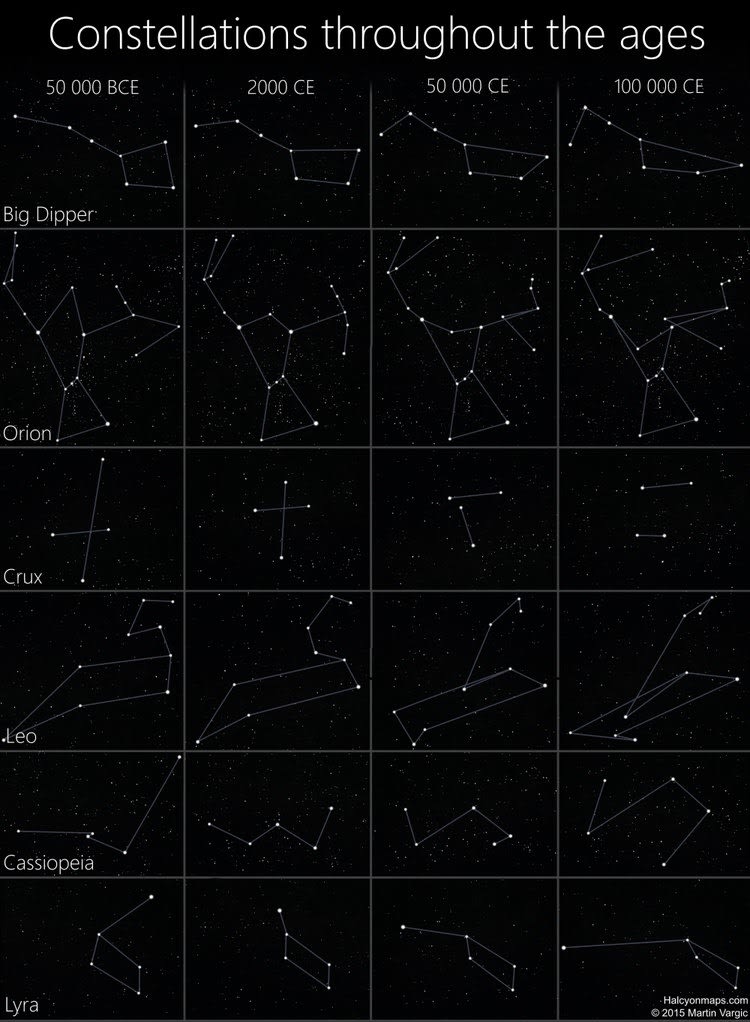
At the Bay Area Solstice, I heard the song Bold Orion for the first time. I like it a lot. It does, however, have one problem: …
lesswrong.com
307 points · by dash2 · 2y ago · 123 comments
Around 2/3 of cultures have a story in which there are seven things (seven sisters, seven boys, seven chickens, and so forth.). The other 1/3 of cultures have a story in which there are six things. And a surprising number of them have a story in which there were originally seven, but one got lost (like in the Greek myth of Electra).
The interesting thing is that two of the stars in the cluster are quite close together and can't be distinguished by eye. A pair of astronomers looked at the proper motions of the stars in the cluster and figured out that tens of thousands of years ago these two stars were far enough apart that they could have been distinguished by eye. So it seems that early humans recognized the Pleiades as having seven stars and this persisted in the myths of most cultures for tens of thousands of years, even when the seventh star was no longer visible.
https://skyandtelescope.org/astronomy-news/many-pleiades-can...
No idea if there's any truth in the story, but I wouldn't be surprised
One of the best parts is the legend of the seven sisters in Australian aboriginal tradition.
Theory goes that the legend far, far predates first contact with Europeans, so it must have come with the first aboriginal settlers when they sailed from Africa. Which would make it one of (if not the) oldest stories in history.
On a related note, something that has always intrigued me is why there is no historical record of Polynesian arrival on the east coast of Australia.
Indeed, with sufficiently good conditions and good vision, you can see more than seven. The Seven Sisters are just the brightest of the Pleiades.
Seven sisters chased into the sky by a hunter, and the seventh sister left the sky to marry the hunter.
The aboriginals were isolated from the rest of the world for tens of thousands of years. That their legend is nearly exactly the same as European legends is incredibly unlikely to be coincidence. More likely the legend of the seven sisters is a story that was first told before humans left Africa. All of the Pleiades legends must stem from that original story.
The interesting part isn't that they have a story about the Pleiades, but that it's the exact same story as everyone else. And they've been telling it for tens of thousands of years before ever encountering the Europeans.
Also consider that no myths survived of much more interesting and recent astronomical phenomena, like the supernova that was visible for a few weeks even in full daylight [https://en.m.wikipedia.org/wiki/SN_1054].
(This one is less interesting as an overall observation about timescales though. Polaris is just quite a young star and sharks are quite and old life form).
Because of the precession of the Earth's axis, Polaris didn't become the north star until about 500 AD. To the ancient Egyptians, Thuban was the north star. When humans were first discovering agriculture 12,000 years ago, Vega was the north star.
Wikipedia has a great table showing the cycle of north stars: https://en.m.wikipedia.org/wiki/Pole_star#Precession_of_the_...
That means that if the sun existed from the big bang to now, it would have only done ~63 complete revolutions around Sagittarius A*. If you account for the Milky Way's creation, that number gets even lower. I'm no expert, so maybe this makes sense to someone who knows more about this, but it definitively feel weird to me.
> I guess my only insight is, I'm not sure why you relate the number of revolutions that the Milky Way has made to its complex and symmetric structure. The spiral arms that you see in a galaxy like the Milky Way do not rigidly rotate with it, they are more like... This is complicated, but they are more like regions where star formation is going on, and therefore the galaxy is brighter rather than regions where there's more density or anything like that. So if you're worrying how the spiral structure forms. It can form pretty easily in one or two revolutions, I don't see why it would take even 68, much less, but need more than that.
[1] https://www.preposterousuniverse.com/podcast/2023/10/09/ama-...
Regarding the spiral arms: the arms itself do not really move, but stars move through the arms. The arms contain a lot of gas and when stars move through them, they can collect more gas and result in supernovas creating new stars.
"Mickey Mouse degrees", https://xkcd.com/793/, the attitude displayed by the bully in "Zero for Conduct" and similar IRL dismissals of the entire ME area in the post 9/11 discourse, mid-Brexit politicians saying the country had had enough of experts, some of my fist girlfriends' anecdotes from her childhood, town v gown, …
[1] "Mapping tree density at a global scale" https://www.nature.com/articles/nature14967
My follow-up fun fact is that even though "tree", like "fish", is a term of common parlance, there is no universally recognised and precise definition of the category, either botanically or in common language.
In botany, a tree is a perennial plant with an elongated stem, or trunk, usually supporting branches and leaves. In some usages, the definition of a tree may be narrower, including only woody plants with secondary growth, plants that are usable as lumber or plants above a specified height.
In the words of Justice Potter Stewart: "I know it when I see it." (1964)
In fact, even if we're talking elements themselves, there are elements with halflives of picoseconds. I can't know for sure but i'd bet those elements are more rare than wood. And since I'm extending the analogy, how do we know wood is the rarest? We can't really get a good look at exoplanets yet, they're still just fuzzy balls to us like pluto used to be. Trees could be an evolutionary essential step.
Anyways, it's a nice thought but could probably be phrased in a way to defeat pedants like me. Merry Christmas <3
The Barbers' When They Severed Earth From Sky (2004) hypothesises that the various kingship changes in heaven of several ancient mythologies correspond to the precession of the solstices and equinoxes through the zodiac. Eg, for Greek mythology, they give:
    Head God    Summer    Spring
    CHAOS       Libra     Cancer
              ~6480 BC
    OURANOS     Virgo     Gemini
              ~4320 BC
    KRONOS      Leo       Taurus
              ~2160 BC
    ZEUS        Cancer    Aries
According to this hypothesis, when the fall equinox moved into Virgo and Saturn and Jupiter came into conjunction with Pisces in 6 BC, many ancients took it as marking the advent of a new Kingdom of Heaven ruling a New Age, making them more susceptible to picking up new religions emanating from the middle east around that time, eg Mithraism.
Does Virgil, writing ca 40 BC, predict the New Age? [Fourth Eclogue 4-10]
> Now is come the last age of Cumaean song; the great line of the centuries begins anew. Now the Virgin returns, the reign of Saturn returns; now a new generation descends from heaven on high. Only do you, pure Lucina, smile on the birth of the child, under whom the iron brood shall at last cease and a golden race spring up throughout the world!
(but note that by this counting the "Age of Aquarius" wouldn't be due to start until ca 2160; rather far off in human lifetimes from the 1960s)
It was a kind of weird feeling as a young boy “seeing” change to something considered so static, and all the deeper considerations from that.
---
I doubt if there would have been much gain; and I hope the, evidently long but undefined, gap* in time between the Fall of Barad-dûr and our Days is sufficient for 'literary credibility', even for readers acquainted with what is known or surmised of 'pre-history'
I imagine the gap to be about 6000 years : that is we are now at the end of the Fifth Age, if the Ages were of about the same length as S.A. and T.A. But they have, I think, quickened; and I imagine we are actually at the end of the Sixth Age, or in the Seventh.
Source - The Letters of J.R.R. Tolkien, Letter 211
[0]: https://tolkiengateway.net/wiki/Borgil [1]: https://news.ycombinator.com/item?id=32478492
The galaxy has revolved about half a revolution since then.
I started searching for it, and as it usually goes with HN stories, I ended up on their new/modern version of it over at: https://redshiftsky.com
A brief history of their famous titles (check also aviation) is over at: http://archaic.maris.com/content/indexe5cc.html
Older versions of Redshift can be downloaded/found over at the Internet Archive:
https://archive.org/details/redshift_202204
https://archive.org/details/redshift2
https://archive.org/details/Redshift_3_Maris_Multimedia_1998
Well, assuming we don't self-annihilate ourselves at some point. Or be destroyed by some cataclysm.
I guess we'd better spread to as many locations in the solar system as, err, humanly possible.
This makes it likely that if we ever do settle multiple stars, culture and language will diverge pretty strongly across the different settlements, potentially making other, distant humans our worst potential enemies.
E.g. you could have many jobs in society be done by machines, have humans be raised by them, interact with them on a daily basis, etc. If you want to prevent language drift, you could have these machines speak only one specific kind of language. That way, all the cultural works of the ancestors are still directly accessible to everyone without translation.
“the appalachian mountains are older than saturn’s rings. the appalachian mountains are older than dinosaurs. the appalachian mountains are older than trees. the appalachian mountains are literally older than BONES. the appalachian mountains should be regarded with pure terror.”
He'd also never been here, so he might have just been wrong.
(or for that matter the German notion of western: https://www.youtube.com/watch?v=DZrXWdLxtfM )
The second one would fit in at the CMAs.
The stars and their appearance on the sky is natural like the day-night cycles, while how they are grouped together and what they are called is human made. (And different civilisations had wildly differing opinions on how this should be done.)
Unfortunately Orion is still older than most hominids. I can imagine a new constellation triggering the “need” for new stories, but only after language developed.
And while I strongly believe we will continue to push back the beginnings of Man, and of civilization, we are probably past the inflection point. I suspect we aren’t likely to quadruple the origin dates for our species. Which is what you’d need to have a plausible story about oral traditions affected by Orion sprouting a new star.
Every 7th cycle would be the start of the week; the 6th cycle would be the end. (Think, for example, if you had a 2-day week; the 1st cycle would take you to the 2nd day.) But when the week starts is not universally agreed—I believe USians usually start it on Sunday, and Europeans usually start it on Monday.