73 points · by rencrisa · 2y ago · 136 comments
https://www.drugdiscoverynews.com/what-now-for-the-amyloid-h...
That says a lot about how worthless the whole science journal and peer review process is. At this rate your assumption is that 50% of what is published is complete junk.
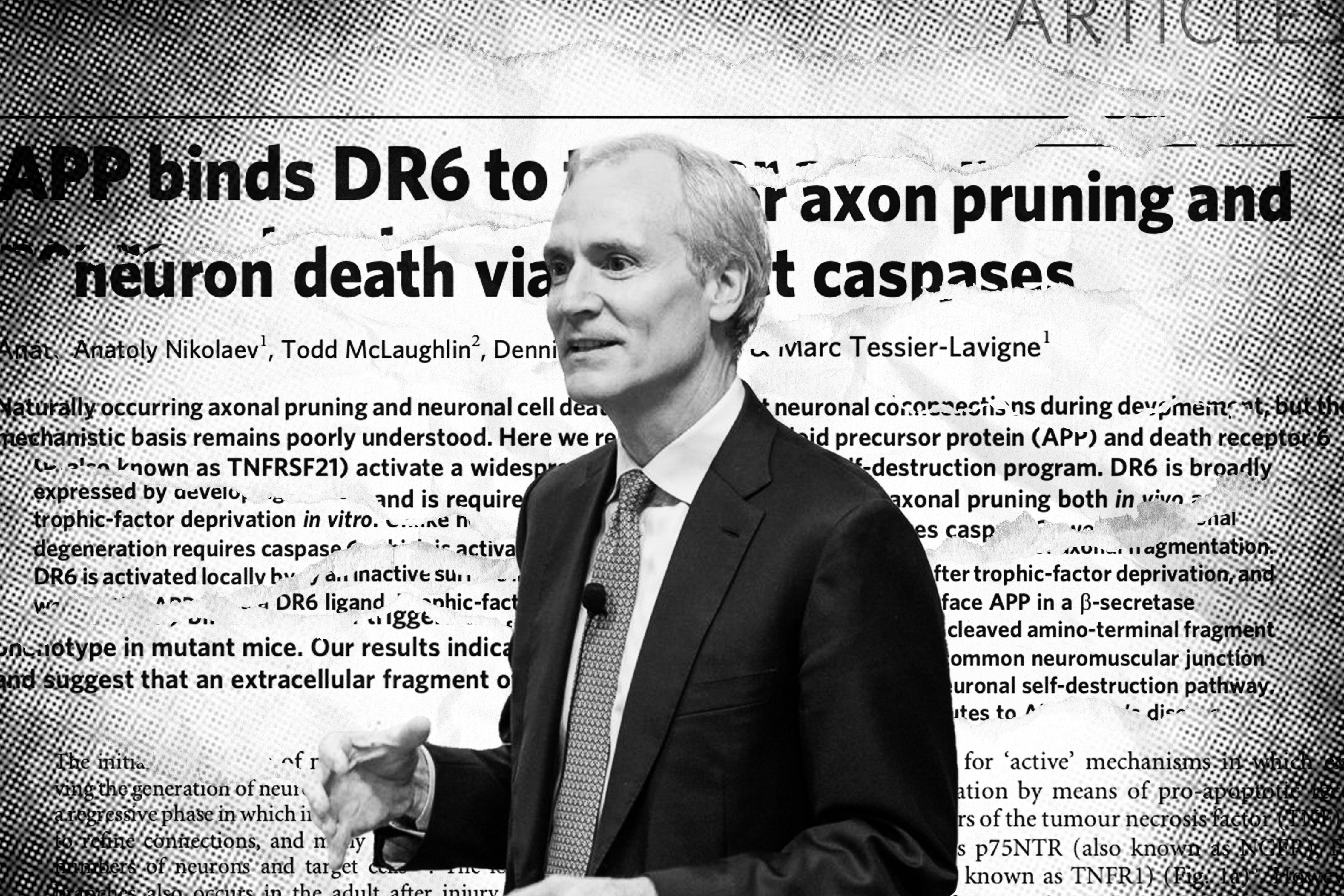
There are definitely major problems in academic research (the number of retracted papers should be much higher than it is), but it's worth noting that Tessier-Lavigne did the non-reproducible research whilst working at Genentech. One of the strangest parts of this story is how Genentech apparently already knew that the claims didn't replicate, but allowed MTL to publish a paper in Nature about it anyway ... and then went ahead and presented the claims to investors. MTL left soon after Genentech was acquired, and when they concluded years later that the paper was definitely bad they had apparently lost the ability to retract it, even though it had been done by their own employees.
Whilst papers are not much of anything, presenting research to a potential acquirer that you knew wasn't reliable sounds like the basis of potential legal claims. Normally companies are very careful about that because the liability from misleading investors or acquirers can be huge.
it's fairly clear that it is the case. You are rewarded with tenure for pushing lots of papers, regardless of their validity, since nobody actually cares about replicating anything.
> peer review system is an imperfect, but perhaps effective
The peer review system is just about checking points of details or calculation in a study, they never bother to actually check if the original results are valid. It's a mostly useless process that does nothing but remove the most obvious problems in the writing stage.
> the alternative
just like we did for hundreds of years now, proper replication baked in, by different people in different places, following the exact same conditions or protocol.
From the article:
> Retractions remain exceedingly rare for scientific papers: Just eight out of every 10,000 are retracted, according to a Retraction Watch database.
Think about how much attention has to be paid for retractions to happen, how long the work existed without retraction, how difficult it was to get a retraction for outright fraud (ignoring work that itself was poor quality). This maybe says more about the incentives against retraction which then explains the low retraction counts better than whether or not the remaining papers are good. After all, the papers that have been retracted are high citation count papers that are foundational for certain avenues of research (this one for Alzheimer’s, the other famous fraudulent work about honesty pledges, etc). What does this say about all the papers that then cite these papers as work they’re basing theirs off of. What about the papers that then “agree” with papers that turn out to be completely fraudulent?
You're just making the data fit your preconceived beliefs, which would is how we get fraudulant research.
There are many more papers that are less cited that will never get looked at in enough detail to discover fraud.
The reality is we don't know. Should it be more than 8 out of 10,000? Almost certainly, since quite a lot of papers barely get any attention after publication.
But should the number be 10 out of 10,000? 20 out of 10,000? 100 out of 10,000? We don't know.
And boring papers without any interesting conclusions published just for CV reasons also don't really matter, and the 10,000 figure is also wrong, and we also don't really know what the correct value for that figure is.
It has become a LOT easier for non-experts to hunt down fraud as electronic dissemination has widened.
> Retractions remain exceedingly rare for scientific papers
This retraction actually happened because someone BOTHERED to check the results and push for hard questions.
You can bet that this does not happen for every publication... So...
> [Elisabeth] Bik later told The [Stanford] Daily in an interview, relying on her experience of investigating more than 20,000 papers for research misconduct and causing nearly 1,000 retractions and roughly the same number of corrections to make that claim.
https://stanforddaily.com/2022/11/29/stanford-presidents-res...
Let's assume Bik chooses papers to investigate because, to a significant degree, her expert judgment is that they are most likely to have fraud, and Bik may know that topic better than anyone in the world.
Of the 20K most likely candidates, 5% were retracted and 5% corrected, and 90% apparently needed neither (though possibly they were inconclusive or she couldn't convince publications or authors to retract).
This to me is a crucial statistic. Is this number much less than it should be? Or are many more papers dubious in their methodology?
It's fun to hear people complain about accuracy in this way.
Maybe it's more than it should be, or just about right.
If we are just going to assume our biased preconceived notion is correct and the conflicting data is wrong, why have data? But if we use that method, what is the likelihood that our claim will eventually be retracted?
That begs the question, how did at least four such cutting-edge research works with fabricated data and results go through the review process unscathed?
The purpose of these institutions isn't to educate, it's to confer status (in a tax efficient and positive-eugenic way)
But I can say that aside from intellect, attendees of top universities are not ethically superior to the average person.
But I never said the education is bad. I just said their purpose is not to educate. Morill Act institutions were developed to educate, and by accepting the vast majority of people that apply University of Oklahoma will always exist to educate. The same cannot be said for Brown or Stanford.
I work with a lot of Stanford grads. They’re terrific folk.
But the concentration of corruption, delusion and depravity in its graduates, professors and administration begin to make one question if they were great and collected and resisted Stanford’s transformative effect, which increasingly (albeit with low confidence) looks like it may be net negative, or if they were transformed positively by the experience.
Reading HN, one might get the impression that it's much higher.
Then people actually tried it which confirmed everything I mentioned:
> This certainly does not only happen in cancer research. In a study from Nature, out of 1,576 researchers, more than 70% have tried and failed to reproduce another scientist’s experiments, and over half failed to reproduce their own. And even though 52% agree there is a reproducibility crisis, only 31% think that failing to reproduce published results means that the result is wrong. Even if replication is not necessary for results to be valid and true, any further work based on these results requires confirmation of valid results beyond the initial study.
source: https://vce.usc.edu/weekly-news-profile/the-replication-cris...
Current Science is mostly cargo cult.
Because I certainly don't get that impression at all, and it doesn't seem like anyone else in this thread does either, so do you have some polling, or maybe NLP analysis of comments? Of course you're entitled to your impressions, but so are the rest of us.
With our hiring and interview process serving as a great filter, it was impossible to tell who fell into which population until they told you.
Maybe a very simple comparison is between young tennis players that work with a local pro and go to tennis camp, and the super-talented ones working with elite professional coaches, the kind that train world champions. It was clear that there is no way you could teach yourself at anywhere near the level of top-10, nor find that education at most schools. And remember that your peers are part of your education - you won't find that population of peers either.
I know some institutions hire only from the elite, top-10 schools. I used to think it was 83% prejudice, but after those experiences I understand why. It's still lazy and unfair, but I also see significant reasons for it, maybe 33% prejudice.
(Possibly other top-10 schools aren't as good as the one I have experience with, of course.)
Because all I can take away is that people like me are just objectively inferior compared to you, destined to not be a future leader or professional. Is that not what you are attempting to communicate? I just want to be crystal clear. We all know people like you are superhuman. I'm just wondering what it should mean for the rest of us, the 99.99%.
With that said, the Square interview process isn't as algorithmic as most tech or finance companies and is instead more collaborative, so the raw IQ most MIT grads would use for their Jane Street interviews probably doesn't apply here.
All I see is the rich fucking over everyone else for power and inflating public perception of their intelligence to try and keep actually intelligent people down.
> Doudna joined Yale's Department of Molecular Biophysics and Biochemistry as an assistant professor in 1994.
... and now works at UC Berkeley.
David Liu [2], who pioneered base editing, a generational improvement on classic CRISPR, works at Broad Institute (which is a collab between Harvard and MIT):
> He is the Richard Merkin Professor, Director of the Merkin Institute of Transformative Technologies in Healthcare, and Vice-Chair of the Faculty at the Broad Institute of Harvard and MIT
I absolutely loathe the current social meta where people are allowed (even celebrated) for thoughtlessly punching upwards, regardless how broad the brush (boxing glove?) seems to be. Are there shitheads in these institutions? Undoubtedly. Are there also a ton of really brilliant people who have good intentions, have integrity, and deserve your utmost respect? Undoubtedly. Are the shitheads more likely to be located in administration? My bet is yes, because the scope of administration is a lot more political, but again -- we have to be careful.
Is it anywhere near accurate to say "They’re all wrought with dishonesty and self preservation"? I don't see how this statement could be supported with anything other than personal emotion. Anti-intellectualism is just another form of dangerous prejudice and should be treated as such. You can sign me up for metaphorically stringing up this particular asshole.
I also say all this as someone who didn't go to a prestigious school.
Happy New Years!
[1] https://en.wikipedia.org/wiki/Jennifer_Doudna [2] https://en.wikipedia.org/wiki/David_R._Liu
Citation needed.
In the negative, you have this story at Stanford. With MIT you have the Jeffery Epstein connection, some high profile retractions, and the president part of the three Uni Presidents who flubbed the anti-semitism question in the congressional hearing.