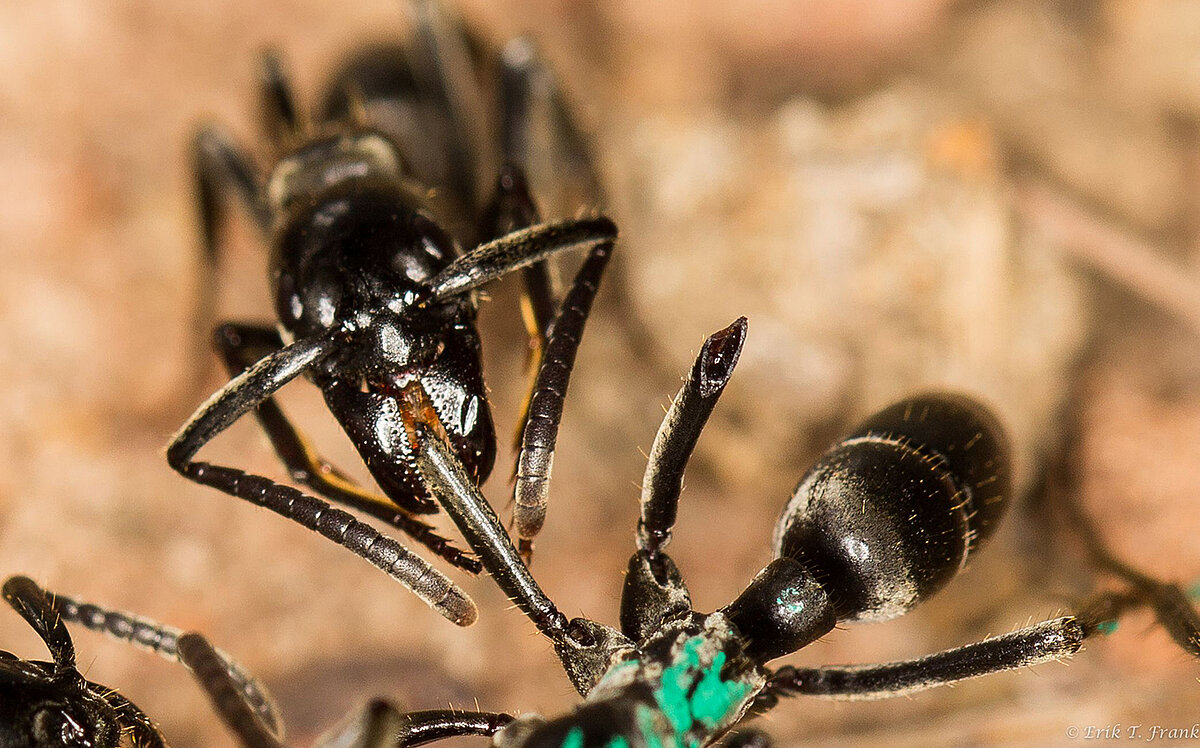
Ants Recognise Infected Wounds and Treat Them
The African Matabele ants are often injured in fights with termites. Their conspecifics recognise when the wounds become infected and initiate antibiotic treatment.
uni-wuerzburg.de
469 points · by hhs · 2y ago · 163 comments
"Erik Frank. Laurent Keller also adds that these findings 'have medical implications because the primary pathogen in ant’s wounds, Pseudomonas aeruginosa, is also a leading cause of infection in humans, with several strains being resistant to antibiotics'."
Love imagining leading scientists from big pharma rushing to investigate the compound cocktails ants are using to make the next blockbuster drug.
Mainly the Orphan Drug Act of 1983 with provided tax incentives as well as subsidized research. There is also the Rare Disease act of 2002 but that IMO is less signifigant.
Don't forget that for rare diseases affecting children the government awards fast track vouchers. These allow you to shorten the approval time of another drug (or sell it for a few hundred million for another company to do the same.
See: https://en.wikipedia.org/wiki/Orphan_Drug_Act_of_1983 https://en.wikipedia.org/wiki/Rare_Diseases_Act_of_2002 https://en.wikipedia.org/wiki/Priority_review
Developing antibiotics has lower technical success rates. The medical need is more acute and distributed across more broad populations with much of them poor making patients 'harder to find'. Any novel antibiotic are typicaly held in reserve until after generation of resistance to all the current drugs, limiting volume. Commonly, physician and patient over-/mis-usage of antibiotics generates resistance, generating a limited 'valuable' life span of the drug.
There are many governmental/regulatory incentives being developed, and at least one industry-backed fund (AMR action fund) supporting early research but it’s still a challenge to build business plans for this.
Edit: it feels more like something you'd read from Adrian Czajkowski/Tchaikovsky rather than reality.
Ants farm aphids. They don't just find aphids and collect their "honeydew" excretions. They actually bring the aphids to the plants and then tend to them.
Ants harvest the sunflower seeds from my sunflowers. Not just some of the seeds. If I leave the flowers even one day past the time to harvest those seeds, the ants get every single seed. They do it by having some ants up on the flower popping out the seeds, and more ants down below collecting them off the ground. That's some incredible coordination. And these are tiny ants, not some big powerful ants. It's mind boggling to think any creature is able to pull it off. I'm honestly surprised they don't have megalithic structures built of huge stones. Though their underground colonies are megalithic in scale compared to the ants.
Maybe instead of ancient aliens we should look into ants as the actual builders of the pyramids.
https://www.animalcognition.org/2015/04/15/list-of-animals-t...
Not only do they farm aphids, they also farm fungus. Leafcutter ants bring the leaves to their fungus farm. Then they eat the fungus.
So ants farm both livestock and crops.
They also form super colonies.
Ants have a similar hivemind.
It was pretty awesome.
Ants: use antibiotics to treat wounds
Human: I'm not using that! It has microchips from Bill Gates in it!
But ants are pretty damn close to human levels of scary, IMO. Look up the acid spitting crazy ants and tell me that's not a little bit scary.
and also fungus
https://www.smithsonianmag.com/science-nature/how-ants-becam...
https://arstechnica.com/science/2016/01/why-leafcutter-ants-...
Each ant could be very dumb while the system of ants as a whole are quite "smart" (I.e. exhibit complex and interesting behaviours).
edit - didn't see eigenket's comment basically saying the same thing
I, for one, welcome our ant overlords.
I fully agree while thinking the same thing about our immune system behavior. The insanely scary impressive thing is that this level of adaptation is the rule not the anomaly in biological systems.
https://www.ncbi.nlm.nih.gov/pmc/articles/PMC9881685/#:~:tex....
https://www.journalofscience.net/showpdf/MjY4a2FsYWkxNDc4NTI...
I was curious about this metapleural gland and found this article on its uses: https://pubmed.ncbi.nlm.nih.gov/21504532/#:~:text=The%20meta....
The termite warriors would literally bite off the ant's limbs in 1 quick bite.
They mentioned the antibiotics allowed ants to resume basic functionality within a day. Imagine losing your arm at 9am and then still be useful by 3pm with no more than a few seconds or a minute of someone giving you antibiotics. We're not talking about regeneration here, but walking around and acting as normal as you can be given your missing limb(s).
Do you have a link?
Unfortunately no. It was probably about a year ago and searching around for "ants" videos isn't coming up with anything. I've noticed that after a while YouTube will remove the red border to indicate you've watched a video.
I can say for sure it wasn't a Kurzgesagt video, but they have a number of videos about ants. I haven't seen all of them but their videos are usually high quality: https://www.youtube.com/results?search_query=Kurzgesagt+ants
The video I'm thinking about had pretty big black "warrior" ants scout out an area and engage with termites, I'm not sure of their species. Based on my memory it felt like a documentary style video. It was all live captured video with a narrator, not an animation.
To be honest I'm not super into ants. It was one of those videos that somehow landed in my feed and I was pleasantly surprised because I like learning about new things.
The top one ("Megaponera analis - termite predators of the african savannah") was decent although the accent was hard for me to understand. It's definitely not the video the GP referenced, though, because the narrator doesn't mention the wound treatment or antibiotics, just that the injured ants are carried home.
https://www.netflix.com/title/80213846?preventIntent=true
Also, visually very impressive documentary
What a horrible assumption I made thinking I saw this about a year ago, I got tricked into thinking it must have been a long time ago since my YouTube history was coming up empty. I did watch life on our planet shortly after it was available. This is one of the pitfalls of watching lots of media on different platforms, it all blends together. I watch a lot of documentaries on both platforms.
That's reserved for the Axolotl https://en.wikipedia.org/wiki/Axolotl#Regeneration
so they are different terms. in another way, if the molecules will be used as drug, it probably call antibiotic.
The fact that a gland could arise through natural selection makes over 112 different components from anti-biotics to chemicals blows my mind.
The underlying theory that "random mutation" and errors in the copying of ant DNA created a secretion sac is crazy to me. I imagine this first ant was like the "Mule" in foundation, where he could introduce chemicals to "Control and conquer". There seems to be some underlying learning mechanism built within "Random mutation".
It appears that we have long known that ants, like humans, have microbiomes that produce myriad antimicrobial and antibiotic compounds (and other bioactive molecules) which they are able to make use of. [1] In this paper it sounds like there are other glands that also store and secrete these antimicrobial compounds.
So both mechanisms -- antimicrobial compounds from the microbiome and storage/secretion in glands -- most likely existed prior to the development of this specialized metapleural gland. This specific gland is used very frequently in grooming behavior. When they groom themselves, each other, the queen and larva (and even their fungal colonies in the case of leafcutters), they may massage their metaleural gland prior to this grooming to apply antimicrobials/antibiotics and reduce risk of infection. Presumably grooming behavior existed prior to this gland as well, and almost certainly involved secretions from other glands (saliva or the ant equivalent comes to mind), especially to 'clean off' old pheromones as well as crud that would interrupt signaling.
So we have pretty much all the ingredients independently for this rather specialized organ + behavior (*this is a narrative constructed via layperson reading and speculation, not in any way intended to be presented as scientific fact).
Also, I'm no biologist (let alone evolution/genetics specialist), but what I understand and what makes the most sense to me is that evolution is no longer strictly believed to occur solely on the basis of random mutations. For instance, we have a lot of evidence in very specific cases that epigenetic changes can occur in response to the environment as well as internal processes, and that these changes can be inherited and become a permanent part of the genome by various proposed mechanisms:
>There is now good evidence that epigenetic inheritance is ubiquitous and is involved in adaptive evolution and macroevolution. I argue that the many evolutionary consequences of epigenetic inheritance open up new research areas and require the extension of the evolutionary synthesis beyond the current neo-Darwinian model.
The abstract of another paper goes into more detail on how epigenetics may directly and indirectly influence evolution, if you are interested. It's mostly over my head beyond the broad strokes. [3]
[1] - https://www.ncbi.nlm.nih.gov/pmc/articles/PMC1634922/
[2] - https://www.ncbi.nlm.nih.gov/pmc/articles/PMC5566804/
[3] - https://royalsocietypublishing.org/doi/10.1098/rstb.2020.011...
Leave this Mixture in a shallow lid/dish next to the Ant entry point:
1 part borax dish soap
3 parts granulated sugar
15 parts warm water
They will ingest the mixture, and return the payload to the colony if dilute enough. A few days later the slow poison should start to knock out the group.
Indeed, once a path is chemically marked it is very hard to keep ants out, and failure to remove a waste bin lures them in again.
Mixing kiln dried diatomaceous earth with water for treating the surrounding external structure also helps knock down anything with a chitin exoskeleton. It can be effective if a colony has attached to a tunnel system.
Best of luck =)
1. Give them what they want. I have a bottle of cheap corn syrup I use as a truce offering. If I start getting scouts or the beginnings of an incursion I just dump a big glob of the syrup right next to their nest outside. Everyone disappears from my house within a half hour. Usually, they forget about the kitchen for a couple weeks. Then I repeat.
2. Peppermint oil. The ants here will avoid it. If I smear it across an active ant line it interrupts it even.
3. Ant moat. Works great for sugar products and pet dishes. I use 4 shot glasses full of soapy water holding up a small kitchen rack. The rack is perched on 4 small submerged pillars I added to the rack's feet.
Edit: of course an invasive species needs to be dealt with in accordance to the threat to the local ecosystem. I'm just providing options for simple nuisance ants.
Not a great idea, as people can skew the ecosystem into causing more harm. More ants can increase Aphid populations that spread viral plant diseases (see Huanglongbing or citrus greening disease).
"2. Peppermint oil."
Never tried this one, but seems expensive. Also, most mint products are illegal to import in some areas, given it can carry symbiotic fungus spores that may decimate food crops.
"3. Ant moat. "
Many species have building skills, and some will even build tiny twig/gravel roads/bridges over dangerous/irritating substances.
They are fascinating little creatures, and an important part of the ecosystem. =)
Nonsense. A wipe with plain white vinegar suffices to dissolve the pheromone trail, and seems to deter foragers for some while after.
They get into toilet tank, cat's water bowl, flower vase, my cup, looking for nothing but water. Not once had I seen them moving any sort of food in my house, (they also doesn't seem to be interested in cat food), but they always manage to find water. I wonder how they manage such a low calorie diet.
It took quite a bit of effort to caulk every one of their entrance; which seems to be the most effective measure so far.
Prevention better than cure, as always :-).
Of course I wash my hands with soap very well after he does that since he obviously has many germs.
Just find that very interesting.
If it were an injury on the dog, it's very helpful for preventing infection.
However, because it's on you, it's a good way for you to get an infection and need your limbs amputated.
https://people.com/human-interest/man-who-lost-arms-legs-nos...
Some pharma company will vopy the antibiotic.
Farmers will give it like candy to animals and in third world countries they will dump it to rivers.
Bacterias get resistant. So the antibiotic becomes useless for humans and then ants stsrt to die off.
turns out problem solving and intelligence don't have to be localized at all and even not having them localized doesn't necessarily hinder the ability for it to handle complex problems either
Re: ants. A quick google suggests there could be around twenty quadrillion ants on earth. With such volume, they could literally "learn" through pure trial and error like a machine learning model.
A similar joke:
Batman and Robin are in hot pursuit of the Joker when they hop in the Batmobile. Unfortunately it fails to start so Batman tells Robin that he is going pull out the Batskates and continue to chase the Joker. In the meantime he tells Robin to check the battery. Robin agrees but after a moment pauses to ask "What's a 'Tery'?"
There's even a bunch of "what did this site become" comments from way back too!
I think it's we who change, we mature, grow older, more grumpy or less grumpy.