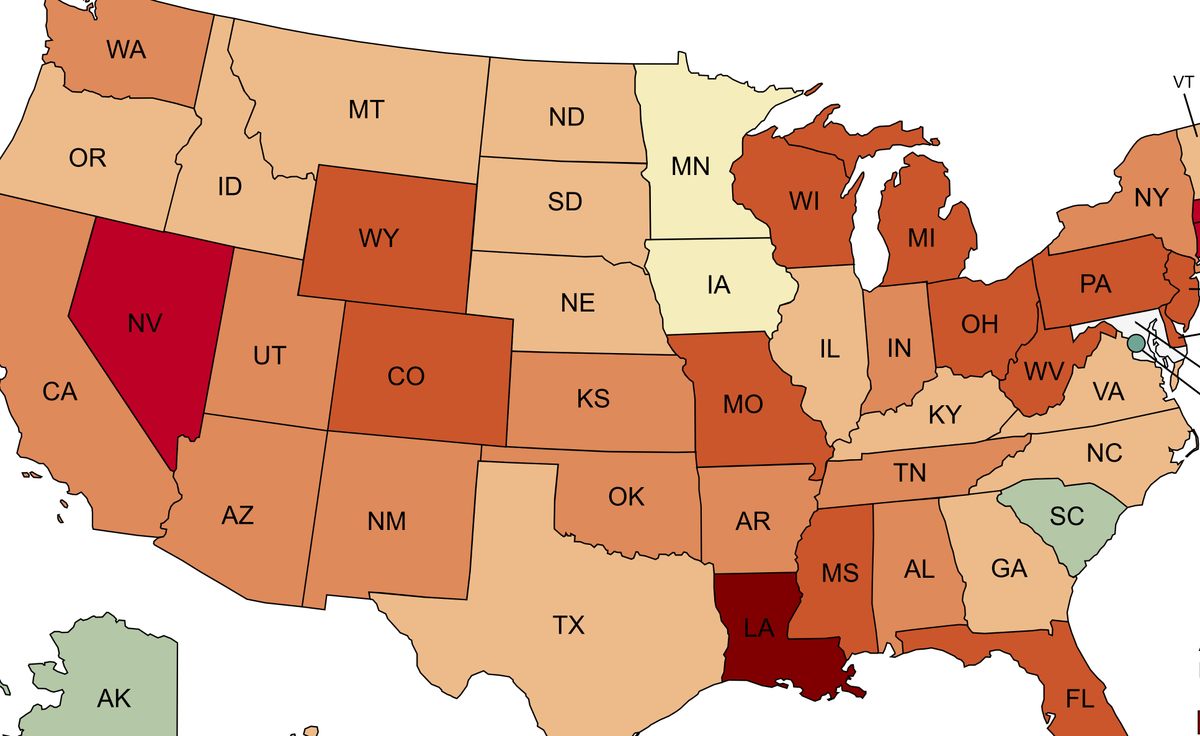
Most States Start School Too Early in the Morning
This map shows which parts of the U.S. ignore the science.
Atlas Obscura
116 points · by jseliger · 2y ago · 206 comments
I'm starting to dislike the phrase "the science", since I usually hear it used as a conversational bludgeon. The American Academy of Pediatrics recommended 8:30 AM as a minimum start time, that's not the same as "the science" definitely saying one thing or another. I don't have kids, and don't really care when schools start, so this is less a comment about that as it is about how annoying "the science" is as a phrase, how it's not a good description of how science works, and how it's usually misapplied to end conversations in favor of your prior opinion.
This also goes up there with the "in this house we believe SCIENCE IS REAL" signs.
We're currently living through the replication crisis and are awash in fraudulent academic journals. I don't think people who say this stuff would actually engage with you in a conversation about proper p-values for given sample sizes. So it's really just shorthand for trying to associate yourself to a certain intellectual class.
In general, it's filling the vacuum left by religion. One part of that is what you identified: people generally need something greater than themselves to identify with, and "intellectual" is a tempting option.
Another part of it is that people generally crave certainty and fear the unknown. Religion fills that need by providing crisp, clean answers that don't provide a lot of room for questions and "what if"s. In the absence of a traditional organized religion, people try to fill that void with what seems to be the new, popular replacement—science.
Unfortunately, science is by design all about uncertainty. As soon as it becomes a dogma it ceases to be science.
It's not a surprise that people put "science" up on a pedestal when science education is too often about getting the correct answer to questions. Instead of asking questions and understanding the limitations of any approach to answering them. Restraint and humility aren't exciting, but they're so important.
If anyone "believes", "trusts", "follows", etc. science, then they are doing science wrong.
The most fundamental element to science is skepticism. Following the essays of a scientist is no different than following the teachings of a priest.
    I This House We Believe That
    Simplistic Platitudes
    Trite Tautologies
    And Semantically Overloaded Aphorisms
    Are Poor Substitudes
    For Respectful And Rational Discussions
    About Complex Ideas
I wonder if whoever coined the phrase knew it was a joke deprecating whoever buys it. Like those movies where the point is "those monsters are horrible, aren't they? yeah, you are doing basically the same right now."
'Science' isn't something to believe in, it's a testable thing instead. That's kinda the core idea.
You don't have to believe in science, if anything science says that you should be skeptical until you do the experiments yourself.
It strikes me as a response to a trend callousness and deliberate ignorance.
Signs like these take a strawman version of "the other side" and define the residents of the home in opposition to that strawman. It's evidence that the person who put it up views themselves as part of the culture war, not evidence that they strive to be kind to and understanding of people who are different than them.
I disagree in that, I don't think this is a divisive topic. I have not heard of a valid critique for school start times should be later aside from schools being a daycare supplement for working parents. But that's not science, its politics/economics. "The science" is, in my experience, very clear that young people should be allowed to wake-up later in the day to better conform with their natural sleep cycles.
For a personal perspective, when I was in high school, if I had needed to take the bus, I would have had to get on it before 6 AM, since I was at the beginning of the route (first or second stop, IIRC). Luckily, some family friends had a daughter who was an upperclassman at the same school, and she drove me. I would guess there are few parents well-served by their teenagers getting up at five in the morning.
That already crosses into politics. Science can answer if-then statements. Once you start using the word "should", you are talking about morality, preference, and tradeoffs.
In that case, I will also cross over into politics by expressing the opinion that answers to if-then statements should, when they are available, be taken into account in political decision-making.
Do you really think all the states and people that decided these things in the past were all stupid, or not following "the science" back then, or just picked start times at random? Do you really think you know better than all those states and people? Did the science change since then? Did the reasons to start school early/late change since then? Maybe they did. But if they did, you could maybe elaborate on that rather than just saying "the science is so clear" and dictating the way things should be.
let's look back at the 1800s when school became commonplace. at that time science decided what was the best time to get up and milk the cows. and how to make the most of the available daylight. work and school had to fit into that schedule. so in a way science was used to decide school times indirectly. what is important is to consider that school has not changed since then.
however in the meantime new research suggests that we should rethink schools, and so here we are questioning whether current school starting times are still adequate. this is not saying that in the past people were stupid or picked the times at random, only that the factors that led to those choices have changed.
Yes. Why do you believe otherwise?
> or just picked start times at random
No, they chose based on when they needed daycare to start, because the workday was starting. Or, because the children needed to be available to work the fields during certain hours. Things have changed.
> Do you really think you know better than all those states and people
Yes.
> Did the science change since then
Yes.
> you could maybe elaborate on that rather than just saying "the science is so clear"
Does every discussion need to re-articulate the accumulated evidence? Can't there be some assumption of informed debate?
https://www.cdc.gov/sleep/features/schools-start-too-early.h...
I don't really disagree with your point, but... Have you looked at the overall quality of the decisions those people made?
They were not stupid, but the overall amount of real information they dealt with was ridiculously low. And the overall amount of fake information they dealt with was ridiculous high. The odds of any random choice they made being a good one aren't very high.
> your viewpoint really feels like, to phrase it as a software engineering analogy, a new developer that comes into a 20 year old project, looks at what currently exists, calls it all trash, says the people that came before you were dumb and didn't know what they were doing, and you just start rewriting all the code.
Do you think society has peaked and our understanding of civics hasn't evolved? That nothing can ever be better? To continue your analogy, your (unstated) viewpoint is like the stodgy programmer stubbornly sticking to PHP "because it works" and refusing to accept that webtech has evolved and there are better tools. Or a more contemporary way, an old C programmer stubbornly refusing to learn Rust because "C just works". Does it make sense to put Rust into the project? Possibly not, there are many excellent reasons not to. But its a discussion worth having.
> Do you really think all the states and people that decided these things in the past were all stupid, or not following "the science" back then, or just picked start times at random?
If I were to hazard a guess, I imagine most school systems are still bound by the legacy of farmwork and the start/end times are holdovers from that. I doubt the timing has significantly changed since schooling became a primary factor of our lives. But that's just a guess. I would certainly hope that the people who start a new school district are taking into account many factors before dictating a start time.
> Do you really think you know better than all those states and people?
I do not feel the need to be beholden to history for history's sake. My own post acknowledged (one) challenge with changing the start time. But...
> Did the science change since then? Did the reasons to start school early/late change since then?
This is exactly what I and others have posited, yes.
> Maybe they did. But if they did, you could maybe elaborate on that rather than just saying "the science is so clear" and dictating the way things should be.
Others in this thread have posted extensive good research on this very subject for your consumption. I myself have posted a reference to a book I found useful and entertaining. Not every single comment needs to be a doctoral thesis containing every possible scrap of information or interpretation on a subject. This, and other subjects of the like, are artifacts _with context_. Within context of this post, it is in direct response to an article that explains the reason with even more links and a friendly bulleted list.
A mildly provocative analogy is demanding a link to every peer-reviewed journal when discussing climate change. I don't feel the need to point out every scrap of research to state a claim that "Climate change is real". I will merely state, especially in a comment to an article discussing legacy policy around climate change, that climate change is real.
This is a nitpick at best. From outside a given field, one generally has no option but to pick one or some sources as authoritative and refer to them (or to declare no source is authoritative).
In other words, if I say “the science says XYZ” this is shorthand for “my preferred authoritative sources of information on the relevant field assert XYZ”
Can this be incorrect? Yes. Is this often used as a bludgeon? Yes, and reasonably so: without piercing the research veil, what discussion could exist besides disagreeing on a sources’ authority?
If I say “the science says kids shouldn’t wake before 8 am”, and you respond with some neuroscience argument that childrens brain can adapt to waking up before 8 am, you are essentially making an off topic argument: I am referencing an authoritative position, not arguing why that position is correct. In that sense, yes, I am applying a bludgeon; and I right well should, because I can’t have a meaningful engagement with your scientific position anyways.
I see your sentiment often and even though I agree that usage of “the science says” is a poor description of how science works, nonetheless language is an evolving construct and “the science says ___” is a mainstream construct in English language dialogue at this point
There’s nothing wrong with appealing to authority. Often times it’s the best we can do. Sometimes authority is not sufficiently convincing and in such situations it’s fine to point out that whatever “the science” refers to needs more evidence supporting their claims
There’s something to be said by beginning a conversation with a shared understanding of what is considered a reasonable ground truth.
I dislike it when it is used to describe something that is not science.
> I don't have kids, and don't really care when schools start
As a taxpayer, your money is being wasted trying to teach sleepy teenagers who are not the right physical state for learning. Given that these are future coworkers and the people that will be funding the government when you are retired, it might be wise to suggest maybe spend monty teaching teens when they are awake and physically ready to learn?
It presumes that this single thing is the one we should all build our lives around and there are no other priorities to balance.
All of us in our lives "ignore the science" in some form or other.
Good science happens when the best scientist is wrong.
Am Acad. of Sleep Medicine Consensus guidelines with 26+ references: https://jcsm.aasm.org/doi/10.5664/jcsm.6558
This bizarre and historically unprecedented scenario where parents simultaneously must both work but be prosecuted for doing so will likely be a blip in history.
And this is in L.A., home to probably the least-challenging weather in the country. We have entire generations of junior-high and high-school kids who are apparently too feeble to ride their bikes, walk, or take the bus to school. Pathetic.
Weather is a minor factor vs. the population-size/density/quality of a place like LA.
Just watch some of the George Floyd protest videos from LA to get a sense of what likely really concerns LA parents. No amount of snow, sleet, wind, and sub-zero temps can hold a candle to those apocalyptic scenes.
In my county the kids are not permitted to walk or bike to the school; they can only take the bus or be driven (and they have to be picked up by a parent or someone on an approved list). I assume that stops when they're of driving age but I wouldn't be shocked if the 16-year-olds are allowed to drive but not to bike....
Some of my fondest childhood memories involve conversations with peers from these walks. I think it's an incredible shame that I can't let my children do the same, even at 8, and even though my 8yo is miles more mature than I was at his age.
at one point my oldest was in a school that did not allow kids to go to school or go home on their own. so in the afternoon i had to go to the school and pick him up. they would not let him leave until i showed up. however they could not force me to accompany him in the morning. because, well, what were they going to do when the kid was at the school gate and i wasn't there?
Though I admit I'm just making this up and I could be completely wrong. How common was it to mothers to work in the 60s, 50s, and before? Was state-funded K-12 as ubiquitous back then as it is now?
Granted, just one piece of anecdata from just one U. S. state. But without evidence to the contrary, I'm having a hard time picturing any adult in the process, parents or school employee, being content with uneducated ignoramuses as long as they get the pigs fed.
That's the PRIMARY function, eh?
If the pipes in your house burst right now, your immediate emergency would be to pretty much stop everything and stop your house from completely flooding.
That doesn't mean that the primary purpose of your life is a pipe-fixer.
I think you made the classic mistake of confusing urgency with importance.
We could argue about whether the schooling system is sufficiently meeting those long term goals, but that doesn't mean they take a back seat to the immediate consequences of school closures.
If babysitting was the primary function, there are much cheaper and easier ways to achieve it.
Given that the vast majority of cost and effort is spent on the educational aspect, I would argue that is indeed the primary function.
Additionally, if you look to history, schooling originated long before the need for babysitting.
There's an alternative, though. Instead of monitoring your child for the entire school day, the school will put your child in a room with all the other children of parents too busy to monitor them. They'll be given an iPad, Wi-Fi, access to a bathroom, and a reasonably nutritious meal. They will receive no formal education, but the staff will make sure they don't hurt themselves or anyone else. This will enable you to go to work. Your earnings will be $37,290 a year.
These are your only two options. The state requires you to choose one of them, or you'll go to jail. Also, if you choose the second option, your taxes won't go up next year.
Which would you choose? Which would people in your demographic choose?
The tl;dr of how it applies is tht industrialization mandates finding something for young people to do (that isn't working) in a way that previous eras did not. In the era of, say, sail, you could be a 14-year-old sailor. A 14-year-old in a factory was decided (over years and lessons paid in blood) to be not only counter-productive, but dangerous for the 14-year-old. We outlawed it. But that does cause the demographic problem: you can't have these young folks roaming free getting into trouble, so what do you do with them?
The hypothesis that forms is high school is less about education and more about containment (making sure, essentially, that we babysit / warehouse our young adults until they ripen enough to be productive industrial-society members).
Why should that be self-evident? What is wrong with kids 'roaming free'?
I might be wrong though. I haven’t completed my Cynicism 101 course yet.
(you're never gonna finish Cynicism 101 if you don't get your act together!)
They do this so high school—and nb many high schoolers can get themselves to school in the morning, so parents don't necessarily have to be home for that—can start earlier (no district has so many buses they can start all schools around the same time—they have to stagger them), to leave more time after school for sports practice and other extracurriculars (but really, for sports).
> If it started later, that time would be replaced with pre-school care/activities.
Even without ours being the way it is, that would still just mean more time in (typically paid) after-school care. The hours absolutely do not overlap well enough to provide convenience, only relief from part of the cost of childcare.
+ Sad that some downtrodden drones try to bury this sentiment instead of demanding better treatment.
Oh wow, it’s still a thing: https://www.nj.gov/labor/youngworkers/find-a-job/working-pap...
Took me years to get over a kind of situation-induced SAD that I'm pretty sure was caused by that. Like, 15 or so years.
More broadly, how many folks have nightmares about school for years into adulthood? Mine didn't stop until my mid-30s—they were practically the only nightmares I still had, and were frequent. And my experience in high school was relatively good!
High school's... kinda horrible, as practiced. Being cooped up in bad lighting during Winter with at least a few total assholes you can't escape and the school can't kick out unless they get really bad, and add hormones to the mix. Work expectations and judgement harsher and far less flexible than anything I've experienced in the "real world". No wonder people have nightmares. I'd drop a job with those conditions as soon as I could find another, if not sooner.
As others have said, my instinct is that if you gave high school me a later start time I would have simply stayed up later. My bedtime was almost never dictated by sleepiness, but rather things like homework, hanging out on AIM with friends, video games, etc.
Surely this is something that has been studied already. Is there a correlation between school start time and student bed times? Or a statistically significant difference in teenage bedtimes between standard and daylight savings time?
School has become a place where children stay so that their parents can work. While there is nothing inherently bad about trying to solve two problems with only one solution, for the specific case of the educational system, conceptualizing schools as places for taking care of kids instead of a place for learning is very problematic in so many aspects that it's hard to even start.
I'm an early riser, so it's not a problem for me.
For them, it's always been a challenge :(
Probably ended up being an inch or 2 shorter, due to bad sleep cycles during adolescence, which led to many other issues.
It does eventually settle into some kind of rhythm, although the agreement that they should not take their devices into their bedrooms at bedtime definitely helps with them actually going to sleep at a sensible time.
Whatever the actual reason for the schedule, it is not this, at least not as the only or original reason. There are plenty of other reasons. It may be difficult or dangerous to practice outdoor sports after school in some parts of the country if you end the day too late. There's some housekeeping that needs to be done by the school staff after the kids leave, whether that be literally cleaning the school or grading homework, and the staff probably doesn't want to be doing that super late into the evening. It's fairly sensible to intentionally be offset from office-induced rush hours, so the day may start earlier than a typical workday for that reason. Kids who work after school can more easily do so if they get off school before the typical start of a late work shift.
I'm not intending to personally endorse any of these as good enough reasons to continue the early day, and I will also gladly admit that I've been an early bird my entire life so the schedule worked out fine for me even as a child. For what it's worth, my elementary school actually had two different schedules for cohorts called "early birds" and "late birds." The early birds started the day at 7 AM and the late birds at 10 AM. This was in LA County in the mid 80s. I have no idea how widespread that ever was or why my middle school and high school didn't do the same thing.
As we both work, we pay for a school club that will look after the kids from 7:40, and after school until 18:00. Although thankfully our work is flexible enough that we generally only have them in there from 8:30-17:00.
So the time of start is really determined by when people need their kids out of their hair so they can work, not because it's some optimal time for the kids...
Not sure what the solution they are suggesting here. Triple the number of buses and bus drivers on the road? Let high schoolers sleep in so that grade schoolers can stand on dark streets at 7:30am? Have grade schoolers stay home until 10:30am stay at school until evening?
Also, having been a teenager [citation needed], I have strong doubts about the "the science" as presented. Had school started two hours later, my natural sleep cycle would probably have... also been delayed two hours.
Another is to have high schools start last so they can watch their mid-school age siblings while parents go to work.
* cries in American *
Your entire premise ("duplicating public and school buses") assumes a public bus infrastructure in the first place. That... is not in general a good assumption for any but the largest US cities.
In the rural area where I grew up, and the few others I am familiar with, the school bus picked all students of all ages at once, because the routes were up to 25 miles one way and it was more efficient to drive them once rather than three times.
Logistically it makes sense-- high school kids can get themselves to school even if their parents have already left for work. Sucks for little kids though. My five year old has to be in bed by 7:00pm and even then waking him up is a chore. He sleeps until 8:00 or 8:30 if left undisturbed on weekends.
I had questions about how this is averaged... I know that in Seattle schools start after 8:50am. But it has Washington as a dark orange.
But given that Washington's 2 most populous urban areas (Encompassing Spokane, Seattle, and Tacoma) both start their schools after 8:40am, I'm wonder how this has Washington as averaging 7:56am to 8:05am.
Additionally, the more I check the counties in Washington, the more I doubt that this is correct. School start times seem to be consistently after 8:30am, which would align with what I know about the state.
So I looked at their source: https://nces.ed.gov/surveys/ntps/tables/ntps1718_table_05_s1...
And their information for Washington is just wrong, from their own source. It's also for the years 2017-2018.
(??)
That's one conclusion but not the only one. Another is that COVID was never shown to be a severe risks to children (symptoms were generally mild, in great majority of cases) and being out of school would stunt their education and impact their friend relationships, mental health, and more. Parents who pushed for their kids to stay in school (whether one agrees with the argument) did so out of concern for their well-being.
it should be a legal right to accommodate working times and locations so that parents can take care of their kids. there need to be benefits for companies hiring parents so that they are not favoring childless employees.
1) The reason melatonin does not build up in kids anymore is because the lights are on, and the screens are on. Those actually prevent melatonin build up in the brain.
Turn off the lights in the house, and get the screens dimmed to nearly the lowest level.
2) Wake up early on purpose. Your body will SET your go to bed time based on your wake up time. Even if you miss some sleep because of it, waking up at 6 (and staying up all day) will almost certainly make you wake up at 6 the next day and cause your body to get tired when it is supposed to.
But, you're all right, just keep whining about this. Maybe if whining keeps wining we'll all have school at 8pm at night because people keep shifting things for the next 100 years. But don't worry, because education is racist, school will only last 15 minutes.
Short version: Young people sleep schedules naturally deviate and it is legitimately difficult for a large segment to "Just go to bed earlier".
It may be true that the book is based on some weak studies but anyone can cherry pick a few individual sentences out of their context and from that write an essay about how wrong someone is (essentially the first 4 points that don't relate to a data error are summed up this way).
In fact, even some of the studies that person is referencing don't agree with the theses presented.
As one real basic example: The author of that blog is disingenous when they take the sentence:
> the shorter your sleep, the shorter your life span
Out of context from the rest of the page: https://archive.org/details/why-we-sleep/page/n9/mode/2up
Within context it's clear the author is speaking about specifically getting too little sleep as short sleep. In that context, shorter doesn't mean what is implied by the blog author's response (less in hours).
I still think the book has merit as an accessible way for people to learn more about sleep.
When I was a teen, I didn't get tired until nearly midnight.
Even when I was getting up for school at 6 AM. My parents would send me to bed some time between 9 and 10, and I'd toss and turn wide awake for 2 hours. Even with sleep deprivation stacking up over the week as I was only getting 6 hours of sleep, I still couldn't get to sleep as I was simply not tired.
The problem of course is that they make high school start earlier than middle school despite the tendency to want to rise and sleep later so that high school kids can arrive home before their possible younger elementary school siblings and watch them.
>Early school starts are not the only cause of teenage drowsiness, but they are a crucial factor—especially because natural sleep cycles make it difficult for post-puberty teenagers to fall asleep before 11 p.m.
¹(sunrise ~7:11a in the winter, we'd wake up at 6a. ~40m for breakfast/morning routine, ~1h for transit, and a little bit of wiggle, since you'd want to be there by ~7:40a at the latest.)
(… and there are routinely threads on HN where people advocate for moving that wakeup to ~5a standard by futzing with DST.)
The answer is (surprisingly to most) complicated and illusive.
Laying down in bed at 9pm doesn't guarantee a person falls asleep right away. For some people, yes, their natural cycle syncs up with an ideal work/life sleep schedule, or their bodies are just better at adapting.
But that isn't the case for everyone.
This gets even more important for kids and teenagers because your chronotype can shift drastically as you transition towards young adulthood until it settles into a certain rhythm.
depending on which physician you ask, it can actually be worse to just lie in bed for hours and hours without sleeping.
it's definitely bad to put yourself in a situation where you must go to sleep at X PM and wake up at Y AM, and then you're repeatedly failing to fall asleep so now you rely on things like sleeping pills, or you're perpetually exhausted and underperforming at tasks like classes or work and the stress creates a feedback loop of even worse sleep.
it certainly wasn't good for me when i was younger!
When I was a teenager the TV shows I wanted to watch usually dictated when I went to bed.
You're fighting biology.
> Early school starts are not the only cause of teenage drowsiness, but they are a crucial factor—especially because natural sleep cycles make it difficult for post-puberty teenagers to fall asleep before 11 p.m.
(We have one post-puberty teenager and two other kids) ... our experience is that this does depend on whether you let your kids keep their phones and tablets in their bedrooms.
As many adults will confirm, going to sleep sure is easier without distractions.
Yes, you can probably distract someone into not sleeping who would be sleeping well otherwise. Most people however will struggle with sleeping at unnatural hours regardless of any distractions, and may use their phones and tablets in their bedrooms in hopes to help themselves fall asleep earlier.
Source: I was a teen once in an era without smartphones. Turns out lights out at 10pm didn't help me sleep at all, I just tossed and turned for a few hours until my body said it was time to sleep.
bedtime = school_start - time_to_get_ready - 9_hours