Everything will be alright in Iceland
On volcanoes, crises, and what we can learn from Icelanders
memoirsandrambles.substack.com
159 points · by yakkomajuri · 2y ago · 171 comments
Ireland has a "It'll be Grand" culture as well for comparison. It's a trade off with pros and cons and works for some situations and inhibits progress in other situations, things often don't get acted on or resolved quickly but at the same time there is a huge reservoir of tolerance to draw on when things do get shit.
I would consider this the other end of the spectrum to countries like Japan or Germany in the way they respond to certain things. Lots of generalisations of course but that's often the impressions you get from travelling. It's very hard to be precise about big groups of people.
It can be a bit annoying listen to them moan about small things constantly but my impression of the Netherlands is shit just works and things get fixed. They seem to have a very low tolerance for bs and excuses, which is refreshing
But it does get at how some folks here deal with adversity.
You might say it to a clerk instead of “have a nice day”.
Much less conviction about everything being alright, but hopeful anyway.
[knocks]
[door opens]
"Y'alrite?"
"Y'alrite?" is not, contrary to what you might assume, short for "Are you alright?"
It's short for "Are you alright if I come in and interrupt you? It's fine if you're not, I just wanted to check before barging in. It's really not too much trouble is it? I'll go away and come back later. Or never. Sorry. Sorry, sorry."
Literally impossible, by the nature of it.
I remember an interview with a Dutch Engineer during a storm surge that threatened an important dike (aren't they all important?). They had been working all day and continuing into the night.
"What will you do?"
"Well, we'll work like hell and see what happens come morning!"
Not really. Some dikes protect millions, some protect a vilage, and some protect only a handful of people. The Netherlands is currently experiencing minor flooding, and a dike failure in Maastricht led to a dozen house boats needing to be evacuated.
> see what happens come morning
There really isn't anything else you can do. Natural disasters are unpredictable, and the situation can drastically change from hour to hour. When your country is prone to this kind of threat, it'll have dozens of scenarios worked out, planned, and practiced. It's mostly a matter of grabbing the right playbook, working like hell, and hoping it doesn't get worse. If it does get worse, you simply grab the next playbook and carry on.
Mind the (tectonic) gap.
On the other hand, the description of roping up without proper training... yeesh. Sounds like bunch of gumbies putting each other's lives in danger. Not ok.
One weird thing about Iceland (as of 2008) that might be related: They don't do warning signs.
- Superheated geyser pool 3 feet from the foot path? No warning sign 95% of the time. The other 5%? "Danger: Hot."
- A slippery tourist trail 5 feet from a rushing river that immediately goes over an 80 foot waterfall? No warning sign. Often no railing, either.
- A road to a tourist attraction that might rip your transmission out? No warning sign.
I could give more examples of unmarked deadly hazards at major tourist attractions.
Iceland appears to assume that deadly hazards are common, and that you'll use common sense. Or maybe you won't, and you'll stick your hand in a geyser.
I'm reluctant to draw any kind of philosophical point here, besides "When visiting Iceland, please use common sense and pay attention to your surroundings."
I have a couple good friends that work on the search and rescue team, and the increasing number of stories about people putting themselves in serious danger with no self awareness is really concerning. I've unwittingly been pulled into these situations myself with said gumbies, and I'm now at the stage where I have no tolerance of it.
It's really not cool to put a bunch of other folks in danger because you did something stupid, completely ignorant of any potential danger. It's totally ok to take measured risks, with proper training/knowledge and at least some kind of preparation for handling unexpected situations.
And sometimes it's me being the gumby, which probably still happens in small doses :)
Iceland was a very poor country for most people other than a few well off in the fishing industry. Today it's still relatively "medium" with few people very wealthy, but also almost no one in destitution. The attitude is that everyone should be able to live a good life, and while it's not truly socialist, it's pretty darn close.
Þetta reddast is used somewhat interchangeably with "I don't feel like dealing with this" and "Some how things will work out even though it doesn't look like it now" and "fuck it". To most people it's kind of an in joke you say when something really sucks.
I came away with some interesting things:
- In one small town we visited they had turned the local town hall into a tourist greeting center. It had a theater that showed films from the 60s and 70s filmed near that town. One of them explained that there were no roads to the town until the modern period. However the town's main industry was sheep farming. How did they get the sheep to market in the larger towns? Simple, they flow in an aircraft, drove the sheep onboard, and flew them there! Before the airplane people either didn't live there or had to drive their sheep by foot or boat to market -- trips of many many days.
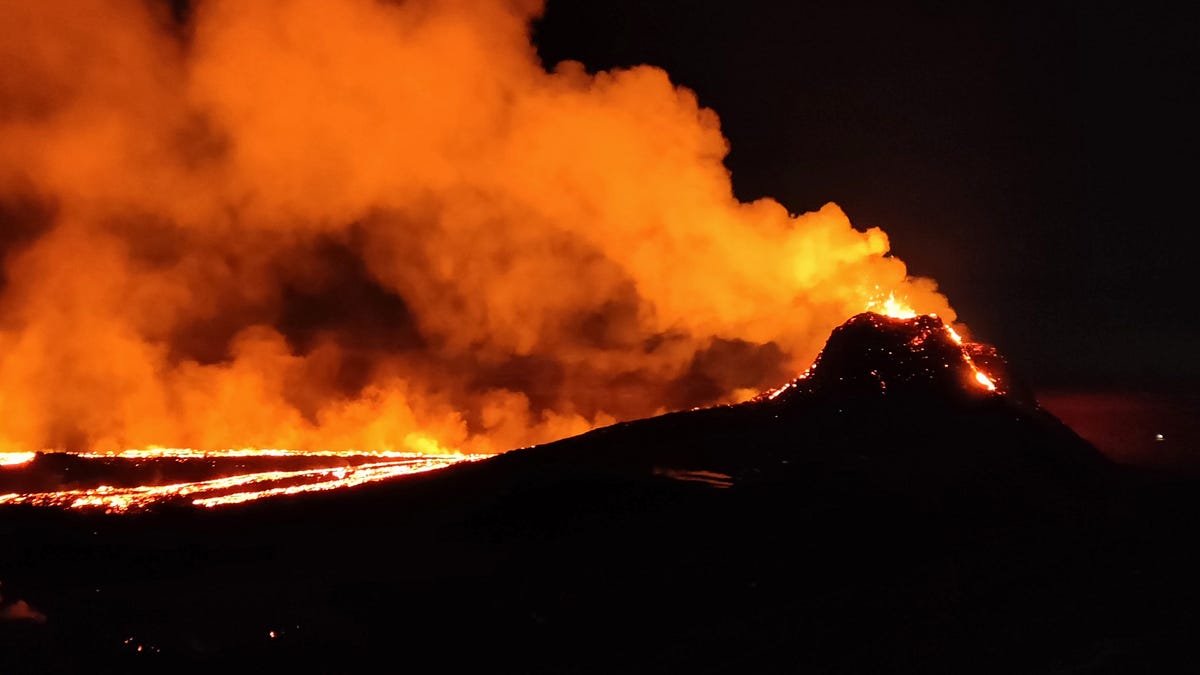
- Icelanders are incredibly comfortable being constantly very near volcanism. Most village centers have a local bathhouse fed by hot water from hot springs and they're very popular social centers, people live on the slopes of active volcanoes, the air often smells of volcanic gases in many places in the country, and so on.
- Much of the landscape is virtually impassable. It's the first time I've really ever seen such a vegetatively sparse landscape that was so inaccessible simply due to the terrain. In some areas, relatively "flat" landscapes were so rocky that I can't even imagine how one might traverse those.
Beautiful country, hearty people, expensive, surprisingly consistently good food.
There are certainly areas lacking in vegetation for natural reasons but much of the land is vegetatively sparse because the Vikings cut down all the trees:
> At the time of human settlement almost 1150 years ago, birch forest and woodland covered 25-40% of Iceland's land area
From: https://www.skogur.is/en/forestry/forestry-in-a-treeless-lan...
https://www.nytimes.com/interactive/2017/10/20/climate/icela...
A lot of the roughness in the terrain is because there are lots of old lava fields
I haven't been to Iceland, but I got similar vibes the first time I hiked through the Kilauea East Rift zone (vegetatively sparse, nearly impassable), where it's perhaps even more stark since lush tropical forest is just a few miles away.
The countryside of Iceland gave me the impression that instead of a "natural vegetated living world" there was two distinct things - an inorganic rock world, with a thin crust of life - lichen, moss and grass over it.
I mean, technically this is true everywhere; but in Iceland the vegetation was so thin and recent and patchy as to be noticeable in an unfamiliar way.
This also applied to large parts of the United States in 1969, and was part of the reason why many leftists and Black activists saw the Apollo program as a symbol of misplaced priorities at the time.
Iceland wasn’t any poorer than Mississippi, for example. And at least Iceland had a program in place to build a Scandinavian-style welfare state so everyone really would get that running water pretty quickly, as well as healthcare and education and the rest. America is still struggling with that while again spending tens of billions on a microwaved-Apollo-cum-Artemis program that’s mostly pork distribution for senators.
The Vietnam War had absolutely 0 value. We hyped it up as some do-or-die necessity, we invaded, participated in the killing of millions of people, blew a trillion dollars, lost the war, went home, and there was no grand catastrophic change. We could have just skipped to the end by not getting involved in the first place. By contrast one can argue about the exact value of the Apollo Program but it's absolutely undeniable that there was value. We learned a bunch, showed what's possible with human ingenuity, and just plain old did something that would make one proud to be a human, let alone an American at the time. If we did more things like this, it's very likely that the relationship between the people and the government would be far better than it is today.
Not to mention the millions of people devastated by Agent Orange.
The fact that the specialists warned the US military of these effects and it didn't stop them from poisoning the population for generations is mind boggling. How did these people rationalize their actions?
Anyway - there's no possible price tag for that. Your point of comparison is correct; the space race as a whole was about the best- and cheapest-case scenario for a "war"
The arguments were far less about the monetary value in that case, though.
By 1970, 93% of the homes in the US had "complete plumbing facilities", which means not just running water but hot and cold water, a shower or bath, and a flush toilet. See https://www.census.gov/data/tables/time-series/dec/coh-plumb....
1940 54.7%
1950 64.5%
1960 83.2%
1970 93.1%
1980 97.3%
1990 98.9%
In the 1950's and 1960's, the United States was able to do more than one thing at a time.
This always feels terribly myopic to me. There's a lot of state capacity and doing a sing;e time bound endeavor did not prevent civil rights legislation from passing or economic development in Mississippi. The moonshot caused NASA's funding to peak at ~4% of the federal budget for a single year in 1966, returning to less than 1% by '73.
It was also not clear from originally that Apollo would be single time limited project, in the beginning there was a lot of talk about moon bases and such.
Even if it's really inefficient and bad.
In contrast in the USA 7% of households were missing any plumbing in 1970.
Iceland was late industrializing and getting basic infrastructure. But so were other colonies. In 1918 Iceland stopped being a colony and by the 1950s it had pretty much caught on (with the major exceptions of road and rail networks).
So they got a freshwater connection to the mainland in 1968, and they do have some aquifers on the island (just really unreliable). I do know that they had problems with water prior to the main land connection, but I don’t know if most houses had plumbing connected to the unreliable aquifers prior to 1986.
Very insightful. I had no clue this was the case.
Is there any published list somewhere that measures the relative richness between the countries? I am just curious to see which countries come out at the top and which ones at the bottom. Anyone knows any such list?
It's not wealthy in an absolute sense, but it's incredibly wealthy per capita.
Same for a number of folks in Fairfax Co VA (US ~wealthiest). My best friend's house was typical for the area. Cold running water arrived ~1970. Hot 1982. Outhouses stayed until about 2000.
This doesn't appear to be true. Iceland is one of the wealthiest nations on the planet per capita.
Iceland also has the highest median wealth of any country at $413,193 compared to the US median of $107,739. Even in average wealth, Iceland ranks #5 globally only behind Switzerland, Luxembourg, United States, and Hong Kong. Keeping the average and median much closer than those other four does agree with your claim that they're good about making sure everyone has a good life. https://en.wikipedia.org/wiki/List_of_countries_by_wealth_pe...
Interesting thing I learned recently, is that Iceland has the highest rate of millionaires (in USD) of any country at 20% of the adult population. This more than double the 9% of US adult population millionaires. https://www.statista.com/statistics/262687/countries-with-th...
One of the reasons there are a lot of house-millionaires is because some of the oldest generations, who bought their homes before 1980 or so, took normal loans with fixed interest rates, just before massive inflation in the 80s. The decrease in value per krona in ten years starting 1980 was something like 99.7%, so the loans went pretty quickly to something indistinguishable from zero. Inflation-indexed loans have been the only type of housing loan you could get for most of the time since about 1981, and are still the norm. The effect around that time of transition was that the younger generations (next waves of house buyers after them) were saddled with a lot of the burden.
Source: I'm Icelandic.
But we have a word for both want and feel like, but they're different from "nenna". In some ways a better translation would be "I can't be bothered to".
The word is somewhat socially acceptable as an excuse not to do something.
"Þetta reddast" and "Ég nenni þessu ekki" are words many of us Icelanders live by.
I'm past my prime, but would love to know your secret. I remember not wanting to return from Iceland, dreading the inevitable Anxiety Circus™ that was my life in the US. While in Iceland, I felt good about being alive. The way the people just get to the point and aren't afraid to say what they mean instead of this weird communication dance most Americans seem to do. The fact that yeah, danger looms in a variety of ways and the environment can be a bit hostile, but that's fine because we can deal with it together. It is difficult for me to call my experience there anything but refreshing...and yet I was not able to hang on to that.
A fault of my own, to be sure, but seeing as you adopted it in your early years, was there anything in particular that you did to make that happen?
I had a lot of anxiety growing up - from "If I fail this test then everything is downhill" in school to "If I miss this payment then everything is downhill" in the scare quotes "real world". I remember listing out on paper every time I could remember that I thought there would be dire consequences if I failed and there wasn't actually dire consequences. Maybe it was a kind of retrospective cognitive behavioural therapy? I noticed a pattern (though I didn't have the understanding to call it a pattern back then).
But that was the moment that something switched and I had the confidence that even if shit hit the fan I would make it through. Probably it was the culmination of other realizations and not just this act by itself, but that was def the crystallization. And not that I'm always this way, but it's rare for me to fall back into the anxiety circus. It still takes some practice to maintain it in particularly tough situations.
Maybe you associate that state of mind with a place because you felt it most strongly there? But I think a state of mind is part of you and you can cultivate that anywhere.
But heard, half-heard, in the stillness
Between two waves of the sea.
Quick now, here, now, always--
A condition of complete simplicity
(Costing not less than everything)
And all shall be well and
All manner of thing shall be well
When the tongues of flames are in-folded
Into the crowned knot of fire
And the fire and the rose are one.
-- ts eliot, following julian of norwich
We US-ians compulsively fear negligible risks (stranger kidnapping, terror attacks) while being unable to sense harm in play (elimination of child growth environments due to false risk perception and systemic destruction of free range area).
https://www.reddit.com/r/interestingasfuck/comments/v870vf/m...
There is a phenomena that if you life under a consistent, visible threat to your life, like for example a huge damn upriver, you suppress that fear and become instead a "believer". And why wouldn't you, after all, if it goes wrong no survivors, so that story makes total sense, until it doesn't and even then.
Wow. I took Sierra Club Basic Mountaineering class, and we learned self-arrest three ways: head down facing down, facing up, and head up facing up.
The class was cancelled later when someone stuck the ice ax into their stomach and sued, and insurance rates skyrocketed.
And this guy learned it by watching a video.
I've since actually gotten a bit into alpinism and done a proper course. My instructor (a super experienced British guy in the Alps) refused to teach self-arrests to beginners because he said the risks were greater than the potential benefits. He said a lot of people get hurt practicing it (as you've noted) and so he preferred to really drill down on precautions and crevasse rescue techniques etc.
As for the story, I need to note the slope wasn't too steep, but being unable to brake would maybe have sent me down the crevasse (unclear how wide it was, we stepped over it on the way there and it seemed it may have been narrow). I also doubt my technique was perfect, but I just remembered to not just try to have the axe over my head somewhere but rather push my body/shoulder into it with the axe placed more diagonally.
I'm certain it was not beautiful nor perfect but at least enough in that situation.
Was it safe? Obviously not. But 1000's of people did it before anyone got badly hurt.
Of course there was no danger, but I get the sense other cultures would perhaps not go straight to that kind of hands on training.
I did go there last year and I'm not sure I'd want to live there. Nice place to visit though and mostly nice people (apart from the large Ford truck driving psychopaths)
In comparison, the USA ? Don't make me laugh.