160 points · by impish9208 · 2y ago · 156 comments
Id say, considering that, and considering that for these corps taxes are lava, i’d go to look at incentives on taxes about R&D filing
1. What publicly-traded companies report to investors and what they report to the IRS are more different than you might initially suspect.
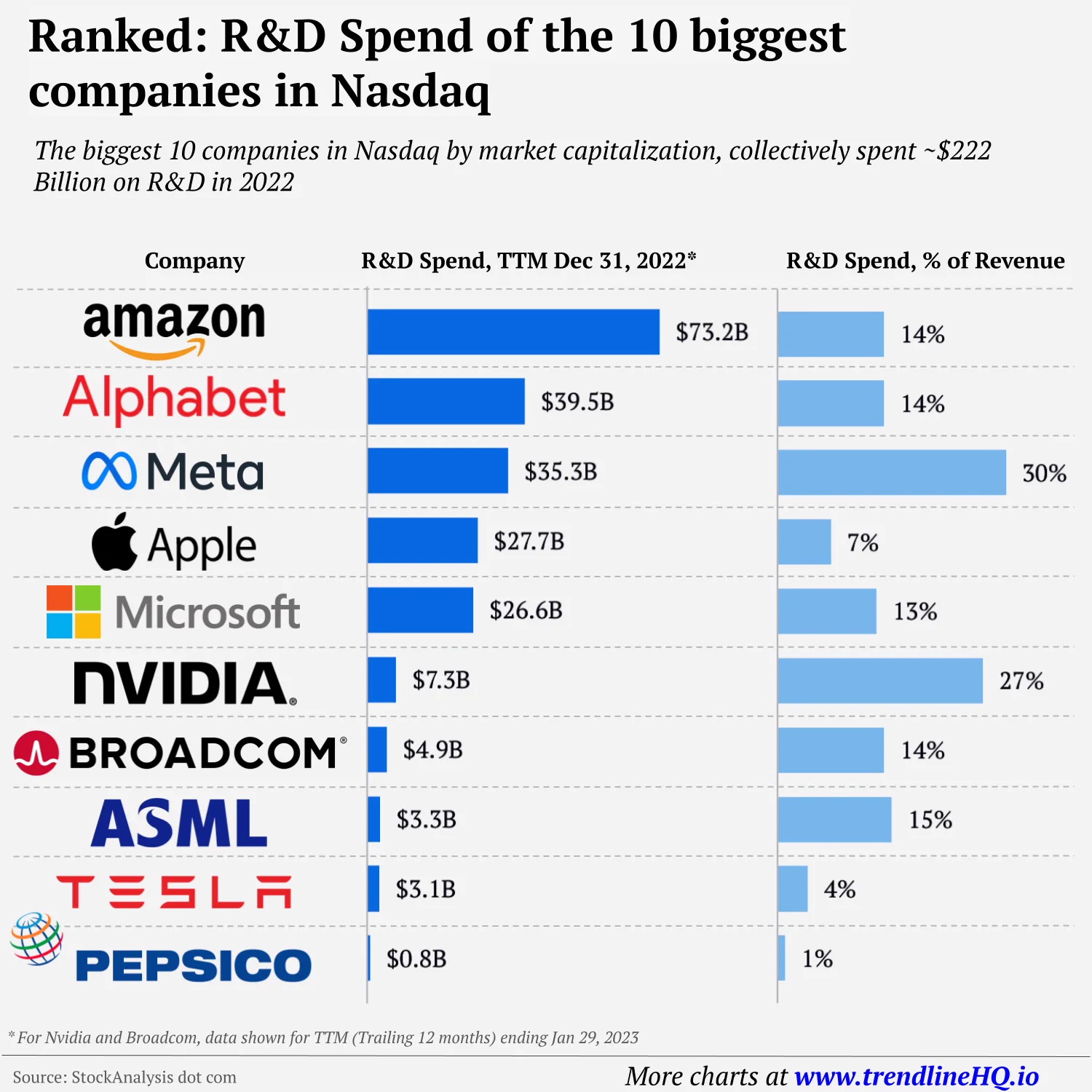
2. This $73.2B figure was pulled directly from their 2022 10-K filing[1] under an ops expense line item labeled technology and content, which includes R&D and then some. The devil in the details is buried in a footnote on p. 26:
>> Technology and content costs include payroll and related expenses for employees involved in the research and development of new and existing products and services, development, design, and maintenance of our stores, curation and display of products and services made available in our online stores, and infrastructure costs. Infrastructure costs include servers, networking equipment, and data center related depreciation and amortization, rent, utilities, and other expenses necessary to support AWS and other Amazon businesses.
At face value, to handwave this figure as just R&D and purport that it's directly comparable to other publicly-traded companies who report disaggregated research and development strikes me as somewhere between shotgun analysis and hoodwinking.
[1] https://www.sec.gov/Archives/edgar/data/1018724/000101872423...
It's both hilarious and disheartening how much of a tax grift it is.
I mean I work in a RnD dep. now and it honestly is some R but like 2% of my time.
This doesn't seem like a profit-driven decision.
Bench / sub 100% utilization is one reason consultants cost so much.
I suspect the numbers are wrong.
My own hypothesis was that the first table and the second table don't measure the same thing. Which would mean the headline is comparing apples to oranges.
But genuine R&D would look very similar. There isn't a good test to distinguish "I don't know how to do this thing" from "nobody knows how to do this thing". I don't have the time, resources or inclination to know what everyone else knows. And then having to second guess what the tax office thinks everyone knows, because I know they'd accept some of the things I'm doing as research. It just isn't clear where they think the line is.
How the huge mining companies get away with claiming so much is beyond me. But they do.
Not in the UK and most EU law is identical to UK.
You want to give tax breaks for real research and development of new things.
The thought of research tax breaks is that the market qualifies them as useful. Useless inventions make no money, and have no income to be taxed anyways.
If I build a new assembly building for a new product, that roof is going to be mainstream, long lasting, cheap as I can get it, and billed to “development” because that’s exactly what it is.
You can say the same standing up a CD/CI infrastructure, writing unit tests, mundane documentation and validation processes. It’s all development, getting stuff into production and into the market.
I can't wait until we automate the people cheered this law on, out of a job.
I always felt, from outside, that anti trumpers just are against everything he does with simplistic explanation, its a good law amazon has enough money to pay their own r&d
If your goal was "foment another wave of far-right nationalism in America", this is a good idea. Judging by the rest of your post, however, I don't think that's what you had in mind.
All those options (the ones I see anyway) are used, so when I limit the search to "Condition - New" they all go away.
This is the natural, simple, user-friendly design I want.
Don't give me some bullshit instead.
https://arstechnica.com/ai/2024/01/lazy-use-of-ai-leads-to-a...
All four of those non-Adidas hits are "Sponsored" results, but that's not particularly easy to notice (for one of them it's almost impossible).
I would agree with GP that Amazon product search often leaves much to be desired. It's hard to search for X without getting accessories for X, competitors to X, products that can be connected to X. This is annoying at best, and crippling if you want to, say, sort by price (all the cheapest matches will be accessories or otherwise not what you wanted).
Now that Amazon has captured user-share, they will (ineluctably) abuse user good-will (by padding search results with ad-placed products the user does not want) until they reach some marginal breaking point. The users that remain are either oblivious or cursed with a lingering taste of bad-faith and bullshit.
Eventually the giant will strangle itself in its sleep, but that's probably 50+ years out given how these things go.
I can see (because I was there discussing it back in 95) what the appeal of personalized search results could be for both sellers and consumers. But a few decades of that BS have fairly convincingly made the case that it is a horrible idea.
eg searching for 25GbE network cards shows a bunch of 2.5GbE network cards, and no amount of -"2.5GbE" nor "NOT 2.5GbE" options (and variations) gets rid of them. :(
Ebay though seems to work ok. :)
How do you define a Adidas shoe? Something with the same name could easily be fake
Would you believe what drives more sales and what you think you want could be different?
The problem is, they don't.
What's an associated seller?
https://www.irs.gov/businesses/corporations/irc-41-asc-730-r...
(Though, of course, that might be wrong. American SEC tries to have global jurisdiction, whether you want them to apply to you or not. Matt Levine writes about that a lot in his 'Money Stuff'.)
If you imagine a tech company that declares that they're feature-complete, and they cut expenses to those required to maintain existing service to a high degree of quality/reliability, that seems like a reasonable benchmark of spending that could be classified as "not R&D".
https://pro.bloombergtax.com/brief/rd-tax-credit-and-deducti...
I get that they have high R&D costs but I'm still trying to get my head around how that money is being spent.
This bit:
Cost of Sales: 272,344
Fulfillment: 75,111
Technology and Content: 73,213
Sales and Marketing: 32,551
General and Administrative: 8,823
Other Operating Expense (Income), Net: 62
So Technology and Content is the $73bn number.I think Fulfillment covers warehouse and delivery costs.
"Technology and Content" presumably mixes in Amazon Prime studios, which apparently was $16bn in 2022: https://techcrunch.com/2023/02/03/amazon-ramped-up-content-s...
My guess is that it covers AWS infrastructure too.
No regulation is bad or worse. Even less accountability.
There is nothing technically stopping ChatGPT from hitting up endpoints with JSON other than OpenAI's forced limitations.
It has excellent voice to text, excellent text to voice, excellent comprehension (it can understand vague commands like "set all the lights in the house to a Christmas color theme") and it knows how to generate JSON in a particular format that you can specify. That plus an output scraper that knows where to send the JSON to is pretty much all you need to make this work. It's so close to a commercial product that I can literally taste it. And yet here we are, having to hack together our own solutions... with local LLM's that are about as good as GPT 3.5.
To me, it feels like Siri/HomeKit (or even Home Assistant/Assist) has a much clearer path to that ideal than ChatGPT spitting out JSON.
These are not flying cars, but batteries that are 5 times cheaper in 10 years is impressive. I don't know much about farming but it looks like now, tractors do most of the job, and the guy in the cab is just checking to see if everything goes well. Farmers are still needed, be we need less and less of them for bigger and bigger fields.
Tesla and Panasonic and CATL are doing R&D on batteries. And Tesla and Panasonic are known long-term partners. So, how do they share the R&D? Do they research different topics (chemistry, manufacturing, etc...), does Tesla pays Panasonic to do the R&D? Directly or indirectly?
Tesla must have played a major role regarding battery technology. Other EV manufacturers too, but I suspect Tesla more than the others since they were the biggest player for quite a while (and still are by some metrics), have loads of money, and offer battery products other than cars.
Amazon market cap: $1.6T
France GDP: $2.9T
These numbers would be skewed even more if Apple ($3T) or Microsoft ($3T) were used instead.https://finance.yahoo.com/quote/AMZN/
https://data.worldbank.org/indicator/NY.GDP.MKTP.KD.ZG?locat...
This is a lot like the recent “Novo Nordisk’s market cap is greater than the GDP of Denmark!” comparisons — true, but they’re not like numbers (and indeed, much of Novo Nordisk’s revenue is captured in Danish GDP).
# of Amazon employees: 1.7M
# of working people in France: 30M
https://en.wikipedia.org/wiki/Amazon_(company)That isn't a comparison that makes sense. It's sort of like confusing stocks and flows, but market capitalization isn't even a stock.