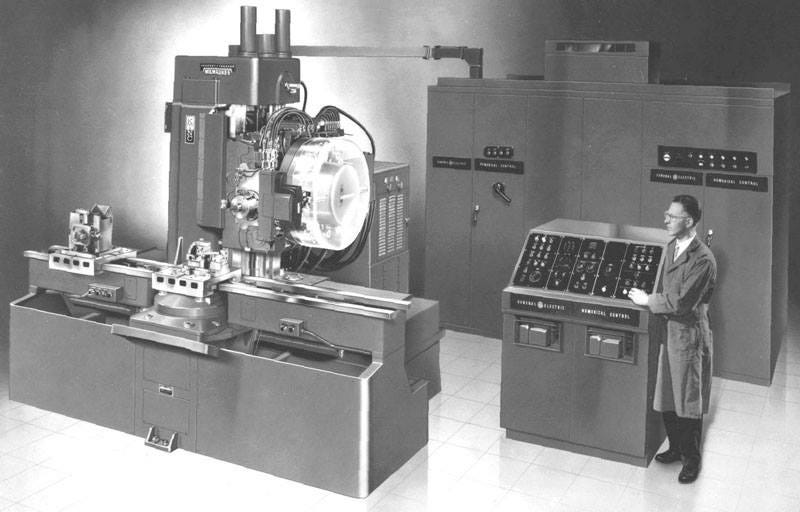
What Happened to the US Machine Tool Industry?
Machine tools – machines that cut or form metal – are the heart of industrial civilization.
construction-physics.com
230 points · by jseliger · 2y ago · 211 comments
I had the good fortune to tour the Starrett factory some years back. They were still running pre-NC screw machines to make parts. It really is true that old machines, well cared for, will last just about forever. Apparently it's something of an axiom in the machining industry that tools that are no longer economically viable for large scale production end up in job shops where the capability is needed but there isn't a need to pump out volume.
The Springfield Armory[1] is also a neat visit. For hopefully obvious reasons, their machining exhibits are focused on the production of weapons. The American Precision Museum is actually housed in a historic privately-owned gun factory. It turns out a lot of the progress in machining is driving by the need to make weapons.
Legend! I’d have enjoyed working with him. The smell of cigarettes could be a turn-off. Only perfectionists (in their craft) can use that level of swearing.
Sure there were a few odds and ends made in America, things like X-Acto knives, or wax melting machines or something. Paper, ink, and a few other chemicals used for various parts of the production processed were usually sourced from the U.S. or Canada IIR.
But the presses, big cutting and binding machines? Every single one was from overseas: Heidelberg, Hamada, Ryobi, others. It was simply impossible to get machines of the quality and precision from the U.S. This often meant multi-week downtimes for aging machines that needed parts replaced or repaired, waiting for a single roller or a latch or something while it was shipped from the home country.
As things moved more and more digital, the front-end equipment likewise became more and more foreign made.
In my lifetime, the U.S. never owned the entire vertical supply and manufacturing chain in that industry. I'm not sure if it ever did.
Even though, I myself was never involved directly in it, nor am I today, I know from him there were several trends:
1) Printing companies in Europe and elsewhere got bigger. What use to be 10 printing companies, now it's 1.
2) Equipment manufacturers for that industry got bigger. What use to be 4,5 equipment manufacturers in EU/USA, now there is one.
3) Lasers. Lasers got to a level where they can compete and surpass mechanical removal on quality and speed. This is true also for industry I'm in.
“Though the conglomerates enjoyed owning machine tool firms in the boom times when profits were high, they quickly became disillusioned during the lean periods when new orders slowed to a trickle. The new owners’ focus on profits meant that they were reluctant to make the long-term investments in R&D or new equipment needed… Conglomerates were often quick to divest their machine tool holdings when the companies began to struggle, resulting in frequent management changes and organizational whiplash…
“In his history of the American machine tool industry, Albert Albrecht states that “the actions of these larger corporations and conglomerates, under the leadership of financial MBA’s, perhaps more than any other factor, contributed to the restructuring and decline of the US machine tool industry at the end of the 20th century”.”
Bingo.
The article points to cycles of high variance in demand for machine tools. Other commenters have pointed the dominance of foreign companies (eg Japan due to their national standardisation on FANUC), globalization and “more cost-effective to import” more generally, and also suggested America is in a “post-machining” stage of manufacturing.
I think all of these claims have merit, but the real underlying cause is most certainly the humble MBA. To wit: they bought themselves into a cyclic industry, replaced the survivor-mindset management, and effectively took these resilient existing businesses and crystallized them into brittle conglomerates while the industry was on the rise of one such cycle, and when they where wholly unprepared for the inevitable down stage of the cycle, they divested, leaving a wasteland behind.
US is, by a clear margin, the wealthiest nation isn't it? Certainly more so than Germany or Japan.
Edit: I may have missed some sarcasm there.
If you work in traditional manufacturing in the Midwest and mostly consume domestic goods, then it's easy to feel like the US is circling the drain.
If you work in IT or finance in a coastal city and mostly consume imported goods, then it's easy to feel like the US is in a golden age.
The US is wealthier than Japan and Germany combined. With room to spare.
I think that summarizes the article. It has been cheaper to import, so we do. The strong dollar policy supports some industries at the expense of others.
The issue that the free marketeers have been railing about for approximately the last 50 years it seems like almost every major policy the US adopts increases the cost of manufacturing relative to a hypothetical entity that didn't do that. It has been a constant adjustment of labour law, environmental law, energy policy and financial regulation away from manufacturing. It is plain why US manufacturing isn't the global top dog. The real question is whether it is a bad outcome or not.
Over the last 50 years China has improved their energy use by 1 UK economy per capita. IMO we should also ask more seriously if those regulations were worth it. A UK per capita energy is a lot of QoL improvements and it was linked to doing a lot of manufacturing. The US on the other hand is behaving politically like people are worse off than they were.
It's definitely bad. The U.S. won't even have the world's biggest navy pretty soon because of that. And there are tons of scenarios where the U.S. is economically hosed because of some international conflict. Not only does the U.S. not make things, it doesn't know how to.
US has somewhere around 450 Navy vessels.. China has closer to 350 but is rapidly adding new tonnage. Sounds ominous! Except Japan has another 150, Australia has 50 more, the UK has 70 more, Spain has 150, France 180, Korea has 160, if some war ever comes down to the sheer number of available ships -- it literally won't matter who has more since the nukes will have flown long before some Canadian frigate is exchanging fire with some Chinese gunboat.
The US has the most productive, wealthiest economy in the history of the world, and a very strong one at the moment, without so much of the 'making things'. Why change?
(And why do American taxpayers have to subsidize someone else's uncompetitive, unproductive business? Perhaps they are better off letting the free market allocate the revenue.)
i do believe the US still does high-end (but low volume) manufacturing. It's just mass manufacturing that went away.
Lemme try:
Because trade deficits induce demand for dollars? Like how Japan and now China hold a bajillion US dollars? So if the US had (prolonged) trade surplus, no one would be holding dollars?
But wouldn't trade partners still need US dollars to buy US goods? Like the situation post-WWII?
So then we'd "loan" partners US dollars to buy our stuff?
Aiugh. My brain just broke.
How does a noob like me learn about these systems. I know it all probably makes sense to the learned. But with my folk (mis)understanding, these claims sound counterintuitive.
Thanks.
In a normal, non-reserve-currency situation, the demand for a country's currency is proportional to the demand for its products. After all, that's what you use a currency for: to buy the products that are sold in that currency. This has a well-behaved equilibrium, because if a country produces a lot of good products, that means the value of its currency will rise, which makes goods developed in that country relatively more expensive, which cuts demand, until everything equilibrates at a point which is roughly reflective of the actual quality and productivity of the country.
In a reserve-currency situation, the currency is used for many things other than buying the products of the country. For example, oil is priced in dollars; if India wants to buy oil from Saudi Arabia, it needs dollars to make the transaction, and then Saudi Arabia has an excess of dollars. Frequently it uses these to buy U.S. T-bills or invest in American tech startups like Uber or WeWork, both other sources of demand for dollars. The dollar is basically the currency of the global financial system: instead of directly converting rupee to riyal, you convert rupee to dollars, handle your transaction, and then convert dollars to riyal.
This creates a large source of demand for dollars outside of the traditional market for a national currency. Indeed, America's export here is basically financial services, which as a sector has been doing great since 1990, one of the few areas where you're likely to get paid handsomely. The other area is tech, which at its core is about enabling these cross-border commerce flows - Amazon, Google, Facebook, UpWork, Stripe, CoinBase, Ripple, Stellar, PayPal, E-bay, Shopify, AirBnB are all about creating global marketplaces where you can buy anything from anywhere.
Finance and tech crowd out everthing else that you would normally use dollars for. Basically America has specialized in being the global marketplace - it's only purpose is to be the common standard that every other country needs to transact in. Because there's so much demand for dollars simply to do international transactions, it pushes the price of the dollar up. This makes everybody who's trying to sell actual things in dollars (rather than take a commission when other people sell things in dollars) uncompetitive.
It works great, until the rest of the world decides that it wants to cut out the middleman. At that point, since we don't produce anything anymore, we're screwed. America's basically given itself Dutch Disease, where our only viable industry is financial services.
I think this video addresses the topic in question at a layman level.
Other way around, they buy T-bonds -- i.e., "loan" dollars to the US Government. But the country is still owed that money back - it's like a trillion dollar bank account. One could say China "lends" dollars to the Treasury, but it's also just as accurate to say they "deposit" dollars into the Treasury. It's all just words to describe the action of giving money to another party to hold onto temporarily.
"Strong" currency means there's more demand for it. Demand is usually a function of what you can buy with the currency.
When countries reinvest their dollars into T-Bonds, they are double dipping on establishing demand for dollars. On one hand, they are owed back the dollars handed over to the Treasury (thus, creating future demand for USD), and on the other, accepting USD for the sales of their goods/services induces demand for USD, since it is yet another good that can be purchased with USD.
"Weak" currency means that there's less demand for it. Weak currencies tend to be those from countries that produce little in the way of goods and services, or they only produce commodities (like oil) that are generally traded in other currencies.
A weak currency can be a benefit. Hence why so many countries seek to artificially weaken their currency (aka currency manipulation). They often do this by strengthening the the USD. Sell to the USA, accept USD from foreign trade partners, buy T-Bonds with excess currency. The market for USD is so damn big that this is often trivial to do unnoticed, like using ocean to fill a swimming pool. But economies like Japan and China eventually grew to the point where their currency manipulation had a meaningful impact on the USD and American economy, rising the ire of American politicians. You can read about the Japanese "lost decade" which was suspected to be the result of American politicians intentionally targeting the Japanese economy due to currency manipulation and a general fear that the Japanese would "take over the world." (you can see these fears highlighted in 80s movies)
> How does a noob like me learn about these systems.
Take an economics class. Eco 101 is kind of trash for understanding anything truly useful. But at higher levels, you get into mathematical models for the underlying systems that govern trade. Granted, it's a little more hand-wavy, since economists can't conduct experiments at the scale that physicists can. But there is generally some experimental data supporting the models (it just might be data collected on college students trading candy bars).
You can read about what happened to the Swiss economy during the pandemic. They are a smaller economy that's been plagued by an absurdly strong currency. There's been a lot of reporting and research into the many factors contributing to the currency's strength as well as the impacts it has had on such a small country.
How does a noob like me learn about these systems. I know it all probably makes sense to the learned. But with my folk (mis)understanding, these claims sound counterintuitive.
Thanks. "
don't worry, your intuition is right. you are on the right track when you say that your brain broke. you are more learned, or rather, more wise than those guys.
because a lot of economics is BS, a hotchpotch of some art, craft, heuristics, observations and formulae, pretending to be a science.
this is exactly why economics is known as "the dismal science", and why there is a saying that if you get 20 economists in a room and ask them the same question, you will get 20 different answers.
(italics mine)
I studied economics in high school for a whole year (11th grade). the course covered both microeconomics and macroeconomics. the Samuelson (MIT prof., IIRC) book was one of our text books.
I did well in class, was among the top few students.
I made some penetrating comments to which my teacher had no satisfactory answer. it was on a situation / question regarding OPEC (the oil cartel).
from that time on, and also from subsequently reading economics articles and news now and then, I could intuit and piece together the opinions that I stated above. :)
so, not to worry :)
I think in the long term (and maybe short term) we will live to regret this error.
Would be nice if someone with first-hand knowledge of Japanese corporate world could confirm/deny it.
It should be no surprise few machine tools are made when there's less domestic industry overall.
Is the same thing to happen with software?
When it becomes worth the time of the U.S. economy to produce basic machine tools again, they'll get to create new machine tools factories using all the latest technology: so it is probably good thing the "old way" is not still around hanging on by a thread.
The market naturally is culling technical debt.
Offshoring in software development has been around for a very long time. Most large US companies have a mix of onshore and offshore devs. The more mundane the software, and the tighter the financial macro-environment, the more the ratio shifts toward offshoring. This is the way the offshoring cycle has worked for a long time.
However, unlike hardware, software is about information and communication, and cultural context is very important. I have seen firsthand that non-US teams building software for US consumers often don't quite understand the reasoning behind the requirements and may lack polish around basic things like English. (The same is true, of course, in reverse, if US teams build for non-US audiences.) So I think it should be a little bit stickier.
You also cannot copy software design in the same way that you can copy, say, the design of a lathe. A lathe is a lathe, and as long as you've got the tools and materials, a lathe made in the US should not in theory be any different than one built in China. The same is not true of software.
Something I'm curious about, have you seen this happen with countries culturally close to the US? Like teams based in Canada, Ireland, or the UK?
In reality there are incredibly large gaps around even the most basic things like the meaning of words. As a very basic example: the meaning of the word "interesting" differs radically between cultures. Most US employees would think the boss is indeed interested when they describe an idea as "interesting" and may even bring it up again at some later date after more research. Meanwhile, someone from the UK means that it's the dumbest thing they've ever heard and they will be incredibly miffed if it is ever brought up again.
But some manufacturing, in fact a large amount, is Chinese. And I'm not convinced they've got our best interests at heart. Either China needs to calm down over their "Wolf Warrior" style, or we need to cut back on providing benefits to an obviously and increasingly antagonistic power.
---------
The other part, with respect to Taiwan + China, is that we must defend Taiwan as they are a critical source of advanced-materials (ie: computer chips) to us. Yes, its more efficient to have Taiwan centralize production, but it does come at a cost. We need to be ready to defend Taiwan and keep it safe if we are to continue to build computers and phones out of Taiwan-only parts.
I have a theory that one of the major challenges facing manufacturing in the US is actually the opposite.
A manufacturing company in the US is competing for smart, numerate STEM graduates with the likes of Google who offer graduates $180,000 with zero experience (or so I'm told)
But they're also competing with manufacturers in the far east, where $40,000 is a great salary, for someone with several years of experience.
Difficult to win both competitions.
They know the tech sent off shore will, for the most part, remain off shore.
Additive manufacturing, an example of "latest tech", is a primary build up target here. It is new and expertise is being created as the tech itself is.
Hopefully policy makers and the citizenry will resist following what, as you say, the US economy is trying to say.
You see ...
You can stop making elementary machine tools.
You will never stop making (people who can only make elementary machine tools).
Fanuc.
And when Fanuc realized that only GE was capable of competing with it in the computer controls needed to run machine tools (and wasn’t doing shit, another Welchism), it cleverly bought off GE by giving it the U.S. franchise for Fanuc, at least until the GE stink began to be undesirable.
Aaaand, the money quote:
" In his history of the American machine tool industry, Albert Albrecht states that “the actions of these larger corporations and conglomerates, under the leadership of financial MBA’s, perhaps more than any other factor, contributed to the restructuring and decline of the US machine tool industry at the end of the 20th century.” "
MBAs & financial "leadership" have basically optimized American excellence, leadership, and its middle class out of existence, and putting the world's democracies in jeopardy.
They benefitted greatly by privatizing and optimizing profits into their pockets, but at the cost of nearly breaking the society onto whom they externalized the costs.
This article really hits home for me. I grew up in Cincinnati and it was a tool making powerhouse back in the day. Cincinnati Tool, now Milacron and many others were made here in town. We still have a few nice tool makers in Ohio - Kett and Wright but its sad to read about how much this industry powered the nation and a lot of its innovation.
Going to our museum center, hell even our Airport has a bunch of exhibits that take about all of the tool making and industry we used to have. Makes me sad really.
Are they now considered good guitars??
2. lack of cheap 3-phase power in said zoning, and aging power infrastructure. EVs will likely make the problem worse.
3. lack of skilled labor due to career churn from outsourcing. i.e. it became a demand-deficient labor-force now reassigned to other careers.
4. Manufacturing domestically is strictly a niche industry, as consumers are cost sensitive, and value blind
If you go to foundry districts in India, one will see many US machines that were sold for scrap still powering emerging economies. The mechanical equity of 60 year old machines are still supporting entire communities.
I learned a lot from a domestic slip-casting company as a kid. It taught me big heavy things are not economical to ship, and thus remain locally competitive in a global market even when competitors are 100% subsidized. Amazon shifted this calculus a bit, but is still constrained by energy/fuel costs.
The power of plastic is automated cycle times under 45 seconds, minimum infrastructure needs, and shipping weight. In a way, Tesla Giga Press technology leverages similar strategies for Aluminum parts.
This isn't true. Porcelain is brittle and delicate, and usually shatters when dropped. It's easily broken through normal handling. Just guessing, I imagine most new inexpensive porcelain dishware is purchased to replace broken stuff.
Sure, if you put it in a cabinet and never use it except for once-a-year special occasions, it might last a lifetime, but the stuff you use every day won't.
Meanwhile all the cheap IKEA dishes I bought as a student always broke within a year of purchase.
EVs push their true cost onto the entire grid, and thus every resident/business subsidizes the fleet operation with added service costs due to resource scarcity driven prices.
I do like the idea of EVs in many ways, but only when combined with distributed power generation infrastructure like standalone home solar arrays. EVs suck power in large cities and or locations the require battery temperature management... outside in cold <4'C climates a Tesla Lithium battery heater is like having a fuel tank that will leak out in a few days... thus, it is always leaking energy unless in a heated garage. Not an immediate problem, till you have millions of units commuting in -18'C weather.
Have a wonderful day, and lets admire the sycophantic idealism of EVs together. =)
Markets do not drive efficiency. At least not if chasing quarterly profits drives bad decisions.
"When the machine stopped: A cautionary tale from industrial America"
https://www.amazon.com/When-machine-stopped-cautionary-indus...
Note: referenced in the OPs original article
The counter example is the semiconductor tool industry where the advancement of technical capability remains ahead of the rate other countries can catch up with them. Internal to the industry, the 'low-tech' machines are made by Japanese manufacturers: Track (TEL), Wet (Screen).
US/Europe (AMAT, LRCX, KLAC, ASML, ASMI) remain dominant in that capital equipment market.
Can you think of a single modern US-based industry/association which produces educational, instructional, and/or historical videos like this one anymore?
And, after 10,000 hours of apprenticeship, you can make as much as $50,000 to $100,000 a year as a tool and die maker!
I have some entry-level skills at that sort of thing, from my TechShop days. There's a lot of stuff to learn and you have to do a lot of it to get good.
The 100% increase doesn't seem to make sense in this example.
Suppose those lathes ware out 0.1% faster than expected lasting ~3 days less than 10 years, now eventually you replace 2 of them in the same year thus doubling demand in that year… Except the manufacture wouldn’t notice a spike from occasionally sending out a few days earlier even if it’s crossing a calendar year.
I know that this article said that you could order machine tools from Japan in the 1980s and get them in a few weeks. But that's not the case anymore.
People buy some press or lathe or whatever out of a liquidation warehouse in Michigan for ~$50k and then pay a refurbisher $1,000,000 to get it to whatever specs they need. That's more expensive than buying a brand-new machine from Germany/Italy/Japan, but you get it installed in your facility so much faster that the extra cash is worth it.
And because they last forever with proper care and maintenance, nobody cares if the "new" tool is 70 years old.
Note that this behavior can easily distort the stats on demand for new machine tools ;)
And dunno about USA, but there's a cottage industry of people running hacked up ex-volkswagen robots despite them requiring a human holding dead man switches. They are not going to buy a new industrial robot, but they can afford to turn bunch of ex-volkswagen gear into semi-automatic machines.
Yes, if meticulously maintained and lightly used some can last a good while. In a less pristine environment, say where deadlines need to get met, they wear out unevenly, for lathes, the ways near the headstock usually see more work than the tailstock end. So, the machine now cuts a taper when it is suppose to cut parallel.
[0] https://duckduckgo.com/?t=lm&q=scraping+machine+tools&ia=web
The bed tends to accumulate damage over time, as try as you might, you'll eventually drop something heavy on it.
A lot of it is very much fixable, but I suppose that eventually one decides it's too much to bother, especially if something is damaged is badly enough, or the lathe is old enough and it doesn't make much business sense to fix it.
If you abuse a machine badly enough you can get something bent to the point it's not really worth fixing.
Usually you sell the machine at this point to someone who doesn’t need the precision and get a new machine.
Calling that a 100% increase doesn't seem to make sense because it actually doesn't make sense.
The most asked question about the CNC gear we sold was whether or not it could be leased and whether we could offer financing. Almost none of it was bought outright.
In theory, not a bad idea. In practice, the only business likely to want to lease a $200 item is probably close to bankruptcy.
Sounds like the rich are the only ones who will thrive in this scenario. It will absolutely devastate American workers.
Yes, this is one of the more common alternative fact on what happened to Boeing. Going beyond the nonsensical take of the evil subsidized foreign company unfairly competing against the hardworking non-subsidized domestic aircraft builder, as various independent pundits have reported in the light of recent events, Boeing's woes are mostly self-inflicted, starting even before the infamous MD takeover.
But it's true that it is more flattering to paint yourself as the victim of unfair globalization as opposed to acknowledging that the ruthless search of short-term gains came at the cost of product quality and passengers lives.
The fact is there's no competition in the American commercial part 121 airline world. No competition makes you lazy and incompetent.
Probably the sentiment expressed by this excerpt. You can probably point to any example of former US expertise and make a similar statement.
We have left that phase of our country's development behind. We have relatively piecemeal demand for such tools, aside from the random new Tesla factory. And that kind of growth is what spurs development and maintenance of these kinds of supporting industries.
As a country, you fall out of the practice of building stuff, and the talent or ecosystem of it migrates away.
Look at railroad building. In China, they have entire industries of people building the tools for building railroads. They can call up 100 experts on design just for EV battery building machine tools and factory processes. Here you're lucky if you can find that many experts on any machine tool topic across all the contractor companies that have had to consolidate to make keeping this kind of talent sustainable. We just don't have this deep practiced industry knowledge in general across many businesses any more. And aside from some specialized centers (NASA, NIST, national labs) that doesn't exist much in the government either. We've outsourced it.
Maybe it's a natural evolution of a country. Maybe the tide can be turned with strategic investment, I don't know.
> The US is still a major purchaser of machine tools (2nd in the world behind China), but unlike for most of the 20th century, today its factories are full of machines made elsewhere.
In short, the MBAs happened. Clueless management was brought in who then decimated anything they did not understand. I.e. everything. Aided by Reagan policy to aggressively outsource manufacturing from the nineteen eighties US manufacturing just imploded.
Just speculating here, but by the time the Japanese and the Germans caught up and got really good at machine tools, the metric system would have become an obstacle as well. Because the US insisting to do everything in inches, foot pounds, and what not doesn't translate very well internationally when you start outsourcing all your manufacturing. Outsourcing meant manufacturing standardized on the metric system using equipment and parts not made in the US.
Just speculating here, but I imagine that all that combined lead to a natural preference for non US based manufacturing companies that took over from US companies to not use any US made equipment or parts. So, manufacturing became predominantly metric based and that would have affected standard components, screws, bolts, parts, etc. All made by non US companies standardizing on all of that.
It’s not necessarily the case that greedy, ignorant MBAs came in and ruined everything. Like, if their practices were so inferior, then any domestic firm that didn’t get taken over by them should’ve had a leg up and could’ve dominated the domestic market.
Don’t you think the more likely source of “pressure” was the international suppliers who had lower costs?
> Aided by Reagan policy to aggressively outsource manufacturing from the nineteen eighties US manufacturing just imploded.
Was the policy to outsource everything, or liberalize markets and let firms and consumers more freely choose where to buy things from? Globalization has done quite a lot to lift people out of poverty and keep prices low.
Often their cost cutting measures seem positive at first as it creates a profit uptick, but it's usually at the cost of the brand, so 3-5 years later things take a turn (once the consumer has figured out the brand can't be trusted anymore). By that point it's hard to put the blame on the appropriate person or identify the appropriate reason for a less profitable year.
There aren't infinite firms. Plus in the article, the previous paragraph goes into how the tooling industry was being bought up by conglomerates so the finite firms became even easier to count.
A company fitting your argument is Telsa. The existing firms weren't willing to canabalize their existing product lines so they didn't invest into EVs and now a domestic firm is eating at their market share. However, "Who killed the electric car?" is from 2006, there has been a lot of pent up demand for EVs that no domestic firm was selling to.
However, something also fitting your argument is Moneyball [1][2]. It's not until the 2002 season that teams start to use statistics to determine who to staff their roasters? The League is from 1876; it took 126 years of baseball before a team figured out how to use math!
> Don’t you think the more likely source of “pressure” was the international suppliers who had lower costs?
Well, the article agrees in that it says "By now, tools from Japan and other countries were as good as or better than US tools, not to mention cheaper and more reliable.".
However, R&D was also being cut prior to this so if you don't do any R&D and your products become uncompetitive it's probably because R&D was cut.
> Was the policy to outsource everything, or liberalize markets and let firms and consumers more freely choose where to buy things from?
Well, don't forget there are winners and losers when trading.
In this case the losers are the American Tooling Industry; the winners were everybody that bought from them lol.
--
I do think this growth every quarter is a big problem though. The early observers of business cycle all noticed that it has its ups and downs. Pretending that there won't be a down and fudging the numbers so that you don't have any downs is going to cause future problems. Delivering not-finished lathes counts to me as fudging the numbers.
[1]: https://en.wikipedia.org/wiki/Moneyball_(film) [2]: https://en.wikipedia.org/wiki/Sabermetrics
The problem with this is that the 1000 people who had been doing the labor in the US for $25/hour don't want that to happen any more than they want it to move offshore, and they're the people with the skills to ensure the automation goes smoothly. So they resist and then lose to offshore manufacturing rather than domestic automation.
Which in turn causes the US to lose even more manufacturing jobs, because now that factory is in Asia and it's more economical for its inputs and outputs to be other factories in Asia.
The way out of this is to make sure domestic barriers to entry are low, so that you get more new domestic companies like Tesla that aren't stuck in this trap. Right now that isn't the case and Tesla is an exception that got there on hype and eccentric leadership, whereas what you really want is for domestic small businesses to be able to eat the lazy incumbent's lunch long before China does, and indeed to be able to eat the Chinese company's lunch by replacing a thousand low-wage workers with a handful of high-paid specialists.
In this instance, it was people like Icahn.
Machine tools were a very cyclical market. Consequently, they did well as part of a vertically integrated conglomerate where the profits could be booked over time and the R&D could be shared with the manufacturing parent. When forced to spin out and stand alone by corporate raiders, those companies were effectively doomed as you just ripped out their ability to do R&D.
In addition, people forget that the Japanese companies were very much not playing fair. MITI (Ministry of International Trade and Industry) and the keiretsu/zaibatsu companies were actively attacking the US companies--this was effectively governmental and monopoly collusion. This attack was to the point that they almost wiped out the semiconductor industry (which prompted the DARPA VHSIC project and later Sematech in response) for example. They did similar actions in the manufacturing industries but the government never responded with the same vigor.
> Was the policy to outsource everything, or liberalize markets and let firms and consumers more freely choose where to buy things from?
The policy was to fund the hell out of West Coast (high tech and mostly no unions) and to leave the Rust Belt (manufacturing and lots of unions) to rot.
I will be one of the first to line up to piss on Reagan's grave for the complete shit that he was. However, to be fair, NOBODY had any answer to the fact that manufacturing automated and could get by on two orders of magnitude fewer employees. Every country dependent upon manufacturing went through a horrible time (see: England and Thatcher for similar vitriol). In fact, nobody still has any answer 4 decades+ later. It's one of the reasons there are so many old, very angry MAGAs.
> Globalization has done quite a lot to lift people out of poverty and keep prices low.
At what local cost? Nobody in Cleveland gives a shit about whether someone in Africa is doing better when they can't make their house payment.
Every country has one.
The change was that ours went from "try to have industry in this country" to "my friends make money offshoring stuff" instead.
It would be just as fair to blame the original culture of having vertically integrated conglomerates to begin with.
If there is anyone who should be able to figure out how to automate manufacturing with a small number of workers, it should be a bunch of machinists. But you put them in a lumbering conglomerate and teach them that automation is the enemy because it will take their jobs. Then they take that same attitude into a smaller company that has to be leaner in order to survive and you've set them up for failure.
Whereas if you embrace it, instead of domestic buyers getting their goods from cheap labor in China, domestic and international buyers get their goods from automated domestic factories that employ fewer people per unit but make more units than ever before because they have globally competitive prices and the global demand when you can supply at a low price is enormous.
> Nobody in Cleveland gives a shit about whether someone in Africa is doing better when they can't make their house payment.
But the reason they can't make their house payment is the same kind of regulatory capture that they supported and caused them to lose their job, which in turn makes housing unaffordable because you can't outsource plumbers and electricians.
Riffing on your last remark, the federal labor statistics list of Ohio occupations with the highest location quotients (prevalence in that area divided by prevalence of the same occupation nationwide) still shows machine tools related professions near the top. Surely that cluster of expertise would be in even greater demand if the national economy were to grow in that direction.
May 2022
Engine and Other Machine Assemblers 4.21
Multiple Machine Tool Setters, Operators, and Tenders, Metal and Plastic 3.79
Patternmakers, Metal and Plastic 3.23
Forging Machine Setters, Operators, and Tenders, Metal and Plastic 2.99
Heat Treating Equipment Setters, Operators, and Tenders, Metal and Plastic 2.91
Tool and Die Makers 2.81
Grinding, Lapping, Polishing, and Buffing Machine Tool Setters, Operators, and Tenders, Metal and Plastic 2.75
Sewers, Hand 2.71
Cutting, Punching, and Press Machine Setters, Operators, and Tenders, Metal and Plastic 2.70
Model Makers, Metal and Plastic 2.64
Hasn't the answer been tons more products being made? More product designers, more tool manufacturers, more people in charge of designing factories, more automation engineers, more robotics engineers?
More people supporting those products, more people in sales, more people doing packaging design, logo design, and so on and so forth.
(None of this is environmentally sustainable, separate discussion!)
> everything in inches, foot pounds, and what not doesn't translate very well internationally when you start outsourcing
It translates pretty well for the last 90 years:
In 1930, the British Standards Institution adopted an inch of exactly 25.4 mm. The American Standards Association followed suit in 1933. By 1935, industry in 16 countries had adopted the "industrial inch" as it came to be known, effectively endorsing Johansson's pragmatic choice of conversion ratio.
https://en.wikipedia.org/wiki/Inch
See also the paragraph above referencing the precision tools enabled by Swede Carl Johansson's "Jo Blocks." For a nice video/contextual storytelling, see Machine Learning channel's Origins of Precision: https://www.youtube.com/watch?v=gNRnrn5DE58
In the beginning they cleaned up messy, inefficient, wasteful processes. However for the most part MBA's ran out of real stuff to do 10-20 years ago. Ever since then it has just been about how much more can they shave off of 0.1% of 0.1% of just one more thing that doesnt need it but hey they have a quartly bonus attached.
Or like a comedian I recently saw said, every new business these days are basically something like:
Hey you know how a taxi driver can afford to feed his family?
What if he couldn't anymore?
Machining today is heavy metric, even in the U.S. and there is still no economic way to make it all work, much like with steel production and other manufacturing concerns.
Likely due to the dominance of metric tooling from abroad.
Old ass machine equipment is imperial and is still in use. Imperial measuring devices are still widely available as well.
I think the OP is probably onto something.
This describes many many things in the USA.
Children who get an MBA before getting a job and think they have some magic sauce that solves problems for an industry without respecting the work that's been done and knowing why those problems exist to begin with (maybe they're trade-offs? For a real reason?) are a problem, as are the clueless twats who listen to their breathless assertions as though they carry any weight.
I am writing this while drinking an 8$ caramel latte from Starbucks with a slice of avocado toast for 17.99$.