Fujitsu bugs that sent innocent people to prison were known “from the start”
Software bugs were hidden from lawyers of wrongly convicted UK postal workers.
Ars Technica
522 points · by MBCook · 2y ago · 270 comments
How does this scandal keep getting worse and worse when the only thing to cover up is a contract for some poorly written software?
At this point I'm starting to suspect some underlying malfeasance yet to be discovered.
Fujitsu still has some blame, but if their statements were being modified by the post office, who's responsibility is it to review that? If I gave a written statement to a police officer, is it my responsibility to follow up and make sure they didn't edit my statement? Of course... if I found out, it is my responsibility to raise a flag, but I should be able to trust agents of the courts to not alter evidence.
From what I can tell from the inquiry testimony, the witness statements weren't exactly modified by the PO; they were effectively drafted by the PO's legal team. The lawyers produced pro-forma template statements, such that witnesses only had to fill in the blanks for names, dates and so on.
Some witnesses balked at some of the language used in the template, e.g. words to the effect of "I believe the Horizon system was working completely correctly". In response, the legal team amended the template.
The evidence produced to the inquiry can be viewed here:
https://www.postofficehorizoninquiry.org.uk/
The inquiry has a youtube channel, where videos of the public hearings can be found:
https://www.youtube.com/channel/UCgijUpaux8X4Nvjx3TmrHhg
For what it's worth, I've never given a statement to police that was in my own words. In every case, the police interviewer led me through my testimony by asking a series of questions, and writing down my answer (in his own words).
But it can happen from:
* smaller-fry butt-covering (e.g., lower-level function trying to cover their own butt, putting larger org at risk of much higher cost to the org);
* arrogance (e.g., individual/org thinks they are in the right and justified in escalating countermeasures);
* bully-like confidence (e.g., individual/org thinks they are powerful enough to get away with escalating the offense, to escape cost from the original offense).
It's not unusual, especially on smaller scales (e.g., in companies without genuine cultures of trust and integrity, many people will try to internally suppress info about failures, committing worse and/or more harmful acts in the process).
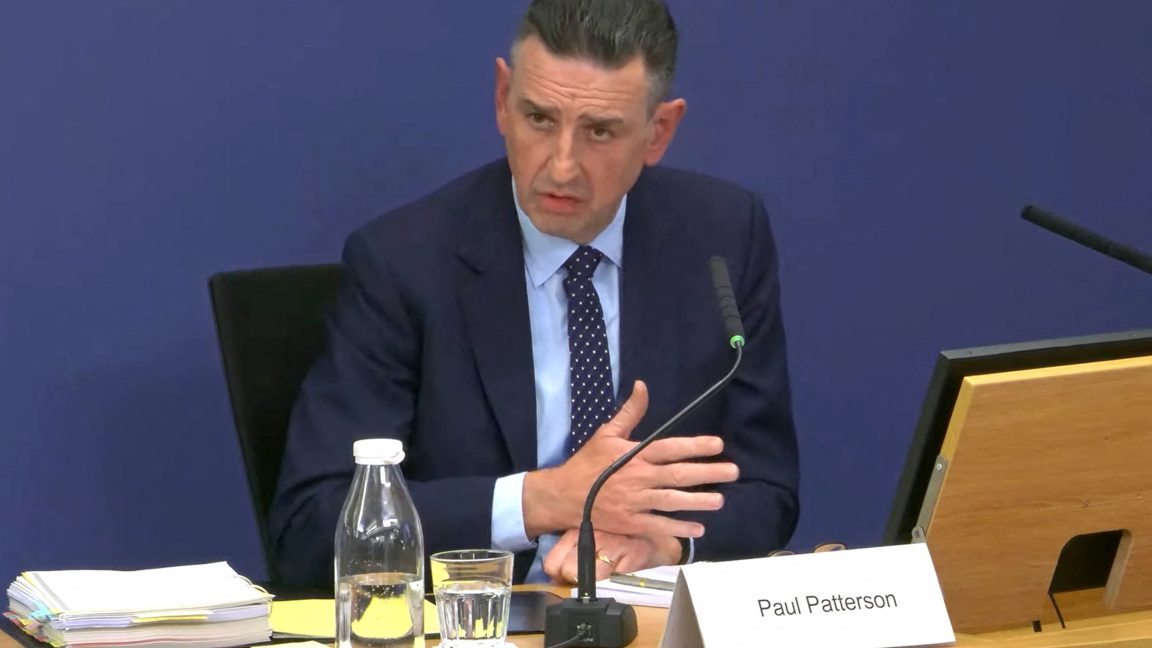
The best example of this is the testimony of one Peter Sewell, who never met one of the victims but who, in an email, called him a “nasty chap” and that he was out to “rubbish the FJ name”.
You can see how he realises the enormity of his stupidity in testimony and tries to half heartedly defend himself (unsuccessfully):
Sounds like he was using a different sense of the term "integrity" than I was.
Figuratively, like integrity of a physical barrier, to the (claimed) attack of this other person.
This also applies to Parliament. They're renowned for it!
They first injured Gary Hinman trying to get money from him- before the Tate murders. While he was injured they spent days first injuring him, and then debating how to keep him from going to the police for two days before he died.
A massive contract for the entire postal service of which a number of government managers? On top of which Fujitsu provides software for a huge swath of other UK government agencies like NHS?
So not only are they protecting a huge contract, but they were also covering up the fact that they lied and people ended up going to jail, committing suicide, etc. Aside from the criminal and civil liabilities - that would generate substantial political outrage and is the sort of thing that would shed a lot of unwanted light on the contracts, how they were selected, etc. Light nobody wanted.
This literally caused deaths - people committed suicide because of the shame and debt and utter destruction of their careers.
I guess just like comedy and bad suspense movies, crimes always escalate.
during a school trip with overnight stays, 2 of the teenage girls went out in the evening, even though it was forbidden. It was noticed after a while, so the teacher went looking for them. Just as he went out, they were about to come back(not too late). But they saw the teacher coming out - and hid themself, to not get in trouble in this moment. And this is of course when the real trouble started, because now the search started for real, with informing police about missing female students, big search etc.
Coming out right at the beginning would have meant been giving a warning ... but the hiding because of fear for the trouble made the trouble very big and got them close to being expelled. And anger from the others, because from then, everything was less fun with the teachers ..
There are a lot of programmers who seem to think it would be a horrific miscarriage of justice for somebody to be held responsible for the behavior of their own computer programs.
How much longer will they drag this through the dirt, because the families of the deceased can finally have peace?
Paywalled: https://www.thetimes.co.uk/article/the-villain-at-the-heart-...
Unpaywalled: https://archive.is/aaJyc
Summary: In the 1960s, the government merged a bunch of companies "at gunpoint", creating behemoths like British Leyland (https://en.wikipedia.org/wiki/British_Leyland) and ICL (https://en.wikipedia.org/wiki/International_Computers_Limite...) that were to compete with international giants.
ICL couldn't beat IBM, but the government were committed to "buying British". That left the government with shit computers and systems. It still didn't help ICL, so in 1981 they faced bankruptcy. Since the government was the biggest user of ICL systems, civil servants persuaded Thatcher that "if ICL went bust, the government would grind to a halt". So ICL was rescued, with the aid of trusted Japanese tech firm Fujitsu. ICL lost its monopoly status, but was deeply embedded in the British state. You know the phrase "nobody ever got fired for buying IBM"? Well in the British Government, replace "IBM" with "ICL".
In 1995 the British government decided to automate their social welfare system. "Project Pathway" was a disaster. It got dumped 4 years later, but the Post Office still went ahead and used it, this time calling it "Project Horizon". According to insiders, everybody knew it was a "bag of shit". By now, ICL was fully owned by Fujitsu, who told the Blair government that if they didn’t sign the deal, ICL would collapse. So the deal was signed. And what a mess for all involved.
This isn't an isolated case though. ICL/Fujitsu built another system for the Cabinet Office in No. 10, for highly classified material. It was absolute trash, taking half an our to boot, and Ministers refused to use it. They dumped the system, prompting Fujitsu to sue for breach of contract. But, even as the Cabinet Office was decommissioning it, another branch of government was buying it.
Why? Partly because of EU rules, departments couldn't share their experiences with a given supplier or system. If a department knew that ICL/Fujitsu sucked, it might influence future contracts "and everyone would be sued".
Instead we have suicides, lives and reputations ruined.
Citation needed.
I have no doubt that you could find some EU legislation from the '90s that could have been a tiny factor in this debacle, but it's fairly obvious that the biggest factor was panic that ICL would collapse if they didn't continue propping them up with fresh money, leaving many government IT systems out of support.
I do not know the baseline rate at which postmasters commit fraud or are prosecuted, but isn't one prosecution every 8 days an awfully high number? Shouldn't the Post Office have conducted some sort of internal investigation as soon as the frequency of prosecutions hit a number this high?
Inexcusable.
Two days before the report was due to be released.
I pick on him particularly because after he handed the role over to Vennells, he went over to ITV for a number of years. The same ITV who provides the very dramatisation that brought all this stuff into the public eye once again.
That said, he had left ITV well before the series would have started production so it may have just been a creative decision rather than due to any outside influence.
I mean seriously, if you were a criminal, would you go to all the trouble to run a post office for years?
From the testimony, it seems that is rather likely. PO managers seem to have had a pretty bad attitude to subpostmasters in general. I think the general view was that subpostmasters are essentially village shopkeepers, drawn from a population that would happily engage in grift if the opportunity presented itself, and therefore needed close monitoring.
That’s ~8.5% of their subpostmasters that were arrested (the actual number according to Wikipedia is 900 not 700). That seems really high to me.
Also I think you meant to say that 700 out of millions would be unimpressive instead of impressive right?
So about 10% committed fraud.
Seems a little high - but I could believe it if the subpostmasters are the local "boss", handling cash, and are supposed to pay 'the blokes in London' who they never meet.
Also, most subpostmasters had many employees - and I believe if any one of their employees was commiting fraud/stealing money, then it was the sub postmaster responsible - so that 10% number might actually only be 1% if every branch had 10 people involved in the running of it.
First, the time period we’re talking about here is 16 years. You’re telling me that the post office in 16 years couldn’t figure out how 10% of their branches were having persistent problems with their counts for 16 years! What business operates this way when dealing with such large amounts of money. At a minimum even if it was legit fraud by the subpostmasters this would be an indictment of the competence of the Post Office in managing the offices.
Then there’s gems like this:
> Some subpostmasters noticed the new system reporting false shortfalls, sometimes for thousands of pounds, but the Post Office insisted that the system was robust and, when shortfalls occurred, prosecuted the subpostmasters or forced them to make good the amounts, as required by their contract.
Then an audit that was disputed and ignored:
> In 2012, as a result of pressure from campaigners and Members of Parliament, the Post Office appointed forensic accountants Second Sight to conduct an investigation into Horizon. Second Sight concluded that Horizon contained faults that could result in accounting discrepancies, but the Post Office insisted that there were no systemic problems with the software.
Finally, the most egregious thing is that even if you go back in time and are an honest player, as the convictions start happening more and more often, maybe at some point you go and ask the question “what changed in 1999 when we started prosecuting and why weren’t we catching this fraud before? Did we become better at it somehow?”
Actually it corresponds to the rollout of the system. It’s possible of course that this system added new auditing capabilities that didn’t exist before but honestly 10% is still ridiculously high.
Ultimately, the facts of the case are pretty clear this is bad faith from the Post Office (and maybe Fujitsu) top to bottom. There’s no point playing hypotheticals with good faith actors when the Post Office even had audits showing the software was buggy and the response was to dispute the audits they themselves contracted. It’s beyond the pale.
The contempt for their staff is insane
Prosecutions are still going on but are being led by the Crown Prosecution Service (vs. the post office).
Fujitsu are continuing to proving the CPS / post office with data that they have been doing for years (and possibly still providing witness statements, I dunno).
Subpostmasters still complain about bugs in the horizon software causing balance errors.
Subpostmasters still get fined and have to pay the Post Office ( automatically deducted from their salary) for any shortfalls that occur.
My employment particulars came the day of the two month deadline. They included a clause that said that the school had the final say on any claim brought by a pupil or their family against me for loss or damage and that any compensation would automatically be deducted from my salary. Unsurprisingly, I did not agree to this clause and did not sign the document! The school also refused to negotiate and I worked there for two years in a kind of contract limbo.
I’ve gone back to being a SWE now. I was lucky to not be beholden to one industry like my fellow teachers were. I can completely see how a sub-postmaster, without a fallback career, can get cornered into accepting some ludicrously unfair terms.
Fujitsu CEO Deposition – Post Office Horizon IT Inquiry - https://news.ycombinator.com/item?id=39059302 - Jan 2024 (1 comment)
Fixing Horizon bugs would have been too costly, Post Office inquiry told - https://news.ycombinator.com/item?id=39039712 - Jan 2024 (59 comments)
Fujitsu says it will pay compensation in UK Post Office scandal - https://news.ycombinator.com/item?id=39023695 - Jan 2024 (26 comments)
How a software glitch at the UK Post Office ruined lives - https://news.ycombinator.com/item?id=39010070 - Jan 2024 (326 comments)
Post Office Horizon scandal explained: Everything you need to know - https://news.ycombinator.com/item?id=38983144 - Jan 2024 (8 comments)
A TV Show Forced Britain's Devastating Post Office Scandal into the Light - https://news.ycombinator.com/item?id=38951802 - Jan 2024 (168 comments)
British Post Office Scandal - https://news.ycombinator.com/item?id=38937705 - Jan 2024 (149 comments)
How the Post Office's Horizon system failed: a technical breakdown - https://news.ycombinator.com/item?id=38931792 - Jan 2024 (4 comments)
Ex Post Office CEO hands back award after IT failures lead to false convictions - https://news.ycombinator.com/item?id=38930011 - Jan 2024 (127 comments)
Post Office Horizon Enquiry – Fujitsu Report on Eposs PinICL Task Force (1998) - https://news.ycombinator.com/item?id=38926582 - Jan 2024 (1 comment)
Fujitsu bosses knew about Post Office Horizon IT flaws, says insider (2021) - https://news.ycombinator.com/item?id=38890468 - Jan 2024 (8 comments)
Mr Bates vs. the Post Office - https://news.ycombinator.com/item?id=38869011 - Jan 2024 (3 comments)
What went wrong with Horizon: learning from the Post Office Trial - https://news.ycombinator.com/item?id=38867712 - Jan 2024 (19 comments)
UK Post Office: 700 Horizon software scandal victims to receive £600k each - https://news.ycombinator.com/item?id=37561428 - Sept 2023 (40 comments)
After 20 years, the Post Office scandal cover-up is happening in plain sight - https://news.ycombinator.com/item?id=36778486 - July 2023 (1 comment)
The UK post office database scandal – “can't see the bug = user is a thief” - https://news.ycombinator.com/item?id=35837576 - May 2023 (2 comments)
Hundreds of lives ruined by faulty UK Post Office computer system - https://news.ycombinator.com/item?id=35792896 - May 2023 (4 comments)
Ex UK Post Office staff tell inquiry of stress of IT scandal - https://news.ycombinator.com/item?id=30394685 - Feb 2022 (2 comments)
Post Office scandal: Public inquiry to examine wrongful convictions - https://news.ycombinator.com/item?id=30329668 - Feb 2022 (149 comments)
Post Office scandal: 'I want someone else to be charged and jailed like I was' - https://news.ycombinator.com/item?id=30329510 - Feb 2022 (2 comments)
Bad software sent postal workers to jail - https://news.ycombinator.com/item?id=26973583 - April 2021 (1 comment)
Convicted Post Office workers have names cleared - https://news.ycombinator.com/item?id=26924882 - April 2021 (187 comments)
UK court clears post office staff convicted due to ‘corrupt data’ - https://news.ycombinator.com/item?id=26913037 - April 2021 (284 comments)
UK legal system assumes that computers don't have bugs - https://news.ycombinator.com/item?id=25518936 - Dec 2020 (24 comments)
Post Office scandal: Postmasters celebrate victory against convictions - https://news.ycombinator.com/item?id=24661321 - Oct 2020 (2 comments)
Bankruptcy, jail, ruined lives: inside the Post Office scandal - https://news.ycombinator.com/item?id=24440476 - Sept 2020 (1 comment)
Postmasters were prosecuted using unreliable evidence - https://news.ycombinator.com/item?id=23454606 - June 2020 (2 comments)
Faults in Post Office accounting system led to workers being convicted of theft - https://news.ycombinator.com/item?id=21795219 - Dec 2019 (104 comments)
Post Office hires accountants to review sub-postmasters' computer claims - https://news.ycombinator.com/item?id=4143107 - June 2012 (1 comment)
It was the recent TV mini series that got this mass attention, which triggered the mass media covering it I believe.
If anyone finds an interesting thread I missed, please reply so I can add it!
Computer Says 'Guilty' - https://news.ycombinator.com/item?id=27392724 - June 2021 (1 comment)
Thank you very much for compiling this list!
I don't think collaboration or editing is in itself a crime - the crime is to sign a statement which you know to be untrue or deceiving.
The real covering-up was the PO lawyers' failure to hand over to the defence evidence that might support the defence case. That's criminal (perverting the course of justice), and also, in the words of the appeal court judge, "an affront to justice".
I hope there is serious jail time and fines for the persons that did this. Bonkers.
Something very similar happened in the Netherlands with the tax office and I suspect that if and when the IND here gets turned inside out we'll find a lot more of this sort of stuff.
That does not work for a piece of software where people's lives and finances are on the line, especially not when you still accuse people of committing criminal actions knowing full well that it could be the fault of your system's bugs rather than their actions.
Some might question if this 'move fast, break things and ignore bugs that aren't thought to be complete showstoppers' is the right move, but the way they handled it on a business and legal level was definitely the wrong one, and the majority of the problems came from the dodgy actions of the execs and business folks trying to cover things up.
Fixing Horizon bugs would have been too costly, Post Office inquiry told
https://news.ycombinator.com/item?id=39039712
Fujitsu is sorry that its software helped send innocent people to prison
How often do you hear a suit talk of their "moral obligation"?
That really struck me. So true
So often we (computer programmers) get to walk away free and clear from the cluster fucks that arrive from our mistakes
unfortunately, a moral obligation is about the least powerful type of obligation there is.
Apart from anything else, this is a diplomatic issue: the Japanese ambassador to the UK make representations to the responsible minister, threatening serious diplomatic consequences if Fujitsu kept being criticized.
A company that stands to make significantly larger profits by doing so.
Why pay $$$ on engineers when you can pay $ engineers, and still get a product you can ship to the customer that works to a sufficient degree to satisfy the purchaser?
Doesn't that mean they should be facing criminal charges?
And who runs the Crown Prosecution Service? Ah yes, the government.
Because the principal and agent aren't the same thing. If an agent commits a crime without the knowledge of the principal, then only the agent should have criminal liability.
IANAL so genuinely curious
https://open.spotify.com/show/6BL7LWzXRdmwa0JVXOChQL?si=51p1...
Every time some CEO issues an apology i can't help but not take it seriously because it reminds of following scene: https://youtube.com/watch?v=15HTd4Um1m4
The central villain of this shit show is the Post Office. The history of the project shows that - from initial procurement onwards. Poorly implemented by ICL, a UK company, taken over by Fujitsu as some sort of favour to the UK government. The developers are guilty but this is just another government project, a disaster, but that's apparently nothing really unusual.
The minor villains are the members of the lynch mob. Most were probably ignorant of the facts and so, filled with righteous indignation they did whatever was necessary to make sure that the evil thieves got theirs.
How do you make something like this right? I don't think you can. Shit happens. The villains will keep their heads down for a while, and then like much of politics, will carry on because it seems that there are no consequences anymore.
You can't make it fully right, since you can't give people back the time they spent wrongfully imprisoned. But you can at least throw a truckload of cash at them to make things a little less awful.
But yeah... these people will never get their lives back, and it will never be right. This is mainly why I am against capital punishment. Even if we do believe we should have the right to say who lives and who dies (I'm not convinced of that, but many people are), we do not have the ability to say with any certainty that anyone is actually guilty. While the state can later recognize a mistake and let someone out of prison, they can't bring someone back who they executed.
The UK government reckon it takes about £600,000 each
If only there was a single person ensconced with supreme authority and a duty to protect the realm around.
(C++ programmer, but not an expert of distributed systems - would be interested to hear from someone that is)
Is the intent accuracy? Was money a motive?
I don't know the full story but cooking the books is how you skim.
And once you're dirty, in order to come clean you need to expose everything.
So far, I haven't seen evidence of anyone at Fujitsu inserting fake records in order to enrich the company - FYI the contract was such that the government took basically no risk, Fujitsu fronted the money to pay for Horizon's development, and in return Fujitsu gets a cut of all transactions. All they need to do is keep the sweet deal going.
What I have seen evidence of is them clearly detecting bugs, and inserting fake records to make the numbers reconcile, but still being so thick that their support staff didn't notice the fake numbers didn't add up either.
https://www.postofficetrial.com/2019/03/the-smoking-gun.html
Their motive appears to keep the corporate gravy train going, so yes it's personal enrichment, and to fudge the numbers on the sly so nobody questions Fujitsu's competence to run their system... but not cook the books directly.
Then of course the Post Office would prosecute the SPMs for discrepencies hallucinated by Fujitsu's broken accounting software, and not be curious or ask questions of Fujitsu, because then the Post Office bosses wouldn't get their performance-based bonuses.
There's also straight up incompetence:
https://www.postofficescandal.uk/post/ecce-chambers/
> Chambers admitted to the Inquiry that despite being told the discrepancies had occurred on various occasions at the branch throughout the year, she only looked at the system information behind the most recent discrepancy. She also didn’t check to see if something similar had been reported by any other branch. Her “investigation”, from assignation to conclusion, took one hour sixteen minutes.
> Chambers conceded that she didn’t know if it was an unknown system error was affecting the branch, and seemed to accept that her stark conclusion in 2013: “No fault in product” and “user” error, was misleading. She added:
> “I don’t think I handled it terribly well. I was frustrated by it and I think that shows… because, you know, it really looked like there was a genuine problem… [but]… There was no sign of it.”
> In summary, ten years ago, Anne Chambers appears not to have considered the possibility of unknown system problems, or prompted an investigation more advanced than what she could achieve within the limits of her knowledge and ability. Instead, after a quick squizz at a limited dataset she concluded there was no obvious problem, which meant there was no problem and the cause of the discrepancy was the Subpostmaster.
No government organisation (typically the Crown Prosecution Service in England and Wales) was involved in bringing these prosecutions.
The Post Office itself was legislatively empowered to bring private prosecutions of their employees to the state courts of England.
The whole thing is insane.
In UK private prosecution for crimes is possible. Probably a major reason for this kind of bullshit goes on.
No, it goes through the same public justice system, it’s just that the prosecution case is made by a private person or entity rather than the Crown Prosecution Service. It’s “private” in the sense that most civil suites are private. More info here: https://www.gov.uk/government/publications/private-prosecuti...
Anyone can bring a private prosecution.
Please note I have no dog in this fight, just generally curious if anyone knows more?
Moral hazard, cobra effect, if all you have is a hammer, etc.
https://www.telegraph.co.uk/news/2024/01/10/post-office-exec...
To be unfair, the job they were tasked with was providing evidence to support the prosecutions. And Sewell was a strikingly unconvincing witness; "It was 2008. I don't remember." Apparently he remembered almost nothing that might have a bearing on the inquiry.
From the article:
> Mr Thomas, of the Post Office security team, told the inquiry there were “bonus objectives”, including a 40 per cent “loss recovery objective”, available to his team.
> Asked if that influenced his behaviour as an investigator, he said: “I’d probably be lying if I said no because… it was part of the business, the culture of the business of recoveries or even under the terms of a postmaster’s contract with the contracts manager.”
> In an email sent by Mr Thomas in 2021 to Nick Read, the Post Office’s chief executive, and which was disclosed to the inquiry, he wrote: “My yearly objectives that were bonus worthy at the time were based on numbers of successful prosecutions and recovery amounts of money to the business.”
> He also discussed “a proceeds of crime unit within Post Office Ltd that ensured some of these individuals lost their homes and families”.
> Mr Thomas was the lead investigator in the case of sub-postmaster Julian Wilson, who was convicted of false accounting and died of cancer five years before his conviction was overturned.
> Mr Thomas did not include any of the problems Mr Wilson had reported with the Horizon system when writing his report after interviewing him in 2008. Years later, Mr Thomas told a colleague he was “pleased” to have his hands on documents relating to Mr Wilson’s case because he wanted to prove there was “no ‘Case for the Justice of Thieving Subposters’” and that they “were all crooks”.
Someone has put it on YT, also available in the torrent bundle on PB. https://www.youtube.com/watch?v=OHIr5fqfqKs
Toss in jail and throw away the key.
Every single prosecutor needs to be considered for perverting the course of justice.
Its like you go to a prison and everyone says "I'm innocent" and the officer sarcastically dismisses them saying "you and everyone else", the irony being..... that's plausible?
however, isn't this a UK issue?
cant help but consider that fujitsu is an SI that competes with infosys and this really undermines fujitsu in the minds of british tac payers...
They tried to cancel another Fujitsu contract, but Fujitsu took them to court and won, so the government have to keep accepting their shit service.
Why are judges ignoring the very foundations upon which our justice systems were built?
What really bothers me is that the CEO of the Organisation at the time was also a Christian priest/deacon
https://en.wikipedia.org/wiki/Paula_Vennells
> witness statements from Fujitsu staff due to be heard in court were then edited by the Post Office as it sought to maintain the line that the system was working well as it pursued innocent people through the courts.
People often assume that if someone has the "right set of beliefs" (whatever that "right set" is, which may or may not be religious) that they're also a good person. I'm not saying there is zero correlation for all people, but typically it's very small at best, if it even exists at all.
IIUC, there are a few aspects of Christian theology that muddy this issue a bit. I'm probably a bit wrong, so I'd be grateful for any corrections:
1) Christians believe in progressive sanctification. I.e., the Holy Spirit works, over time, to make Christians more like Jesus. So you really should expect true Christians, on average, to gradually become better people.
2) Not everyone professing to be a Christian truly is [0].
As an agnostic, those issues have frustrated my efforts to decide if Christianity generally true.
So I don't think No True Christian is relevant here.
Whatever religion the CEO was cosplaying, the bottom line is that she was involved in organising an aggressive criminal cover-up which caused multiple suicides, unlawful jail terms, and bankruptcies.
She must have done this knowingly, because it's unimaginable that information about these problems didn't filter through to the board.
Ultimately everyone on the board is personally responsible, and should be treated accordingly.
I think you can only expect them to gradually become more Christian, and every Christian defines what that means for themselves. There is no definition of goodness that is shared by all Christians.
Only if I accept their beliefs as accurate.
(Of course, magical, invisible spirits that change your personality and values are unlikely to actually exist, so the point is somewhat moot.)
I am hesitant to start listing examples, as I don't want to side-track this discussion too much.
I think there's probably a bit of a general assumption to consider people on "your team" to be "one of the good guys". Perhaps this ties in with how people tend to justify their own actions. I'm not entirely sure where it comes from.
Ah, so they're Scotsmen.
More and more, I have come to regard what people state as their beliefs or guiding principles as some kind of mission statement buried on a corporate website. It's more congruent with reality.
Lots of people have principles. Not so many people are principled.
Anyway the UK Fujitsu/Postmaster scandal is about a huge chain of dishonest human behavior, not bugs in software.
Now, there are also people that will act counter to their beliefs for other reasons. Sometimes for reasons you don't know. But that is, largely, a different thing.
Unfortunately though, police forces around the world are not tasked with solving and prosecuting cases like this, which involve at least, extreme malfeasance, and more likely, malice with the goal of protecting oneself within X public/private institute they have a position in. This is a massively high profile case, so it will get some attention.
Instead the task is for the police is increasingly to mediate minor interpersonal disputes between individuals (easy wins) and ignore anything bigger and more complicated.
> I tell you the truth, it is hard for a rich man to enter the kingdom of heaven. Again I tell you, it is easier for a camel to go through the eye of a needle than for a rich man to enter the kingdom of God.
At the risk of making a No True Scotsman argument, it's anyone's guess as to whether or not she truly is a Christian.
The only conclusion I can really draw from this is that she apparently acted in a way that's not consistent with Christian ideals.
> she apparently acted in a way that's not consistent with Christian ideals
Considering that "Christian ideals", depending on whom you ask, can include some pretty bad things, I don't think this matters all that much.
How so?
lol, in my experience... well, let me not finish that sentence
Or any other way of signaling their self-proported ethics.
I expect this holds for other religions too, I just don't have much experience there.
If it's anything beyond a little add in the church bulletin or a small fish on a truck, it's probably indicative.
Yes
But accounting software that gets totals wrong is not inevitable
Entirely avoidable
That conversion to spreadsheet-format was also unreliable, and required human intervention. So the data presented to the court wasn't the raw Single Source of Truth, but rather had been through a dodgy extraction process, in which human error was possible, and which resulted in Excel spreadsheets with hacked macros for "fixing" errors.
Excel itself is not famous for it's reliability and trustworthiness as accounting software.
Just sayin' ...
I haven't heard any testimony that would lead to that conclusion (yet).
There does seem to have been routine falsification of records; "everyone" knew the system was buggy, so there were standard procedures for correcting incorrect records. When those procedures failed, and the records became even more incorrect as a result, PO managers just gave up and blamed the subpostmasters.
Because Priests have never done anything bad before?
Why does that bother you? It's just a bunch of lies too.
https://www.tiktok.com/@chinesedemystified/video/71123116513...
I only post this as a fascinating example of how different Western and Chinese perspectives can be. Not that these people would be killed in China, or that it would be justice if they were- but we don't even have this in our vocabulary!
I, for one, would never claim that "prisons don't work, don't deter crime, don't rehabilitate" without any qualifiers. Maybe some specific systems have some problems, but that's a very different thing than "prisons" as a concept.
Not all crimes are the same: harsh punishment won’t deter crimes where people think they won’t get caught (e.g. speeding) or where they are not thinking rationally (e.g. drunken fights). In this case, these are lengthily premeditated decisions so deterrence is likely to be effective _if_ they aren’t confident about being able to evade consequences. That’s why it’s so important to have them now because every other white collar criminal is watching and learning.
The other factor is what form the consequences come in. Fines are problematic if they can be treated as a cost of doing business, but even the richest people only have 24 hours in a day. I personally think community service would be better than jail: if nothing else, it’s cheaper and I think these guys would be incredibly motivated to avoid spending their time scraping gum off of park benches.
The only reason for prisons and criminal justice of various to exist throughout history has been to (1) deter crime by threatening punishment and (2) give the rest of the society confidence that "crime doesn't pay" - because a system that has higher intrinsic trust and follows rules invariably outperforms ones that don't economically and often militarily. Yes part of such a successful system is graded treatment for people who have a better chance of rehabilitation as such folks are much more useful in society and tempering of justice contextually.
However trying to add additional tasks to the system, like rehabilitation or empowerment or economic development of a disadvantaged class serves only to compromise the core function and result in societal breakdown. These are all important tasks and they should be delivered through other parts of the government that are focused on these missions. It is perfectly fine for different arms of a government to have seemingly contradictory missions and these need not be aligned like how audit/controls and commercial functions are not necessarily aligned.
Citation needed
Prisons, generally, suck.
Are prisons good schools or preventers of recidivism? Some say yes, some say no. But most agree that they suck.
I cannot speak for the remainder of HN but my read is that prisons are effective at delivering suckage--sometimes more or less than intended, which you can call a miscarriage of justice.
America has weird leadership fetishes. Captains are supposed to go down with the ship but in times of crisis the President abandons us all to run away on his.
That’s… not that weird when you think about it. The ‘Going down with the ship’ cliche exists because the ship and crew are main responsibility of the Captain. His responsibility and power do not extend Nation-wide. In a time of crises the last thing you need is your head of state throwing their life away, because then you also have to worry about matters of succession on top of the pre-existing crisis.
we've never actually tried prosecuting/convicting/incarcerating CEOs or other high level officials, so we don't know what the deterrent on that would actually be. we need to run the experiments through to the end to see.
I don't know who has argued that, HN is a community of people all with different views. That's a big part of why I am here!
I think the current crime rate in El Salvador, which is now supposedly lower than in the US, is a pretty clear illustration that prisons do work. Of course, there are also a lot of negatives and injustices with mass imprisonment, but it sure looks like it works to reduce crime.
But the people who knowingly did wrong should receive some sort of punishment, even if it is just financial or being barred from their career path.
But I think it's more nuanced than that. I don't think it's hypocritical to believe that some crimes are better handled with mental health care or drug treatment programs than prison, while also believing that people who knowingly send people to jail under false pretenses should themselves spend some time there.
Also consider that sometimes people think that others should be punished. If my neighbor goes to jail because they like cocaine, and just had some around the house (and weren't dealing), I don't think I'm going to sit back and be all like, "wow, that person had it coming, glad they're getting punished for ::gasp:: having some powdery substance at home, the horror". But if my neighbor goes to jail for murdering my other neighbor, I'm probably fine thinking that a murderer deserves some sort of punishment for what they did.
So even prison abolitionists are often rather sanguine about imprisoning people like CEOs and high level officials who, despite being absolutely manifestly not railroaded, who have the structure covering from them at every turn, and end up both committing and being convicted as criminals.
I don't think this is necessarily contradictory: you can be fine with the idea of some kind of prison while also recognizing that the current system is a rather pointless and dysfunctional form of sadism that has no relation to any practical or ethical goal.
Ironically, the threat of prison might be much more effective if white collar types expected to be punished more regularly than they are. Economically, people who wind up incarcerated are often[1] on the low end of the income scale. That is, people who may feel they have little to lose by committing crimes because their standard of living isn't great to begin with. [2]
If these CEOs/HLOs felt there was a good chance they'd end up not only ruining their career but actually going to jail ... they might feel they have too much to lose to commit the crimes in the first place.
[1] https://www.prisonpolicy.org/reports/income.html [2] I'm not suggesting that the standard of living in prison is comparable to being free, even if you are actually dirt poor. But if you've been broke or poor, and you have no expectation of that changing, you might understand why someone might take risks.
First of all - HN is a website where many different people, with different views post comments and have discussions/debates. Declaring that there's one singular view while ignoring the dozens of debates in comment sections all over the front page is kind of absurd. Some people don't think prisons work, some do. The voices calling for prison reform or abolishment may not be the same voices calling for CEO imprisonment.
Second - The idea that the law should be applied to everyone with the same vigor is not at odds with wanting to change bad laws. If the law can send a peon to prison for years, it should just as well send a CEO to prison for years too. Hell, if I think a law is bad and needs to change, having a CEO face consequences for it might cause a rare circumstance where a CEO uses their position and influence to effect the change.
Third - wanting prisons that actually rehabilitate or deter or whatever is often advocating for prison reform, not consequence-free law-breaking. I can want a murderer sent to prison at the same time I want make prisons actually effective, in fact it's pretty consistent no?
Fourth a lot of voices are louder when a CEO or official is suspect of a crime since (as in this case) often they get away with crimes far worse than those committed by people who are severely punished. Even when the ceo/official is blatantly guilty. Even more so when the ceo and officials commit additional crimes and frame innocents for them.
Fifth, in the spirit of "turnabout is fair play" - (again as in this case) the CEOs and officials that wanted to stomp out the bad actors and be tough on the crime should not be hypocritical and accept that the crimes they committed need to be stomped out and have tough consequences.
rich people on the other hand