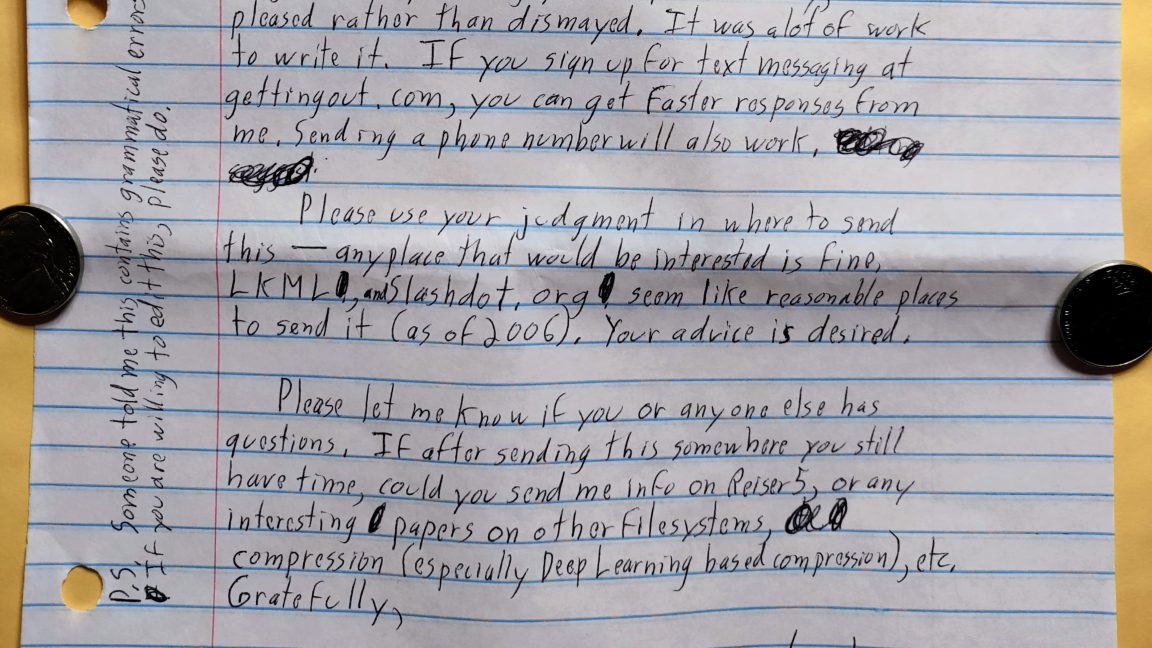
Convicted murderer, filesystem creator writes of regrets to Linux list
The man I am now would do things very differently," Reiser says in long letter.
Ars Technica
103 points · by WithinReason · 2y ago · 76 comments
Lots of interesting aspects to it, but one that stands out to me is how he is an example of an engineer who didn’t realise the importance of people skills.
I quite often see software developers who have an almost antagonistic attitude towards business, users and sometimes colleagues because they feel that their project failing to succeed is other people’s fault: “business didn’t give me the right requirements”, “users didn’t use the software in the correct way”, “all the other software developers are useless”.
This attitude may not get in the way of small scale solo projects, but for any non trivial sized project, it’s going to work very badly.
Significant sized projects require collaboration, you need to work well with others which may require compromise. Assuming that your organisation is not dysfunctional, it’s not unusual that requirements aren’t initially 100% clear, this is why software development is often an iterative process.
The most valuable software developers know how to work with others towards the common goal of making excellent software and the process can sometimes seem messy due having to work with many different kinds of people, but that’s the skill you need to rise above being a merely great coder, but one who can’t really work with a team.
I blame the popular notion of hacking together Facebook over a long weekend or similar. There is usually a lack of respect and clear communication at the heart of negative feelings. I attempt to properly level set expectations so there is even room for the soft skills you identified. It's hard to deploy them when the business has a fundamental misunderstanding and antagonism towards development.
We do know that he did do it, I am just curious as to how it was proven.
That last part immediately jumped out to me and made me a bit sad. We have adults walking around with the emotional intelligence of toddlers, because nobody ever thought it might be important to impart that in a systematic way. Did we used to when society worked differently? Maybe, maybe not? I don't know and I'm certainly not one to argue that things used to be better in the old days. But I feel like we're failing our children by not emphasizing emotional intelligence more in schools. We've learned so much in recent decades about how to regulate emotion, how to handle emotional crises, suffering and pain. Schema therapy, DBT and ACT have only really become a widespread thing in the past 2 decades. Did any of us know about cognitive behavioral therapy a decade ago? There is so much we could be doing as a society to improve the mental health of so many people, but we just ... don't.
Add up all the required group projects, team stuff, etc and there you have it.
It's the same in other fields, e.g. sports/physical ed often works that way, language and maths as well depending on the teacher. But with none of them, the failure to impart that knowledge increases the risk of murder (as seen here, even though that's an extreme case.)
Edit to add: and in cases like Hans Reiser it's doubly sad because he surely was a smart kid. Sending him off into special "emotional intelligence classes" probably wouldn't have affected his intellectual skills in the slightest (or maybe even in a positive way). But while it's an aspect that most schools try to impart through osmosis, they don't detect when they fail, or even when they notice, there's little they can do about it.
Instead we should teach kids cognitive empathy and explore applied theory of mind. Do it in an intellectual way. Why do people think differently, what motivates people, how does this motivation lead to events and outcomes in society? It's sort of an intersection of psychology and sociology. If people get skillful at this it helps to reduce how judgemental people can be, which is one of the things the author talked about. You could tie it in with teaching kids about CBT. Teach kids to analyze their own thoughts and assumptions about themselves, others, and the world they're in.
The other comment hits the nail on the head perfectly with referencing lord of the flies.
Your parents read to you, and you developed a love of books? Probably you know pretty well how to imagine another person's emotions in a hypothetical situation. And that different characters could feel very differently about otherwise-similar situations. You can probably name three to five different ways a person might feel about, say, having their work usurped.
On the other hand, a decade or two ago attempts to teach this sort of thing used exercises like dividing people into four quadrants, named things like 'plants' and 'stars' as if the very idea that different people are different was a shocking revelation they needed to spend several weeks introducing.
Perhaps our techniques for teaching this stuff have improved in the past few years? The way it used to be taught was something of a waste of time.
I didn't say it's working, I said that they focus on it more than you think.
Unfortunately that group is indoctrining those children to share in that groups' problems by giving those children the same emotional issues at impressionable ages.
Kinda funny, if Mussolini had invented sliced bread, would sandwiches have been a bad idea for decades too?
You think that's the most notable thing out of all the other things he did?
Parents do that all the time to their kids after divorce, there's probably even a Wikipedia page about parental alienation
As an open source developer myself, I don't understand how it's possible. Why would you give away your labor for free if you don't feel empathy towards others?
My general level of empathy for people I don't know has declined significantly over the past decade and my open source contributions have also declined in line with that. I just don't see the point anymore.
I met some very good people through open source but, overall, the experience has taught me that most people on earth range from neutral to horrible.
Open source probably represents the best kind of environment to meet the best of humanity. The smartest of the good people... But it's still disappointing.
This kind of cynicism is self-fulfilling, though I’m sure you’re already aware.
Selflessness at its core is doing something for others not expecting anything in return. But I think true selfless acts are rare, because you need motivation to do anything, and “not getting anything in return” is zero motivation. Especially if you filter selfless acts towards family and close friends.
But I think there are still benefits in contributing to open-source and being “selfless” to strangers. Altruism gets others to become less cynical and more selfless themselves, reversing the apathy feedback loop. Open-source in particular also improves your resume and gives you connections, and makes you a better programmer so you do your job which you get paid for faster and easier.
Ultimately, I think the issue is that people need to focus on themselves before they do anything remotely selfless. My impression is that most people help others, but only after they help themselves to whatever their “fulfillment” level is; and while some people never feel fulfilled, most people’s level is relatively sane. Except the current economy and worldview is making a lot of people struggle, and the internet and social media (self-exposure and exposure to others) is making a lot of people guarded.
We all get mad at our spouses, but we don't kill em
Personally I still feel empathy towards people even when I'm angry at them. If rational people act like complete assholes to me, I start thinking that maybe they were molested or something really nasty must have happened to them.
While I agree that controlling emotions is essential, gracefully dealing with them in the first place is also very important. Emotional outbursts seem like singular events while in reality they are build-ups that happen over long stretches of time. Maybe a more intuitive example is amok runs at schools. Counter-intuitively these are usually done by people who seem calm - cholerics are less likely to do amok runs.
FWIW reading also through the Wikipedia page, there was already a restraining order a year before.
Interestingly, mine has gone up. The more personal faults and failures I see in myself (and the list is extensive), the more empathy I have for other persons' imperfections.
If you are able to do this to your kids you are a special kind of human.
The same goes for my comments about Stallman; I don't care for the man and probably wouldn't hang out with him or entertain his ideas but there's no denying his contributions to open source and the gnu set of things. His relevance now is basically zero and so is Hans's but I don't need to flog either of them anytime their names come up.
So my previous comments I apologize for (https://news.ycombinator.com/item?id=39042626&p=2#39045093).
I don't know enough about filesystems or what was maybe planned for v4 v5 and beyond for reiserfs but I am glad we have some really nice filesystems in Linux. I'm stoked to see what I can do with bcachefs and am quite happy with xfs and zfs on my systems.
Any of them or just a specific small subset?
Edit: https://www.vice.com/en/article/9ke3ke/famed-computer-scient...
https://selamjie.medium.com/remove-richard-stallman-fec6ec21...
I think maybe somebody should re-post the request to credit the 3 developers, because that is directly relevant to LKML and may have gotten lost in the middle of all the text.
We are all the center of our own worlds.
Remember that this man strangled a woman to death, the mother of his children.
Many of us suffer with social skills but we don't murder people for it.
And what should he do? Just go die? He apologized, he went to jail and is serving out his sentence, he worked on becoming a better person, what are you expecting him to do after the event?