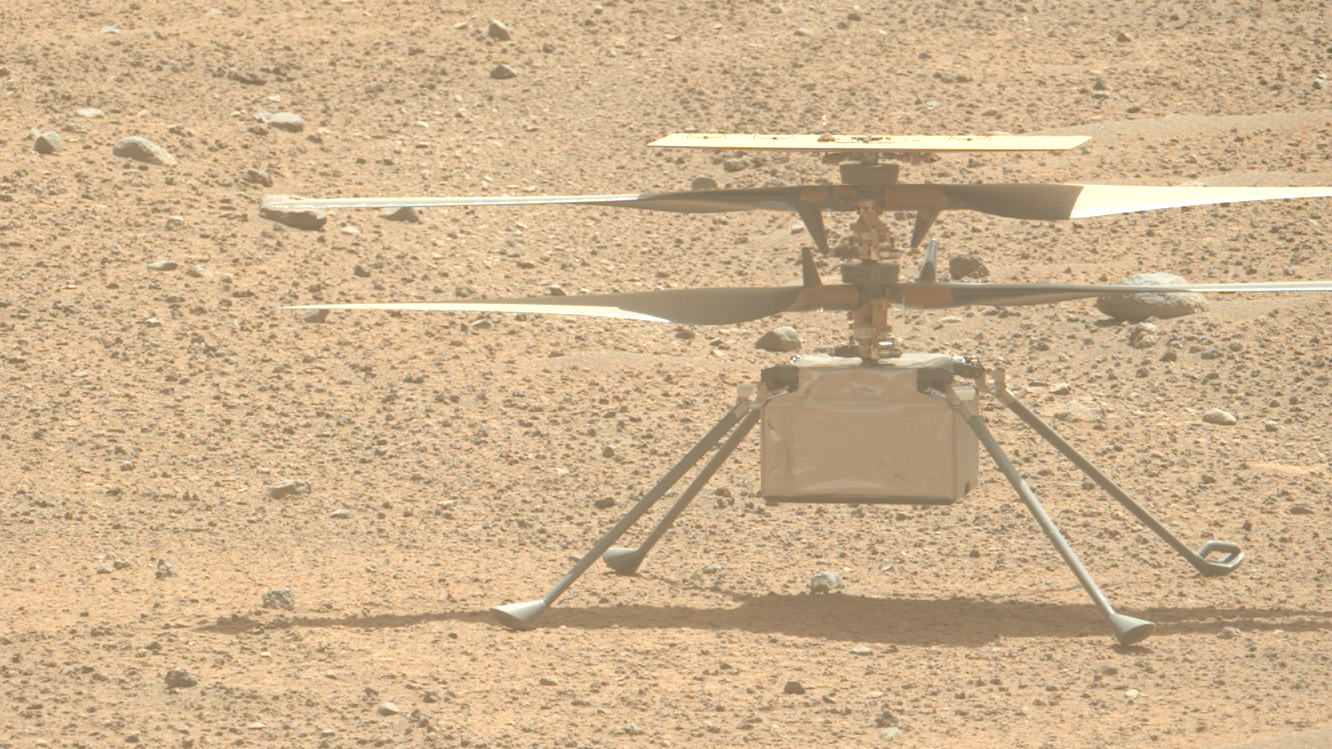
NASA loses contact with Ingenuity Mars helicopter
The dropout occurred on Thursday (Jan. 18), during Ingenuity
Space
207 points · by basementcat · 2y ago · 184 comments
If everything they build lasts longer than expected, not only are they giving bad estimates (which perverts allocation of resources), they are way too smart and experienced to be doing it unintentionally.
Now if Ford Motor underpromised on your car, telling you it would last 2 years, you wouldn't buy it in the first place - you'd never find out that it really lasts 10 years. But I suspect NASA gets away with it because everyone is blown away by even the underpromised result - helicopters on Mars, holy sh-! - and also nobody has experience with how long Martian helicopters typically fly.
Take a much more common example: expiration dates. A product going bad before its expiration date is an issue. Potential a massive one that could kill people. A product that remains in good condition after its expiration date is fine. As a result, expiration dates almost always occur far before the product actually expires.
That is salesperson talk. NASA has been doing public communication half a century too, and they know what people will take from it.
Cyberdyne industries: I never said you would die at the end! Aieee my eyes!
Furthermore, you are answering it with a “they must have known!”
I just don’t see how you can know this. (For context, I work at JPL and interact regularly with some of the Perseverance team, but nobody from the helicopter team, which was very small.)
Some context. The helicopter was originally quite controversial because it had no clear science rationale (mission science requirements did not imply a need for a helicopter). My understanding is that it was put on as a tech demo and (paraphrasing) cool thing. The lab director at the time was a proponent.
Of course it was a huge success.
Because of its precarious status, it was not designed to fly a lot. Planning flights takes a lot of resources, coordination with the rover takes resources, etc. Bandwidth, time, and people. My point is that the “plan” was kept small partly because these ancillary costs had to be kept down. This would hold even if the hardware could last forever. The tech demo must not get in the way of the prime science mission, which had already been planned.
The use of COTS components is another factor. The effects of radiation on microprocessors (in the Mars-surface or deep space environment) are not really well known, as a practical matter. There is just not much engineering experience with how bad it can get. So the longevity of the Snapdragon was (AFAIK) highly uncertain, not to mention whatever other COTS components were on it.
Hope this context is helpful.
I know nothing about the helicopter in particular but as I pointed out, NASA seems to very frequently underestimates longevity and performance (not a crime at all and maybe politically wise); I can't remember when they've overestimated. Forget my impressions in prior posts - how and why does that actually happen?
> tech demo ... precarious ... not much engineering experience
Also, while I've taken the opportunity of spare resources to do experiments (though not usually on Mars), I'm careful about timing and appearances - I don't want to embarass my team or partners with a failure that's visible to outsiders who wouldn't understand it was an experiment, and would think we just failed at our jobs.
Everything NASA does seems to be on a very public stage, interpreted by endless outsiders (like on HN :) ). The whole world watched the helicopter's first flight. How can someone approve the helicopter, and promotion of its flight, and risk the world saying, for the next decade, 'that crazy helicopter embarassment shows we need to rein in NASA', blah blah blah? NASA's reputation is very important to humanity.
Thanks for sharing what you know. You guys do amazing things; people are so jaded that they don't realize how incredible it is.
OTOH there is approximately 0% chance a Ford is going to last 10 years without any maintenance or repairs.
NASA built in lots of margin to help ensure they met their objective, especially considering that it's really fucking hard to get a new helicopter to mars if it breaks.
If it broke in those two years you’d be very upset, but if it does last longer that’s a bonus.
So, we keep having gear designed that shows us exactly what could happen for longevity while accomplishing the actual mission goals for the same budget
when they get the funding for the mission is when they make the lowball estimates, but with the funding they build equipment that is much more durable. It's hard to see where any perversion takes place
Is that actually the case when it comes to the helicopter in question?
(*I don't necessarily mean the practice of shooting a rocket into space and launching a telescope, but the ability to build an object that can perform that exactly to its specifications under those kinds of circumstances.)
For example, what requirements for the Ingenuity helicopter were set for the engineers? Five flights or a 100 of flights?
Unfortunately this leads to uninformed reporters to make stupid claims like "a probe only designed to last 90 days...". There's no self destruct or planned obsolescence in NASA probes. They don't have an egg timer set to 90 days and then explode.
The probes are designed to last at least as long as the ability for their consumables/power supply lasts. Consider the stresses of launch, transit through space, and insertion/landing are way worse than day to day conditions for a lot of probes. If they can survive all of that rolling around a desert is relatively easy (in comparison). If Ingenuity made one successful flight there was little reason it couldn't make more so long as it had the appropriate power available and the Martian Space Defense didn't shoot it down.
Ingenuity didn't overperform, it performed according to its actual design and construction. It only overperformed misinformed media expectations.
C'mon let's not blame the reporters. NASA pushes this line - why do think everyone repeats it, using the same language almost every time? You can even see it here on HN.
That brought to mind the glass-half-full / half-empty (false) dichotomy: The engineer thinks the glass is twice as big as it needs to be (or maybe 30-40% bigger to allow for a safety margin).
Under promise, overdeliver, is a nice way to say that you're dishonest with the client. The fact you can overdeliver means you're making some trade-offs elsewhere, e.g. in design/production price, time, weight or somewhere else.
Overdelivering is a nice byproduct, but it shouldn't be the goal.
That's the wrong kind of overperforming.
NASA’s got a history of their rovers overperforming like this. Between this and Webb, it’s hard to argue they’re not the best out there.
It's underpromising and overdelivering. It's a smart strategy because it's just hard to get stuff to work in space and on another planet. So it's best to underpromise.
You can bet that the internal goal is a lot higher than the public goal.
Sure, there is less lift... But there is also less drag. So your rotors can go far faster with the same power input - and, roughly, it looks like the power needed to hover (for a craft of a given mass and size) is actually less on mars due to the lower gravity, despite the rotors moving super fast.
I think this is a misconception. Even in water, you cannot provide lift equal to your bodyweight.
It is easier to swim (vs sink) in water because the water gives a large amount of buoyancy.
However, in air and on mars, buoyancy is small enough to be negligible.
FYI, these two things are __directly__ related.
Lift = c0 r v^2 A
Drag = c1 r v^2 A
=> Lift = c0/c1 Drag
You should be able to reason this out too. Think about how you generate lift. The blades spinning have to push something, right? What is it pushing? Then think about drag. What is that dragging against? Is it related to the thing you're also pushing against? I think you know the answer.
Yep. Setting maths and motors aside... it's why helicopters have service ceilings and why no one has built a helicopter that can fly away into the stratosphere.
Just like the mars helicopter cannot fly on earth.
Great ROI, we should keep going on bigger projects. All that data...phew.
Working there must feel like pure Americana each time you tap a key. I'd be coding extra just to enjoy that, especially seeing the level of impact these teams have. I wonder if they drink coffee while they build or if they found that it reduces performance for the engineers or for the astronauts?
https://x.com/NASAJPL/status/1748883252604236281?s=20
For those who would rather not go to x.com, the text is:
Good news today: We've reestablished contact with the #MarsHelicopter after instructing @NASAPersevere to perform long-duration listening sessions for Ingenuity’s signal.
The team is reviewing the new data to better understand the unexpected comms dropout during Flight 72.
Also, replacing the domain with nitter.net always works.
Genuinely astounding to me, and slightly disappointing.
For example, this is (one of) the core reasons of why peace in Israel/Palestine is so hard (each side fears accepting sovereignty of the other side means they will continue to encroach and wipe them out).
Humans are pretty clever and ingenious at all levels
OT: We know everything we need to survive and prosper very well - imperfectly, but with margin of error to spare, including capable political systems. The people still killing are just criminals who want to steal and murder.
Of course, killing people because they privately worship the Head-Chomper is probably too far, unless they're actively chomping (your?) heads. Also, Beelzejuice isn't real.
But principles like human rights and freedom are worth fighting for, and necessary to sometimes fight for (or else we're all screwed)— Beliefs, certainly, if not anthropomorphized as "gods".
Also, religions are a pretty strong indicator of social in-groups and out-groups. If you removed the gods from some religious wars, they'd probably still be fighting each other over skin color, language, ethnicity, culture, social ties, Adidas vs. Nike preference, external political goals, land use, water contamination, domestic political pressures, fishing rights, economic disenfranchisement, etc. Theology may help divide and rationalize it, but control over resources and power are pretty concrete motivations for creatures that have to worry about starving/dying, and gods are a proxy for that.
Scarcity begets conflict. GDP per capita is ~$900 in Gaza, ~$350 in Afghanistan, ~$5,000 in Omsk. Doubt many would willingly sign up, or accept being conscripted, to murder unbelievers if they were more sure about having warm meals and meaningful works to cherish. Doubt NASA engineers would be "capable of flying a remote vehicle on a literally other planet" if they were busy scrounging for physical necessities.
Even Bin Laden introduced his 2001 statement by referencing the partitioning of the Ottoman Empire and its effects on people. Kirill may talk of the "Antichrist", but what Putin wants is Sevastopol.
I think it's reductive to just say "we also kill each other in large numbers over whose god is correct". We kill each other for a variety of reasons, usually fear of ourselves being killed, and sometimes we bring gods into it but it's very rarely, if ever, the sole reason.
This approach would be more respectful of the engineers who believe in God and who also contribute to projects like the space vehicles and probes or other impactful projects, and certainly more respectful of the great names in human history who are remembered for their contributions and noted also in the record for their love for God...
https://www.theverge.com/2021/2/19/22291324/linux-perseveran...
So they intentionally crashed it into the planet instead as to not potentially contaminate said moon - possibly our first implementation of the prime directive!
But, on the other hand, while measures are taken to ensure that spacecraft headed to other bodies are not contaminated, we've also found that life still often manages to find a way. So I thibk the various landings on Mars, and the lander on Titan (plus the quadcopter heading there later this decade) are somewhat likely to have brought along some extremely resilient (but dormant) life anyway.
It has already happened before, when the helicopter flew far ahead of the rover and just stayed there until rover caught up
I trust dedicated journalist more than generalist run-by ones that clickbait another working moment like it's the end of the world
There's a big argument going on in military procurement right now about the high $ state of the art drones vs cheap & adequate.
There was a time when they were going to try to do more, cheaper, faster missions, which IIRC lasted until the first one failed, and then that policy was abandoned.
Similarly, the video (and associated audio which malfunctioned) of the skycrane-deployed landing was done by COTS components which otherwise would not have been present at all.
Also, by COTS, they're using components which would otherwise be meant for industrial use, so they're still likely to be more rugged than what might come to mind when thinking of off the shelf components.
Question: Can Ingenuity autorotate to a landing in the Martian atmosphere?
"Perseverance is currently out of line-of-sight with Ingenuity, but the team could consider driving closer for a visual inspection," NASA's Jet Propulsion Laboratory in Southern California, which manages both robots' missions, said via X on Friday.
Close inspection may not be advisable due to difficult terrain:
See: "How Ingenuity Knows Where It Is And Where It's Going" <https://picknik.ai/slam/localization/state%20estimation/mars...>
I've been saving that one for years.